by
by
I set up and ran Zipchat AI on Rushu and Anantam IAS, then stopped using it on both because the recurring cost did not fit the stores’ budgets. My verdict in this Zipchat AI review: it is worth testing for ecommerce brands that lose sales to unanswered product questions, but I would not treat it as a default expense or pay before estimating monthly reply volume.
The direct paid plan starts at $49 for 500 AI replies. That can work when one or two recovered orders cover the bill. It gets expensive when support chatter consumes the same reply allowance. The old $99 AppSumo lifetime deal is sold out, so reviews that still pitch it as the default purchase route are giving you stale advice.
Verdict: Zipchat is best for stores with repeat pre-purchase questions, enough traffic to create those conversations, and margins that make a recovered sale meaningful. Skip it if you mainly need ticket management, want flat pricing, or run a rupee-earning small business whose existing software subscriptions already strain the monthly budget.
Testing context: I created the Zipchat agent for rushu.in and checked the crawl, learning state, website widget, email, WhatsApp, Instagram, and Messenger settings. I also ran Zipchat on Anantam IAS. I do not have a measured conversion lift from either site, so I am not claiming one. I eventually stopped both deployments because the recurring cost did not fit their budgets.
Zipchat AI Pros and Cons
- Good: The product is built around ecommerce buying questions, not a generic FAQ bot.
- Good: Setup starts with one store URL, and Shopify currently offers a free 120-reply plan.
- Good: The Shopify App Store shows a 5.0 rating from 157 reviews, a much stronger signal than most young AI chat tools have.
- Tradeoff: Extra usage costs $49 per 250 replies, so busy support traffic can change the math fast.
- Tradeoff: The dollar-based starting price is difficult to carry for many Indian small businesses once it joins the rest of their software stack.
- Tradeoff: Zipchat is not a replacement for Gorgias, Freshchat, or Intercom when ticket operations are the main job.
- Tradeoff: Its AppSumo listing is sold out, and a small Trustpilot sample is sharply more negative than Shopify feedback.
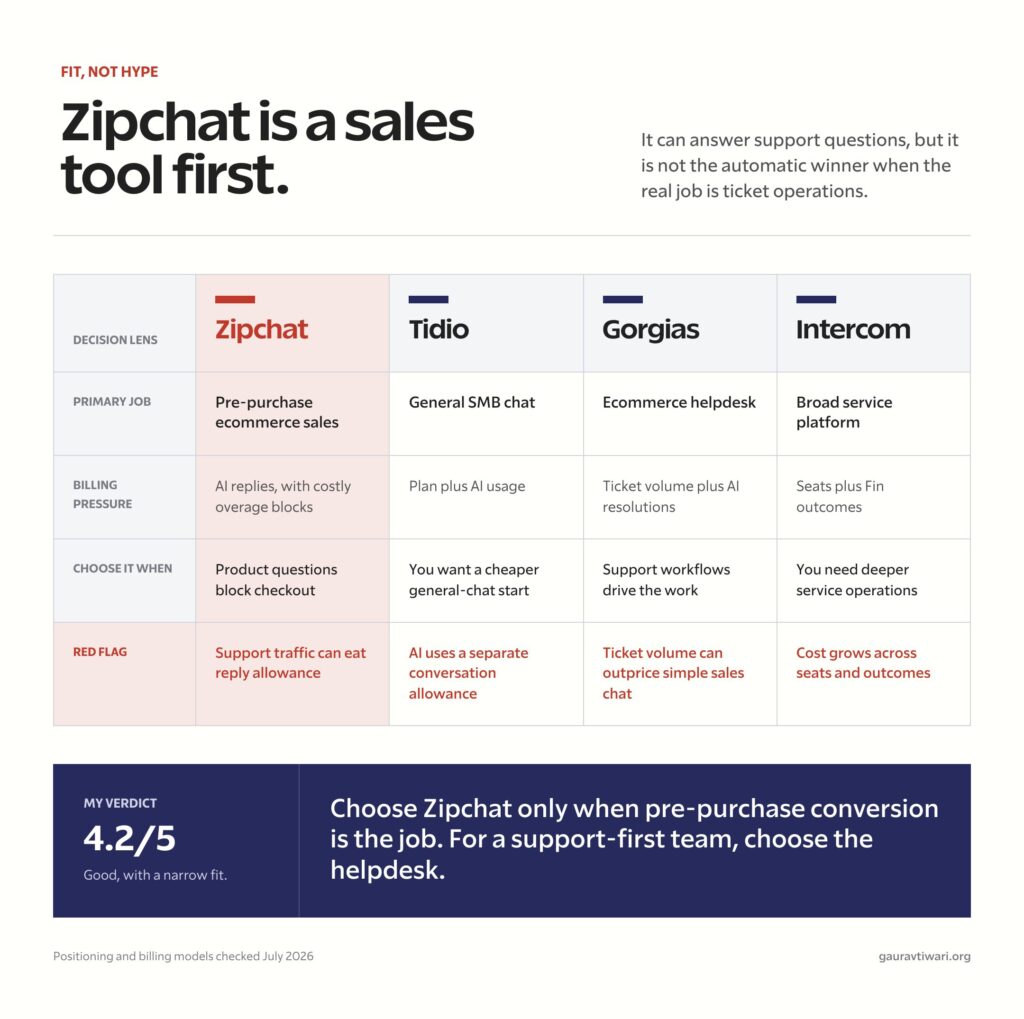
Quick comparison: Zipchat beats Tidio when ecommerce sales questions are the priority. Tidio is easier to justify for general small-business chat. Gorgias wins when support tickets and agent workflows matter more than pre-purchase conversion. Intercom covers a broader customer-service stack, but its seat and AI-outcome pricing is harder for a small store to absorb. My live chat software guide explains the operational difference in more detail.
Zipchat AI Review: How I Tested It
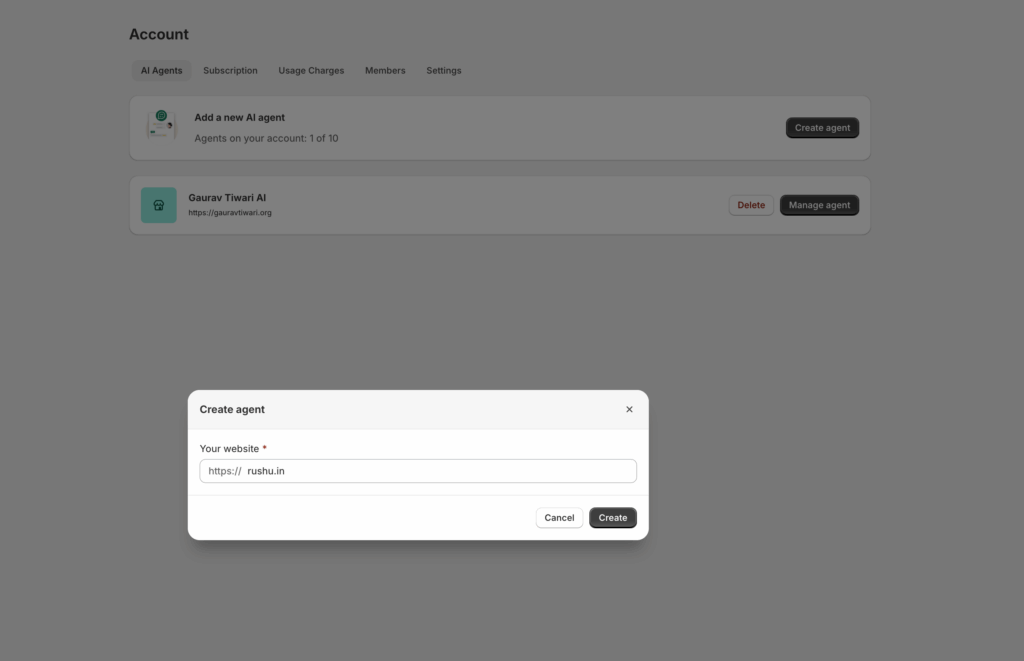
The evidence here combines a detailed setup test on Rushu with live-use experience on Rushu and Anantam IAS. It is not a months-long controlled conversion case study. On Rushu, I created an agent, gave Zipchat the store URL, and watched it move into the learning phase while the dashboard exposed the rest of the configuration. That validates the onboarding flow. It does not prove Zipchat will raise your revenue by a specific percentage.
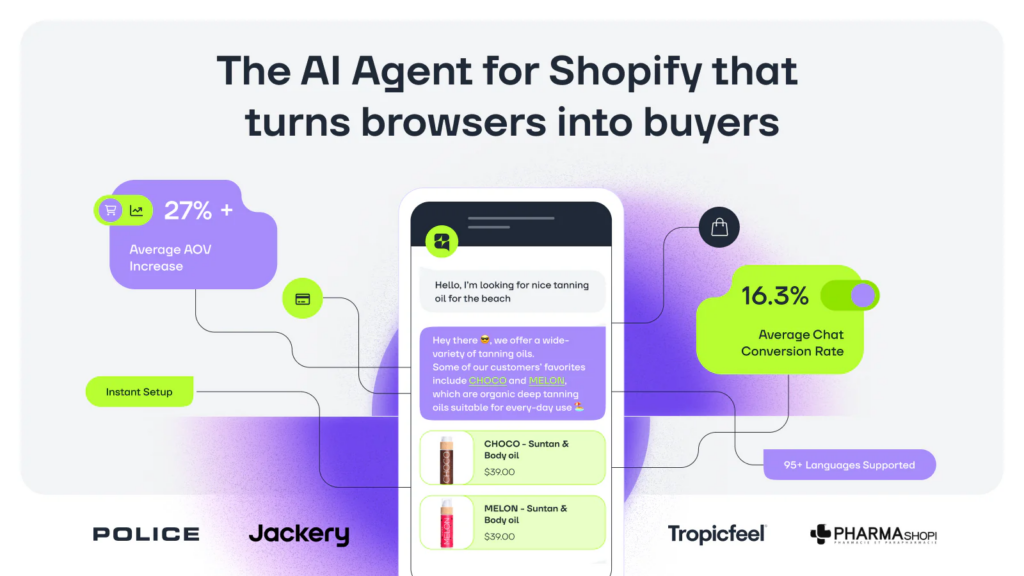
That distinction matters. Zipchat’s own marketing cites a 27% average-order-value increase and a 16.3% chat conversion rate. Those are vendor claims, not results I reproduced on Rushu. I would use them as a reason to run a pilot, never as a forecast for your store.
What Does Zipchat AI Do?
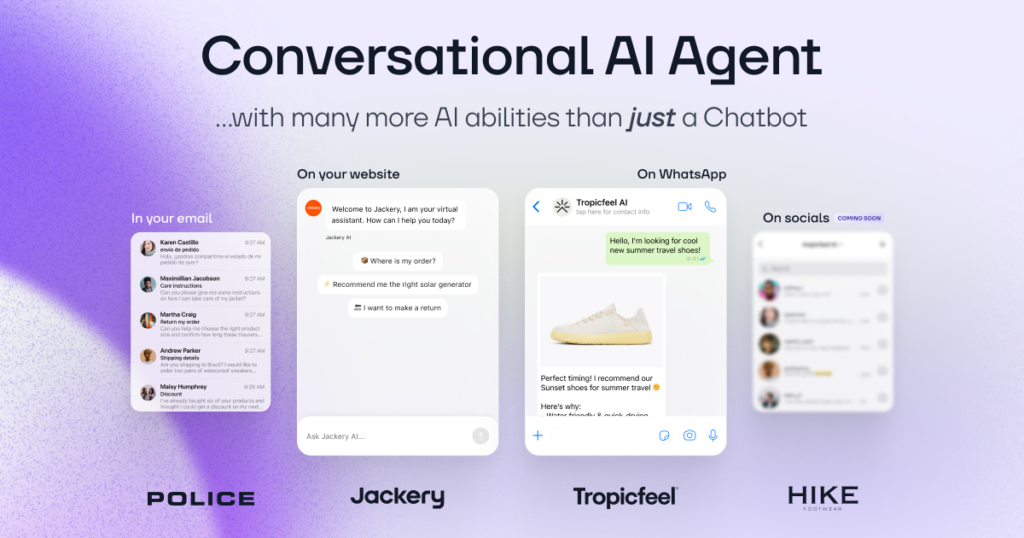
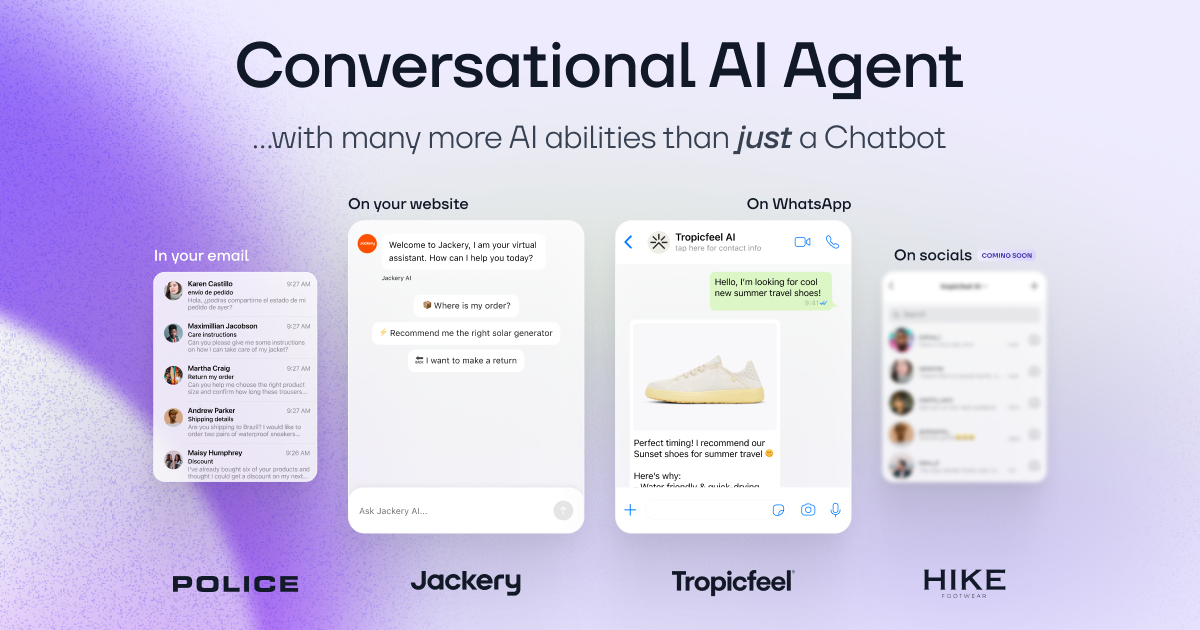
Zipchat is an AI sales and support agent for ecommerce stores. It learns from your product catalog and store pages, answers buying and order questions, recommends products, and can move a shopper toward checkout. Current integrations can also handle actions such as order tracking, returns, discounts, and stock checks. Proactive prompts and follow-ups remain its clearest distinction from a passive FAQ widget.
The product sits between a chatbot and a sales assistant. It can handle routine support, but it is not built to replace a mature helpdesk. Its better use is the moment before a sale: sizing, compatibility, shipping dates, returns, bundles, ingredients, or any other question that keeps a buyer from clicking the checkout button.
That is also why Zipchat belongs next to my guide to conversational marketing with AI chatbots, not in the same bucket as a ticket inbox. A sales agent tries to resolve hesitation while the visitor is still shopping. A helpdesk organizes work after the customer asks for support. Some products do both, but one side usually drives the design. If you are still deciding on the storefront itself, start with my Shopify review before adding another app.
Who Should Skip Zipchat AI?
Skip Zipchat if your store has little traffic, most conversations happen after purchase, or usage caps make budgeting uncomfortable. A $49 chatbot cannot fix weak product pages or a thin traffic pipeline. And if 80% of your volume is order changes, returns, and internal escalation, a support-first platform is the better foundation.
- Low-traffic stores: Fix the offer, product pages, and traffic quality before buying another dashboard.
- Support-heavy teams: Use Gorgias for ecommerce ticket operations, Freshchat inside Freshworks, or Intercom when you need a broader service platform.
- Flat-budget buyers: Reply quotas and $49 overages will keep bothering you even if the bot performs well.
- Indian SMBs with crowded software stacks: A useful chatbot can still be the wrong purchase when several dollar-priced subscriptions already consume the monthly technology budget.
- Hands-off operators: Product data changes, policy exceptions, and weak answers still need review and correction.
If you want a cheaper general-purpose starting point, Tidio is the first alternative I would test. It is less specialized around ecommerce selling, but its free plan and lower paid entry point make the experiment easier to control.
How Much Does Zipchat AI Cost?
Zipchat has a free Shopify plan with 120 AI replies per month, while direct paid pricing starts at $49 for 500 replies. The paid plans include all channels, email forwarding, human escalation, API access, and integrations. The important variable is reply allowance, not the feature checklist.
| Plan | Price | AI replies | Approx. conversations | Best fit |
|---|---|---|---|---|
| Free | $0 | 120/month | Shopify listing does not specify | Testing on one store |
| Starter | $49/month | 500/month | About 200 | Small stores validating sales chat |
| Growth | $129/month | 1,500/month | About 600 | Stores with steady daily conversations |
| Pro | $249/month | 3,000/month | About 1,250 | Teams treating chat as a revenue channel |
| Scale | $499/month | 6,000/month | About 2,500 | High-volume brands |
Zipchat advertises a 7-day trial, a 30-day money-back guarantee, and 20% savings on annual billing. Extra usage costs $49 per 250 replies, while an unlimited plan starts at $999 per month for higher-volume teams. The official pricing page also says the chat bubble is disabled after you exhaust the allowance unless you upgrade or buy more replies. Connected channels can be handled manually, but the AI stops replying.
Why Reply Pricing Changes the Buying Decision
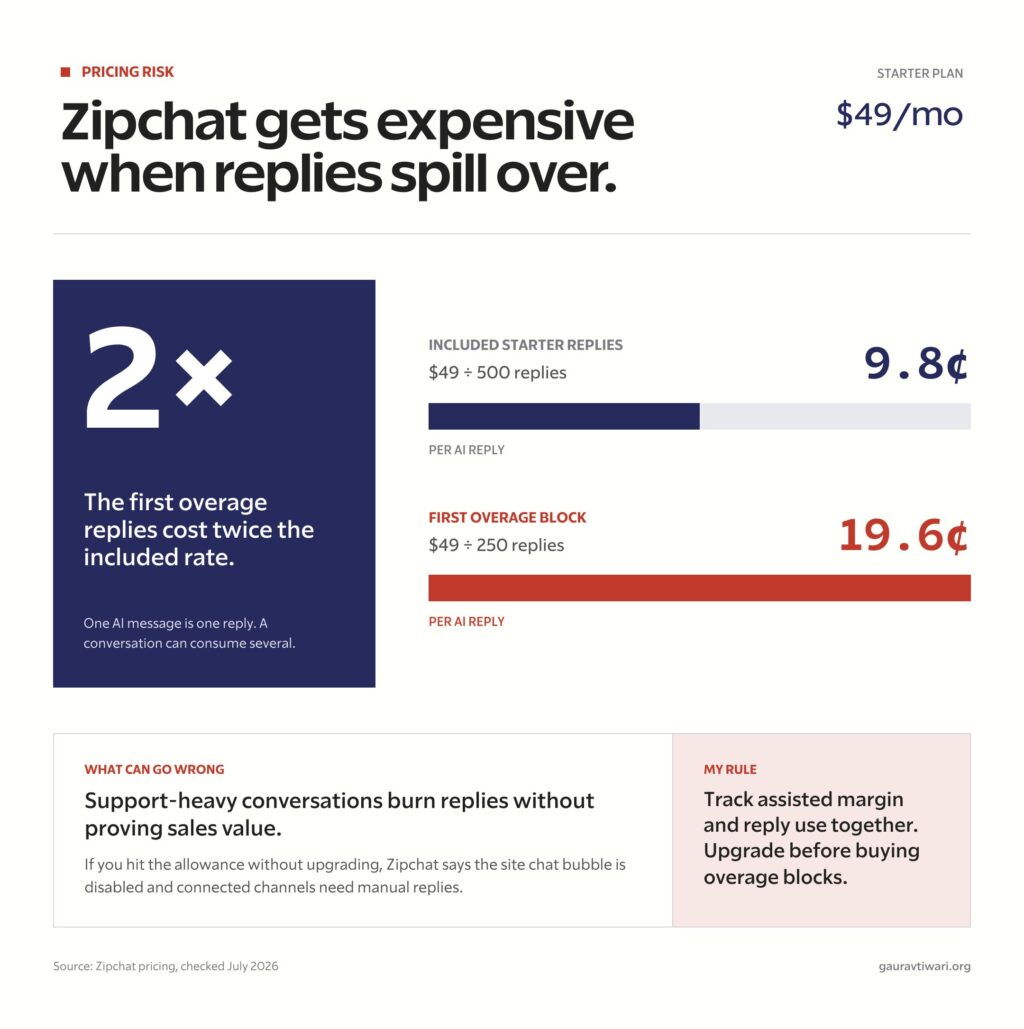
A reply is not the same as a conversation. The Starter plan estimates about 200 conversations from 500 AI replies, so a single shopper may consume several units. At full included usage, Starter works out to 9.8 cents per reply. The first overage block costs 19.6 cents per reply, exactly twice that rate.
| Scenario | Monthly cost | Effective cost |
|---|---|---|
| 500 included replies | $49 | $0.098 per reply |
| 750 replies with one overage block | $98 | $0.131 per reply overall |
| 1,500 replies on Growth | $129 | $0.086 per reply |
| 3,000 replies on Pro | $249 | $0.083 per reply |
The practical test is margin. If one recovered order produces $60 in contribution margin, Starter can pay for itself with one extra sale. If your margin is $8, you need seven extra orders before the tool covers its base price. This is why I would track assisted orders and reply use together. A high chat conversion rate can still hide poor unit economics.
Why Western SaaS Pricing Is Hard to Carry in India
Zipchat’s $49 starting price follows a familiar Western SaaS model: a modest monthly fee in dollar terms, followed by usage-based upgrades. That price does not translate cleanly to an Indian small business earning in rupees. At the RBI-listed July 27, 2026 exchange rate of about ₹96.19 per US dollar, Starter converts to roughly ₹4,700 a month before taxes or card conversion charges.
The businesses I work with are willing to pay for software that helps them sell. The problem is the stack. A $30 plan, a $50 plan, and a $100 plan from three different tools total $180 a month. At the same exchange rate, that is about ₹17,300 every month or ₹2.08 lakh a year before taxes and conversion charges. Each purchase can look reasonable alone while the combined bill becomes difficult for a small or medium Indian business to carry.
I reached that limit myself. I ran Zipchat on Rushu and Anantam IAS, then stopped it on both because the recurring cost did not fit the stores’ software budgets. The product did not become useless; the unit economics failed.
This does not prove that Zipchat is overpriced everywhere. A store earning in US dollars or euros, with a high average order value and healthy contribution margin, may recover $49 from one assisted order. A lower-ticket store earning in rupees needs a much stronger lift to justify the same charge. Regional or purchasing-power pricing would make Zipchat easier to retain on Indian stores.
India pricing test: add Zipchat to your complete monthly software bill, not a separate chatbot budget. Keep it only when assisted contribution margin stays comfortably above the base plan and likely overages.
What Should You Measure During the 7-Day Trial?
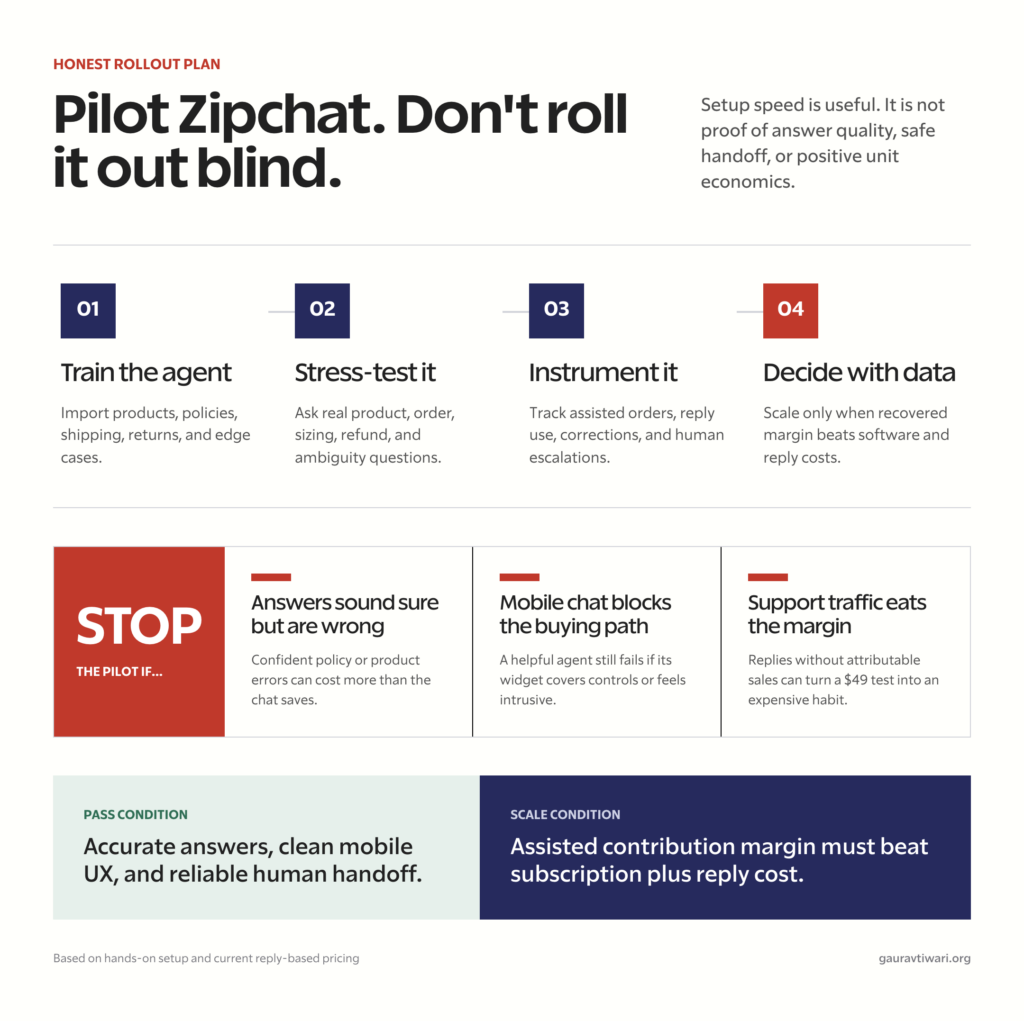
A useful Zipchat AI review cannot tell you whether the tool will pay for itself on your catalog. The trial can. Start with a small group of products that already receive questions, then compare the agent’s answers with the product page, shipping policy, and return policy. One confident wrong answer about compatibility or refunds can cost more than several good chats earn.
- Answer accuracy: test at least 20 questions across products, shipping, returns, and edge cases. Record wrong, incomplete, and invented answers separately.
- Reply consumption: divide replies used by completed conversations. This gives you a store-specific ratio instead of relying on Zipchat’s estimate.
- Human handoffs: count how often a shopper needs a person and whether the transcript gives that person enough context.
- Assisted margin: track contribution margin from orders touched by chat, not just revenue or conversion rate.
- Mobile interference: test the bubble around add-to-cart, sticky bars, consent notices, and checkout controls on a small screen.
Do not judge the pilot on the number of chats alone. Ten conversations that resolve high-value purchase doubts can be better than 200 “where is my order?” messages. The first group tests Zipchat’s sales thesis. The second group mostly tests how quickly you will hit a quota.
The same logic applies to any attempt at increasing ecommerce sales: do not celebrate a conversion metric until you connect it to margin and cost.
Is Zipchat AI Still Available on AppSumo?
No. Zipchat AI is no longer available on AppSumo. The listing is sold out, and you cannot buy the historical lifetime deal. The old entry tier was $99 one-time for 400 monthly replies and one store. That price is archive context only, not a current purchase option.
Existing lifetime buyers still need to watch their tier limits. AppSumo’s page lists plans that once reached 25,000 monthly replies, and the old offer carried a 60-day refund window when it was purchasable. None of that makes the deal available today. New buyers should use Zipchat’s current direct pricing and trial.
How Easy Is Zipchat AI to Set Up?
The initial setup took me a couple of minutes. I entered rushu.in, created the agent, and Zipchat began collecting pages in the background. Crawling takes longer than the form itself because the agent has to read the catalog, policies, and supporting pages before its answers become useful.
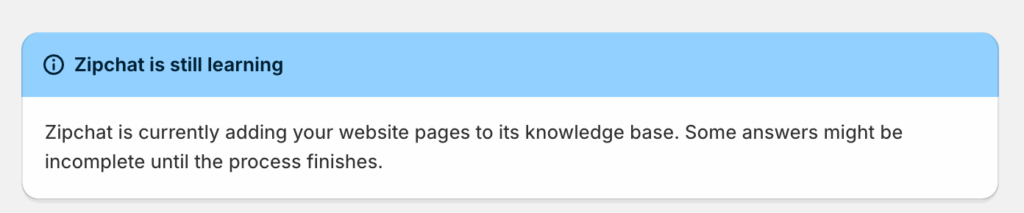
You do not have to wait for the crawl to finish before configuring channels. The dashboard exposed website chat, email, WhatsApp, Instagram, and Messenger settings while the learning job was still running. Current paid plans include those channels and human escalation; the Shopify free plan is more limited.
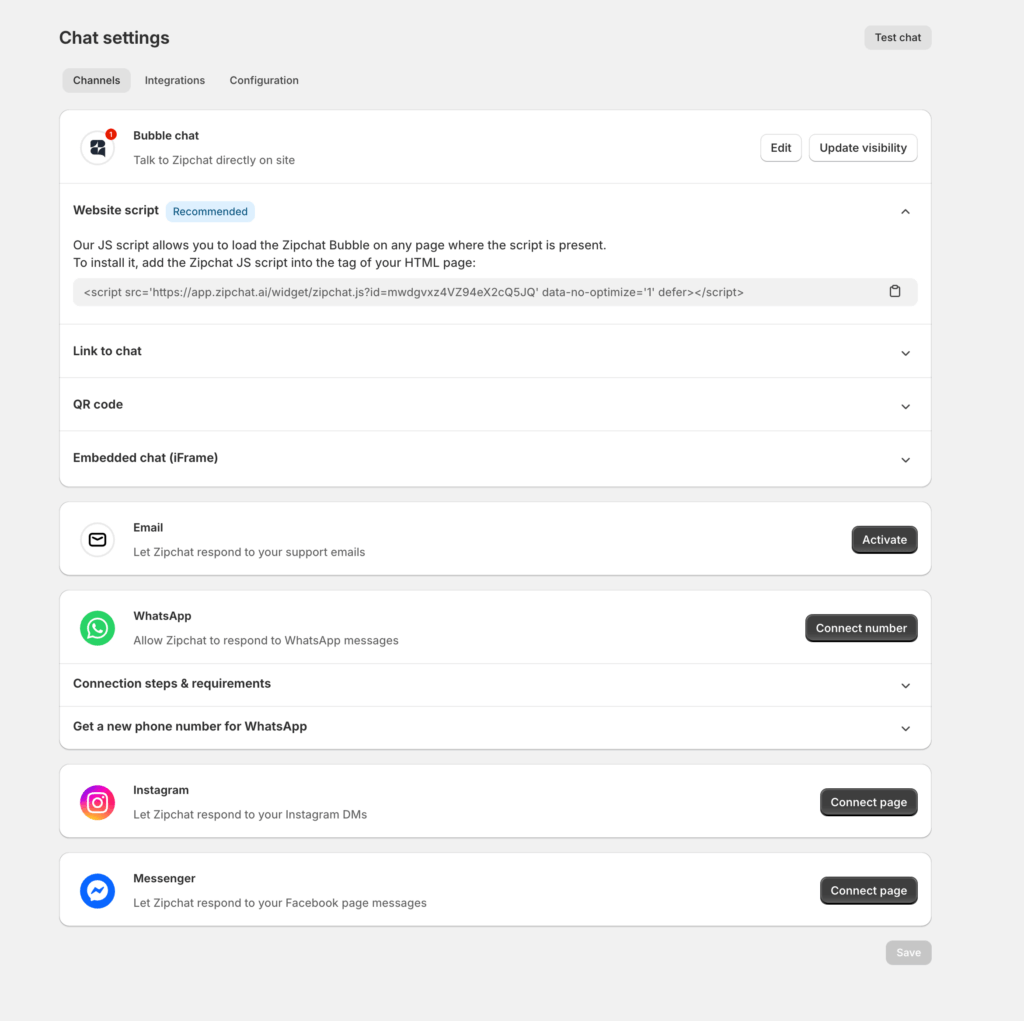
The Setup Steps That Matter
- Import the store: give Zipchat the primary domain and let it collect products, policies, and supporting pages.
- Test product questions: ask about fit, delivery, returns, and compatibility, then correct any weak or invented answer.
- Style and place the widget: match the store and make sure it does not cover checkout or mobile controls.
- Connect the channels you will monitor: email and messaging integrations create more places where a bad automated answer can travel.
- Configure sales tracking: assisted revenue is the metric that has to justify the reply bill.
- Review conversations: corrections and knowledge updates are operating work, not a one-time onboarding task.
What Zipchat Gets Right
Zipchat’s strongest choices are its narrow ecommerce focus, fast onboarding, and willingness to expose correction and escalation workflows. Those choices make it easier to judge than a broad AI assistant that promises to handle every customer interaction.
It Starts With the Sale, Not the Ticket
Product fit, shipping uncertainty, returns, bundles, and checkout hesitation are questions with commercial intent. Zipchat is built to answer them while the visitor can still buy. That makes more sense for a lean Shopify brand than paying for an enterprise helpdesk and using only its widget.
The Correction Loop Is Visible
A useful AI agent needs a way to fix bad answers. Zipchat lets you review conversations, correct responses, and improve source material. That does not remove hallucination risk, but it gives the operator somewhere concrete to act. The failure appears first, then you can trace it to a weak source or missing rule.
The Shopify Proof Is Strong
The Shopify App Store currently shows a 5.0 rating from 157 reviews, with 153 five-star reviews, one two-star review, and three one-star reviews. It also carries the Built for Shopify badge. Marketplace ratings are not a substitute for your own pilot, but this is stronger adoption evidence than a page of vendor testimonials.
Where Zipchat Falls Short
The biggest weaknesses are cost predictability, a narrower support workflow than dedicated helpdesks, and public feedback that changes sharply by platform. None of these automatically disqualifies the product. They do change who should buy it.
Overages Are Expensive
The $49 overage block contains only half as many replies as the $49 Starter allowance. If you repeatedly need overages, move plans or leave. Paying twice the per-reply rate every month is not a sensible steady state.
The Public Review Signals Conflict
Shopify shows 5.0 from 157 reviews. Trustpilot shows 2.5 from 11 reviews, with most complaints focused on unsolicited sales outreach and some support responsiveness. Trustpilot also says Zipchat has not invited reviews, so the sample may not represent the customer base. Eleven reviews are too few for a sweeping verdict, but the gap is too large to hide.
I would separate product performance from sales conduct when reading those complaints. Reports of unwanted outreach do not prove the Shopify agent answers badly, but they do tell you something about the company experience outside the app. The support complaints matter more during a paid pilot. Send one technical question before the refund window closes and judge the speed, specificity, and ownership in the reply.
It Is Not an Operations-First Helpdesk
Zipchat now includes ticketing, a unified inbox, automatic assignment, human escalation, and order tracking. That is more support depth than the earlier product had. I would still choose Gorgias or Intercom when service-level reporting, complex routing, workforce management, and post-purchase operations are the center of the stack.
How Does Zipchat Compare With Tidio, Gorgias, and Intercom?
Zipchat wins when your main question is whether AI can recover ecommerce sales before a shopper leaves. Tidio is a cheaper general chat starting point. Gorgias is a better support desk for ecommerce. Freshchat, Zoho SalesIQ, and Intercom make more sense when they match an existing business stack or broader customer-service need.
| Tool | Starting price | Pricing model | Choose it for |
|---|---|---|---|
| Zipchat AI | Free on Shopify; paid from $49/month | AI replies | Pre-purchase ecommerce sales |
| Tidio | Free; Starter $24.17/month annually | Plan plus AI usage | General SMB chat |
| Gorgias | Starter $10/month | Ticket volume | Ecommerce support operations |
| Freshchat | Free; Growth $19/agent/month annually | Agent seats | Freshworks users |
| Zoho SalesIQ | Free; paid price varies by region | Operator seats | Zoho-centered teams |
| Intercom | $29/seat/month annually plus $0.99 per Fin outcome | Seats plus AI outcomes | Broader service and engagement |
- Pick Tidio when you want general live chat and a cheaper paid entry point.
- Pick Gorgias when tickets, agents, and ecommerce support operations drive the purchase.
- Pick Freshchat if the rest of your customer-service stack already lives in Freshworks.
- Pick Zoho SalesIQ when cost control and the Zoho ecosystem matter more than sales specialization.
- Pick Intercom when you need a broader service platform and can carry both seat and AI-outcome costs.
Who Should Use Zipchat AI?
This Zipchat AI review points to a narrow fit: Shopify and other ecommerce stores where buyers repeatedly stop to ask a question before purchasing. The strongest candidates can name those questions, estimate monthly chat volume, and connect assisted sales to margin.
- Shopify brands with repeat product questions: sizing, compatibility, delivery dates, ingredients, bundles, and returns are good candidates for a trained sales agent.
- Lean teams that cannot staff chat around the clock: Zipchat can cover the first response and hand exceptions to a person.
- Stores with meaningful order margin: a few assisted sales can cover the plan before overages become a concern.
- Operators willing to train the agent: the product gets safer when someone reviews conversations and corrects weak answers.
WooCommerce stores can also use Zipchat. The company now has an official WordPress/WooCommerce plugin that installs the widget, sales tracking, and customer identification. Shopify still has the clearest free plan, badge, and review evidence. If you run WooCommerce, pilot it on a controlled slice of traffic and check product answers, order lookups, mobile behavior, and script performance before a full rollout.
My Zipchat AI Review Verdict
Zipchat is worth a pilot for an ecommerce store with clear pre-purchase friction. The onboarding is quick, its sales-first positioning is sensible, and the Shopify record is hard to dismiss. My own use makes the recommendation more conditional: I ran it on Rushu and Anantam IAS, then stopped it on both because the recurring cost did not fit their budgets.
I would start on the Shopify free plan or the 7-day direct trial, record the questions shoppers ask, and track assisted contribution margin against reply use. If your business earns in rupees, judge Zipchat inside the full software budget rather than as an isolated $49 purchase. I would not wait for an AppSumo return, and I would not let a 5.0 Shopify score erase either the Trustpilot warning or the cost of keeping another subscription active.
Bottom line: choose Zipchat when unanswered product questions are costing sales and your margin can absorb a dollar-priced subscription. Choose Gorgias when support operations are the problem. Choose Tidio when you need a lower-cost general chat tool. For an Indian SMB, usefulness without provable payback is not enough.
Zipchat AI Review
Zipchat AI
Pros
- Sales-first ecommerce positioning is more useful than a generic FAQ widget
- Shopify shows a 5.0 rating from 157 reviews and a Built for Shopify badge
- Initial setup starts with one URL and exposes correction and channel controls
- Free Shopify plan creates a low-risk way to test 120 AI replies
Cons
- Extra replies cost $49 per 250, twice the Starter plan's included per-reply rate
- Not a full replacement for an ecommerce helpdesk such as Gorgias
- Trustpilot's small sample is sharply more negative than Shopify feedback
- Dollar-based pricing is difficult to justify for many rupee-earning small businesses
Summary
Zipchat AI is a sales-focused ecommerce chat agent that is easy to set up and strongest on Shopify. I stopped using it on Rushu and Anantam IAS because the recurring cost did not fit their budgets. It can still pay for itself on higher-margin stores, but reply overages and dollar-based pricing make a measured pilot essential.
Price: USD 49 /month
See Zipchat PricingFrequently Asked Questions
Is Zipchat AI worth it for Indian ecommerce stores?
It can be, but not by default. I stopped using Zipchat on Rushu and Anantam IAS because the recurring cost did not fit their budgets. At the RBI-listed July 27, 2026 rate, $49 is about ₹4,700 before taxes or card conversion charges. It makes more sense for a high-margin store that can prove assisted profit exceeds the subscription and overages.
Does Zipchat AI have a free plan?
Yes. The Shopify App Store lists a free plan with 120 AI replies per month and training for 100 website pages. Zipchat’s direct website focuses on paid plans, which start at $49 for 500 replies.
Is Zipchat AI good for Shopify stores?
Shopify is Zipchat’s strongest fit. Its listing has a Built for Shopify badge and a 5.0 rating from 157 reviews. That is useful marketplace evidence, but you should still test product answers and track assisted margin on your own store.
Does Zipchat work with WooCommerce?
Yes. Zipchat has an official WordPress/WooCommerce plugin that installs its widget, sales tracking, and customer identification. Shopify has the clearest free plan and review record, so WooCommerce users should still run a staged pilot before a full rollout.
Is the Zipchat AppSumo lifetime deal available?
No. AppSumo currently marks the Zipchat AI deal as sold out. The historical entry tier cost $99 one-time for 400 monthly replies, but it should not be used as the current purchase price or recommendation.
Can Zipchat hand a conversation to a human?
Yes. Current paid plans include email forwarding, human escalation, all channels, API access, and integrations. When the AI reply allowance is exhausted, connected channels can continue in manual mode while automated replies stop.
What happens when Zipchat runs out of AI replies?
The website chat bubble is disabled unless you upgrade or buy more replies. An extra 250 replies costs $49. Connected channels can be handled manually, but the AI stops answering after the allowance is exhausted.
Which Zipchat alternative should I try first?
Try Tidio for cheaper general-purpose chat, Gorgias for ecommerce support operations, Freshchat for a Freshworks-centered stack, and Intercom for a broader service platform. Zipchat remains the more focused option when pre-purchase ecommerce sales are the job.
Tell Google you want more of this.
Add Gaurav Tiwari as a preferred sourceOne tap, and this site shows up more often in your own Top Stories, AI Overviews and AI Mode. Remove it any time.
Disclaimer: This site is reader-supported. If you buy through some links, I may earn a small commission at no extra cost to you. I only recommend tools I trust and would use myself. Your support helps keep gauravtiwari.org free and focused on real-world advice. Thanks. - Gaurav Tiwari