
How Social Casino Platforms Keep Millions of Free-Play Sessions Running Inside a Browser
 by
by
Anyone who has shipped a web app knows the browser is a moving target. It throttles background tabs, evicts data you assumed was safe, and drops connections the moment a phone hands off from Wi-Fi to cellular. Now picture running not one session but hundreds of thousands at once, each expecting instant feedback and none of them forgiving toward a spinner that hangs for two seconds. That is the front-end engineering problem sitting behind social casino platforms, and it turns out to be one of the more demanding examples of real-time browser work on the public web.
For a reference point on which platforms actually run this way, LSR’s free play casino options roundup catalogs which brands operate purely on virtual or sweepstakes currency, and it is a useful map when you want to study these front-end patterns in the wild rather than reverse-engineer them one tab at a time.
For readers here who build on WordPress, ship SaaS dashboards, or tune sites for Core Web Vitals, these platforms are worth studying for the plumbing rather than the games. They have to hold a live, stateful, animated experience together inside a tab that the operating system is actively trying to put to sleep, and they have to do it for a global audience on hardware that ranges from a flagship laptop to a five-year-old budget Android. The techniques they depend on, persistent sockets, layered client storage, edge caching, and disciplined reconnection logic, are the same tools that keep any serious web application feeling quick. This piece walks through how those pieces fit, treating the free-play casino as a stress test instead of a sales pitch.
The Connection Layer Decides Whether the Session Feels Alive
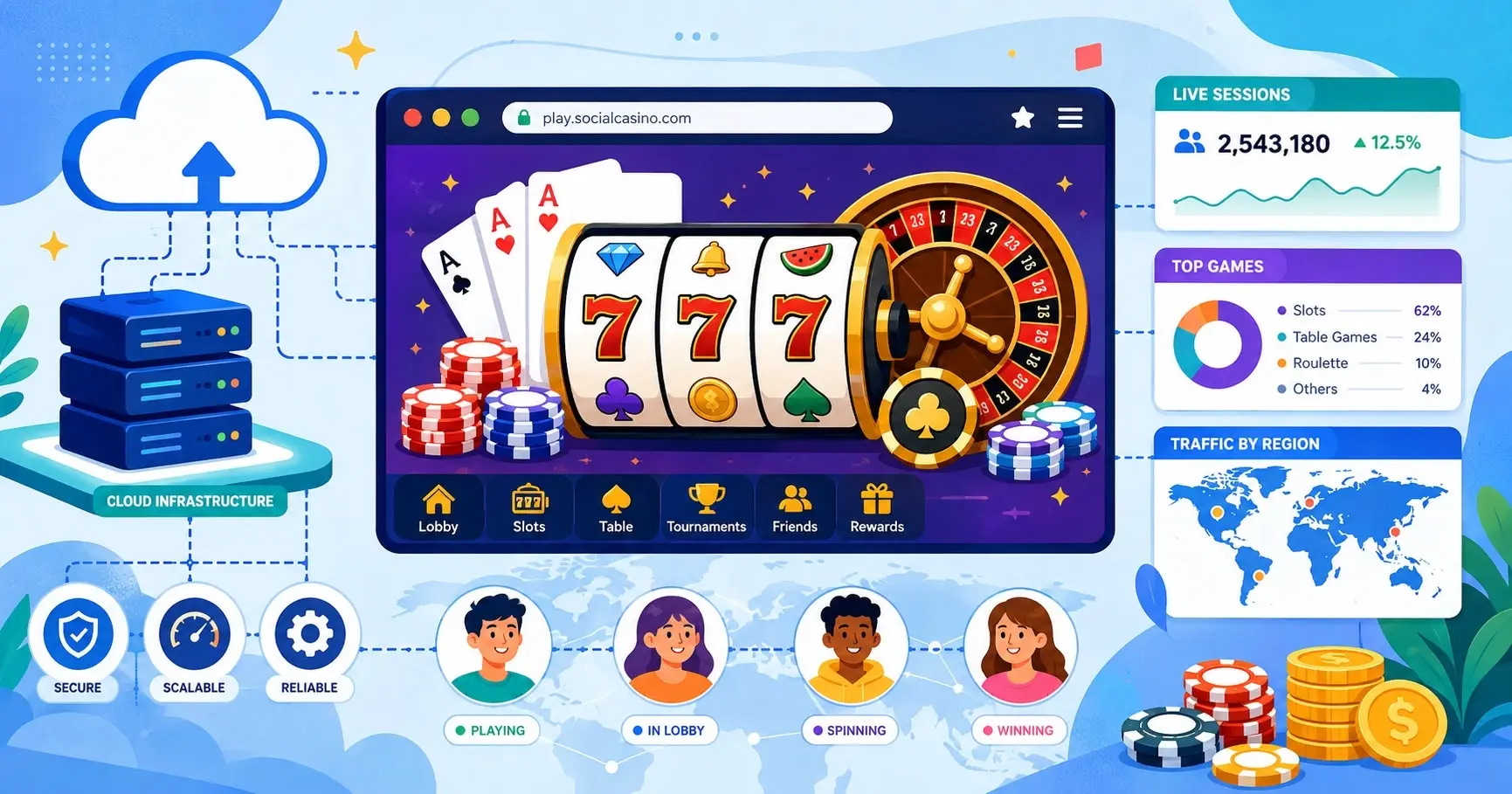
The first big decision is how the browser talks to the server in real time. The old approach, polling, has the client ask again and again whether anything has changed. It is simple and it works, but it scales badly. Every request carries a full set of HTTP headers, so at scale the header overhead alone becomes the dominant cost. Independent measurements put long polling at roughly 5 MB per second of pure header traffic for ten thousand clients firing one event each per second, against a fraction of that for a persistent stream. Multiply that across a platform with a large concurrent audience and polling turns into a bandwidth bill and a latency problem at the same time.
The modern answer is a persistent connection, usually a WebSocket, sometimes Server-Sent Events for one-way updates. A WebSocket opens once, then stays open as a two-way channel, so a balance update or a shared jackpot tick reaches the client in milliseconds without a fresh handshake each time. The tradeoff is that persistent connections are stateful and hungry: the server now holds an open socket for every active user, and connection-heavy apps need careful backend architecture to survive a surge. With tuned infrastructure, though, the pattern scales horizontally to millions of concurrent connections, which is exactly what a busy free-play platform needs on a weekend evening.
If you want the honest engineering comparison rather than a vendor pitch, Ably’s breakdown of long polling versus WebSockets lays out where each one wins and, more usefully, where each one quietly falls apart under real traffic. The short version most teams land on is that WebSockets are the default for anything new, with polling kept only as a fallback for networks that block the upgrade.
The other quiet advantage of edge delivery is resilience. When traffic spikes, the origin server is shielded because most requests never reach it, and regional outages hurt less because a nearby node keeps serving cached assets. Teams that track how these delivery and regulatory patterns shift over time tend to follow the trade press closely; Legal Sports Report on X is one steady feed for updates on how the free-play and social space evolves, which is context worth having when you are deciding how much to invest in edge infrastructure for a given market.
Frequently Asked Questions
Why do these platforms use WebSockets instead of just polling the server?
Polling makes the client ask for updates over and over, and each request carries full HTTP headers, so the overhead grows quickly with the number of users. A WebSocket opens one persistent two-way channel, delivering updates in milliseconds without a fresh handshake each time. At the concurrency a busy platform sees, that difference is the gap between a fast experience and a slow, expensive one, which is why persistent connections are the default for anything real-time today.
How much data can a website actually store in a browser?
It depends on the tier. localStorage is capped near 5 MiB per origin and is meant for small values. IndexedDB and the Cache API are managed against available disk space and can hold anywhere from hundreds of megabytes to several gigabytes, though the exact figure varies by browser and device. None of it is guaranteed to survive, since browsers evict data under storage pressure and privacy rules, so anything important belongs on the server too.
What is the seven-day storage limit people mention?
It is a WebKit rule that affects Safari. On sites a user has not interacted with, script-writable storage, including IndexedDB, service worker registrations, and the Cache API, can be cleared after seven days. It is a privacy protection, not a malfunction. The practical response is to keep the authoritative copy of any account or session data on the server and treat the browser-side copy as a convenience that may disappear.
Yes, almost entirely. Persistent connections, layered browser storage, edge delivery over HTTP/3, frame-budget-aware rendering, and disciplined reconnection are general tools for any real-time web application. A live analytics dashboard, a chat feature, or a collaborative editor faces the same constraints in the same order. The free-play platform is simply an unusually demanding example that exercises all of these subsystems at once and at scale.
Tell Google you want more of this.
Add Gaurav Tiwari as a preferred sourceOne tap, and this site shows up more often in your own Top Stories, AI Overviews and AI Mode. Remove it any time.