
 by
You’ve just started your first abstract algebra course. Last semester was calculus and matrices, where every problem ended with a number. Now the lectures are full of definitions, and the homework asks you to prove things about groups you can’t picture yet.
The book you start with decides how those first weeks feel. The best abstract algebra books for a first course stay close to examples, so every definition comes with something you can actually check. A book that runs on definitions alone can make a capable student feel lost within a few weeks.
My advice is simple. If you’re new to abstract algebra, I’d start with one book: Charles Pinter’s A Book of Abstract Algebra. It explains every idea through examples before the proofs, it has hundreds of exercises, and the Dover edition costs a fraction of a standard textbook.
There are 2 exceptions. If your course already names a textbook, I’d start with that one instead. If you can’t spend anything right now, Thomas Judson’s Abstract Algebra: Theory and Applications is legally free online and covers the same first course.
Abstract algebra was part of both my B.Sc. and M.Sc. in mathematics, and groups and rings are where I’d expect most first-time proof writers to struggle. I haven’t worked through all 10 of these books cover to cover. For the ones I know less closely, my verdict comes from their contents, their exercises and the course each one is built for.
Quick Comparisons
My suggestion is to find your situation in the table and jump straight to that book. Judson’s is the only one that is legally free, and it is a complete course.
| Book | Best for | You should know | Free legal copy |
|---|---|---|---|
| A Book of Abstract Algebra (Pinter) | Your first abstract algebra book | Basic proofs help | No |
| Contemporary Abstract Algebra (Gallian) | A standard undergraduate course | Some proof experience | No |
| Abstract Algebra (Dummit and Foote) | Graduate school preparation | Comfort with proofs | No |
| Abstract Algebra: Theory and Applications (Judson) | Studying for free | Basic proofs help | Yes |
| How to Think About Abstract Algebra (Alcock) | Making sense of definitions | Use beside a main text | No |
| A First Course in Abstract Algebra (Fraleigh) | A traditional course sequence | Some proof experience | No |
| Abstract Algebra (Silverman) | Links to number theory and geometry | Undergraduate proofs | No |
| Abstract Algebra: A First Course (Saracino) | A short, clear first course | An introduction to proofs | No |
| A Concrete Approach to Abstract Algebra (Sawyer) | A warm-up before the course | High-school algebra | No |
| Schaum’s Outline of Abstract Algebra | Extra solved problems | A course in progress | No |
Best Abstract Algebra Books by Goal
Each heading names the job that book does best, so you can jump straight to yours. Every entry also says who I’d send elsewhere.
Best first book: A Book of Abstract Algebra
Charles Pinter’s A Book of Abstract Algebra is the book I’d give anyone meeting groups for the first time. Each chapter explains an idea in plain language and works through examples before it asks you to prove anything.
The exercise sets are its real strength. They are grouped by theme and climb from routine checks to genuine proofs, so you can watch your own progress inside a single chapter.
The 2nd edition is a Dover reprint, so it costs a fraction of a standard textbook. Its gentle pace has one cost: an honors course that moves fast will take some topics deeper than Pinter does.
It is my pick for a first course and for self-study. If your course runs at honors speed, I’d keep it beside the assigned text as the book that explains things, never as a replacement.
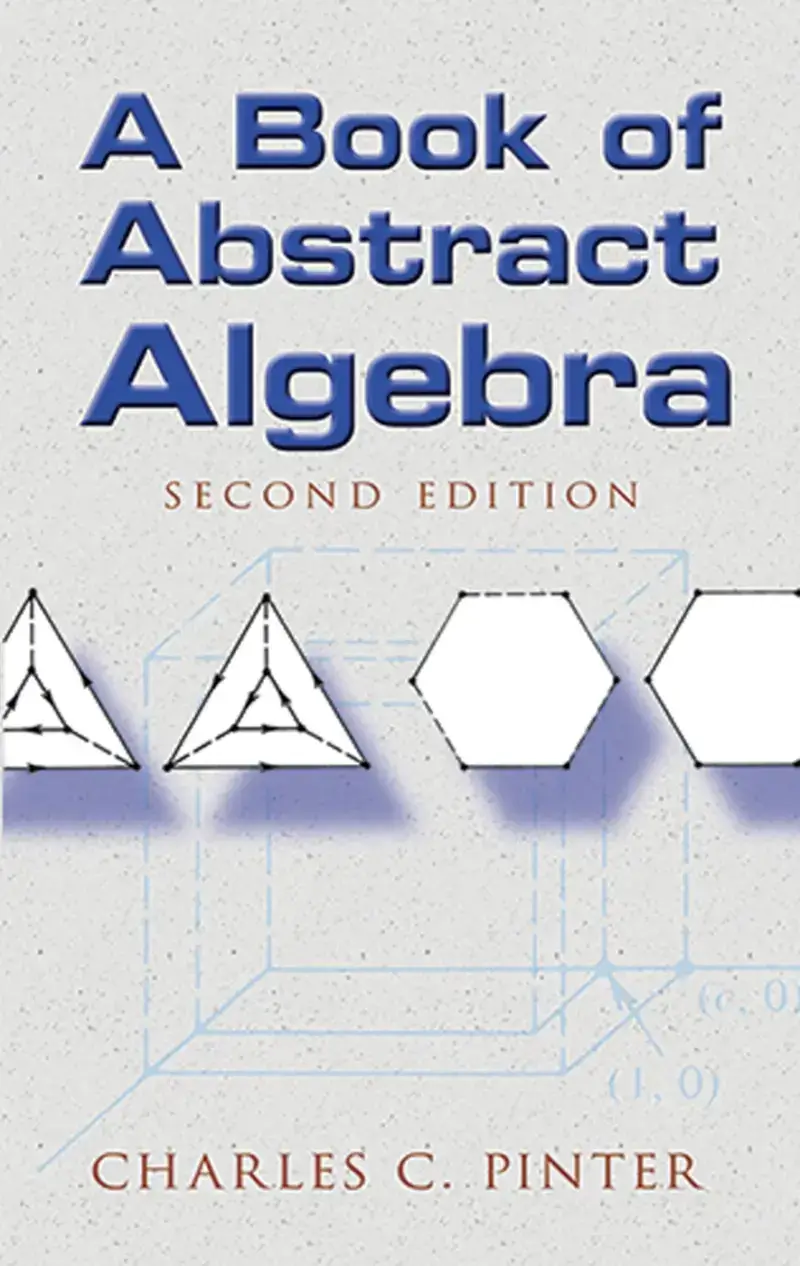
- By Charles C. Pinter
- Best for: independent first study
- Level: Proof basics helpful
- Main strength: Uses many examples and problems to make groups, rings, and fields approachable.
- Watch-out: Its informal pace may not match a theorem-dense honors course.
- Verify the exact edition, format, and seller
Best course textbook: Contemporary Abstract Algebra
Joseph Gallian’s Contemporary Abstract Algebra is one of the most widely used textbooks for a first undergraduate course. It earns that place with clear examples, real applications and a very large exercise set.
Gallian adds short biographies of mathematicians and applications such as check digits and cryptography. Those breaks keep a hard subject from feeling like an endless list of definitions.
The current edition is the 10th, published by CRC Press in 2021, and the link below is the 9th, which covers the same core. Its length is the one catch, because for a single semester of self-study it is more book than you can finish.
My recommendation is to buy it when your course assigns it. For self-study, Pinter gets you through the same first course with far less weight.
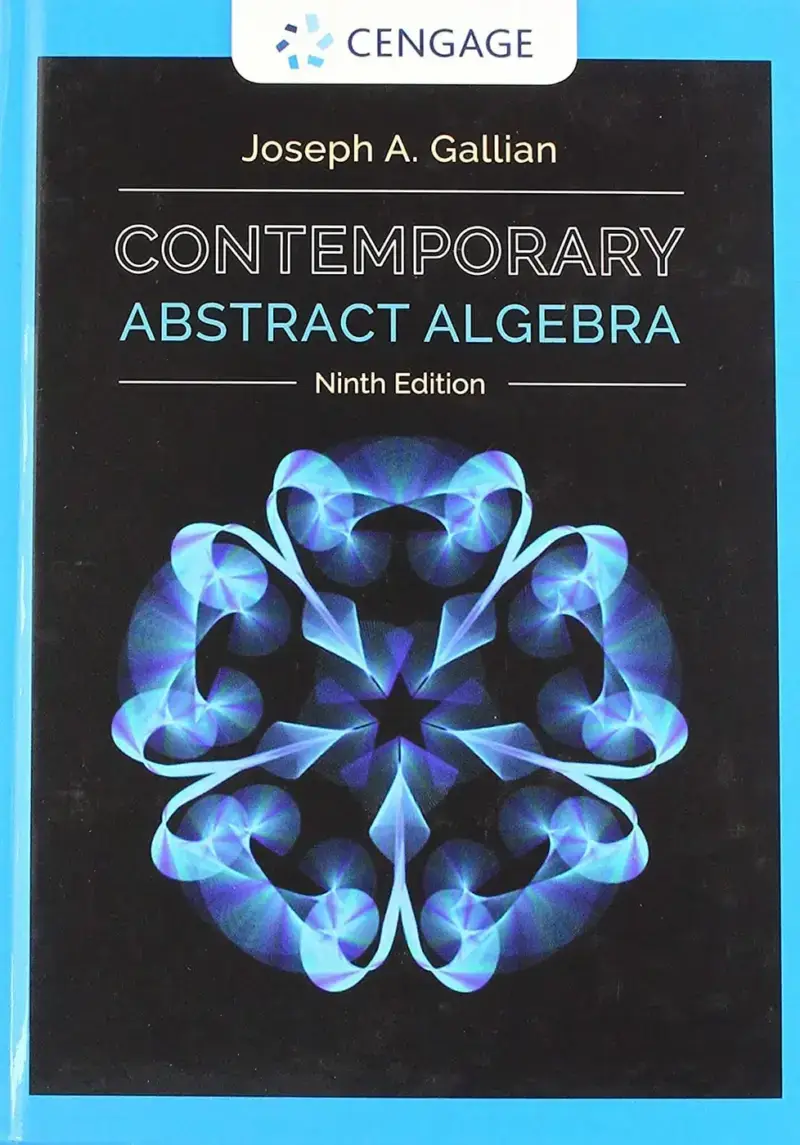
- By Joseph A. Gallian
- Best for: a standard undergraduate class
- Level: Proof experience helpful
- Main strength: Balances readable exposition, examples, applications, and a large exercise set.
- Watch-out: The length can feel heavy for a one-semester self-study plan.
- Verify the exact edition, format, and seller
Best for graduate school: Abstract Algebra by Dummit and Foote
David Dummit and Richard Foote’s Abstract Algebra is the reference most graduate students keep on the desk. It covers groups, rings, fields, modules and Galois theory in depth, with a huge set of exercises.
As a first book, it is too dense for most students. The detail that makes it a lifelong reference makes it slow going when every definition is still new.
The 3rd edition from 2004 is still current. I’d buy it in your final undergraduate year or at the start of a master’s program, once a first course is behind you.
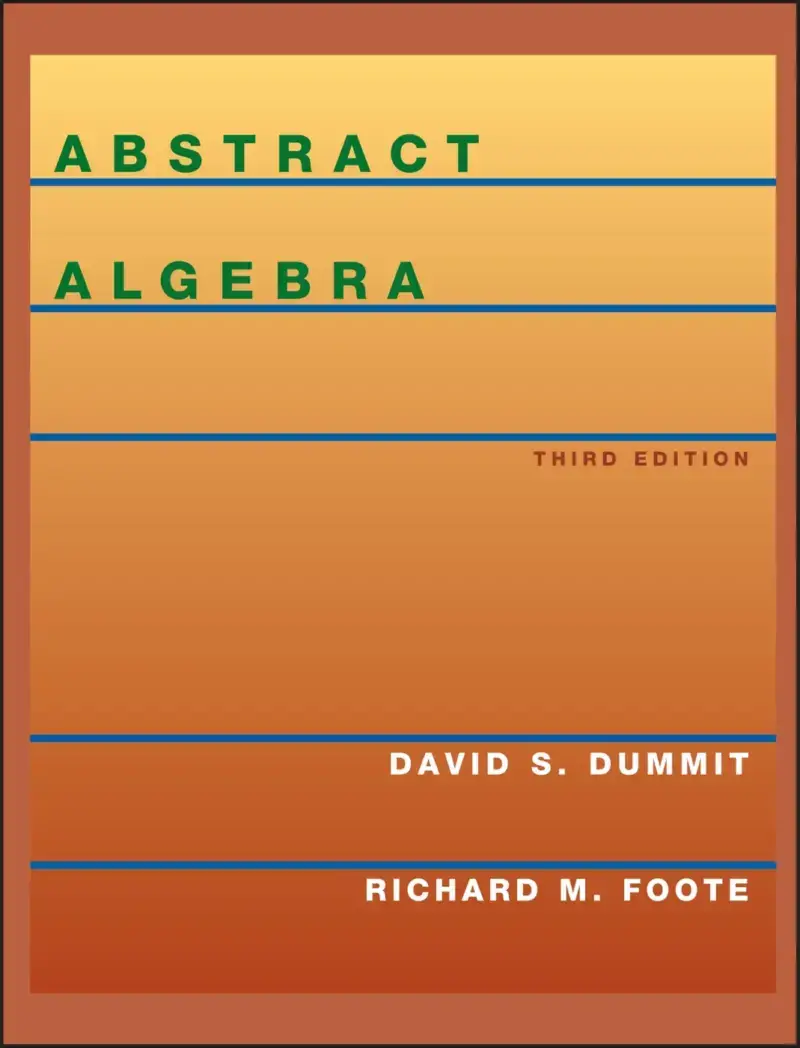
- By David S. Dummit and Richard M. Foote
- Best for: students continuing to graduate study
- Level: Strong proof background required
- Main strength: Covers groups, rings, fields, modules, and more with depth and long-term reference value.
- Watch-out: It is too dense for many first encounters.
- Verify the exact edition, format, and seller
Best free textbook: Abstract Algebra: Theory and Applications
Thomas Judson’s Abstract Algebra: Theory and Applications is a complete course that the author publishes free on Judson Books. It covers groups, rings and fields, with applications such as cryptography and coding theory.
The free online edition also has Sage cells, contributed by Rob Beezer, so you can compute with groups right inside the book. Judson wrote it for college juniors and seniors, and it reads a little drier than Pinter.
The print copy has the same text as the free edition. It is wise to read the free version first and buy paper only if you study better that way. I’d pick it whenever cost matters more than warmth.
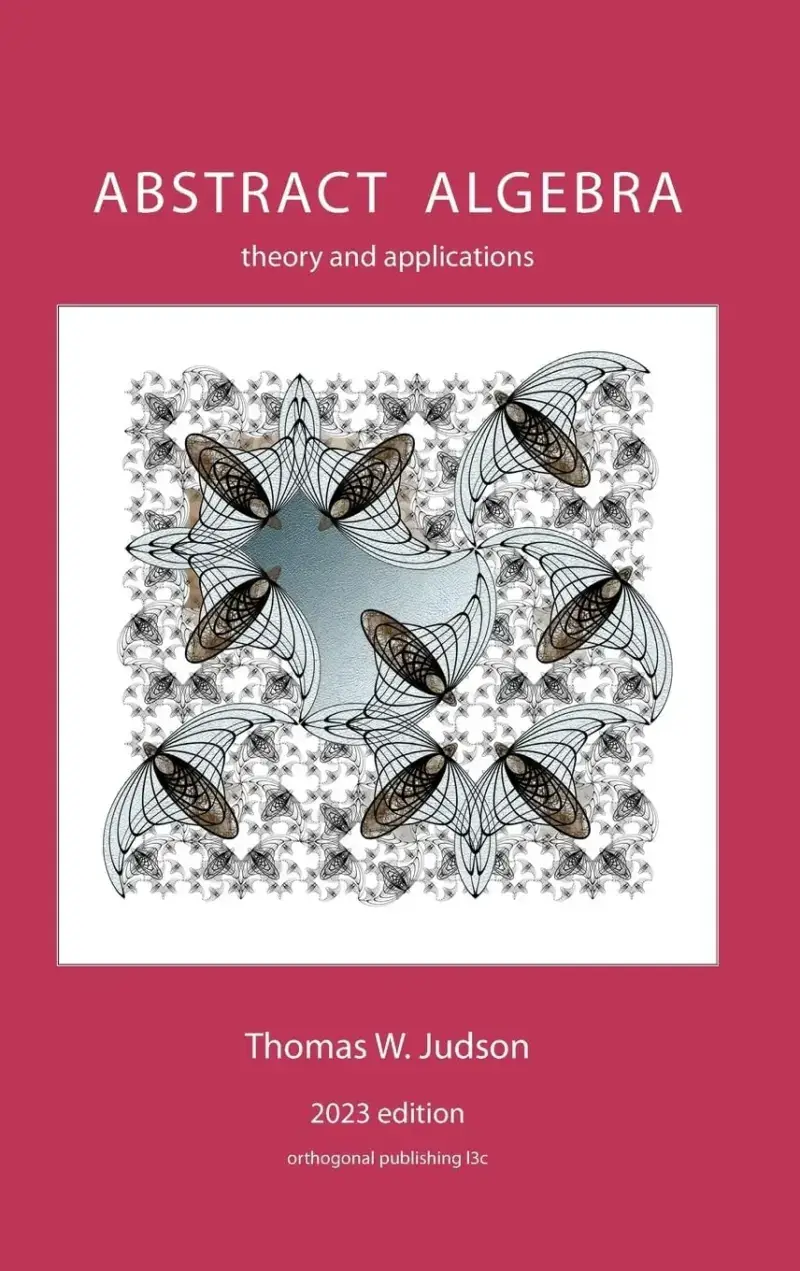
Abstract Algebra: Theory and Applications
- By Thomas W. Judson
- Best for: budget-conscious students
- Level: Proof basics helpful
- Main strength: Provides a full open course with applications and freely available digital access.
- Watch-out: The print copy is optional because the legal online edition is free.
- Verify the exact edition, format, and seller
Best for making sense of definitions: How to Think About Abstract Algebra
Lara Alcock’s How to Think About Abstract Algebra teaches the skill most courses quietly assume. It shows you how to read a definition, build your own examples from it and turn those examples into a proof.
It works as a companion and can’t carry a course on its own. If definitions keep slipping away from you in the first few weeks, I recommend reading it beside your main textbook.
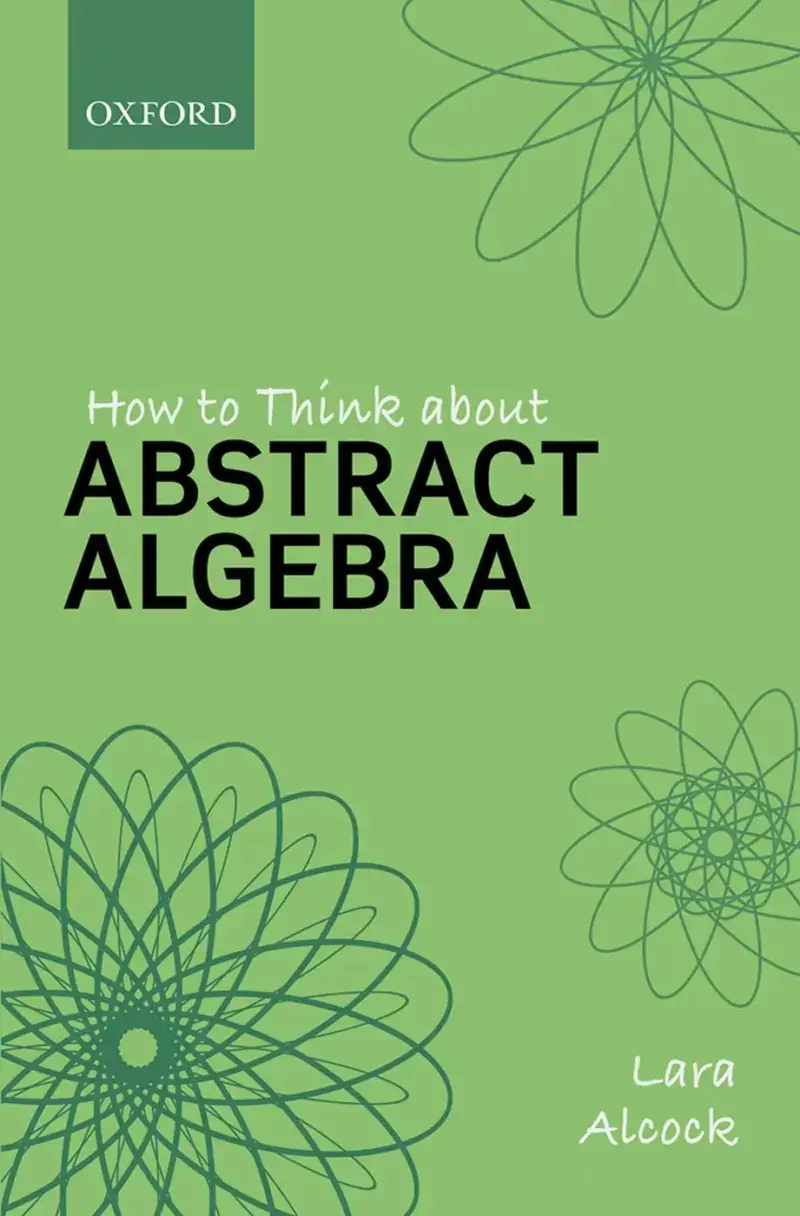
How to Think About Abstract Algebra
- By Lara Alcock
- Best for: students struggling with abstraction
- Level: Use beside a main text
- Main strength: Explains how experts read definitions, build examples, and reason about structures.
- Watch-out: It is a companion to a course, not a complete syllabus.
- Verify the exact edition, format, and seller
Best traditional textbook: A First Course in Abstract Algebra
John Fraleigh’s A First Course in Abstract Algebra follows the classic order of groups, then rings, then fields, with many examples along the way. A lot of departments still assign it.
The 8th edition, revised with Neal Brand, is the current one, and the 7th edition linked below covers the same material. The presentation is more formal than Pinter’s or Gallian’s, so I’d buy it when your course uses it.
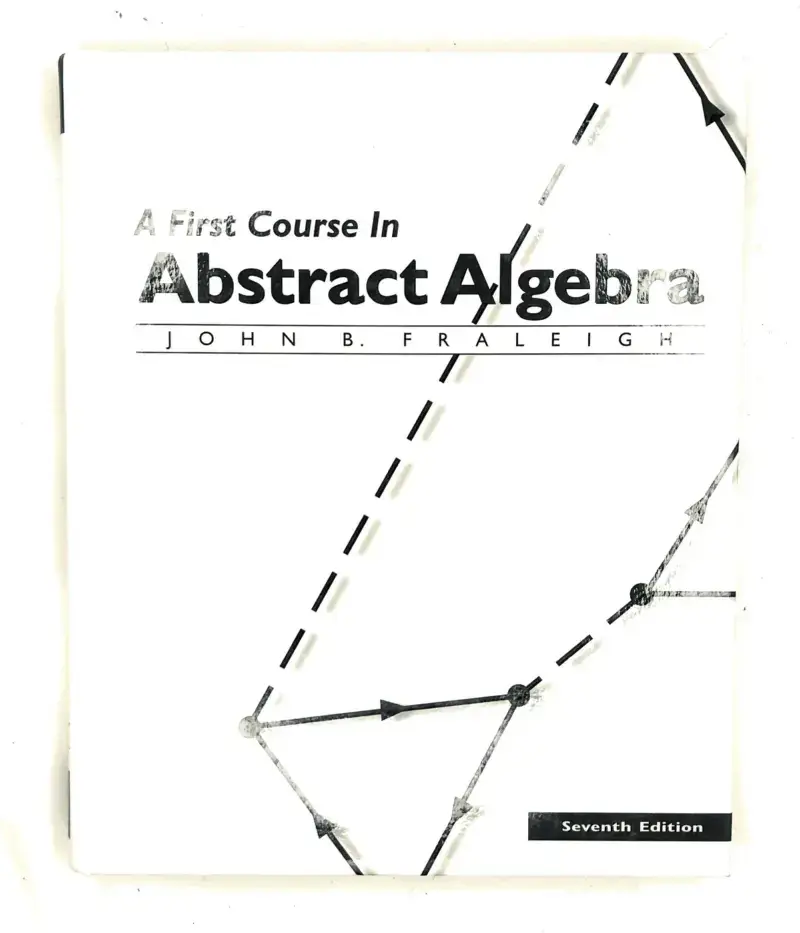
A First Course in Abstract Algebra
- By John Fraleigh
- Best for: students following a classic groups-rings-fields sequence
- Level: Proof experience helpful
- Main strength: Builds core structures through numerous examples and a conventional undergraduate progression.
- Watch-out: The older presentation can feel less intuitive than newer student-centered texts.
- Verify the exact edition, format, and seller
Best for number theory links: Abstract Algebra by Joseph Silverman
Joseph Silverman’s Abstract Algebra: An Integrated Approach introduces groups, rings and fields through number theory and geometry. Every structure arrives with a reason to care about it.
It follows its own route through the subject, which can clash with a department’s week-by-week syllabus. I’d pick it if you enjoyed number theory and want algebra tied to it. My number theory book picks are a good place to start that side.
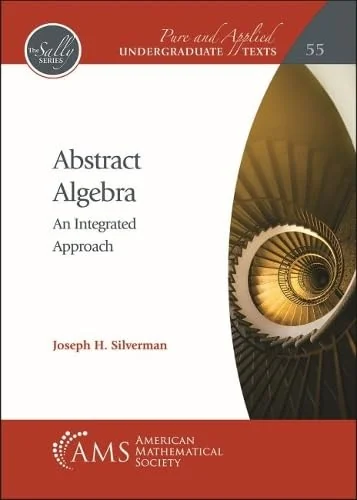
- By Joseph H. Silverman
- Best for: students who want concrete applications alongside structure
- Level: Undergraduate proofs
- Main strength: Uses number theory and geometry to motivate groups, rings, fields, and related ideas.
- Watch-out: Its distinctive route may not align with every department's syllabus.
- Verify the exact edition, format, and seller
Best short course: Abstract Algebra: A First Course
Dan Saracino’s Abstract Algebra: A First Course is one of the most concise readable routes into the subject. It balances definitions, examples and proofs without rushing into graduate-level generality.
It goes less deep than Dummit and Foote, and for a one-semester course that is the point. My suggestion is to choose it when you want a concise text you will actually finish.
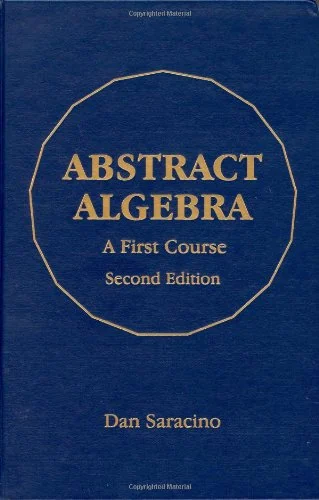
Abstract Algebra: A First Course
- By Dan Saracino
- Best for: students who want a readable bridge into abstraction
- Level: Introduction to proofs
- Main strength: Balances definitions, examples, proofs, and exercises without rushing into graduate-level generality.
- Watch-out: It offers less encyclopedic depth than Dummit and Foote.
- Verify the exact edition, format, and seller
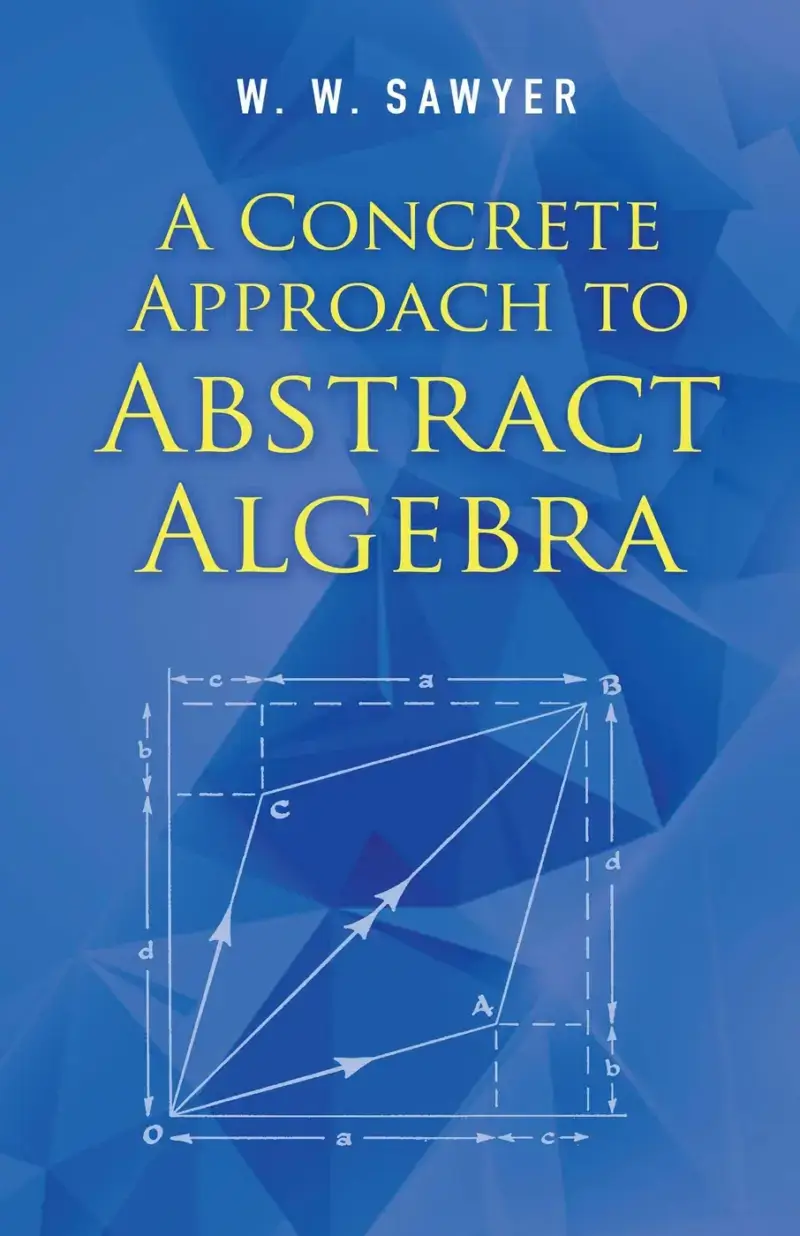
Best concrete warm-up: A Concrete Approach to Abstract Algebra
W. W. Sawyer’s A Concrete Approach to Abstract Algebra builds the big ideas from arithmetic, polynomials and number systems you already know. It first appeared in 1959, and Dover keeps it in print cheaply.
It works as a warm-up and doesn’t cover a full course. I’d read it in the weeks before your course starts if abstraction makes you nervous.
A Concrete Approach to Abstract Algebra
- By Author or maker shown on the exact listing
- Best for: learners who need computation before generalization
- Level: College algebra and proof basics
- Main strength: Motivates abstract structures through explicit arithmetic, symmetry, and worked examples.
- Watch-out: Readers preparing for graduate algebra will eventually need a deeper reference.
- Verify the exact edition, format, and seller
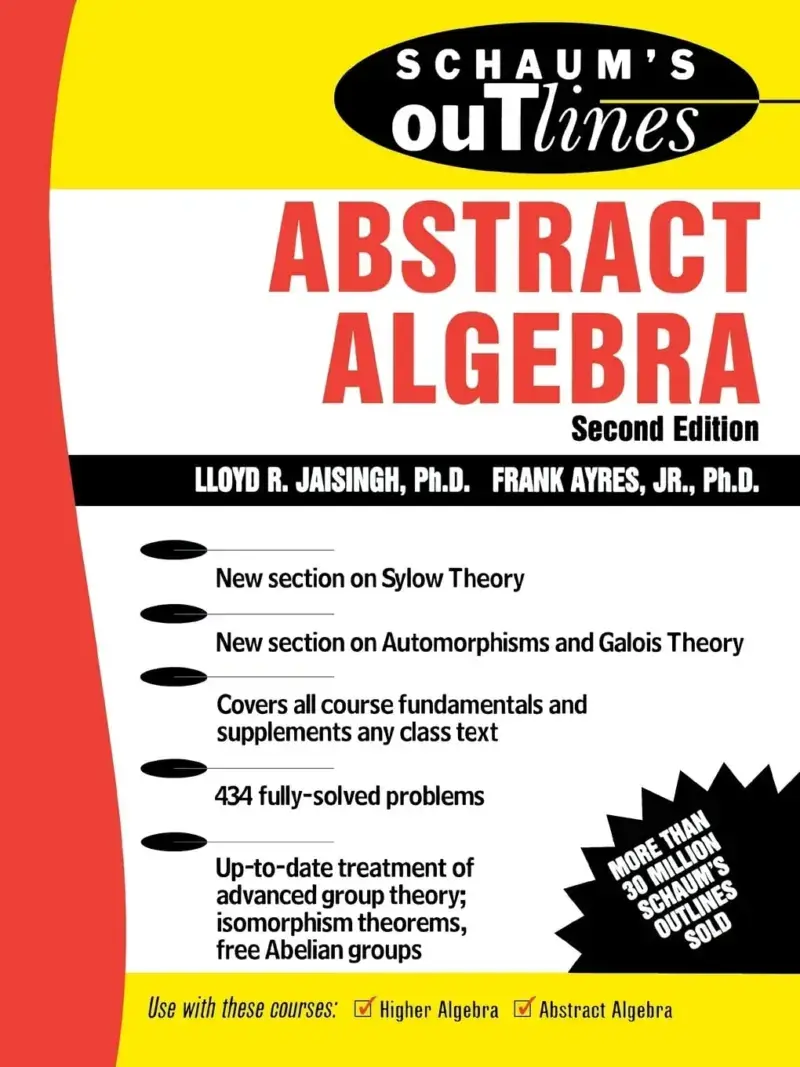
Best for extra practice: Schaum’s Outline of Abstract Algebra
Schaum’s Outline of Abstract Algebra by Frank Ayres and Lloyd Jaisingh gives you short summaries and a large set of fully solved problems.
It assumes a main textbook. My advice is to use it next to your course text, never instead of it, because solved problems can show you a method but can’t teach you the ideas.
For CSIR NET and IIT JAM, where group theory questions come fast and in familiar shapes, this is the book I’d keep on the desk.
Schaum's Outline of Abstract Algebra
- By Author or maker shown on the exact listing
- Best for: students who need solved exercises and exam review
- Level: Concurrent abstract algebra course
- Main strength: Provides concise summaries and a large collection of worked problems.
- Watch-out: It is a supplement and does not develop the subject as coherently as a full text.
- Verify the exact edition, format, and seller
Free Abstract Algebra Books
You can study a full first course without paying. If I had no budget, I’d pick one resource, Judson’s free textbook, because it is a complete course with exercises. The other one below is an alternative for a specific need.
- Abstract Algebra: Theory and Applications: Thomas Judson’s complete open textbook, with an HTML edition, a Runestone edition with working Sage cells and an optional print copy.
- LibreTexts Abstract and Geometric Algebra: free books and modules on groups, rings and fields, useful when you want a second explanation of one topic.
Only 1 of my 10 picks is free this way, which is a smaller free shelf than linear algebra has. That is why a cheap Dover title like Pinter is often the smarter first purchase.
How to Choose an Abstract Algebra Book
I’d start with your proof experience and then look at how many worked examples the book gives you. Those 2 questions settle the choice faster than any bestseller rank.
In abstract algebra, the definitions are short. Using them well is the real work.
Have You Written Proofs Before?
Abstract algebra is often the first course where nearly every homework problem is a proof. If you’ve taken an introduction to proofs, any book on this list will work. If you haven’t, Pinter is the safer start, because it eases you into proofs one exercise set at a time.
Writing a proof that someone else can follow is its own skill. I wrote How to Write Mathematics for exactly this stage, and it covers how to set out a readable proof and a clean problem-set solution.
Does the Book Show Enough Examples?
A definition sticks once you’ve checked it on a few small groups you can write out by hand, such as the integers mod 6 and the symmetries of a square. A book that gives you those examples right after each definition does half the teaching for you.
Before you buy, it is wise to open a sample chapter and see how often an example follows a definition. Pinter, Gallian and Sawyer do this best on this list.
Is the Book Set by Your Course?
If your course names a book, I recommend buying that book, including the edition. Exercise numbers shift between editions, and a mismatched copy turns every assignment into a search.
In India, many B.Sc. and M.Sc. syllabi list older or Indian textbooks such as:
- I. N. Herstein’s Topics in Algebra
- Bhattacharya, Jain and Nagpaul’s Basic Abstract Algebra
- Khanna and Bhambri’s A Course in Abstract Algebra
If your exam follows that syllabus, my suggestion is to read the listed book for its notation and keep Pinter beside it for the explanations.
Books I’d Skip as a First Book
Some famous abstract algebra books are excellent and still the wrong place to start. These are the ones I’d keep for later:
- Herstein, Topics in Algebra: brilliant problems in a terse style written for strong students. I’d save it for the second pass, unless your syllabus requires it.
- Dummit and Foote as a first book: the same book I recommend for graduate school, for exactly that reason.
- Artin, Algebra: excellent and built around linear algebra and geometry, at an honors pace that assumes confidence with proofs.
- Lang’s Algebra and Hungerford’s Algebra: graduate texts that assume a full undergraduate course.
- A new edition at full price: if your course doesn’t assign numbered exercises from it, an older Gallian or Fraleigh teaches the same core for much less.
How I’d Study Abstract Algebra
One main book plus one free resource is enough, and it is wise to finish that book before opening the next. Reading 3 introductions at once feels productive, but it delays the part that actually teaches you, which is writing proofs.
The habit I’d build from day one is testing every new definition on small examples before you try to prove anything about it. A theorem about groups makes sense much faster once you’ve seen it hold in the integers mod 6.
For a First Course
This is the order I’d follow:
- Pinter, or your course’s assigned textbook, one chapter at a time.
- Every exercise attempted on paper before you look up a solution.
- Schaum’s, only if your exams need more solved problems than your textbook gives you.
- A weekly redo of the proofs you got wrong, in place of reading new pages.
For CSIR NET and IIT JAM
For exam preparation, I recommend this order:
- A full first course with your university textbook, so the definitions are solid.
- Schaum’s for speed on standard group theory and ring theory problems.
- Timed past papers, once the first 2 steps are done.
For Graduate School
For the road to a master’s or PhD, this is the order that makes sense to me:
- A first course with Pinter, if you haven’t had one.
- Dummit and Foote, chapter by chapter, through modules and Galois theory.
- Artin’s Algebra in place of Dummit and Foote, if your program leans on linear algebra and geometry.
Abstract algebra leans on the courses around it. If matrices still feel shaky, I’d start with my linear algebra book picks. For the other proof-heavy course most math majors take alongside it, my real analysis books are the next step.
FAQs on Abstract Algebra Books
What are the best abstract algebra books?
My top pick for a first course is Charles Pinter’s A Book of Abstract Algebra. Gallian’s Contemporary Abstract Algebra is the standard course textbook, and Dummit and Foote’s Abstract Algebra is the best reference for graduate school. Judson’s Abstract Algebra: Theory and Applications is the best free option.
Which abstract algebra book is best for beginners?
I’d start with Pinter’s A Book of Abstract Algebra, because it explains every idea with examples before the proofs and costs a fraction of a standard textbook. If you need a free alternative, Judson’s Abstract Algebra: Theory and Applications covers the same first course.
Is Dummit and Foote good for beginners?
Not for most beginners. It is a dense graduate-level reference, and it works best once you have finished a first course. My recommendation is to start with Pinter and move to Dummit and Foote in your final undergraduate year.
Is Herstein’s Topics in Algebra good for a first course?
It is an excellent book with brilliant problems, but it is terse and written for strong students. Unless your syllabus requires it, I’d read Pinter first and keep Herstein for the second pass.
Are there free abstract algebra books?
Yes. Thomas Judson’s Abstract Algebra: Theory and Applications is a complete open textbook with an online edition and Sage exercises. LibreTexts also hosts free books and modules on groups, rings and fields.
Do I need linear algebra before abstract algebra?
It helps a lot. Many first courses use matrices as examples of groups and rings. So I’d finish a first linear algebra course before abstract algebra, or at least take the 2 in the same semester.
Can I learn abstract algebra on my own?
Yes, if you have a way to check your proofs. I’d use Pinter, whose exercises build in small steps from routine checks to real proofs. When a proof feels shaky, posting it on Math Stack Exchange is a good way to get it checked.
Final Remarks
If your course starts this week, I’d get Pinter and work through the first chapter’s exercises before your first class. If your course assigns its own textbook, that one comes first.
Either way, my advice is to buy one book and finish it. Abstract algebra rewards the student who writes proofs every week, and no shelf of books can do that part for you.
Best of luck.
Tell Google you want more of this.
Add Gaurav Tiwari as a preferred sourceOne tap, and this site shows up more often in your own Top Stories, AI Overviews and AI Mode. Remove it any time.
Disclaimer: This site is reader-supported. If you buy through some links, I may earn a small commission at no extra cost to you. I only recommend tools I trust and would use myself. Your support helps keep gauravtiwari.org free and focused on real-world advice. Thanks. - Gaurav Tiwari