
 by
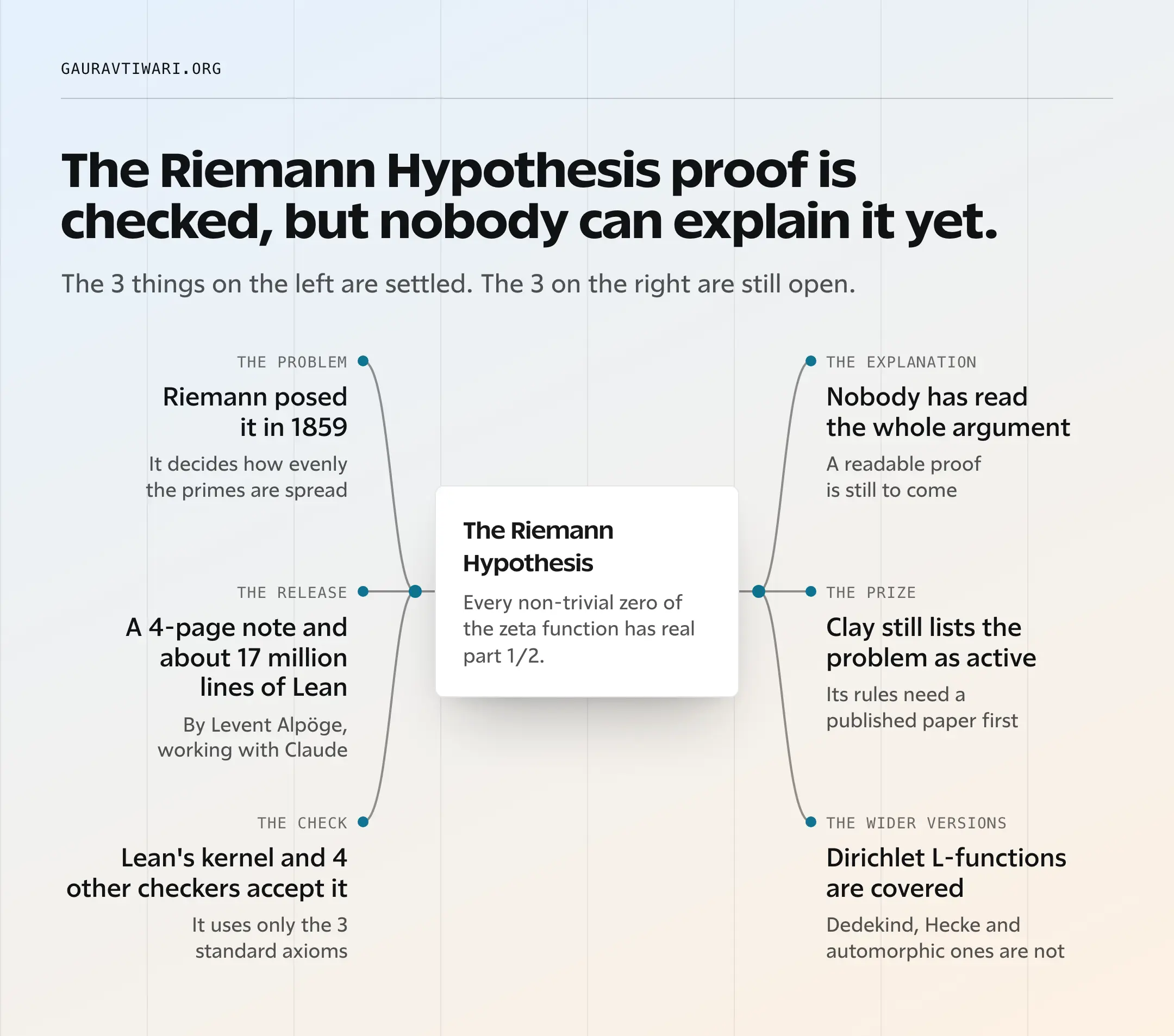
The Riemann Hypothesis proof that Levent Alpöge released on November 20, 2026 has been checked, and it holds. It’s about 17 million lines of code in the Lean proof language, written with Anthropic’s Claude, and independent checkers on separate machines have accepted every step.
What’s missing is everything else a proof is supposed to give you. No person has read the whole argument, nobody can yet explain in ordinary mathematics why it works, and the Clay Mathematics Institute still lists the problem as open. The 167-year-old question has an answer, and the explanation hasn’t arrived.
I’ve written about a “solved” Riemann Hypothesis before. In June 2021, Indian newspapers reported that a Hyderabad physicist had cracked it, and I wrote that he hadn’t. This claim is a different kind of object, and you can see the difference without reading a line of Lean.
Before the proof, I want to ensure the statement itself is clear, because everything after it depends on that one sentence.
What the Riemann Hypothesis Says
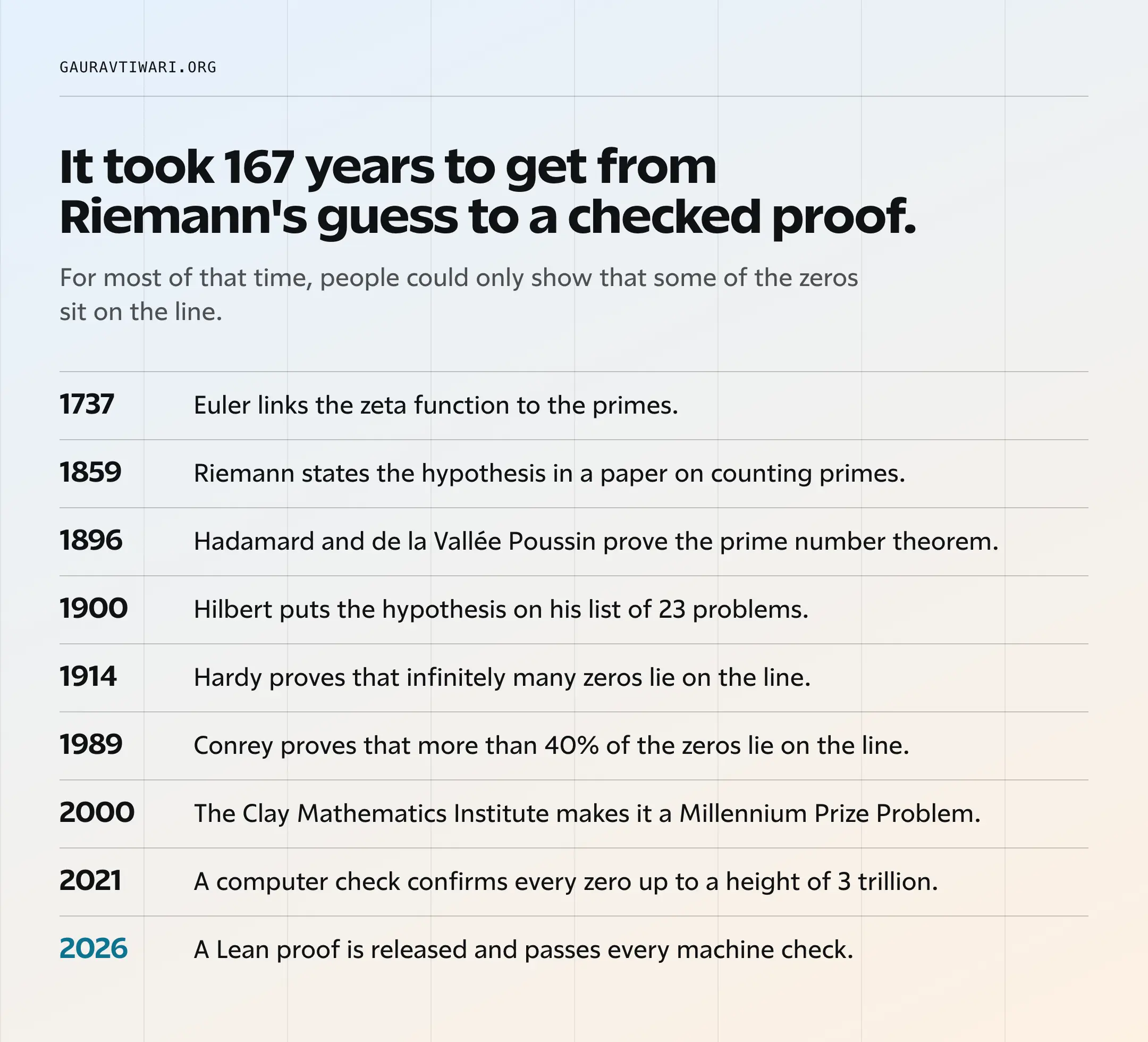
The Riemann Hypothesis says that every non-trivial zero of the Riemann zeta function has real part exactly 1/2. Bernhard Riemann proposed it in an 1859 paper on counting prime numbers, and nobody could prove it for 167 years.
A complex number has 2 parts, a real part and an imaginary part, and you can plot it as a point on a plane. The hypothesis is a claim about where certain special points sit on that plane.
The problem has been on the most famous lists in mathematics for over a century. David Hilbert put it among his 23 problems in 1900. In 2000 the Clay Mathematics Institute made it one of its 7 Millennium Prize Problems, each worth $1 million.
The zeta function starts as a simple infinite sum:
$$\zeta(s) = \sum_{n=1}^{\infty} \frac{1}{n^s} = 1 + \frac{1}{2^s} + \frac{1}{3^s} + \cdots$$
That sum only makes sense when the real part of \(s\) is bigger than 1, but the function extends to the rest of the complex plane. A zero is a value of \(s\) where \(\zeta(s) = 0\).
Extending a function this way is called analytic continuation, and there is only one way to do it. So the zeros far from the original sum are fixed by the function, and nobody gets to choose them. The one point left out is \(s = 1\), where the function is not defined, and that is why the Lean statement further down mentions 1.
The zeros at −2, −4, −6 and so on are easy to find and are called trivial. Every other zero lies in the critical strip, where the real part is between 0 and 1. Riemann’s guess was that they all sit on one vertical line down the middle of it.
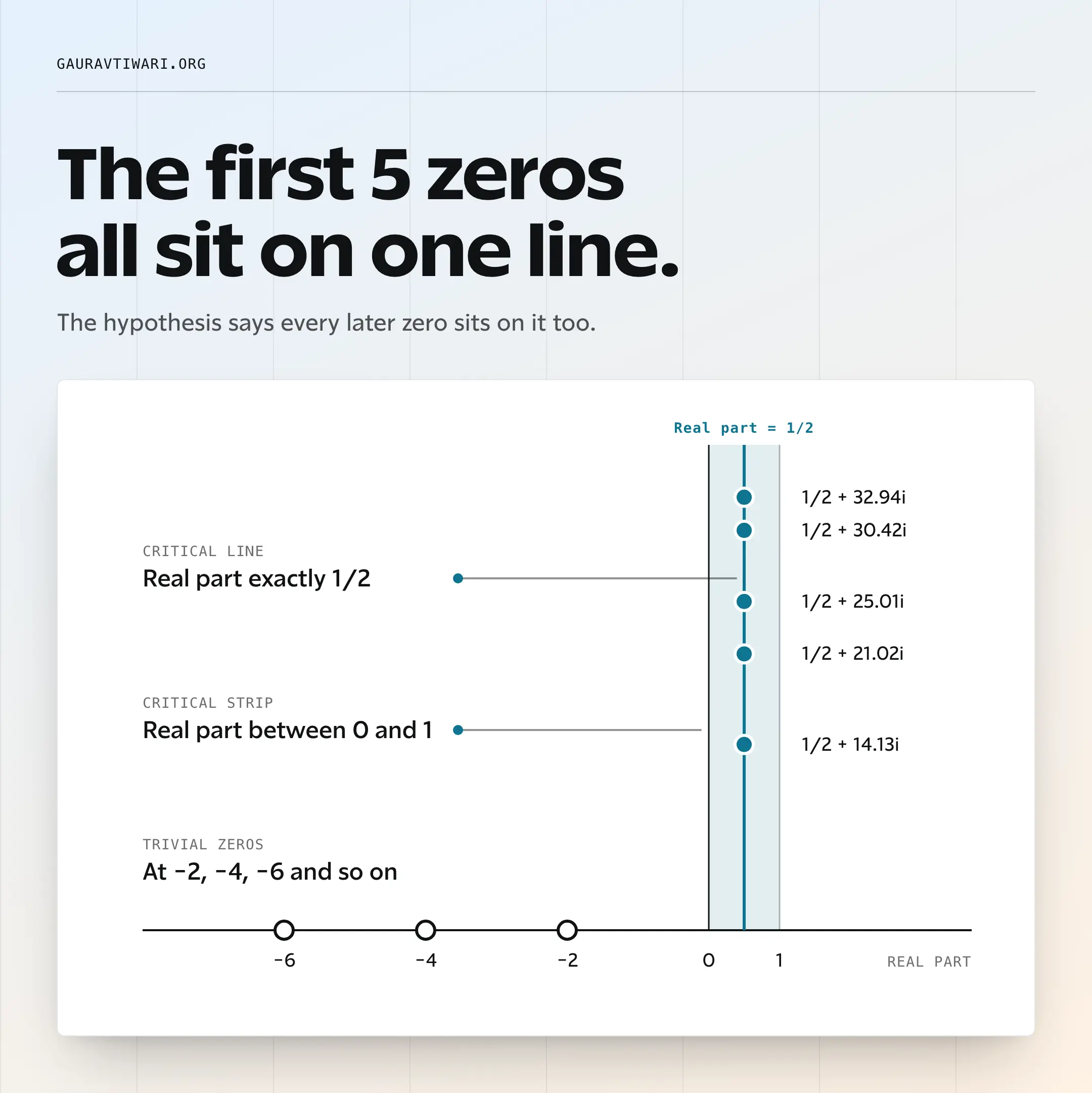
The first zero sits at about \(1/2 + 14.135i\), the next at \(1/2 + 21.022i\) and the third at \(1/2 + 25.011i\). They come in mirror pairs above and below the horizontal axis, and they crowd closer together the higher you go.
Why Primes Appear in the Zeta Function
Nothing in that sum mentions primes, so the link needs one more step. Leonhard Euler found it in 1737, more than a century before Riemann:
$$\zeta(s) = \prod_{p \text{ prime}} \frac{1}{1 – p^{-s}}$$
The left side adds over every whole number, and the right side multiplies over every prime. The two agree because every whole number factors into primes in exactly one way.
A small check shows it working. At \(s = 2\) the sum equals \(\pi^2/6\), which is about 1.645. The product over only the first 4 primes, 2, 3, 5 and 7, already gives about 1.595.
So the zeta function stores the primes in another form. Riemann’s idea in 1859 was to let \(s\) be a complex number and read the primes off the function’s zeros.
What the Zeros Tell You About Primes
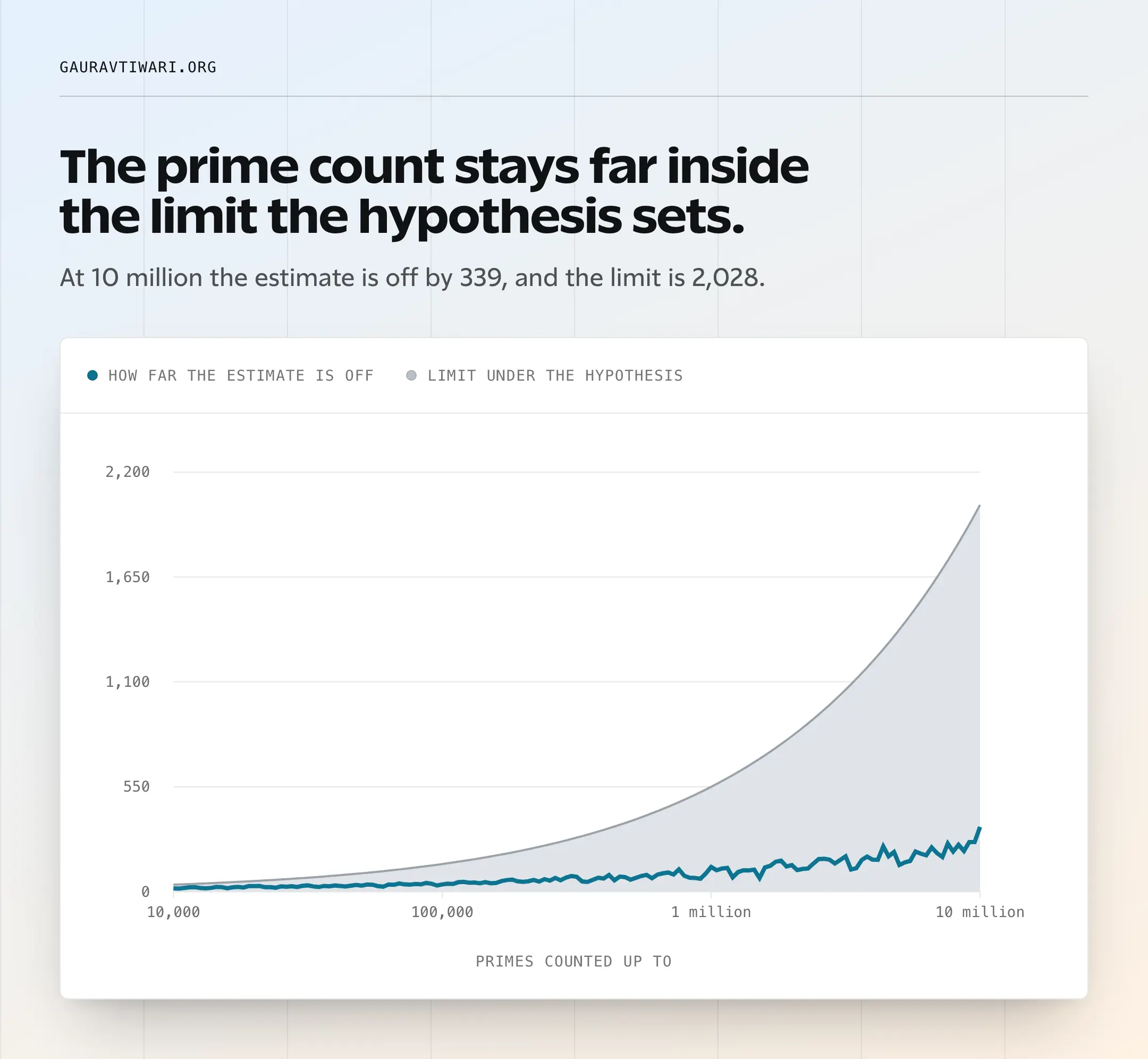
The zeros control how far the primes stray from their expected count. The primes below 1 million show it: there are 78,498 of them, and the standard estimate, the logarithmic integral, predicts about 78,628. The estimate is off by about 130.
The estimate is much older than the hypothesis. Gauss guessed it as a teenager in the 1790s, and in 1896 Jacques Hadamard and Charles-Jean de la Vallée Poussin proved that it is right in proportion. That result is the prime number theorem.
Their proof needed only one fact about the zeros: none of them has real part exactly 1. The Riemann Hypothesis pushes every zero as far from that edge as it can go, and the error shrinks with it.
The Riemann Hypothesis is equivalent to a guarantee on that error. In the form Lowell Schoenfeld proved in 1976, it says that for every \(x \ge 2657\):
$$|\pi(x) – \operatorname{li}(x)| < \frac{1}{8\pi}\sqrt{x}\,\ln x$$
At 1 million the right side is about 550, so the real error of 130 fits with room to spare. Without the hypothesis, nobody could promise an error anywhere near that small.
The same pattern holds as the numbers grow:
| Up to | Actual number of primes | Estimate | Gap | Limit under the hypothesis |
|---|---|---|---|---|
| 10,000 | 1,229 | 1,246 | 17 | 37 |
| 1 million | 78,498 | 78,628 | 130 | 550 |
| 100 million | 5,761,455 | 5,762,209 | 754 | 7,329 |
| 1 billion | 50,847,534 | 50,849,235 | 1,701 | 26,075 |
The gap grows slowly and the limit grows much faster, so the primes stay well inside it. The square root in the limit is the size of error you’d expect from tossing a fair coin \(x\) times. That is why people say the primes behave like a random sequence once the hypothesis holds.
That’s one reason a clean formula for the primes has been so hard to pin down. It is also why hundreds of results were proved only on the assumption that the hypothesis is true.
Before this month the evidence was strong, but it wasn’t a proof. G. H. Hardy showed in 1914 that infinitely many zeros lie on the line.
Later results narrowed the gap without closing it:
- 1942: Atle Selberg proved that a positive share of all the zeros lie on the line.
- 1974: Norman Levinson raised that share to more than a third.
- 1989: Brian Conrey raised it to more than 40%.
In 2021 Dave Platt and Tim Trudgian verified by computer that every zero up to a height of 3 trillion does. Infinitely many zeros were still unchecked.
Numerical evidence has misled people in this area before. In every prime count ever computed, the estimate sits above the true count, as it does in the table. J. E. Littlewood proved in 1914 that the order flips infinitely often.
The first known flip is near \(10^{316}\), far beyond anything a computer can count to. So 3 trillion checked zeros were strong evidence and still not a proof.
What Alpöge and Claude Released
Alpöge released a 4-page note and a Lean library of about 17 million lines spread over 175,187 files. He didn’t release a conventional paper.
Alpöge is a number theorist on leave from Harvard who works at Anthropic, according to Nature. His note makes the claim in one line: “I believe I have, working with Claude, discovered a proof of the Riemann Hypothesis.”
Its timeline has 20 entries. The first, dated October 6, is “Stepanov determinant” and the last is “11/16/26: GRH”, so the listed work spans about 6 weeks.
The note is frank about who did what. Alpöge chose the route, an argument descended from Sergei Stepanov’s proof of the matching result over function fields, and steered toward the right setting. Then, in his words, “Claude far outpaced me near the finish line.”
He adds that in some parts “Claude is the expert and not me”, and that for those parts he is paraphrasing a summary.
The phrase “function fields” needs a word of explanation. Mathematicians have long studied a parallel version of the Riemann Hypothesis, in which polynomials over a finite number system play the role of whole numbers. André Weil proved that version in the 1940s.
Stepanov found a more elementary proof of it starting in 1969, and that is the argument Alpöge’s note names as the ancestor of this one. For decades the hard part was carrying any of those ideas back to ordinary whole numbers.
Lean is a proof assistant: a programming language in which a proof is a program, and a small trusted core called the kernel checks every logical step. Here is the whole claim, as it appears in Mathlib, the community-maintained library of mathematics for Lean:
def RiemannHypothesis : Prop :=
  ∀ (s : ℂ) (_ : riemannZeta s = 0) (_ : ¬∃ n : ℕ, s = -2 * (n + 1)) (_ : s ≠ 1), s.re = 1 / 2
It reads as: for every complex number s, if zeta of s is zero, and s isn’t one of the trivial zeros, and s isn’t 1, then the real part of s is 1/2. Those 2 lines are the statement, and the other 17 million lines are the proof.
Each piece of the statement does one job:
riemannZeta s = 0says that s is a zero.¬∃ n : ℕ, s = -2 * (n + 1)rules out the trivial zeros at −2, −4, −6 and so on, because n runs over 0, 1, 2 and upward.s ≠ 1rules out the one point where the zeta function is not defined.s.re = 1 / 2is the conclusion: the real part is 1/2.
What “GRH” covers here. The library proves the same result for every Dirichlet L-function, which is the usual meaning of the Generalized Riemann Hypothesis. Andrew Sutherland’s verification page at MIT marks the limit: Dedekind zeta functions, Hecke L-functions and automorphic L-functions are not among the statements that were checked.
How a Proof Nobody Has Read Was Verified
The proof was verified by answering 4 questions about the code, and none of them requires understanding the mathematics. Kevin Buzzard of Imperial College London set the 4 questions out on November 12, 8 days before Alpöge’s release, as the test any AI-written Lean proof should pass.
The first question is the one people skip. Buzzard’s example is a piece of Lean that looks like Fermat’s Last Theorem:
def FermatsLastTheorem : Prop :=
  ∀ a b c n : ℕ, n ≥ 3 → a^n + b^n ≠ c^n
The statement compiles, and it’s false. In Lean the natural numbers include 0, so a = b = c = 0 breaks it.
A false statement can’t be proved, but a slightly different or weaker one can, and a machine will check that proof perfectly while it checks the wrong sentence. That’s why “it compiles” was never enough.

| Question | What the checkers found |
|---|---|
| Is the Lean statement the real conjecture? | The theorem proved is Mathlib’s existing definition of the Riemann Hypothesis, which Lean and number theory experts had vetted. |
| Does the code compile? | Dozens of people reported that the code compiles. At MIT, a rebuild on a separate machine with no network access reproduced the 61.6 GB proof export byte for byte. |
| Does it prove exactly that statement? | 2 independent comparison tools matched the proved theorem to Mathlib’s statement. The proof uses only Lean’s 3 standard axioms. |
| Is it exploiting a bug in Lean? | Lean’s own kernel and 4 other checkers accept the proof. 2 of those come with a formal proof that they can’t accept a false one. |
Question 2 has a catch, and the axiom check covers it. Lean lets an author write sorry in place of a missing proof, and the file still compiles with a warning. Every use of it shows up as an extra axiom, so a proof that uses only the 3 standard axioms has no gaps left in it.
The 3 axioms are called propext, Classical.choice and Quot.sound. Almost all of Mathlib uses them, and they match assumptions that ordinary mathematics makes without comment.
Sutherland’s page lists the checkers that ran besides Lean’s own kernel:
- nanoda
- con-leche
- con-ron, a Rust port of con-leche
- lean4lean, which ran on the compiled modules
Anyone can repeat the check. The page says it takes roughly 100 GB of RAM and 70 GB of disk.
On November 21 the Lean FRO and the Mathlib Initiative published a joint statement. These are the organizations that back Lean and Mathlib, and they wrote: “We hereby certify that both the statement and the proof of the Riemann Hypothesis are correct.” Sutherland told Scientific American that “the chance that anything is fishy here is approximately zero.”
This is a stricter test of correctness than peer review. A referee can read a paper for months and still miss a gap on page 200.
Here several programs checked every inference. Different people wrote them, some in different programming languages, and they’d all need the same undiscovered bug for a false step to get through.
It is the same idea as asking several accountants who have never met to add up the same ledger. One of them can slip, but all of them slipping on the same line in the same way is far less likely.
What You’re Still Trusting
You’re trusting that the checkers are sound and that Mathlib’s definitions mean what mathematicians intend. Sutherland’s page says so in its caveats. The second is the softer spot, because a definition can’t be machine-checked against an idea in someone’s head.
There’s a neat test of that. Sutherland’s page reports that the proof was combined with an independent Lean formalization of a 1984 theorem by Guy Robin.
That theorem shows that the Riemann Hypothesis is equivalent to a statement about ordinary whole numbers. The zeta function drops out, and what’s left is this: for every \(n > 5040\),
$$\sigma(n) < e^{\gamma}\, n \ln \ln n$$
Here \(\sigma(n)\) is the sum of the divisors of \(n\) and \(\gamma\) is Euler’s constant. You can try it on a calculator.
At 5040 the divisors add up to 19,344 and the right side is about 19,237, so 5040 fails. It’s the last number that does, and that fact now has a machine-checked proof.
Only 27 whole numbers fail this inequality. The smallest is 2 and the largest is 5040, and the Riemann Hypothesis is exactly the claim that there is no 28th.
The next round number shows how close it runs. For 10,080, which is twice 5040, the divisors add up to 39,312 against a limit of about 39,878, so it passes.
The check still leans on Mathlib’s definitions of divisor sums and logarithms, which are far simpler objects than the zeta function.
One end-to-end run on a later Lean version was still in progress on Sutherland’s page on November 24. Every check that had finished had passed.
Why This Claim Is Different From 2021
The 2021 claim failed the ordinary test of a proof, and the 2026 claim passed a stricter one. Putting them side by side shows what to look for the next time a headline says a famous problem is solved.
| What to compare | 2021: K. Eswaran | 2026: Alpöge and Claude |
|---|---|---|
| What was published | A paper posted on ResearchGate | Lean code and a 4-page note |
| Who could check it | Readers working through the argument by hand | Anyone with about 100 GB of RAM, by running a checker |
| What checking found | Flaws, first pointed out in 2018 | No errors across several independent checkers |
| How the news spread | Newspaper reports, including a false claim that the Clay prize had been approved | A public release that outsiders verified within a day |
| Clay’s status for the problem | Unsolved | Still listed as active |
The useful habit is to ask what was released and who can check it. A PDF with a press report asks you to trust the author. Code that strangers can run and check asks for much less.
Failed claims are common for this problem, and a famous name has never been enough. Michael Atiyah, a Fields Medal winner, presented a proof at a conference in 2018, and mathematicians did not accept it. What settles a claim is whether other people can check the argument.
Why “Verified” Doesn’t Mean “Understood”
Lean tells you the theorem is true. It doesn’t tell you why, and the why is what mathematicians wanted from this problem.
At the minute, we don’t even know why the theorem is true. It’s 17 million lines of Lean code, and this might correspond to tens of thousands of pages of mathematics.
Kevin Buzzard, speaking to Al Jazeera
Buzzard also said nobody yet knows how much of the code is new ideas and how much is standard material the machine had to build along the way. He expects the people translating the Lean back into English to have “a much better understanding” within a week or two.
That work has started. Michael Rubinstein at the University of Waterloo posted a working guide to the argument. Its first version ran to 164 pages, and the second, a day later, ran to 265.
It reduces the Riemann Hypothesis to 1 main inequality and 13 numbered hypotheses, none of which it proves outright, and it says which inputs it takes from the Lean code.
Alpöge is in the same position as his readers. He wrote that he’s “presenting the world with a complete argument before having mastered a massive neighbourhood around its mathematics”, and that his intuition says the proof “will be massively simplified”.
Mathematics has been here before on a smaller scale. Kenneth Appel and Wolfgang Haken proved the four color theorem in 1976 with a computer working through nearly 2,000 cases. Mathematicians accepted the result, and many stayed uneasy that no person could check it by hand.
The difference this time is that the machine also helped find the argument.
Machine-checked proofs of famous theorems are not new either:
- 2005: Georges Gonthier finished a formal proof of the four color theorem in the Coq proof assistant.
- 2014: The Flyspeck project finished a formal proof of the Kepler conjecture on stacking spheres, which Thomas Hales had proved in 1998.
- 2022: The Liquid Tensor Experiment verified a hard theorem of Peter Scholze in Lean.
In each of those, people understood the proof first and the computer confirmed it afterward. This time the order is reversed, and the understanding has to catch up with the checking.
Why does the explanation matter when the answer is known? Because mathematicians reuse the method far more than the result. Andrew Wiles’s proof of Fermat’s Last Theorem mattered less for the theorem than for the tools it built, which are still in use today.
The 250,000 Pages, the “Garbage” Code and the Hype
4 things spread on X faster than the facts did: the length of the proof, a quote about garbage, the timing and the word superintelligence. Each needs a correction or some context.
The 250,000 pages were a joke. The number comes from a footnote in Alpöge’s note: “I of course amused myself, and hit 250,000+ pages.” New Scientist reported it as the length of the full proof.
3 days after the release he posted, “250,000+ pages was a joke guys!” Buzzard’s tens of thousands of pages is the better estimate, and Alpöge expects the final argument to be much shorter.
“Garbage” described the code’s style. In the same post he wrote, “The Lean is full of garbage obviously, but compiles”. Some readers took that as an admission that the proof is broken, and he replied: “It literally checked out days ago?”
Messy, redundant code and a valid proof can be the same file. The kernel checks logic and has no opinion on tidiness.
The timing drew fair criticism. The release came days after Anthropic’s IPO. Number theorist Andrew Granville told Nature that the note was “garbled” and tied its timing to the company’s falling share price.
Alpöge’s note answers that “there is an obvious cynical view, to do with the timing, but it is false”. The release was rough, as he has said himself, and the proof still checks.
“Superintelligence” is a bigger claim than the evidence. Elon Musk called the proof “yet another mind-blowing thing achieved by super intelligence”. Yann LeCun compared such reactions to the people who said in 1997, when a computer beat Kasparov at chess, that superintelligence had arrived.
What the record shows is narrower: a specialist who had been preparing for this problem since his student days, working with a model for 6 weeks. Abhishek Saha of Queen Mary University of London told Al Jazeera that others with similar access to frontier models “were not able to come up with a proof”.
What Is Still Open
The correctness of the Lean proof is settled. The readable proof, the prize, a rival claim and the stronger forms of the conjecture are not.
- A proof people can read. Alpöge says he intends “to write it properly”. Until he does, guides like Rubinstein’s are the only way in.
- The $1 million prize. Clay’s problem page still shows the Riemann Hypothesis as active. Its rules ask for publication in a qualifying outlet, a 2-year wait after that and general acceptance by mathematicians, and no paper has been published yet. For scale, Grigori Perelman posted his proof of the Poincaré conjecture in 2002 and 2003, and Clay announced that prize in 2010.
- The human proof. Hours after Alpöge’s release, Stanford’s Ravi Vakil posted a draft by Alessandro Maria Masullo, a proposed proof of the Generalized Riemann Hypothesis with no AI involved. About 8 hours later Vakil reported that several people had found problems in it. His post says the problems were found with the help of AI models. Those problems are unresolved.
- The bigger versions. The checked statements stop at Dirichlet L-functions, which track primes by the remainder they leave after division. Buzzard described the Riemann Hypothesis as “at the foot of a mountain”, with the extended and grand versions higher up.
One more claim deserves the same 4 questions. On November 23 Anthropic posted a Lean proof that VP ≠ VNP, found by an internal Claude model. The question is an algebraic cousin of P vs NP that Leslie Valiant posed in 1979.
Its own README says “no human mathematician has checked the proof”, and it notes that no machine checks whether the statement file says what’s claimed. It also says, “This does not settle P vs NP.”
That’s question 1, still unanswered, so this result isn’t yet where the Riemann proof is.
What Changes for Students and Mathematicians
Results that depended on the hypothesis become unconditional, and reading a formal statement becomes a basic skill.
Many theorems were proved “assuming GRH”. Buzzard’s example is fast algorithms that “seem to work” and are known to work if the generalized hypothesis holds. The ones that rest on the Dirichlet case no longer carry that condition.
The best known example is Gary Miller’s primality test from 1976. It decides whether a number is prime in a number of steps that grows slowly with the size of the number. Its guarantee was proved only under the generalized hypothesis for Dirichlet L-functions.
Software won’t change, because programmers have used a randomized version called Miller-Rabin for decades. What changes is that the original guarantee no longer rests on an unproven assumption.
Nothing breaks in cryptography, because cryptographers had been assuming the hypothesis all along.
The job is shifting too. Saha expects “asking the right questions” and directing AI to matter more, and technical brilliance in building proofs to matter less.
Buzzard is more cheerful: “The rumours that maths is dead have been greatly exaggerated.” He compares AI to the telescope, a tool that let astronomers see more without replacing them.
My advice to a student is practical. I’d learn enough Lean to read a theorem statement, because trusting this proof started with checking that 2 lines of Lean said the right thing.
And when the next “AI solves X” headline arrives, I’d ask Buzzard’s 4 questions before sharing it. The VP ≠ VNP claim is a good one to practice on.
FAQs on the Riemann Hypothesis Proof
No. By Levent Alpöge’s own account, he chose the approach and steered it, and Claude did much of the technical work, especially near the end. He wrote that Claude “far outpaced” him near the finish line. The two also wrote the Lean code that records the proof.
No. Encryption such as RSA relies on problems like factoring large numbers being hard, and a proof of the hypothesis doesn’t make them easier. Cryptographers already assumed the hypothesis was true, so the proof confirms an assumption they were using.
Lean is a proof assistant, a programming language for writing mathematical proofs that a computer checks step by step. Mathlib is its main library of definitions and theorems, maintained by a community of mathematicians. When a Lean proof compiles, a small trusted program called the kernel has checked every logical step.
Levent Alpöge is a number theorist on leave from Harvard University who works at Anthropic, the company that makes Claude. He has also worked with Tristan Buckmaster on a separate project on the Navier-Stokes equation, according to Nature.
It is the function that adds up 1 divided by n to the power s over every whole number n, extended to complex values of s. Euler showed that the same function can be written as a product over the primes, which is why its zeros carry information about how the primes are spread.
No. The Clay Mathematics Institute still lists the problem as active. Its rules require publication in a qualifying outlet, at least 2 years after publication and general acceptance by mathematicians, and no paper has been published yet.
It makes the same claim for a larger family of functions called Dirichlet L-functions: every non-trivial zero has real part 1/2. The checked Lean library covers that family. It does not cover Dedekind zeta functions, Hecke L-functions or automorphic L-functions.
Tell Google you want more of this.
Add Gaurav Tiwari as a preferred sourceOne tap, and this site shows up more often in your own Top Stories, AI Overviews and AI Mode. Remove it any time.