Somebody told you your project might be publishable. It’s a nice thing to hear and a strange place to be left, with a result, a busy supervisor and no idea what happens next. This book takes you from a finished project to a submitted manuscript, through peer review and out the other side.
chapters in 5 parts, from the first claim to the published paper
6
toolkit appendices you can photocopy and fill in
12
figures for the parts of the process that are easier to see
1
worked study followed from first abstract to response letter
130
pages in the 6 × 9 edition, or 98 in A4
What This Book Helps You Do
The hard part isn’t the prose. It’s knowing that a paper is one claim rather than everything you did, that the venue is chosen before the writing starts, that the figures come first, and that the referee is a tired volunteer looking for a reason to stop reading.
Chapter 3
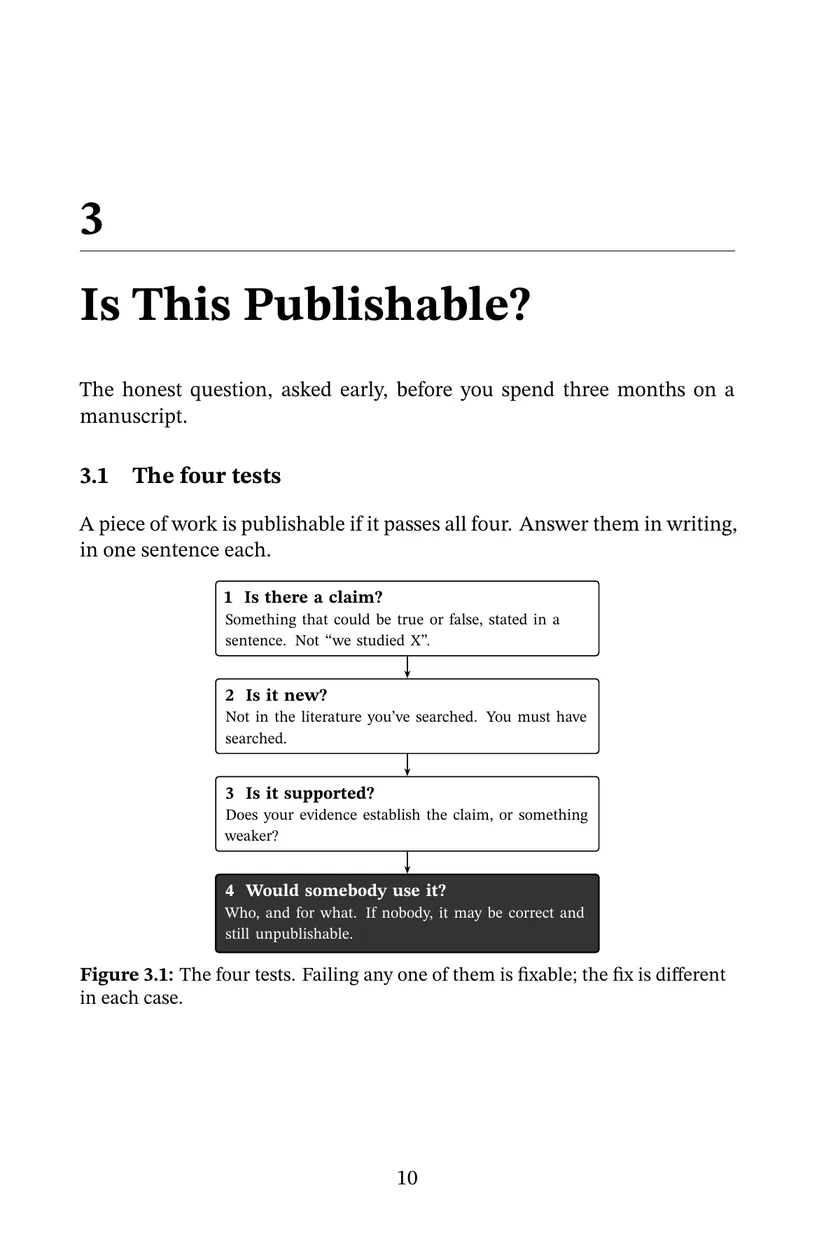
The four tests that tell you whether you have a paper yet
A claim, something new, evidence that supports it and a reader who would use it. Failing any one of them is fixable, and the chapter says how.
Chapter 4
Picking a venue from your own reference list, and spotting predatory ones
Your shortlist starts with the journals you already cite, sorted into three tiers, with the checks to run before you commit.
Chapters 7 and 8
The five-sentence abstract and the five-paragraph introduction
Two shapes that do most of the work, because the editor reads the title, the abstract and the introduction before anything else.
Chapter 9
Related work as a map of the field, not a list of papers
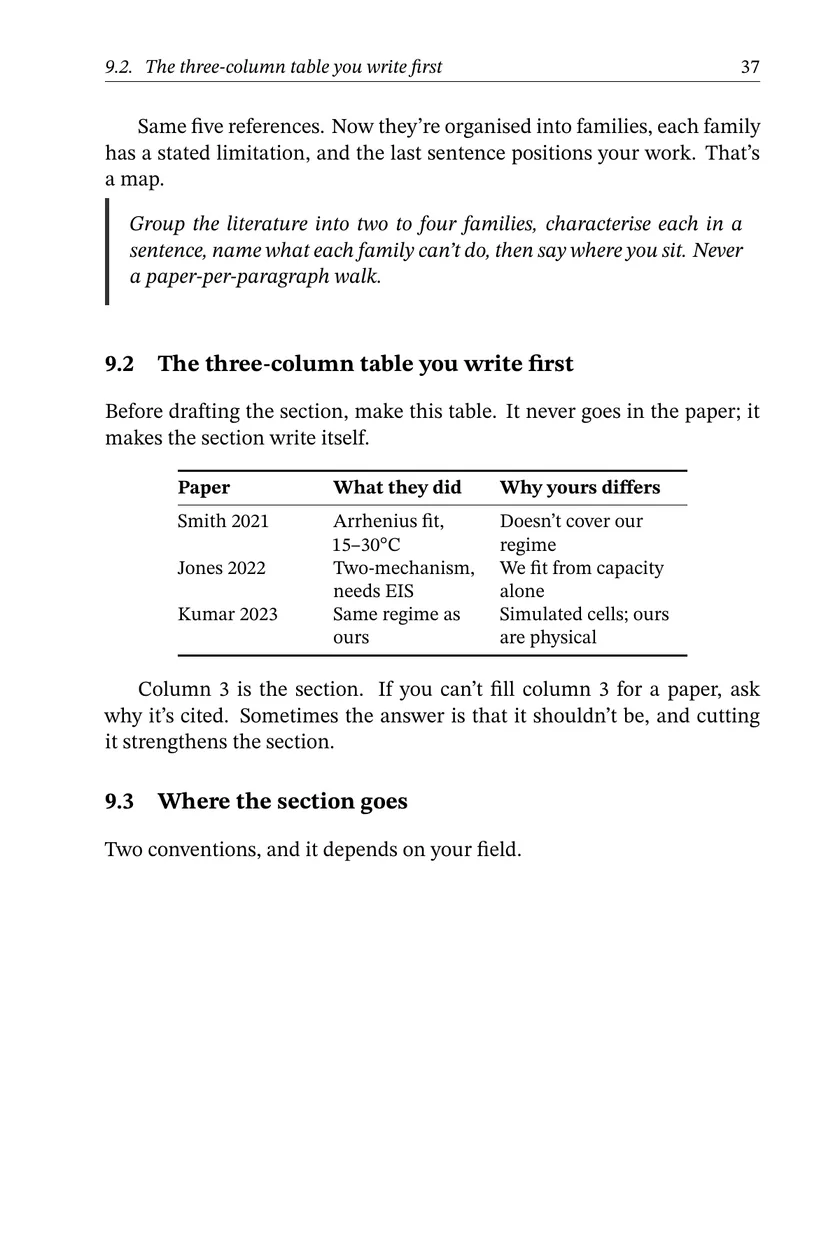
A three-column table you write first, so the section groups the literature into families and shows where your work sits.
Chapters 13 to 15
Authorship, data, and the honesty rules nobody spells out
How to have the author-order conversation, what a shareable repository holds and where the line sits on reuse and AI tools.
Chapters 18 to 20
What referees mean, and how to answer them without losing the argument
Every comment sorted into green, amber or red, then answered point by point in a letter the editor can check.
One invented study runs through the whole book: a lithium-ion cell cycling study whose Arrhenius fit fails above 35 °C. You see its abstract, introduction, related work, cover letter and response letter at each stage, so the advice always lands on the same paper.
Look Inside
These pages come from the 6 × 9 edition. You can open any of them at full size.
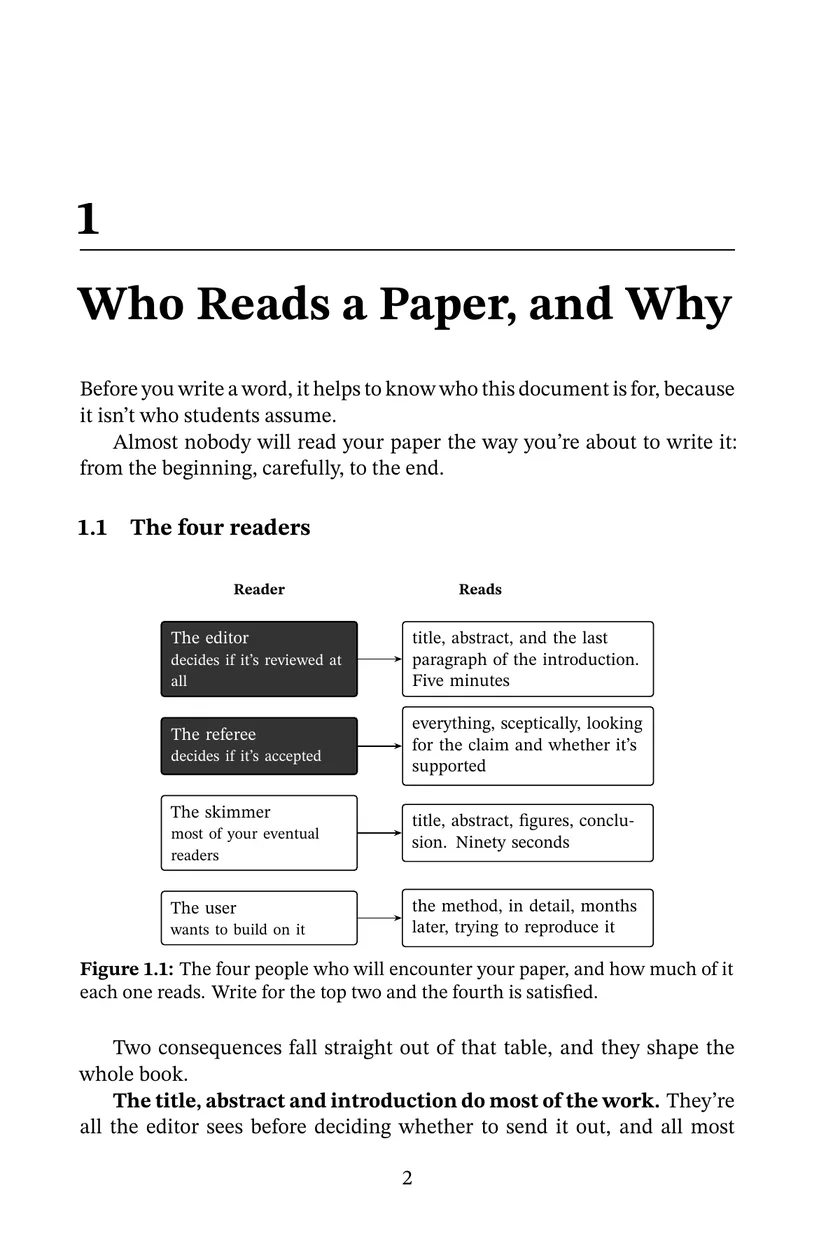
Chapter 1. The four people who will meet your paper, and how much of it each one actually reads.
Chapter 3. The four tests for whether you have a paper yet, drawn as one decision path.
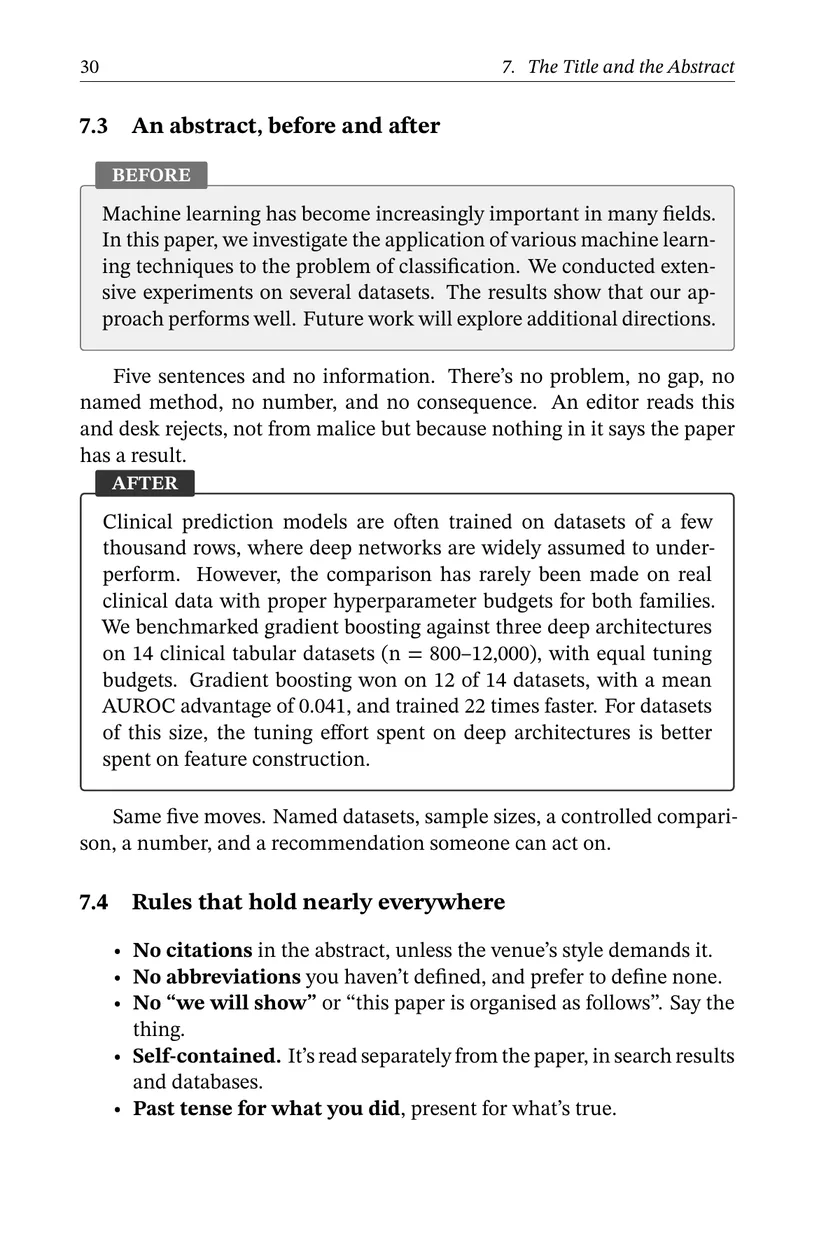
Chapter 7. One abstract before and after: five sentences with nothing in them, then five that carry a claim.
Chapter 9. The three-column table that turns related work into a map before you write a sentence.
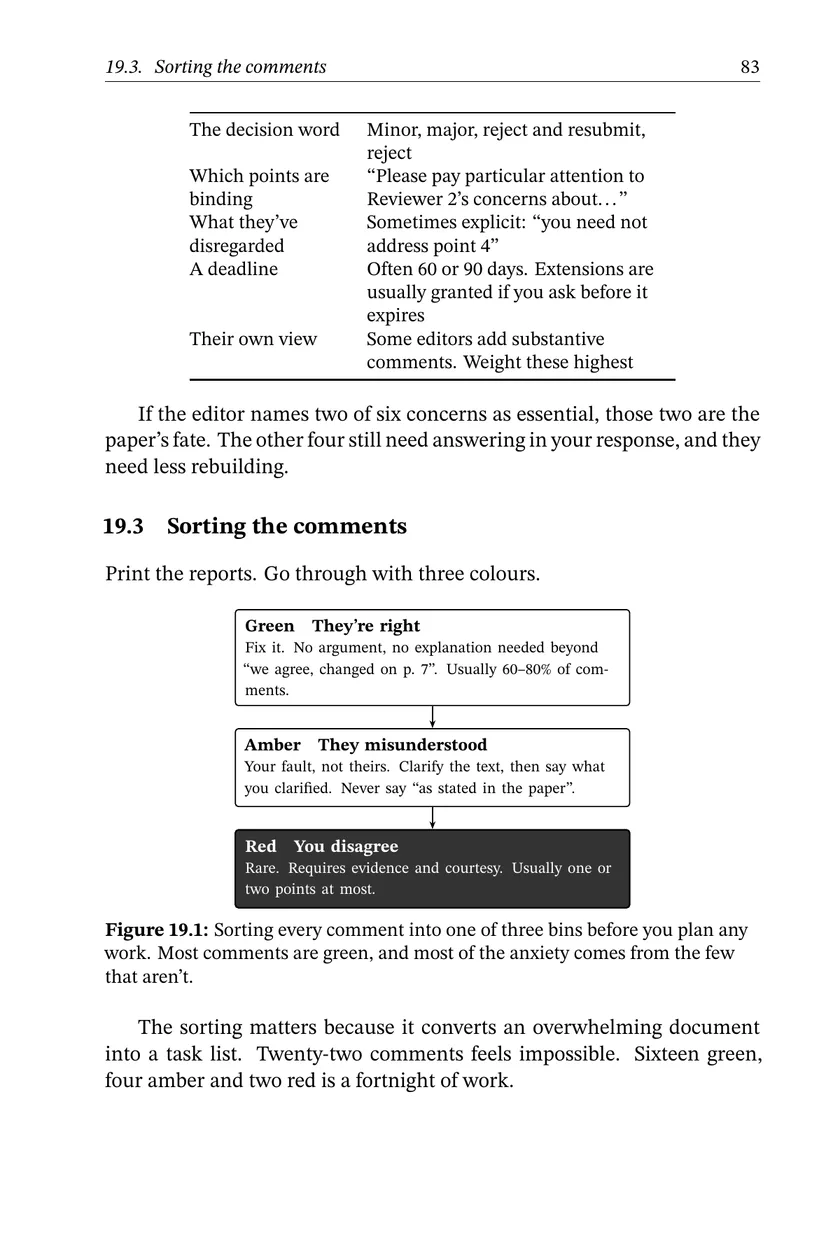
Chapter 19. Sorting every referee comment into green, amber or red before you plan the revision.
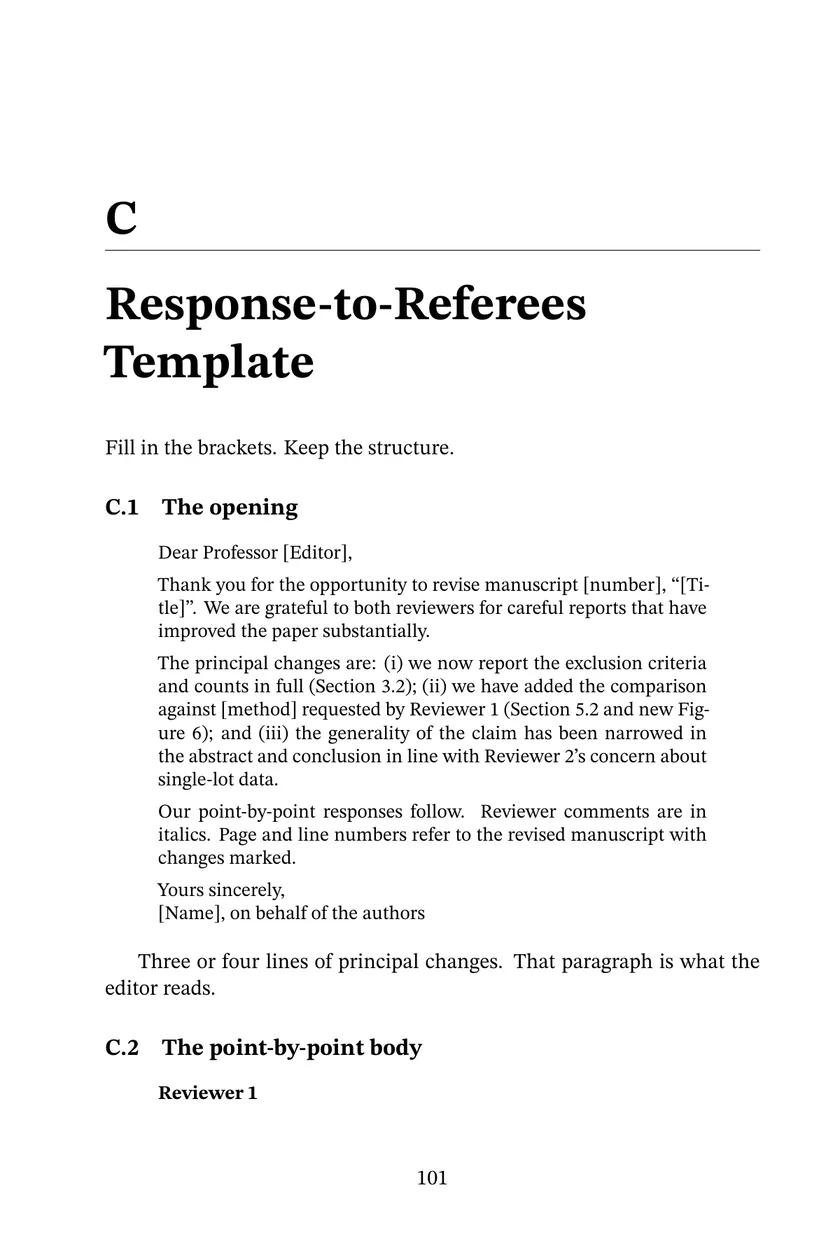
Appendix C. The response-to-referees template, opening letter first, ready to fill in.
Swipe for more pages.
What Each Part Leaves You Holding
The book follows the order a paper actually moves in. Each part leaves you with something you can show your supervisor or send to an editor.
Parts I and II
Decide you have a paper
Find out who reads a paper and how, run the four tests, choose the venue from your own reference list and plan the paper on one page.
You leave with: a yes or a not-yet on the four tests, a shortlist of venues and a one-page plan with the figures drawn first.
Part III
Write it
Write each section to its one job, from the title and abstract through the introduction, related work, method, results and discussion.
You leave with: a five-sentence abstract, a five-paragraph introduction, a related-work map and figures that pass the five-minute audit.
Part IV
Authorship, data and honesty
Settle who is an author and in what order, share data and code properly and know where the lines sit on reuse, ethics and AI tools.
You leave with: an agreed author order, a repository someone else can use and clear answers on reuse and AI tools.
Part V and the toolkit
Submit and survive review
Decide on a preprint, build the submission package, wait well, read the decision letter properly and answer every referee.
You leave with: a cover letter, a pre-submission checklist and a point-by-point response letter.
Table of Contents
The parts follow the order a paper moves in. Each part opens to its chapters, and the filter finds a topic across all of them.
27 chapters and tools
Part IWhat a Paper Is3 chapters
What a paper is for, who reads it and how to tell whether you have one yet.
1Who Reads a Paper, and WhyThe four readers, what the referee is actually asking and field differences stated once.
2The Anatomy of a PaperEach section and its one question, the four moves and converting a thesis chapter.
3Is This Publishable?The four tests, what each failure looks like and what to do when the answer is not yet.
Part IIBefore You Write3 chapters
The decisions that come before the first sentence.
4Choosing the VenueA shortlist from your own references, three tiers and predatory venues.
5Reading the Conversation You're JoiningThe three-pass search, search terms and finding your result already published.
6Planning the Paper Before You WriteThe one-page plan, figures first and a realistic schedule.
Part IIIWriting It6 chapters
Each section written to its one job.
7The Title and the AbstractThe five-sentence abstract, before and after, and keywords.
8The IntroductionThe five-paragraph introduction and a gap that has to be real.
9Related Work Without the Laundry ListThe list versus the map and the three-column table.
10The Method SectionCould a competent stranger repeat it, and the reconciliation check.
11Results, Figures, and TablesReport before you interpret, captions and the five-minute figure audit.
12Discussion, Limitations, and ConclusionThe four jobs of a discussion and limitations written honestly.
Part IVAuthorship, Data, and Honesty3 chapters
The rules nobody spells out until something goes wrong.
13Authorship, and the Conversation Nobody HasWho is an author, author order and how to raise it.
14Data, Code, and ReproducibilityWhat a shareable repository contains and where to put it.
15Honesty: Plagiarism, Ethics, and AI ToolsSelf-plagiarism, data honesty, ethics approvals and where the AI line is.
Part VSubmission, Review, and After6 chapters
From pressing submit to the published paper and the next one.
16PreprintsWhat you gain, what you risk and how field norms differ.
17The Submission PackageFormatting, suggesting referees, the cover letter and the pre-submission check.
18What Actually Happens in Peer ReviewThe pipeline, who your referees are and what the decisions mean.
19Reading the Decision LetterThe three-day rule and sorting every comment into green, amber or red.
20Responding to RefereesThe structure that works, language for each bin and contradictory referees.
21Rejection, Resubmission, and After PublicationWhich rejection it was, resubmitting elsewhere, proofs and what comes next.
ToolkitToolkit6 tools
Six working tools, formatted so you can photocopy and fill them in.
ACover Letter TemplatesJournal, conference, resubmission, extension and status enquiry letters.
BThe Submission ChecklistThe claim, structure, numbers, figures, references and statements.
CResponse-to-Referees TemplateThe opening, the point-by-point body and the checks before it goes.
DReferee Phrases, TranslatedWhat referees and editors mean, and two rules for reading any of it.
EAn Eight-Week PlanWeek 0 to submission, and where the eight weeks actually go wrong.
FGlossaryThe process, versions, identifiers and integrity terms in one place.
Nothing matches that yet. Try a broader word such as review, figures or venue.
Who This Book Is For
It is written for a first paper from a finished project. If you need something else, these are better places to start.
A good fit if you are
a final-year undergraduate whose project result might be publishable
a master's student turning a thesis chapter into a paper
a first-year PhD student writing a first manuscript
in mathematics, physics, computer science, engineering or the life sciences, where the book flags how conventions differ
a supervisor who wants to hand a student one book instead of explaining the process again
Look elsewhere if you need
a sentence-level style manual; this book works at the level of the manuscript
Download links appear right after checkout and stay in your account.
I Build Tools That Pay for Themselves And Give Away the Ones That Can’t
Everything here is quick to set up, light on your pages and built to do one real job well. I only charge for the tools that can make you money. The rest are free.
18+years building websites, plugins and stores, since 2008
I obsess over performance
Switch a feature off and it loads nothing. What does load stays small. A tool that replaces a plugin shouldn’t make your pages slower.
I care how it feels
Clear screens, sensible defaults and settings written in plain English. If you need a tutorial for the basics, that’s my design mistake, not yours.
Aa
I build for everyone
Full keyboard support, visible focus, proper labels and text you can actually read. When more people can use your store, more people can buy from it.
I build tools that earn
My paid tools help you sell, renew, license or convert. If one just sits in your stack, I haven’t done my job.
$0
If it can’t earn, it’s free
I won’t charge for anything that can’t make you money. The free tools get the same care as the paid ones, down to the last setting.
FAQs on Your First Research Paper
Still unsure? Open a few pages in the gallery above, or ask me through the contact page.
Is it really free?
Yes. Both PDFs and the toolkit cost nothing. Checkout asks for your name and email, and the download links stay in your account so you can come back for them.
Why do I go through checkout for a free book?
Checkout puts the files in your account, so the links don't expire and you can download them again on another device. It takes a name and an email address, and no payment details.
Which PDF should I read?
You get both, and they contain the same book:
The A4 screen edition has a larger page and suits a laptop or a home printer.
The 6 × 9 print edition uses paperback proportions and suits a compact printout or a reading app.
Does it cover my field?
Chapter 1 sets out the main differences once, and later chapters flag where mathematics, physics, computer science, engineering and the life sciences part ways, such as author order, preprints and conference papers. Your target venue's author guidelines still have the final word.
Will it get my paper accepted?
No book can promise that, because the referees and the editor decide. What it can do is stop the avoidable rejections: a paper with no clear claim, the wrong venue, a missing gap or a response letter that argues instead of answering.
Can I print it or share it?
You can print it for your own use as often as you like, and the toolkit pages may be photocopied for personal and classroom use. If a friend needs it, send them this page.
Run the Four Tests on Your Project Tonight
Chapter 3 takes an evening and tells you whether you have a paper yet. The whole book, with the toolkit, is free.