
 by
by
Paste a polished paragraph into an AI content detection tool and it comes back “87% AI.” Run the same paragraph through a humanizer, test it again, and the dial swings toward “human.” It feels like progress. But the unsupported claim in sentence three is still unsupported, and the borrowed idea in sentence five still needs a citation.
That is the new race. One system generates the text, another tries to identify it, and a third rewrites the same passage until the score changes. AI content humanization can make a stiff draft clearer, but it can also turn writing into a game where the measurement improves while the work does not.
Lynote.ai puts an AI detector and an AI humanizer in the same workspace. That combination is useful because detection and revision do belong in one editorial process. But the useful version of that process ends with a human decision, not a green circle or a “99%” promise.
Aspects of AI content detection
An AI detector does not inspect a document and discover who typed it. It analyzes patterns that often appear in model-generated text, then returns a probability or category. Predictable word choices, uniform sentence structure, low variation, and repeated transitions can influence the result.
Think of it like a smoke alarm. The alarm tells you to investigate. It cannot tell you whether someone burned toast, a wire overheated, or the building is on fire. The analogy has a limit, though: text does not contain a universal chemical trace of AI authorship. A detector is inferring from patterns, and those patterns change.
The warning is not theoretical:
- OpenAI retired its own AI text classifier in July 2023 because of low accuracy. In its published evaluation, the classifier caught 26% of AI-written challenge-set text and falsely labeled human writing 9% of the time.
- Turnitin’s March 2026 guidance says its model can misidentify human, AI-generated, and AI-paraphrased text. It also says the report should not be the sole basis for adverse action against a student.
- A study by Weixin Liang and colleagues found an average 61.22% false-positive rate when seven detectors evaluated 91 human-written TOEFL essays from non-native English writers.
That last number should slow you down. A formal, concise writing style can look predictable to a detector even when a person wrote every sentence. Technical documentation, translated prose, templated reports, and beginner English can trigger the same problem.
Warning: Never use one AI score as proof of cheating, fraud, or misconduct. Check draft history, sources, prior writing, the applicable policy, and the author’s explanation before making a high-stakes decision.
Longer samples generally give a detector more useful material than a short paragraph. The model used to produce the text matters. So do language, genre, editing history, and the detector’s most recent update. A score can be useful within those limits. It stops being useful when someone treats it as a verdict.
That is the practical role of AI content detection: narrow the review area, then bring better evidence to the decision.
What Lynote’s AI Detector actually does
Lynote applies AI content detection through more than a single percentage. It separates likely AI-generated, mixed, and human-written signals, then highlights sentences that may need closer attention. That sentence-level view is more useful than a bare score because it shows where to start reviewing.
Searching for the best free AI detector usually starts with an accuracy claim. It should start with the report. Can you see which passages triggered the result? Can you upload the format you work with? Does the tool support your language? Does it explain that false positives are possible?
Lynote currently says its detector can analyze writing associated with ChatGPT, GPT-5, Gemini, Claude, LLaMA, Mistral, and other models. The interface accepts pasted text or uploaded documents and presents sentence-level highlights. Its product page also says the detector supports more than 50 languages, including English, Spanish, French, German, Portuguese, Chinese, and Arabic.
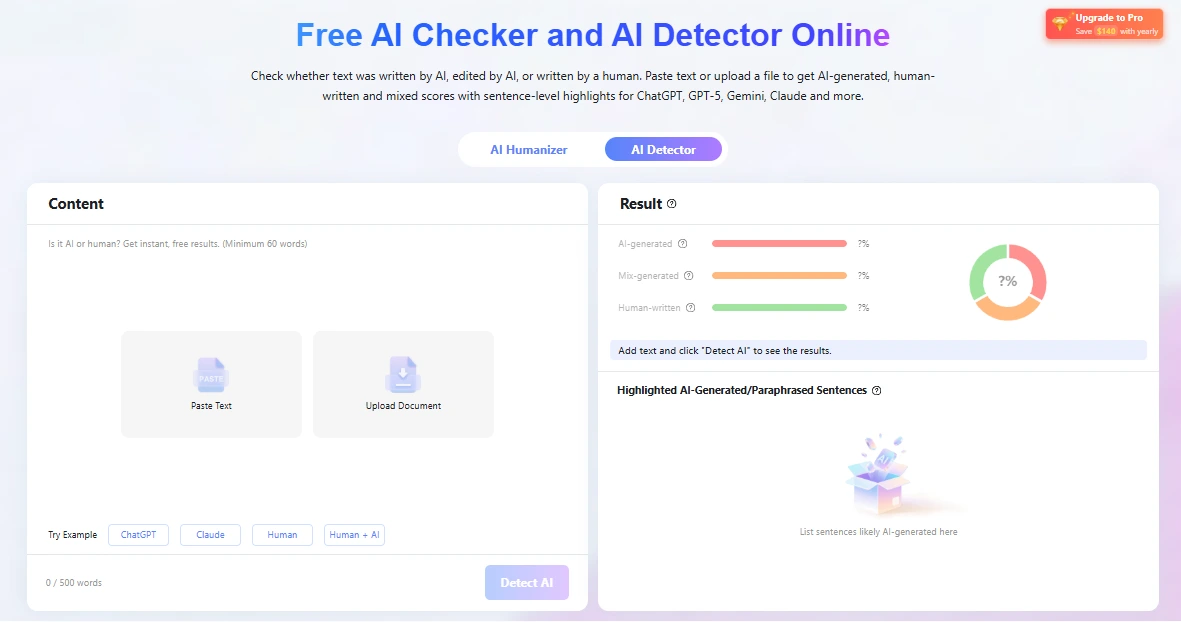
The supplied interface is clean. You paste text on the left, then review the result and highlighted passages on the right. That makes the next action obvious: inspect the sentences instead of staring at one overall number.
Lynote markets the detector with an “up to 99% accuracy” claim. I would treat that as a vendor claim until the company publishes a reproducible test set, model versions, sample lengths, language breakdowns, thresholds, and false-positive results. Accuracy against one controlled dataset does not guarantee the same performance on a translated essay, a legal memo, or text revised by three different tools.
The detector is still useful as a first pass. It can surface repetitive phrasing, suspiciously uniform sections, or a sudden change in voice. It just cannot tell you, by itself, what happened before the document reached the text box.
What AI content humanization should actually improve
The word “humanizer” creates the wrong expectation. Good editing is not about sprinkling randomness into sentences until a detector gives up. It is about restoring decisions that a generic first draft did not make.
Those decisions include:
- choosing a specific example instead of a broad claim
- replacing a stock transition with the actual relationship between two ideas
- adding evidence, limits, and source context
- keeping the author’s intended meaning and level of certainty
- varying rhythm because the thought requires it, not because a score demands it
Basic paraphrasers often work at the surface. They swap words, rearrange clauses, and sometimes turn a clear sentence into something that sounds like a thesaurus was paid by the syllable. A context-aware AI humanizer tries to preserve the paragraph’s logic while changing its phrasing and flow.
If your search is for the best free AI humanizer, compare the rewritten meaning with the original before you compare detector scores. Read every factual claim again. Check names, dates, quotations, citations, and instructions. A smoother sentence that changes the claim is not an improvement.
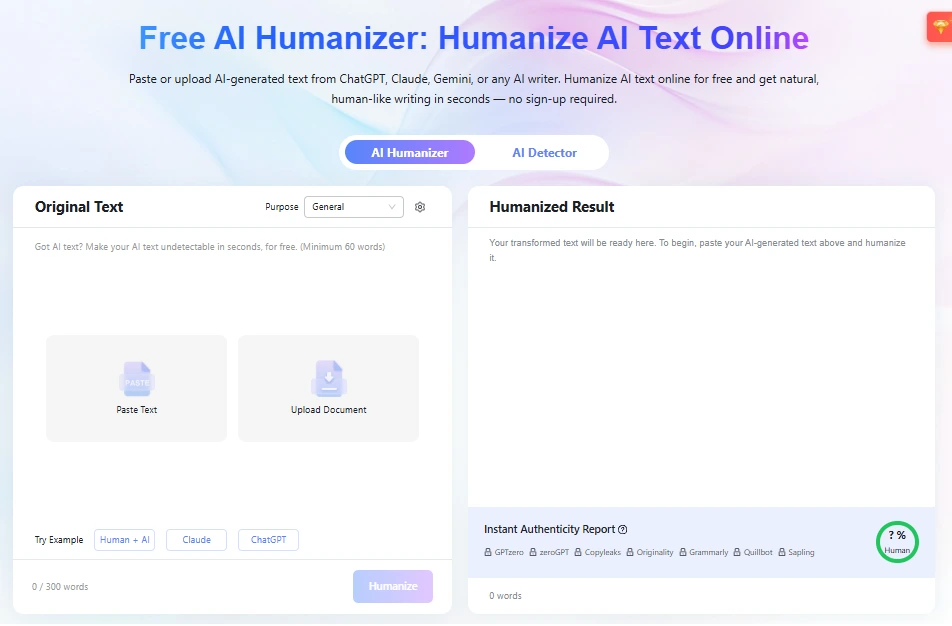
Lynote says its humanizer supports more than 80 languages and offers several rewriting modes. The product is positioned as contextual rewriting rather than synonym replacement. It also promotes a 99% undetectable guarantee.
That guarantee needs the same skepticism as the detector’s accuracy number. Detectors change. Model outputs change. A passage that receives a low score today may receive a different score after an update or in another system. More importantly, passing a detector does not make undisclosed AI use acceptable under a school, client, newsroom, or workplace policy.
Key point: Revise for clarity, accuracy, evidence, and voice. If the only goal is to lower a detector score, the workflow is optimizing the measurement instead of improving the writing.
The market now sells both the lock and the key
AI detectors and humanizers are not developing on separate tracks. They are training against each other. Detectors learn to recognize rewritten model output, while humanizers learn to remove the patterns detectors currently notice. The same market now sells the lock, the key, and the test that tells you whether the key worked.
This creates an adversarial feedback loop. A detector flags uniform sentence rhythm, predictable transitions, or low lexical variation. Humanizers add variation. Detectors then learn to look past that variation and search for deeper signals. The next rewriting model adapts again.
Goodhart’s law explains the failure in plain language: when a measure becomes the target, it stops being a good measure. A detector score may begin as a rough indicator of machine-like phrasing. Once writers optimize directly for that score, it starts measuring how well the text was optimized for the detector, not whether the writing is original, accurate, or useful.
You can see the effect in bad humanized copy. The sentences become less predictable, but also less precise. A simple word becomes an awkward synonym. A necessary qualification disappears. The rhythm looks more varied, yet the paragraph says less.
That is why the most interesting part of Lynote is not the promise that one side can beat the other. It is the possibility of putting detection and revision inside an editorial loop where a person can see what changed. The product becomes more useful when the goal is better judgment. It becomes less useful when the score itself becomes the job.
Detector, humanizer, plagiarism checker, and editor are not the same
These tools answer different questions. Confusing them is how teams end up with a polished paragraph that still contains a false claim, or a low detector score that is treated as proof of original authorship.
| Tool | What it does | Useful for | What it cannot prove |
|---|---|---|---|
| AI detector | Estimates whether text resembles patterns associated with AI generation or AI alteration | Finding passages that deserve review | Who wrote the text or whether a rule was broken |
| AI humanizer | Rewrites wording, structure, tone, and rhythm | Improving a stiff draft while preserving intent | That every fact, citation, and implication stayed correct |
| Plagiarism checker | Compares text with indexed or submitted sources | Finding copied or closely matched passages | Whether unmatched text was written by a person or a model |
| Writing-process record | Shows additions, deletions, paste events, drafts, and revision history | Understanding how a document developed | The writer’s intent or whether every outside source was disclosed |
| Human editor | Evaluates meaning, evidence, audience, policy, and voice | Making the final publication or integrity decision | Perfect certainty without supporting evidence |
One document can pass a plagiarism checker and still be AI-generated. It can receive a high AI score and still be entirely human-written. It can also sound natural after rewriting while quietly losing a qualification that made the original claim accurate.
So keep the jobs separate. Use the detector to locate signals. Use the humanizer to propose revisions. Use a plagiarism checker to examine source overlap. Then use a person to decide what the text means and whether it meets the rules.
Plagiarism checking is becoming process analysis
Traditional plagiarism checking asks whether the submitted text matches material in a database. AI detection asks whether the wording resembles patterns associated with machine generation. Those are different questions, and the scores should never be combined into one vague “originality” number.
Turnitin makes this distinction explicit. Its Similarity Report identifies matching text and leaves the reviewer to decide whether the match is legitimate quotation, weak citation, common phrasing, or plagiarism. Its AI Writing Report is separate and independent because a passage can be original in wording while still being generated by a model.
The reverse can happen too. A human-written literature review may have a high similarity score because it quotes and cites sources correctly. A generated essay may show little source overlap because the model assembled new sentences. One score cannot explain the other.
This is pushing plagiarism checking toward a four-layer review:
- Source overlap: Where does the wording match existing material?
- AI-likelihood signals: Which passages resemble generated or AI-altered text?
- Process evidence: How did the document change across drafts, sessions, and paste events?
- Human judgment: Do the sources, policy, prior work, and author’s explanation fit together?
The third layer is the big shift. Turnitin’s current Writing Report can replay additions, deletions, and pasted text over time. Google Docs and Microsoft Word already keep version histories. Editors increasingly ask for source notes, revision logs, or earlier drafts when the final text alone cannot answer the authorship question.
Process evidence is not perfect. A person can paste their own notes, and a generated passage can be typed manually. But it is harder to game a coherent trail of research, drafting, correction, and source use than one detector score. The industry is moving from “What does this text look like?” toward “How was this text made?”
Text still lacks the durable provenance signals now appearing in some generated images and audio. Metadata can disappear, copying strips context, and a paragraph can move between tools without carrying a reliable creation record. Until text provenance improves, version history and editorial documentation are the practical substitute.
A safer two-way AI content workflow
The strongest part of Lynote’s idea is the two-way workflow. Detection and revision can inform each other. The trap is turning that loop into “rewrite until the detector says human.”
A better process looks like this:
- Start with ownership. Decide who is responsible for the argument, evidence, and final wording. If AI use must be disclosed, write that requirement down before drafting.
- Build the first draft. AI can help organize notes, suggest a structure, or produce a rough version. Do not let it invent evidence or citations.
- Verify the substance. Check names, dates, numbers, quotations, links, sources, and any claim that could change a decision.
- Run detection as a review signal. Look at highlighted passages and changes in voice. Do not rewrite a sentence merely because one tool colored it.
- Revise for a reason. Add a specific example, correct the logic, restore the author’s phrasing, or make an instruction easier to follow.
- Compare meaning. Read the original and revised versions side by side. Make sure certainty, scope, and attribution did not drift.
- Keep evidence of the process. Version history, notes, sources, and drafts are useful when authorship or policy compliance matters.
This workflow is slower than pressing “humanize” three times. It is also the difference between editing and laundering. One improves the work. The other tries to hide how the work was made.
For content teams, the review loop can reduce repetitive cleanup. An editor can scan a draft, inspect the marked passages, revise the weak sections, and run a final check. For a multilingual writer, the humanizer can help smooth an awkward translation, but the writer still needs to confirm that idioms, technical terms, and cultural context survived.
For students, the rule is even simpler: follow the institution’s policy. A detector’s limitations do not create permission to submit generated work as your own. And an undetectable result does not erase the requirement to disclose permitted assistance.
How the detector-humanizer loop is reshaping writing work
AI has made first drafts cheap. The scarce work is moving downstream: choosing credible sources, deciding what matters, checking claims, preserving a distinct voice, and taking responsibility for the final version.
That shift is changing writing roles in three ways.
First, editing is splitting into semantic editing and signal editing. Semantic editing improves meaning, evidence, structure, and usefulness. Signal editing changes phrasing to influence a detector. The first creates reader value. The second may be necessary for investigating a false positive, but it becomes destructive when teams treat a low score as a publishing KPI.
Second, originality is becoming more than word-level uniqueness. A paragraph can contain no copied sentence and still contribute nothing new. Publishers now need to ask whether the work contains original evidence, a defensible judgment, a useful synthesis, or an experience the model could not invent.
Third, accountability is becoming an explicit production step. Teams need rules for permitted AI use, required disclosure, confidential inputs, source verification, and final approval. The writer may use ChatGPT or Claude to organize notes, Lynote to inspect and revise the draft, and a similarity checker to review source overlap. But someone still needs to own every claim.
This changes the economics of content. Generating another 1,000 words costs almost nothing. Verifying those words, finding the missing evidence, and cutting the confident nonsense can take longer than writing from scratch. The teams that understand that will use AI to reduce blank-page time and spend the saved time on judgment. The teams that do not will publish faster and trust their work less.
Where Lynote helps, and where you should be cautious
Lynote’s strongest idea is not that it can settle the human-versus-AI question. It is that detection and revision can share one workspace. That reduces friction when the real job is to find weak passages, improve them, and check the result.
The useful parts are easy to identify:
- Sentence-level feedback gives the score context. Reviewers can see which passages need attention instead of guessing.
- The detector and humanizer sit next to each other. Moving from analysis to revision does not require a second product.
- Multilingual support broadens the workflow. The detector and humanizer list different language totals, but both go beyond English-only use.
- File upload helps with longer drafts. DOCX, PDF, and TXT support is more practical than pasting a document section by section.
- Context-aware rewriting is the right target. Preserving logic matters more than replacing individual words.
The cautions matter just as much:
- The 99% claims are not enough on their own. Ask for methodology, test data, model coverage, language-level results, and false-positive rates.
- A humanizer can change meaning. Always compare the revised text with the source, especially in legal, academic, medical, financial, and technical writing.
- Privacy language deserves a careful read. Lynote’s current privacy policy says the service collects and processes submitted user content and may use anonymized, de-identified, or aggregated data to improve its systems. Do not upload confidential client work, unpublished research, personal data, or protected records until the terms fit your risk level.
- The ethics depend on the use. Editing a disclosed draft for clarity is different from hiding prohibited assistance.
The product pages use stronger language than I would. “Undetectable” is a brittle promise in a market where detectors update constantly. The safer value proposition is more modest: Lynote can help you inspect and revise AI-assisted text in one place.
Who Lynote.ai is for
Lynote makes the most sense for people who already understand that the tools are assistants, not judges.
Content teams can use it to flag generic sections before publication. Marketers can clean up an AI-assisted outline or first draft, then bring the copy back to brand voice. Editors can use sentence highlights to focus attention. Multilingual writers can compare a translated or rewritten passage with the source and correct unnatural phrasing.
It is a poor fit when someone wants certainty from a detector, secrecy from a humanizer, or a shortcut around policy. It is also a poor fit for sensitive files unless the organization’s privacy and data-processing requirements have been checked first.
My recommendation is narrow: test Lynote with non-sensitive text, judge the sentence-level report, and compare every humanized passage against the original. Keep it if that process saves editing time without weakening meaning. Ignore the score theater.
Frequently Asked Questions
Can an AI content detector be 99% accurate?
A detector may report very high accuracy on a specific test set, model mix, language, text length, and threshold. That does not make it 99% accurate for every document. Ask how the claim was measured and examine false positives, especially for short, formal, translated, technical, or non-native English writing.
Can an AI detector prove that a student cheated?
No. A detector score is one signal and can be wrong. Turnitin itself says its AI report should not be the sole basis for adverse action. Educators should review drafts, version history, sources, prior work, the assignment policy, and the student’s explanation before deciding what happened.
Is humanized AI text guaranteed to be undetectable?
No lasting guarantee is possible. Detector models, thresholds, and training data change. Different tools can also disagree on the same passage. More importantly, a low score does not prove human authorship or make undisclosed AI use acceptable under an academic or workplace policy.
Is humanized text automatically plagiarism-free?
No. Rewriting can reduce word-for-word similarity, but ideas, facts, quotations, and distinctive structure may still require attribution. Run source checks, preserve citations, and verify that the rewrite did not introduce a new factual error or hide borrowed material.
How many languages does Lynote support?
Lynote currently says its AI detector supports more than 50 languages and its AI humanizer supports more than 80. Support does not guarantee equal quality in every language, so test the exact language and content type you plan to use.
Should I upload confidential documents to Lynote?
Not before reviewing the current privacy policy and your organization’s rules. Lynote says it processes submitted content and may work with service providers and AI partners. Use non-sensitive samples for initial testing, and keep protected client, student, health, financial, or unpublished research data out unless the terms and approvals are acceptable.
AI content detection works best as an invitation to review, not an accusation. AI content humanization works best as editing, not camouflage. Lynote.ai brings both tasks together, and that is useful, but the final responsibility stays exactly where it should: with the person who signs off on the words.
Tell Google you want more of this.
Add Gaurav Tiwari as a preferred sourceOne tap, and this site shows up more often in your own Top Stories, AI Overviews and AI Mode. Remove it any time.