
 by
byPicking from the best smartphones for BGMI in India gets expensive quickly, and the spec sheet doesn’t tell you the part that matters most. You can spend well over ₹80,000 on a flagship with a 144 Hz or 165 Hz screen, open the graphics menu and find that the game still doesn’t offer you 120 FPS on that model. Then there is the second problem: a phone that runs smoothly in the first zone can slow down by the time the circle closes.
I’ve been playing PUBG Mobile, and then BGMI, since 2018, and I care far more about how a phone holds its frame rate in the 25th minute of a Classic match than about the number printed on the box. So this shortlist starts with 2 phones that make the most sense for a BGMI-first buyer, the OnePlus 15 and the iQOO 15, and then covers the Samsung, Apple and camera flagships that also pass the same hardware filters.
The OnePlus 15 is the one I’d buy if BGMI is the main reason you’re upgrading. It is the lowest-priced phone here, with a 6.78-inch 165 Hz screen, Snapdragon 8 Elite Gen 5 and a 7,300 mAh battery. The iQOO 15 costs ₹1,000 more and gives you a slightly larger 6.85-inch screen plus a separate gaming chip, which is useful if you play with a 4-finger or 5-finger claw and want more room for the buttons.
Quick Comparison
Every phone on this page passes the same 4 hardware filters. I set them deliberately narrow, because a big claw layout needs space and a flagship purchase should last more than one season:
- A display of at least 6.78 inches, measured diagonally as advertised.
- A refresh rate of at least 120 Hz.
- A Snapdragon 8 Elite-family processor or an Apple Pro chip.
- A model first introduced in 2025 or later.
My previous daily driver, an iPhone 16 Plus, fails 2 of these. Its 6.7-inch screen runs at 60 Hz, so BGMI tops out at 60 FPS on it. That is fine for casual matches and it is also exactly the ceiling these phones are meant to remove. I now own an iPhone 18 Pro Max (512GB, Glacier), which passes all 4.
| Phone and Amazon Variant | Display | Refresh Rate | Processor | Amazon Price |
|---|---|---|---|---|
| OnePlus 15, Infinite Black, 12GB/256GB | 6.78 inches | 165 Hz | Snapdragon 8 Elite Gen 5 | ₹84,999 |
| iQOO 15, Apex 2026, 12GB/256GB | 6.85 inches | 144 Hz | Snapdragon 8 Elite Gen 5 | ₹85,999 |
| Samsung Galaxy S25 Ultra, Titanium Gray, 12GB/256GB | 6.9 inches | 120 Hz | Snapdragon 8 Elite for Galaxy | ₹94,999 |
| Samsung Galaxy S26 Ultra, Cobalt Violet, 12GB/256GB | 6.9 inches | 120 Hz | Snapdragon 8 Elite Gen 5 for Galaxy | ₹1,24,999 |
| Xiaomi 17 Ultra, Black, 16GB/512GB | 6.9 inches | 120 Hz | Snapdragon 8 Elite Gen 5 | ₹1,29,999 |
| vivo X300 Ultra, Eclipse Black, 16GB/512GB | 6.82 inches | 144 Hz | Snapdragon 8 Elite Gen 5 | ₹1,59,999 |
| OPPO Find X9 Ultra, Canyon Orange, 12GB/512GB | 6.82 inches | 120 Hz, 144 Hz in some games | Snapdragon 8 Elite Gen 5 | ₹1,69,999 |
| iPhone 18 Pro Max, Glacier, 256GB | 6.9 inches | 120 Hz | A20 Pro | ₹1,79,900 |
Prices are for the exact variants listed and change often, especially around sale events. Bank offers, exchange value and no-cost EMI come on top and depend on your card, so compare the final checkout price rather than the listing price.
Best Phone for BGMI by Player Type
Most BGMI players fall into one of a few buying situations. This is where I’d point each one:
| If You Are | Buy | Why |
|---|---|---|
| A ranked grinder who wants the best value | OnePlus 15 | Lowest price on this list, 165 Hz screen and the biggest battery |
| A claw player who wants more screen | iQOO 15 | 6.85-inch display, a dedicated gaming chip and a large vapor chamber |
| Buying one phone for 5 or more years | Samsung Galaxy S25 Ultra | 7 OS upgrades and 7 years of security updates at a lower price than the S26 Ultra |
| Already on iPhone and staying there | iPhone 18 Pro Max | The only large Pro-chip iPhone that passes these filters |
| A gamer who also cares about the camera | Xiaomi 17 Ultra | The least expensive camera flagship here that still passes every filter |
Best Smartphones for BGMI in India
I’d compare the OnePlus 15 and iQOO 15 first, then look at Samsung or Apple only when their other strengths matter to you. These picks come from current specifications, Amazon India listings and published BGMI reports. I haven’t run a matched temperature and frame-rate test across all 8 phones, so no ranking below claims one phone runs cooler than another.
OnePlus 15
OnePlus 15 is my top pick if you’re buying a large flagship mainly for gaming. It costs the least among the qualifying variants and carries the biggest battery, which makes it the sensible starting point before you pay more for camera flagships.
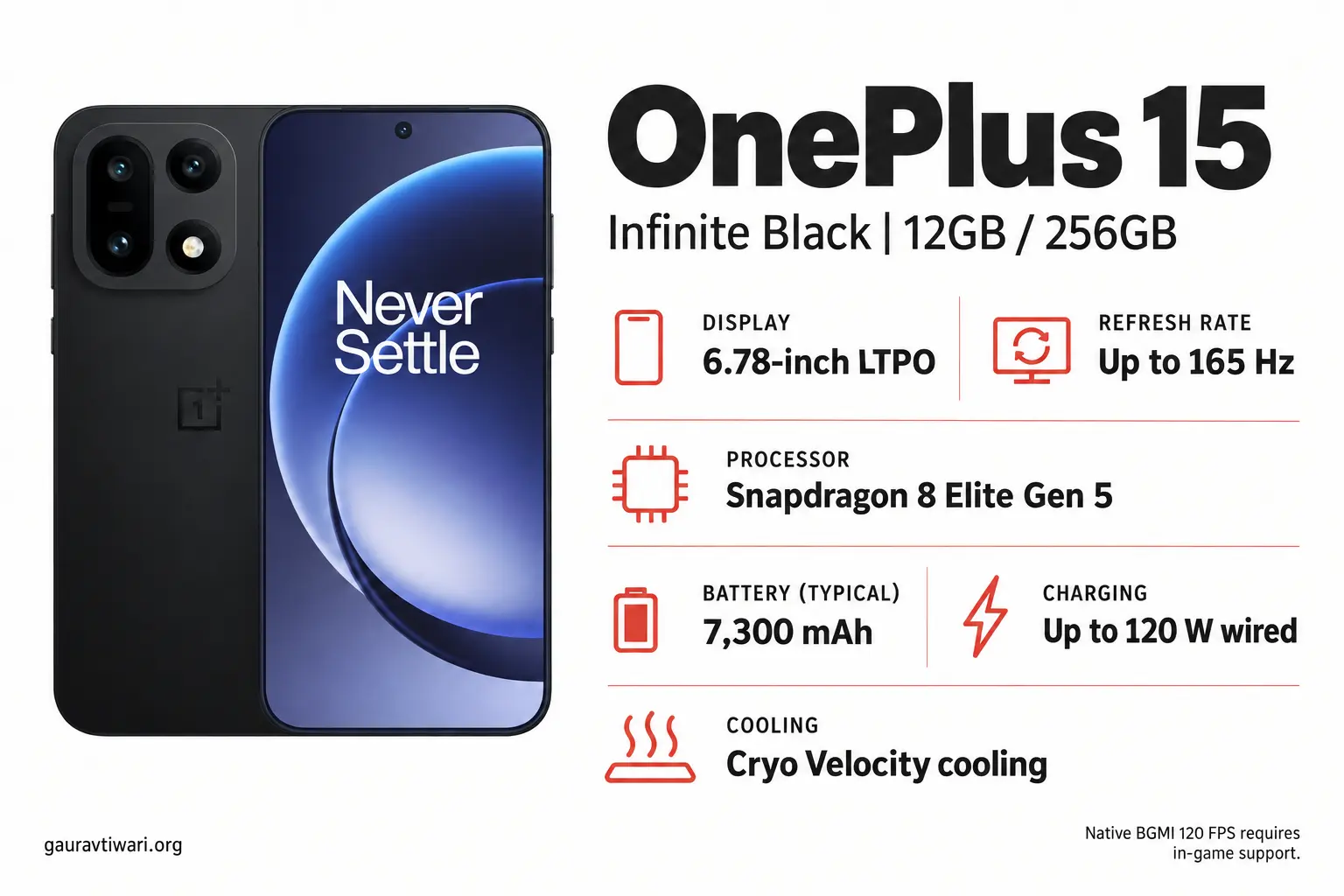
- The OnePlus 15 listing on Amazon.in lists a 6.78-inch LTPO display with a maximum 165 Hz refresh rate and Snapdragon 8 Elite Gen 5.
- The battery has a typical capacity of 7,300 mAh, with up to 120 W wired charging.
- OnePlus describes a 5,731 mm² vapor chamber as part of its Cryo Velocity cooling. That is an advertised cooling figure, not a BGMI temperature measurement.
- An OverByt BGMI test on the OnePlus 15 reports gameplay near 120 FPS on the reviewer’s build and settings at the time.
One caution: OnePlus’s “always-on 120 FPS” marketing is written around Mobile Legends, not BGMI. The 165 Hz screen is useful headroom, but BGMI decides its own frame-rate cap, so confirm 120 FPS on the current game version before treating that screen as the reason to buy.
iQOO 15
iQOO 15 is worth the ₹1,000 step up if you want a slightly bigger screen and the gaming extras. The size difference is modest, so I’d decide between this and the OnePlus by how your claw layout feels in hand.
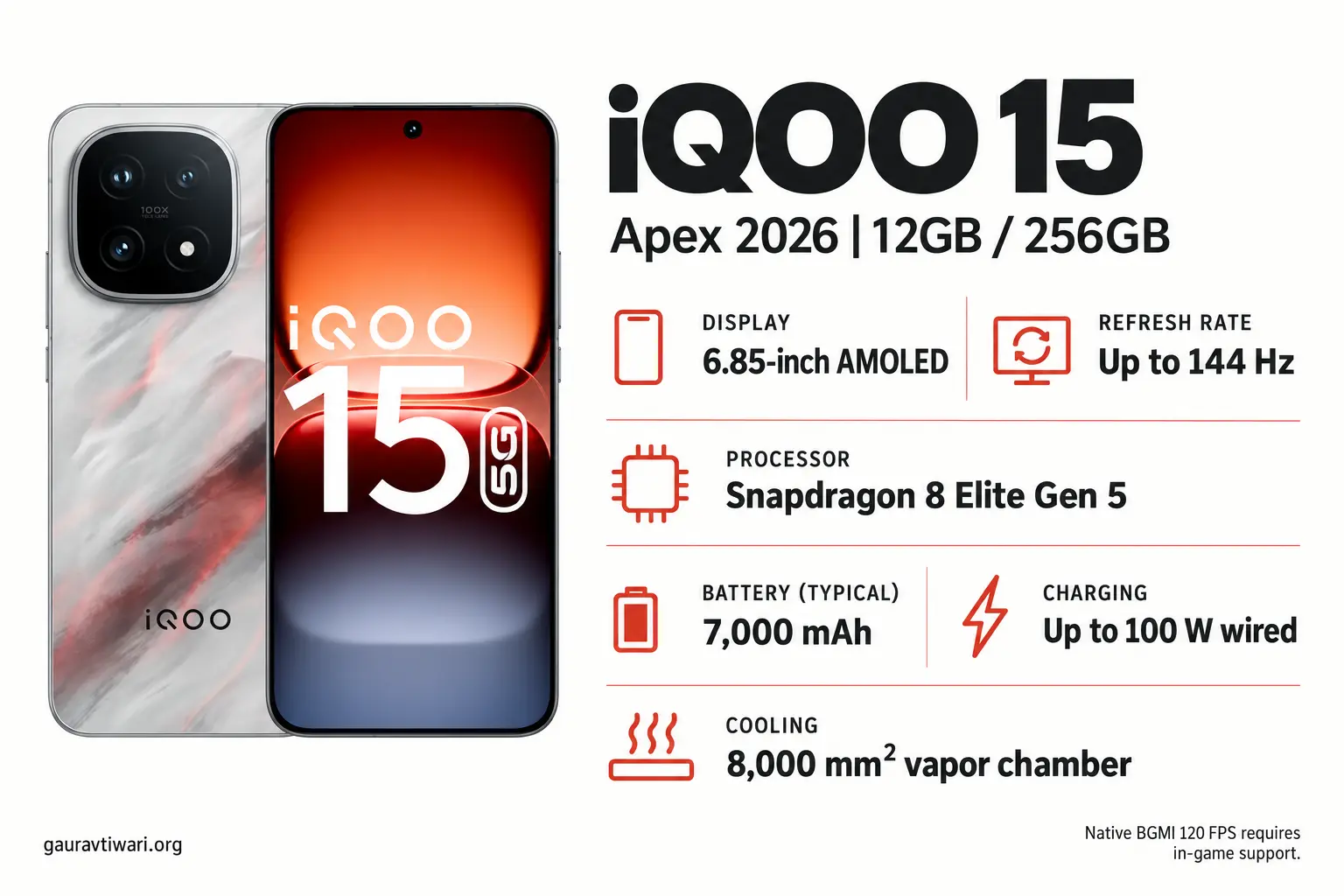
- The iQOO 15 listing on Amazon.in lists a 6.85-inch AMOLED display at up to 144 Hz, Snapdragon 8 Elite Gen 5 and a 7,000 mAh typical battery.
- Charging reaches 100 W wired and 40 W wireless.
- The Supercomputing Chip Q3 handles frame interpolation. iQOO’s 2K at 144 FPS claim includes inserted frames, which is different from BGMI rendering 144 frames natively.
- iQOO advertises an 8,000 mm² single-layer vapor chamber, and the Amazon listing promises 5 years of OS updates and 7 years of security patches.
- A dated iQOO Community BGMI test reports gameplay around 120 FPS. It is one user’s observation, not a guarantee for later game or firmware updates.
If you compare the two phones yourself, switch interpolation off on the iQOO. Otherwise you are comparing native frames on one phone with partly generated frames on the other.
Samsung Galaxy S25 Ultra
Galaxy S25 Ultra is the phone I’d pick if BGMI is one job among many and you want the longest software support. Its first-generation Elite chip still passes the filter, and it costs ₹30,000 less than the S26 Ultra variant above.
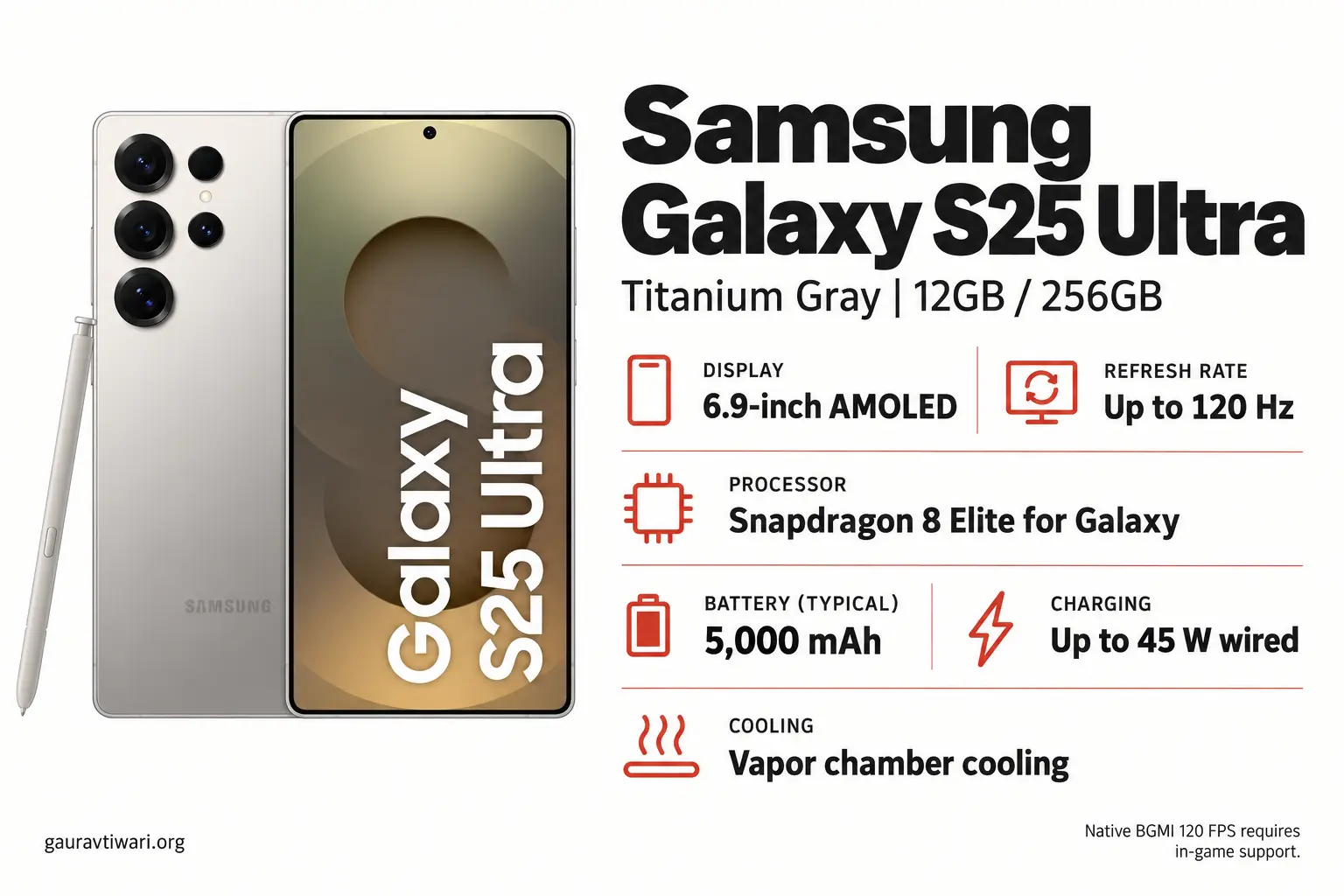
- The Galaxy S25 Ultra listing on Amazon.in lists a 6.9-inch display with an adaptive 1-120 Hz refresh rate and Snapdragon 8 Elite for Galaxy.
- The battery has a typical capacity of 5,000 mAh with up to 45 W wired charging, noticeably smaller than the OnePlus and iQOO.
- Samsung’s Galaxy S25 announcement promises 7 generations of OS upgrades and 7 years of security updates from global launch.
The Galaxy S25 Ultra in Titanium Gray makes sense for a long-term daily phone. Some recent Samsung Community posts question 120 FPS availability on this model, so check the current BGMI graphics menu on a demo unit or with a friend’s phone before you pay.
Samsung Galaxy S26 Ultra
Galaxy S26 Ultra suits the same long-term buyer with a newer processor. I’d pay the extra ₹30,000 only for its non-gaming benefits, because nothing published so far shows a BGMI advantage large enough to justify the gap on its own.
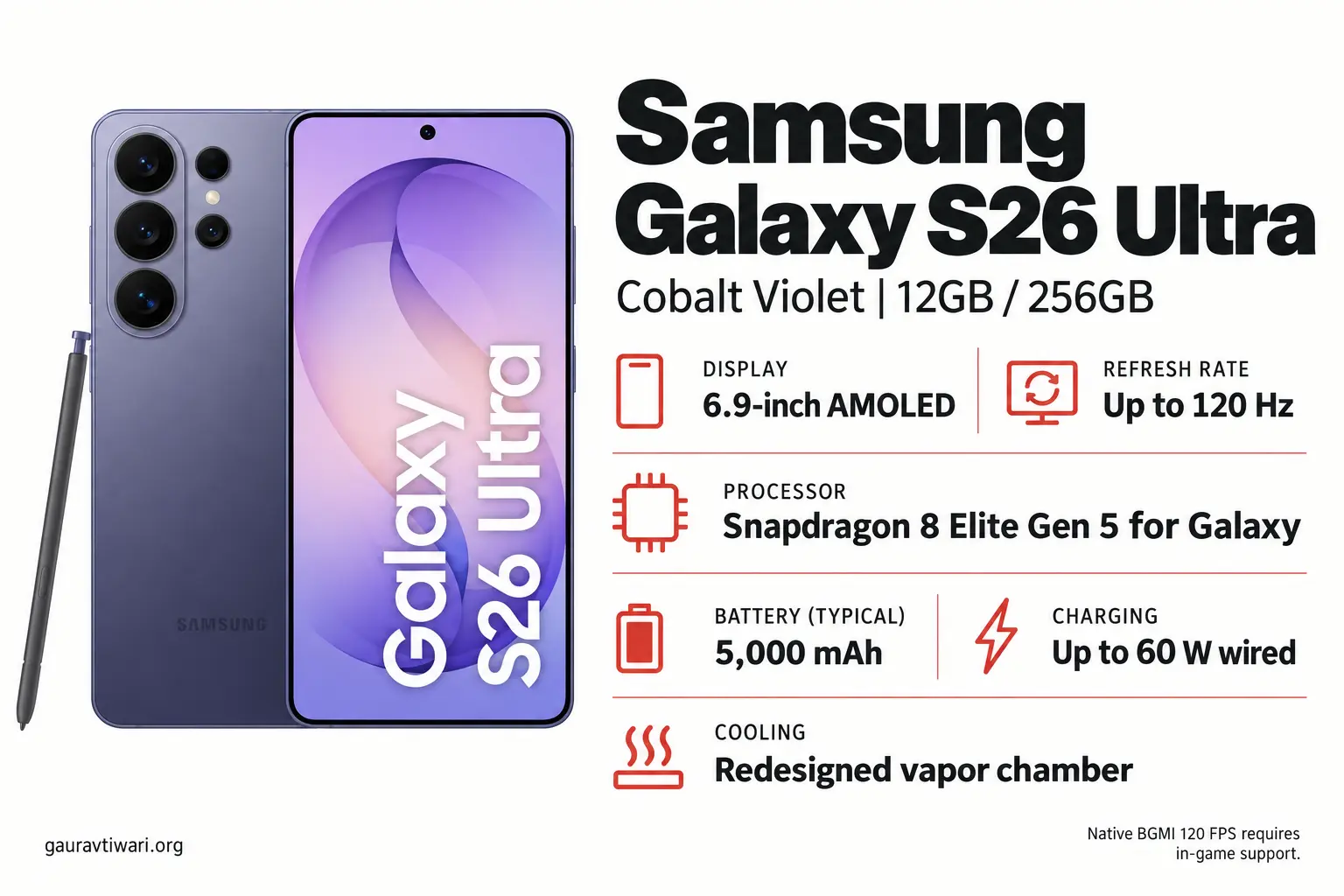
- The Galaxy S26 Ultra listing on Amazon.in lists a 6.9-inch display, adaptive 1-120 Hz refresh rate and Snapdragon 8 Elite Gen 5 for Galaxy.
- The typical battery capacity stays at 5,000 mAh, with up to 60 W wired charging.
- Samsung describes a redesigned vapor chamber.
- Its published support commitment covers 7 generations of OS upgrades and 7 years of security updates.
The Cobalt Violet S26 Ultra is the exact 12GB/256GB variant used here. Galaxy phones also offer Pause USB PD charging in Game Booster on supported models, which I cover in the cooling section below.
iPhone 18 Pro Max
iPhone 18 Pro Max is the large-screen Apple option that meets these filters, and it is the phone I own, in 512GB Glacier. I’d still recommend it only if you want iOS anyway, because at ₹1,79,900 for the 256GB model a BGMI-only purchase needs a stronger reason than the Pro name.
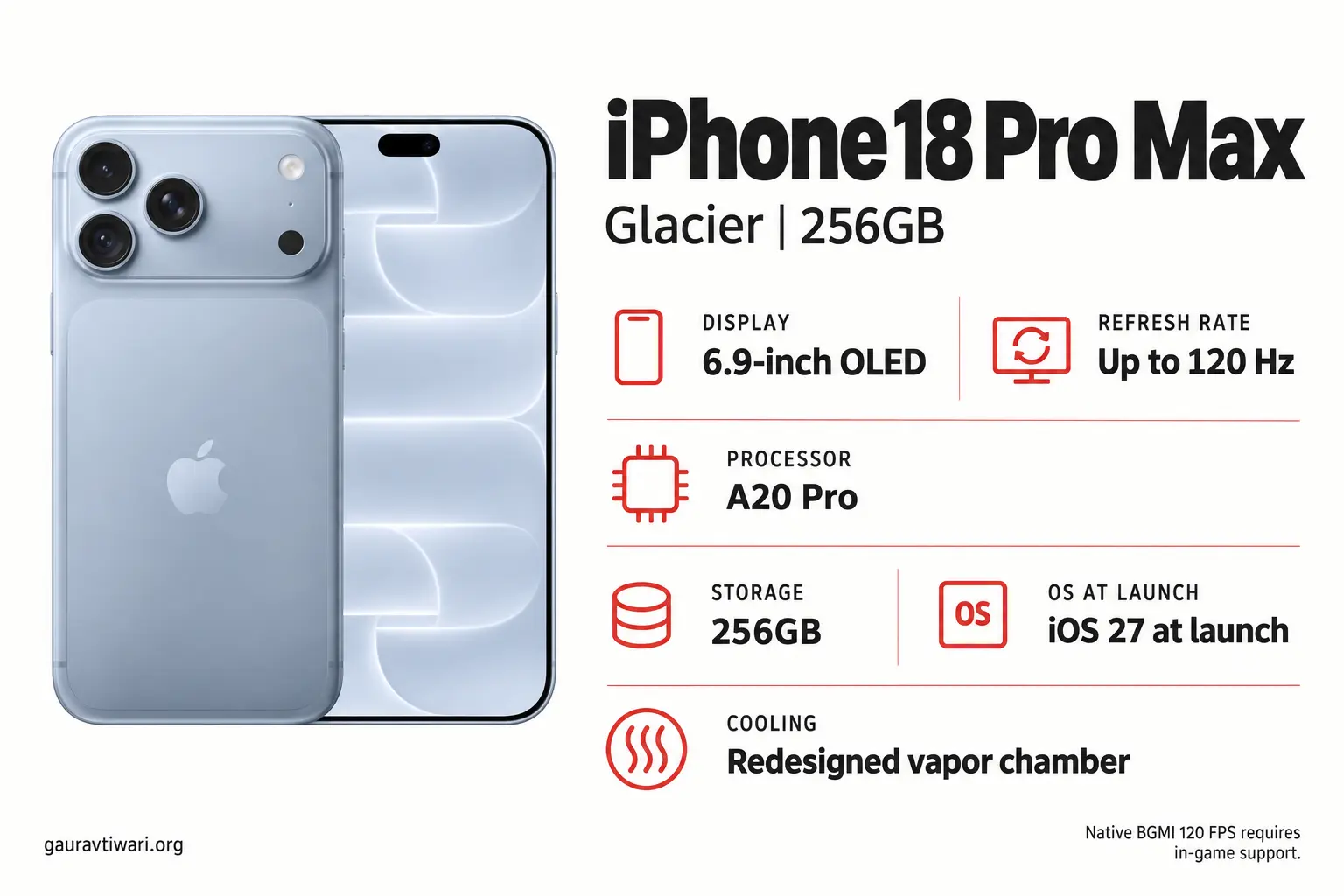
- The iPhone 18 Pro Max listing on Amazon.in lists a 6.9-inch OLED display with ProMotion up to 120 Hz and the A20 Pro chip.
- Apple introduced the model in September 2026, and its launch announcement describes a redesigned vapor chamber.
I’ve played BGMI on iPhones, iPads and Android phones over the years, and the platform matters less than the specific model. BGMI results from an earlier Pro Max shouldn’t be carried over to this model, so buy the 256GB Glacier iPhone 18 Pro Max for iOS first and enjoy BGMI on it as a bonus.
Other Phones That Meet the Hardware Filters
These 3 camera flagships also qualify. I’d consider them mainly when you want their cameras alongside gaming, because their higher prices don’t buy a proven BGMI advantage over the OnePlus or iQOO.
Xiaomi 17 Ultra
Xiaomi 17 Ultra is the least expensive camera flagship here, at ₹1,29,999 for 16GB/512GB.
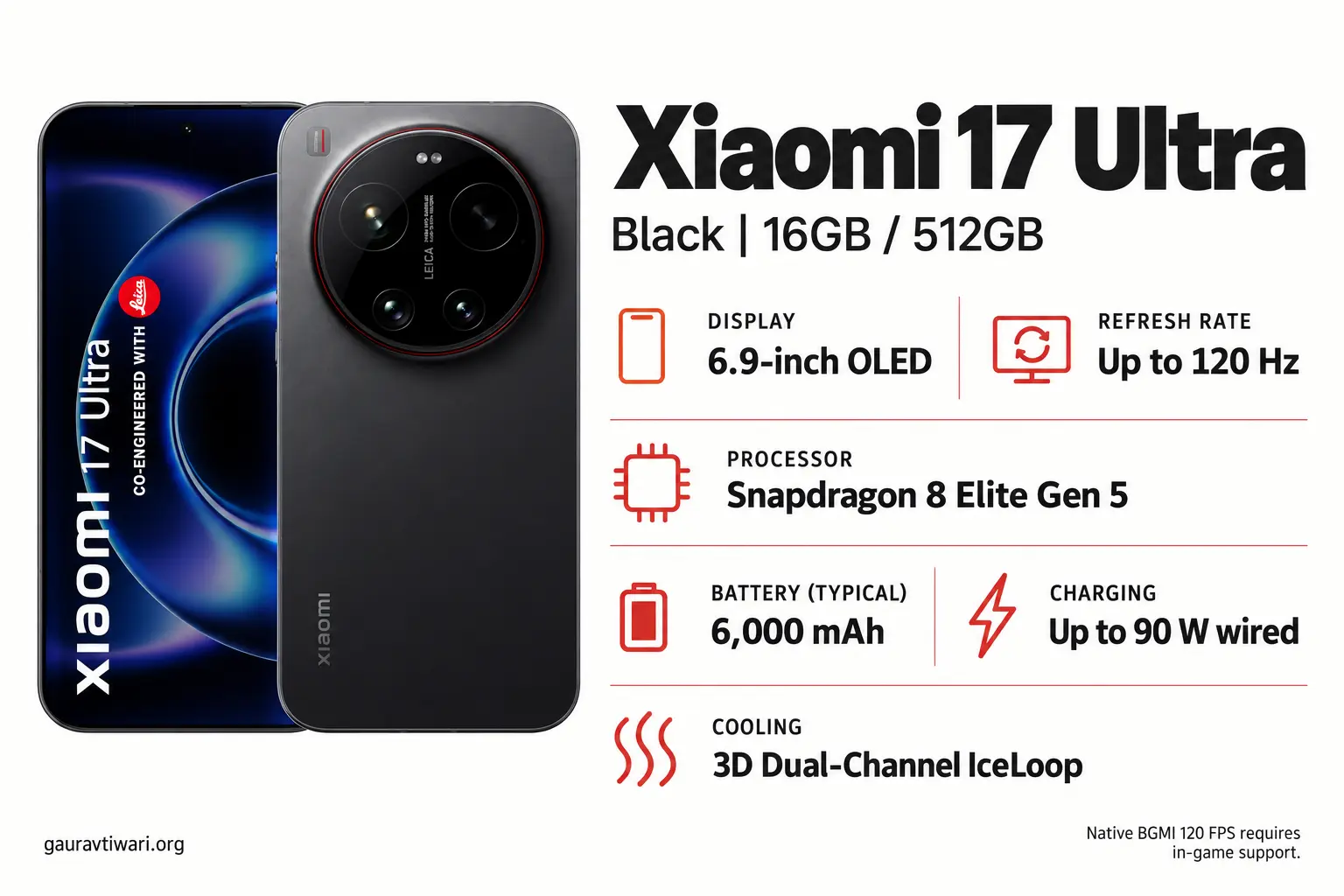
- The Xiaomi 17 Ultra listing on Amazon.in lists a 17.52 cm (about 6.9-inch) display at 1-120 Hz and Snapdragon 8 Elite Gen 5.
- A 6,000 mAh typical battery with up to 90 W wired charging.
- Xiaomi’s 3D Dual-Channel IceLoop cooling system.
The Black Xiaomi 17 Ultra is worth a look if photography matters as much as gaming. Its screen and chip qualify it; native BGMI 120 FPS remains a separate check.
vivo X300 Ultra
vivo X300 Ultra gives you a 144 Hz screen and a big battery inside a camera flagship, at ₹1,59,999 for 16GB/512GB.
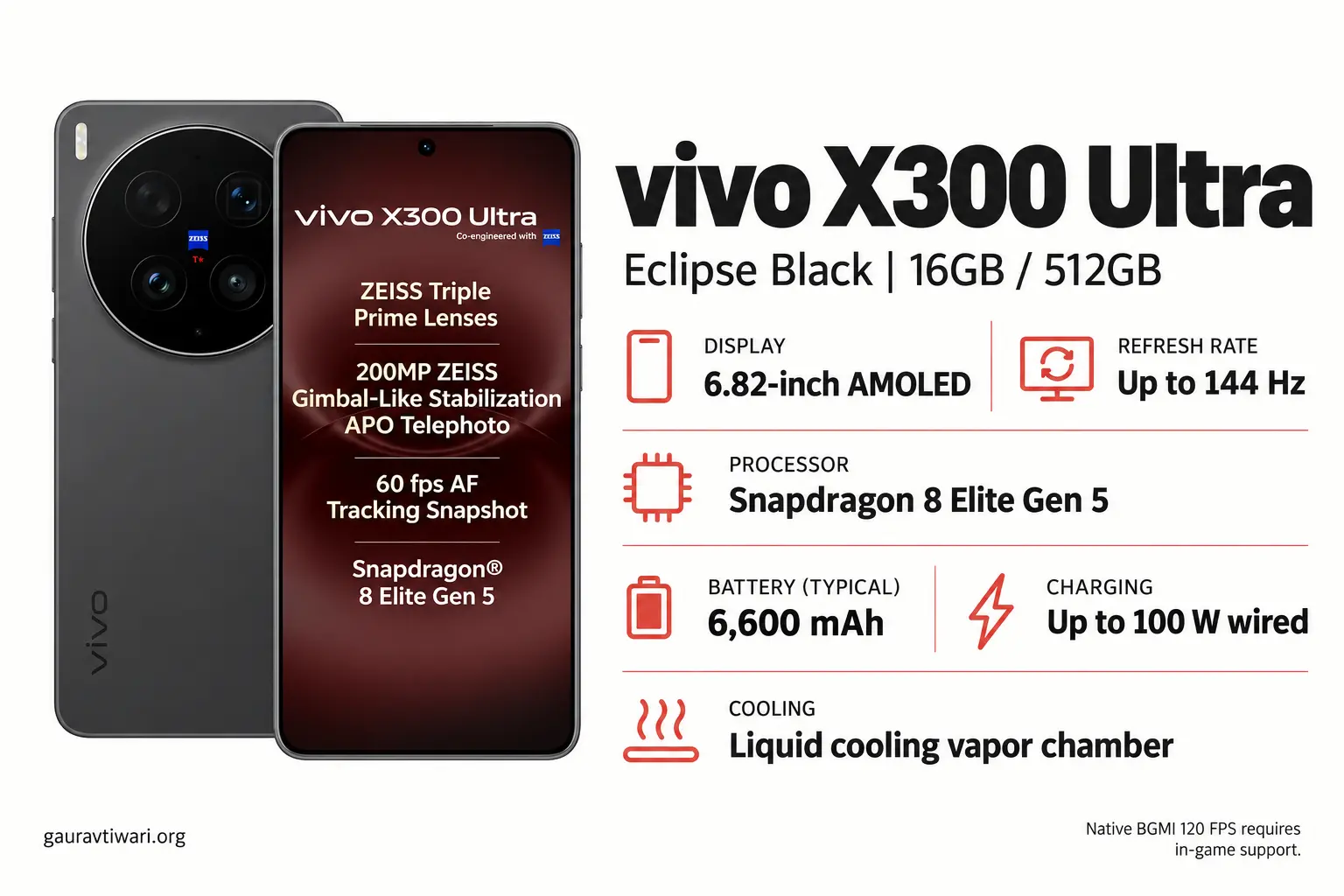
- The vivo X300 Ultra listing on Amazon.in lists a 6.82-inch AMOLED display at up to 144 Hz and Snapdragon 8 Elite Gen 5.
- A 6,600 mAh typical battery with up to 100 W wired charging.
- A liquid cooling vapor chamber, and a weight of 232 g for Eclipse Black.
That 232 g matters if you play with gyroscope on, because you are moving the whole phone to aim. Hold the Eclipse Black X300 Ultra in a store before buying it for long sessions.
OPPO Find X9 Ultra
OPPO Find X9 Ultra is the most expensive Android phone here, at ₹1,69,999 for 12GB/512GB.
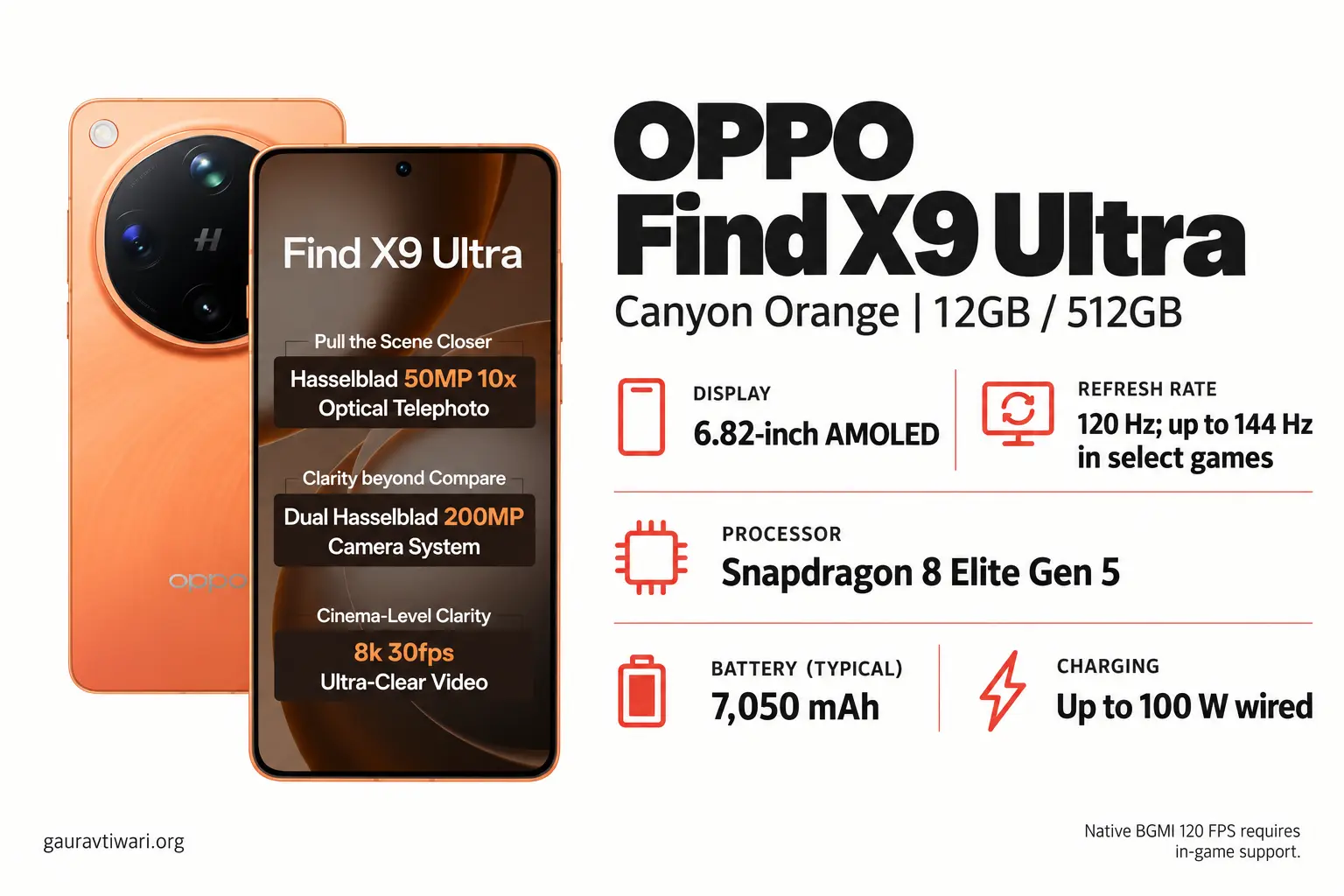
- The Find X9 Ultra listing on Amazon.in lists a 17.32 cm (about 6.82-inch) display that runs at 1-120 Hz and reaches 144 Hz only in some games.
- Snapdragon 8 Elite Gen 5, with a 7,050 mAh typical battery and up to 100 W wired charging.
The Canyon Orange Find X9 Ultra passes every filter, but I’d want to see a specific BGMI advantage before choosing it over the OnePlus 15 for gaming at double the price.
Battery, Charging and Cooling
A Classic match can run close to half an hour, and a ranked session is several of those back to back. That is where battery size, charging speed and cooling start to matter more than peak performance:
| Phone | Typical Battery | Wired Charging | Advertised Cooling |
|---|---|---|---|
| OnePlus 15 | 7,300 mAh | 120 W | 5,731 mm² vapor chamber |
| iQOO 15 | 7,000 mAh | 100 W | 8,000 mm² vapor chamber |
| OPPO Find X9 Ultra | 7,050 mAh | 100 W | Not specified in mm² |
| vivo X300 Ultra | 6,600 mAh | 100 W | Liquid cooling vapor chamber |
| Xiaomi 17 Ultra | 6,000 mAh | 90 W | 3D Dual-Channel IceLoop |
| Samsung Galaxy S26 Ultra | 5,000 mAh | 60 W | Redesigned vapor chamber |
| Samsung Galaxy S25 Ultra | 5,000 mAh | 45 W | Vapor chamber |
Apple doesn’t publish a battery capacity in mAh, so the iPhone 18 Pro Max is left out of this table rather than given a borrowed number.
- A bigger vapor chamber doesn’t prove a cooler phone. The rest of the thermal design and the phone’s power limits decide how it behaves after several matches.
- Battery capacity doesn’t translate directly into gaming hours across brands. Screen brightness, refresh rate and the game’s settings change the drain.
- Bypass charging powers the phone from the charger while skipping the battery, which reduces heat during plugged-in play. Samsung’s Pause USB PD charging guide explains where to find it in Game Booster and which chargers it needs. Check it on the exact model before relying on it.
- Indian summers make every phone work harder. A phone tested in an air-conditioned room will run warmer on a 40°C afternoon, so leave some headroom rather than playing at the highest settings the phone allows.
Software tweaks help too, whichever phone you buy. My guide on how to boost gaming performance on Android covers game modes, background limits and display settings that keep frame rates steadier.
How to Check 120 FPS in BGMI
The only proof that matters is BGMI’s own graphics menu on the exact phone. The BGMI Help Center says the Ultra Extreme frame-rate option must appear in settings for 120 FPS to be available. Krafton enables that option per device, so a fast chip alone doesn’t unlock it.
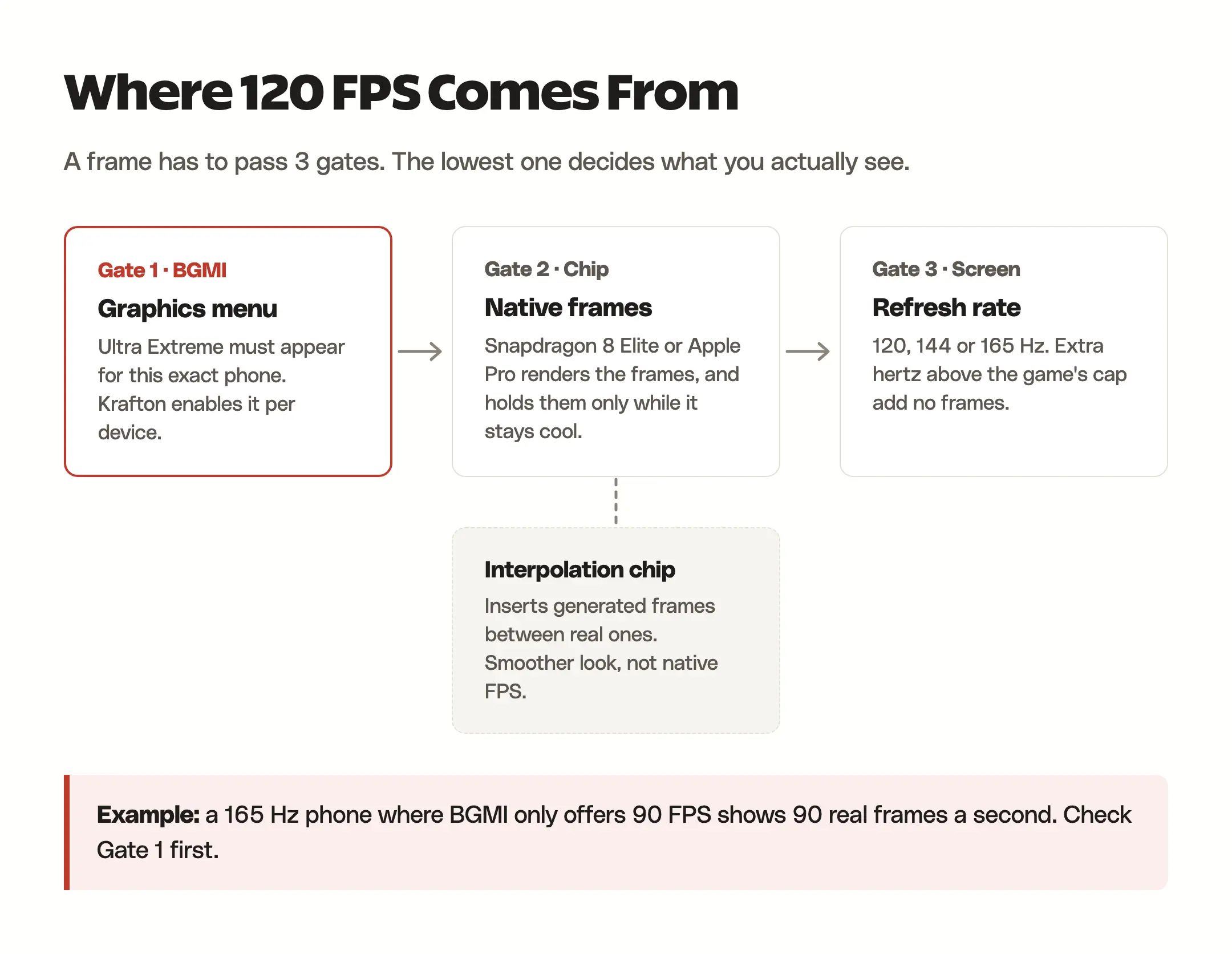
- Hz is how often the screen refreshes. FPS is how many frames the game renders. You need both at 120 to see 120 smooth frames.
- A 144 Hz or 165 Hz screen doesn’t make BGMI run at 144 or 165 FPS. The game’s cap still applies.
- Frame interpolation adds generated frames between real ones. It can look smoother, but it isn’t the game rendering faster, and it can add a little input delay.
- PUBG Mobile results don’t prove BGMI support. The two games are separate apps with separate device lists.
- A settings screenshot shows the option exists. A gameplay recording with an FPS counter shows what happens in a real match.
If 120 FPS is the reason you’re buying, ask a seller, friend or reviewer for a recent clip that shows the game version, the graphics settings and an FPS counter, with interpolation switched off. If you stream or record your matches, the test should include recording too, because that adds load.
Which Phone Should You Buy?
Here is the short version of the decision, in the order I’d think about it:
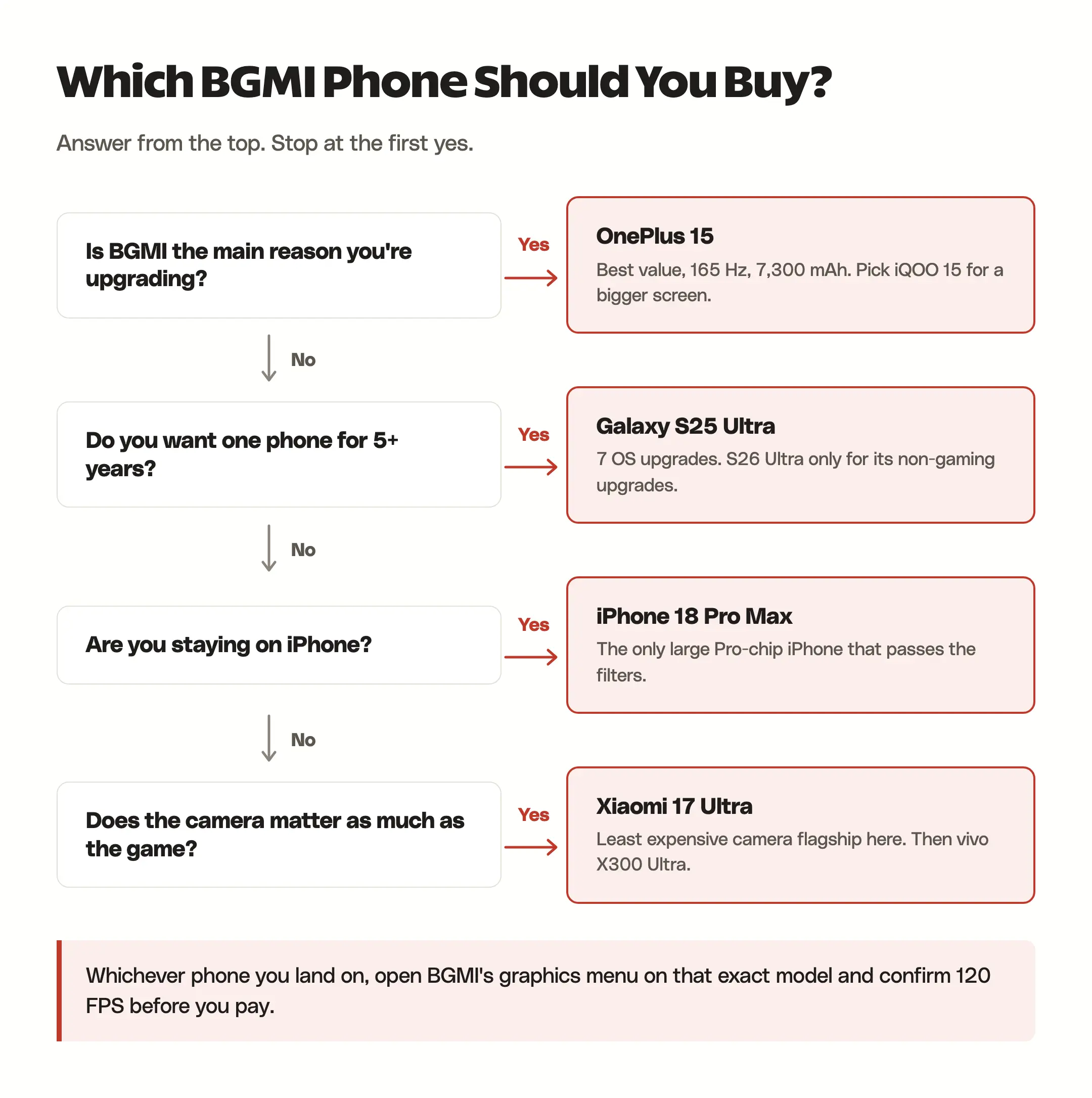
- If BGMI is the main reason you’re upgrading and you’re on Android, buy the OnePlus 15. Pick the iQOO 15 instead if the bigger screen suits your claw layout better.
- If you want one phone for 5 or more years, buy the Samsung Galaxy S25 Ultra, and only step up to the S26 Ultra for its non-gaming upgrades.
- If you’re staying on iPhone, buy the iPhone 18 Pro Max, and treat BGMI as a bonus rather than the reason.
- If the camera matters as much as the game, start with the Xiaomi 17 Ultra, then the vivo X300 Ultra.
Before You Buy
I’d make the final purchase conditional on a few checks:
- Confirm the exact model, storage variant and Indian warranty. The OnePlus 15R and iQOO 15R use Snapdragon 8 Gen 5, not the Elite chip, and fall outside this list.
- Check the current BGMI graphics menu on that model, and ask for recent native gameplay evidence if 120 FPS is essential.
- Play several matches back to back, or watch a long test, before judging heat and frame drops.
- Read the Amazon seller and replacement terms. A missing game setting usually isn’t treated as a hardware defect, so a return may not cover it.
If you’re upgrading from an older phone, its resale value can cover a good part of the gap. My guide on how to sell your old phone for the best price compares exchange offers with selling it yourself.
FAQs on BGMI Phones
Which phone is best for BGMI in India?
The OnePlus 15 is the best value for a BGMI-first buyer, with a 6.78-inch 165 Hz screen, Snapdragon 8 Elite Gen 5 and a 7,300 mAh battery at ₹84,999. The iQOO 15 is the closest alternative with a slightly larger 6.85-inch screen. Confirm 120 FPS in the current BGMI graphics menu before buying either.
Does a 144 Hz or 165 Hz phone run BGMI at 144 FPS?
No. BGMI sets its own frame-rate cap, and 120 FPS is the highest option the BGMI Help Center describes. A faster screen gives you headroom and smoother menus, but the game decides how many frames it renders.
Is frame interpolation the same as 120 FPS?
No. Interpolation chips such as iQOO’s Q3 insert generated frames between the frames the game renders. It can look smoother, but the game itself isn’t rendering more frames, so compare phones with interpolation switched off.
Is the iPhone good for BGMI?
Recent Pro Max iPhones play BGMI smoothly and get long iOS support, but they cost far more than Android phones with similar gaming hardware. Older or non-Pro iPhones with 60 Hz screens, like the iPhone 16 Plus, top out at 60 FPS.
Buy the phone that suits how you play, and check that BGMI actually offers 120 FPS on it before you pay. A ₹85,000 OnePlus or iQOO with the right settings unlocked will serve a ranked player better than a ₹1.7 lakh camera flagship that doesn’t.