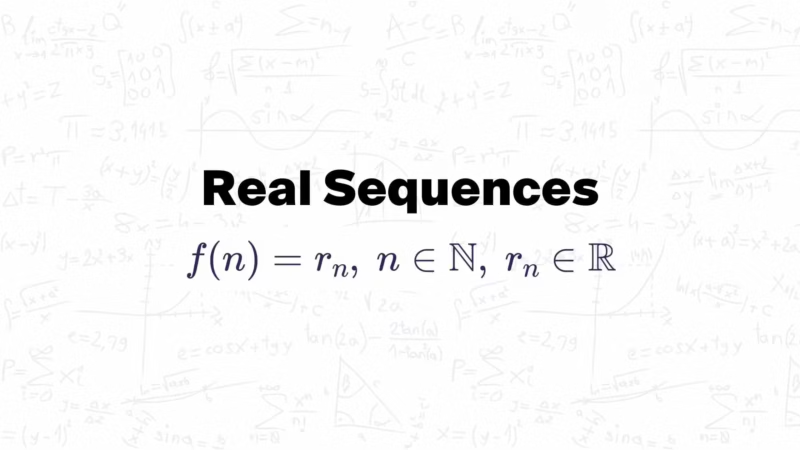
Real sequences form the backbone of real analysis and advanced calculus. I’ve taught this topic to dozens of students, and the key is grasping what sequences represent: ordered lists of real numbers with specific convergence behavior. This guide covers definitions, limit theorems, bounded and monotone sequences, with worked examples throughout.
Mathematics

The area of a disk is pi times radius squared. You memorized this in middle school. But do you know why it’s true? Most people don’t. I show you the derivation using calculus and the elegant geometric argument that predates it. Understanding the proof reveals how mathematics builds complex results from simple principles.

The triangle inequality sounds obvious. No side of a triangle can be longer than the other two sides combined. But proving it rigorously is where things get interesting. I cover the geometric intuition, the formal proof, and the generalizations that make this inequality one of the most useful tools in analysis and metric spaces.

You can figure out what day of the week any date falls on. No calendar needed. Just arithmetic. I’ll teach you a genuine mathematical formula that works for any date after 1582. It takes about 30 seconds once you’ve practiced. Impress your friends or just satisfy your curiosity about historical dates.

Equations are the reason we can solve problems in seconds that would take hours of guesswork. I cover the basics: what equations are, how they work, types of equations, and solving techniques. If you’re just starting your math journey, understanding equations is the single most important skill you’ll develop.

Numbers are the alphabet of mathematics. But here’s what most people never learn: all the complex numbers you encounter, from imaginary numbers to quaternions, are built from a few simple ideas. I start from natural numbers and work up through integers, rationals, reals, and complex numbers, showing how each extends the last.
Logic is the grammar of mathematics. Without logical precision, you can’t communicate ideas or verify they’re correct. Propositions, truth tables, logical connectives, quantifiers, and proof methods explained.
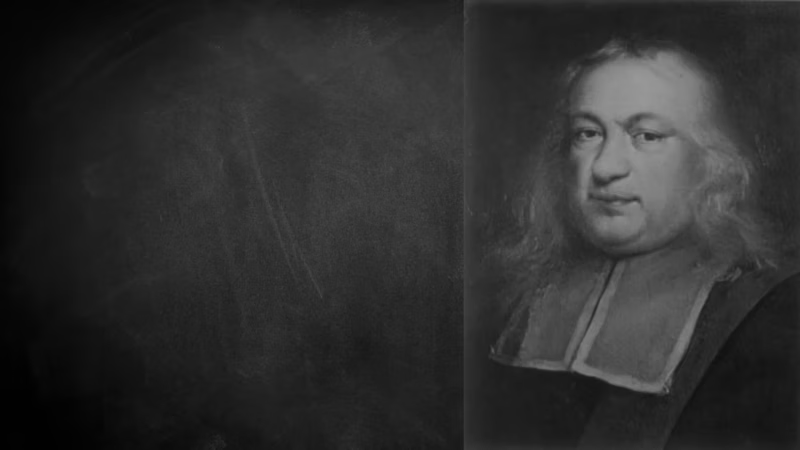
Fermat was convinced he’d found an infinite source of primes. He was wrong. His formula n^2 + n + 41 produces primes for the first 40 values, then fails spectacularly. I cover the important theorems about Fermat numbers, their properties, and why one of history’s greatest mathematicians got fooled by a pattern.
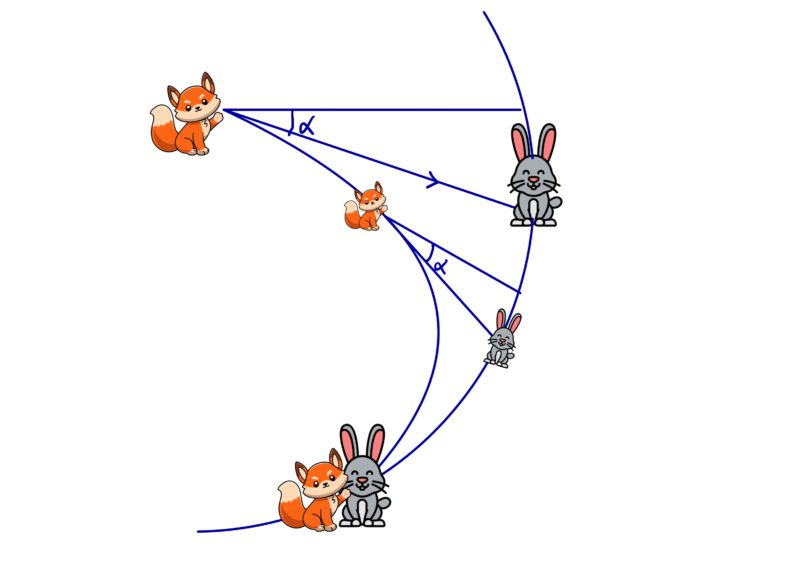
Pursuit problems are some of the most elegant challenges in classical mechanics. A fox chases a rabbit, both moving at constant speed. What path does the fox follow? I present the complete solution with mathematical proof, drawing from David Morin’s work. The calculus is surprisingly deep and the geometry is beautiful.
In 1872, Weierstrass presented a function that’s continuous everywhere but differentiable nowhere. It shattered the assumption that smooth curves are normal. Here’s the full construction, the proof, the historical shock, and why the Baire category theorem shows most continuous functions behave this way.
Most math students use real numbers without ever understanding how they’re constructed. Dedekind solved this with his theory of cuts. He showed how to build the real numbers rigorously from the rationals, filling in all the gaps. I walk through the construction step by step, making this foundational concept accessible.
The Dirichlet theorem connects the Gamma and Beta functions to evaluate complex multiple integrals. Liouville extended it further, making it even more powerful. I cover both theorems with complete proofs, examples, and practical applications. If you’re studying real analysis or probability theory, you’ll use these results constantly.