
Function notation and rules form the foundation of higher mathematics. Understanding how functions work, including domain, range, composition, and inverse operations, is essential for algebra, calculus, and beyond. This reference page covers function notation conventions, key rules for function operations, graphical interpretation, and worked examples that build solid understanding. Whether you’re studying for exams or reviewing fundamentals, this resource has you covered.
Mathematics

Sets are fundamental mathematical objects that form the basis of modern mathematics. From set notation and types of sets to operations like union, intersection, and complement, understanding set theory is essential for discrete mathematics, probability, and computer science. This reference covers set definitions, notation, operations, Venn diagrams, and key properties.
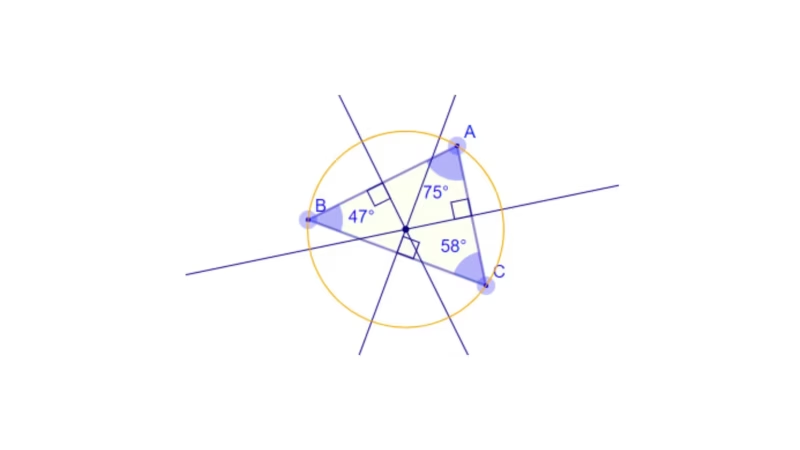
The circumcenter of a triangle is the point where the perpendicular bisectors of all three sides intersect. It’s equidistant from all three vertices, making it the center of the circumscribed circle. Understanding circumcenters is fundamental to geometry, with applications in navigation, computer graphics, and engineering. This article covers the definition, types based on triangle classification, construction methods, formulas, and worked examples.

A complete student reference for significant figures: the five counting rules with worked examples, precision vs accuracy, scientific notation, rounding, and the sig-fig rules for multiplication, division, addition, and subtraction. Includes a decision flowchart, an upgraded calculator that counts and rounds, and a free PDF.

The zero of a function is where it crosses the x-axis, meaning f(x) equals zero at that point. Finding zeros is fundamental in algebra and calculus, used in solving equations, graphing functions, and optimization problems. This reference covers methods for finding zeros including factoring, the quadratic formula, Newton’s method, and graphical approaches with worked examples.

Mathematics has thousands of formulas, but only a handful will genuinely change how fast you solve problems. After years of teaching and solving competitive math problems, I’ve identified the time-saving formulas and theorems that give you the biggest advantage. These aren’t obscure tricks. They’re essential tools that top math students use every day.

We’ve covered integral equation basics and the trial method. Now comes the interesting part: going in reverse. Converting integral equations back into differential equations is a powerful technique that often simplifies the solution process. I walk through the methodology with examples, showing when and why this reverse conversion is useful.

Functional analysis is where linear algebra meets topology. It’s the mathematical backbone of quantum mechanics, signal processing, and machine learning. Essential definitions: normed spaces, Banach spaces, Hilbert spaces, and bounded operators.

Every differential equation can be converted into an integral equation. Just integrate it. Sounds too simple, right? The details matter though. I walk through the conversion process step by step, covering initial value problems, boundary value problems, and the Green’s function approach. The technique is straightforward once you see the pattern.
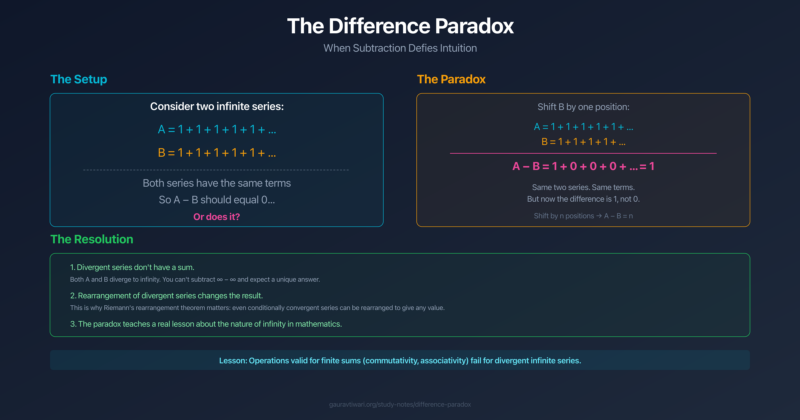
The Difference Paradox is one of those mathematical puzzles that makes you question your arithmetic. The setup is simple, the calculations seem correct, but the answer is clearly wrong. I walk through the paradox, identify exactly where the reasoning breaks down, and explain why mathematical precision matters more than intuition.

Part II of the integral equations series. Covers L2 spaces, inner products, norms, Schwarz inequality, and solving integral equations by the trial method with a worked Volterra equation example.
Integral equations look intimidating, but they’re built from ideas you already know. I explain what integral equations are, their classification system (Fredholm vs Volterra, first vs second kind), and how they relate to differential equations. This introduction gives you the vocabulary and framework to tackle more advanced techniques.