
Mathematical Analysis · Free 22-page PDF
Elementary Analysis on Ramanujan’s Nested Radicals
Ramanujan nested radicals look like mathematical sleight of hand until you track the finite approximants and convergence conditions. This free PDF starts with denesting, builds the constant-coefficient case, and then works toward Ramanujan’s famous identity, general formulas, continued fractions, and Herschfeld’s criterion.
22 A4 pages · 13 chapters · 8 references · 2 appendices · 853,233-byte PDF
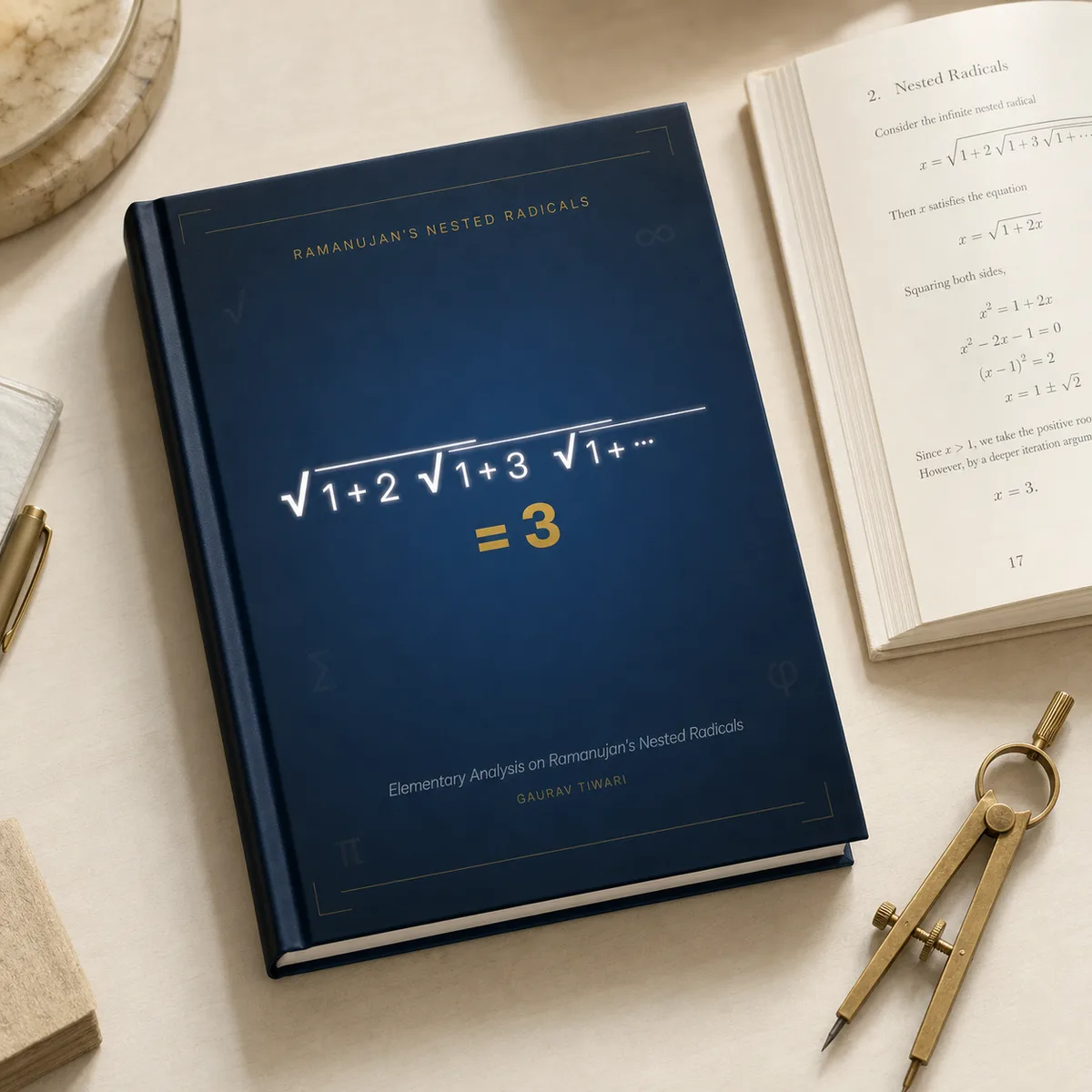
Format:
What’s actually inside
A 22-page route from algebra to convergence.
The current PDF is organized as a mathematical note, not a collection of puzzle answers. It has 13 numbered chapters, a reference list, a numerical-values appendix, and an appendix on Viète’s formula.
Start with the algebra
- Definitions, notation, depth, finite radicals, and infinite radicals
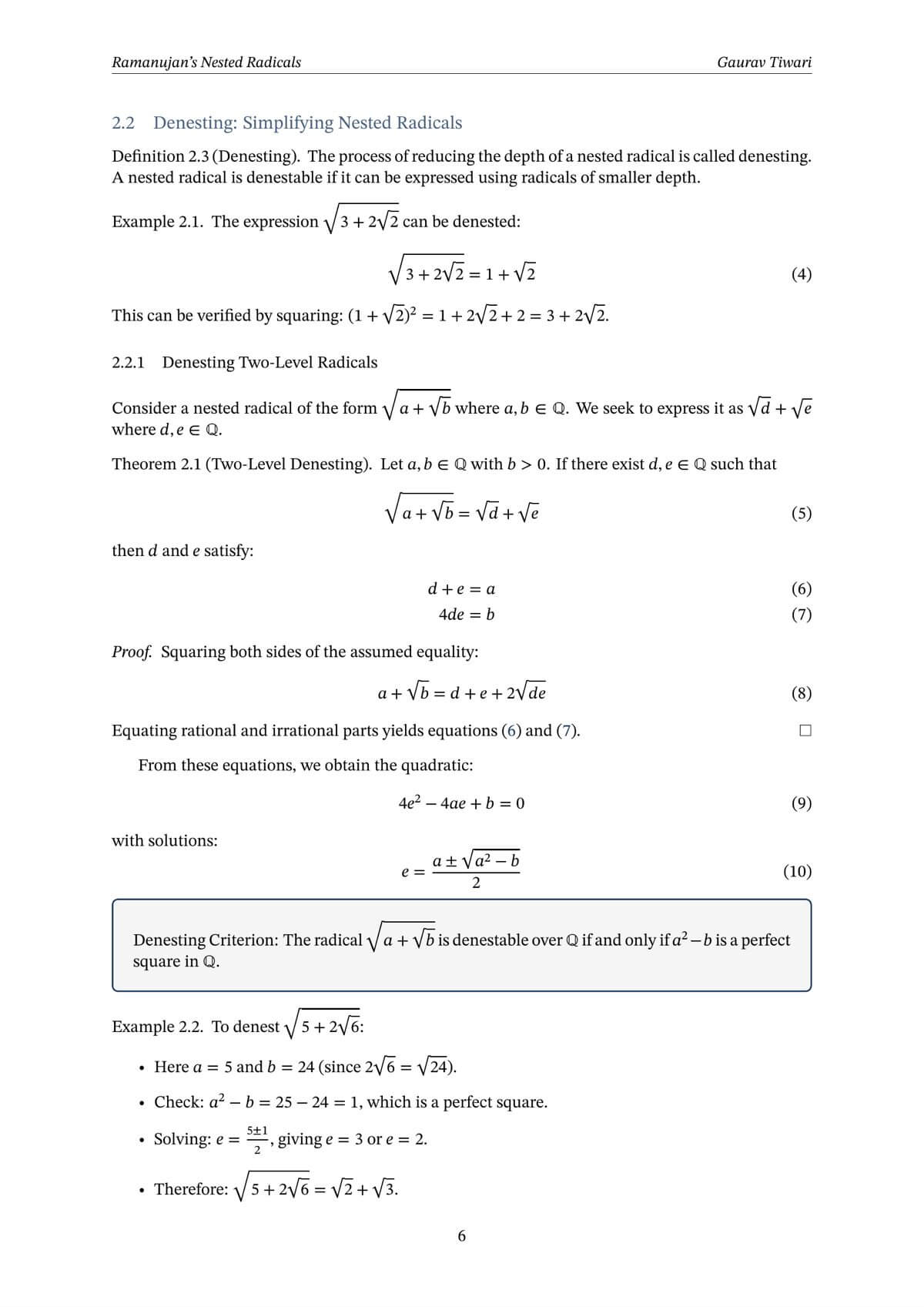
- Two-level denesting with rationality conditions
- Three-level denesting and why the algebra grows quickly
- Ramanujan’s general construction from a binomial identity
Separate value from convergence
- Constant-coefficient radicals and their positive fixed points
- The golden ratio and the plastic constant as special limits
- Herschfeld’s 1935 boundedness criterion for nonnegative terms
- Why solving a fixed-point equation alone does not prove convergence
Follow the classical identities
- The radical commonly written as √(1 + 2√(1 + 3√(1 + …)))
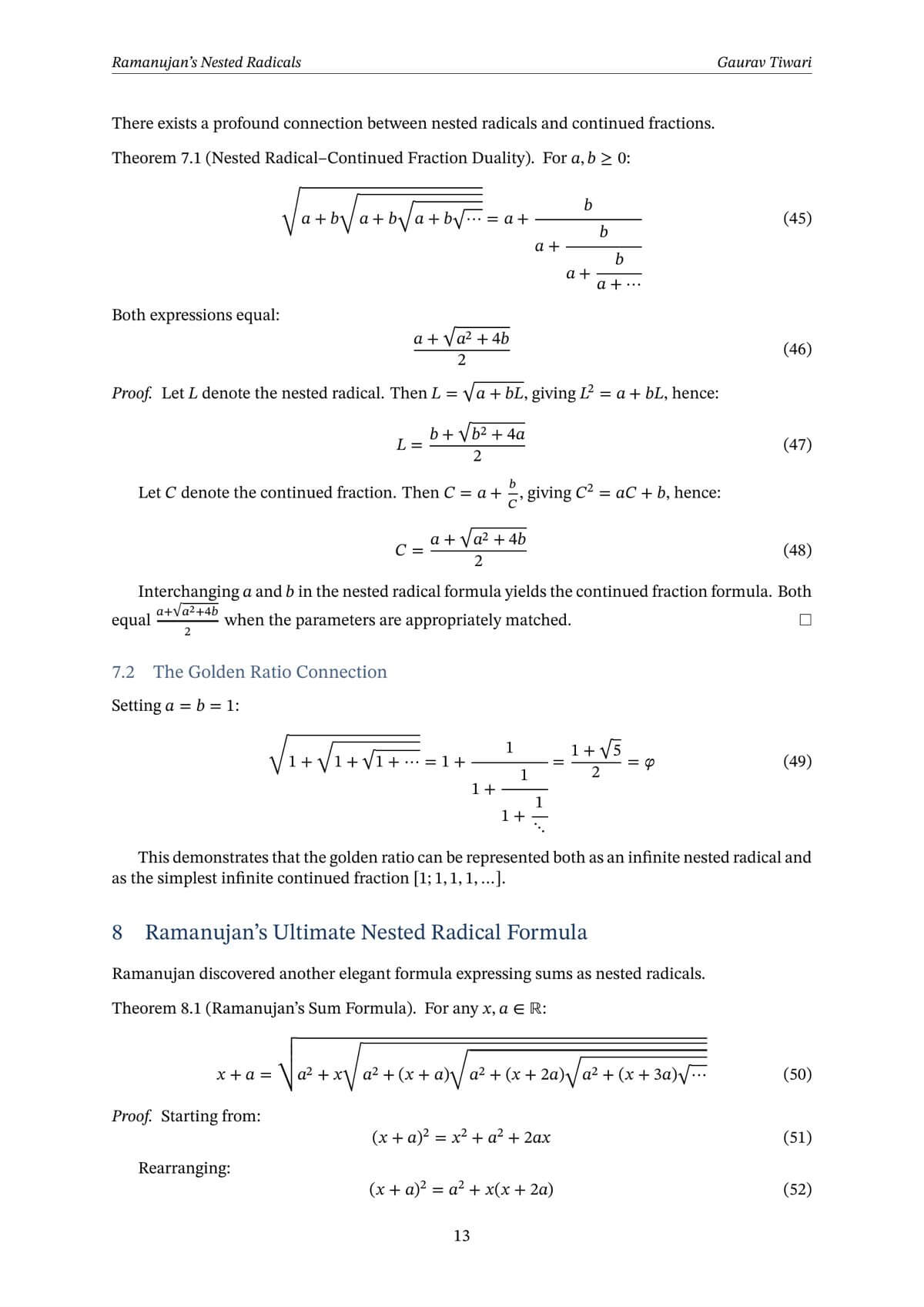
- Continued-fraction comparisons and Ramanujan’s sum formula
- A section on the identity often called Ramanujan’s wild theorem
- Derived identities and numerical values for selected radicals
Know where the note gets exploratory
- Brief extensions to differentiability and integration
- Open questions involving mixed degrees and complex values
- A short discussion of possible modular-form connections
- Viète’s nested-radical product for π in the final appendix
A result you can check now
The constant-coefficient radical has a clean fixed point.
Suppose the nonnegative infinite radical converges:
L = √(a + L)
Squaring gives L² – L – a = 0, so the nonnegative candidate is:
L = (1 + √(1 + 4a)) / 2
- For a = 1, the value is (1 + √5) / 2, the golden ratio.
- For a = 2, the value is 2.
- The fixed-point calculation identifies a candidate. A convergence argument is still required before treating an infinite expression as that value.
The reference spine is identifiable.
The PDF’s bibliography includes Bruce C. Berndt’s Ramanujan’s Notebooks, Ramanujan’s Collected Papers, and these two foundational results:
- Aaron Herschfeld’s 1935 paper, “On Infinite Radicals”, for convergence.
- Susan Landau’s 1992 paper, “Simplification of Nested Radicals”, for algorithmic denesting.
- The 2005 analysis of Ramanujan’s notebook entry, which distinguishes two related expansion formulas.
A sensible reading order
Do not read this as 22 pages of equal difficulty. Use the chapters in layers:
- Read Chapters 1 and 2 for notation and finite denesting.
- Jump to Chapter 5 and verify the constant-coefficient fixed point yourself.
- Read Chapter 6 before accepting any infinite radical merely because its algebra looks plausible.
- Return to Chapters 3 and 4 for the Ramanujan nested radicals construction and special cases.
- Treat Chapters 7 through 11 as the advanced path, then use Chapter 12 and the appendices as further directions.
The file was originally written in 2010-2011 and revised and expanded in January 2026.
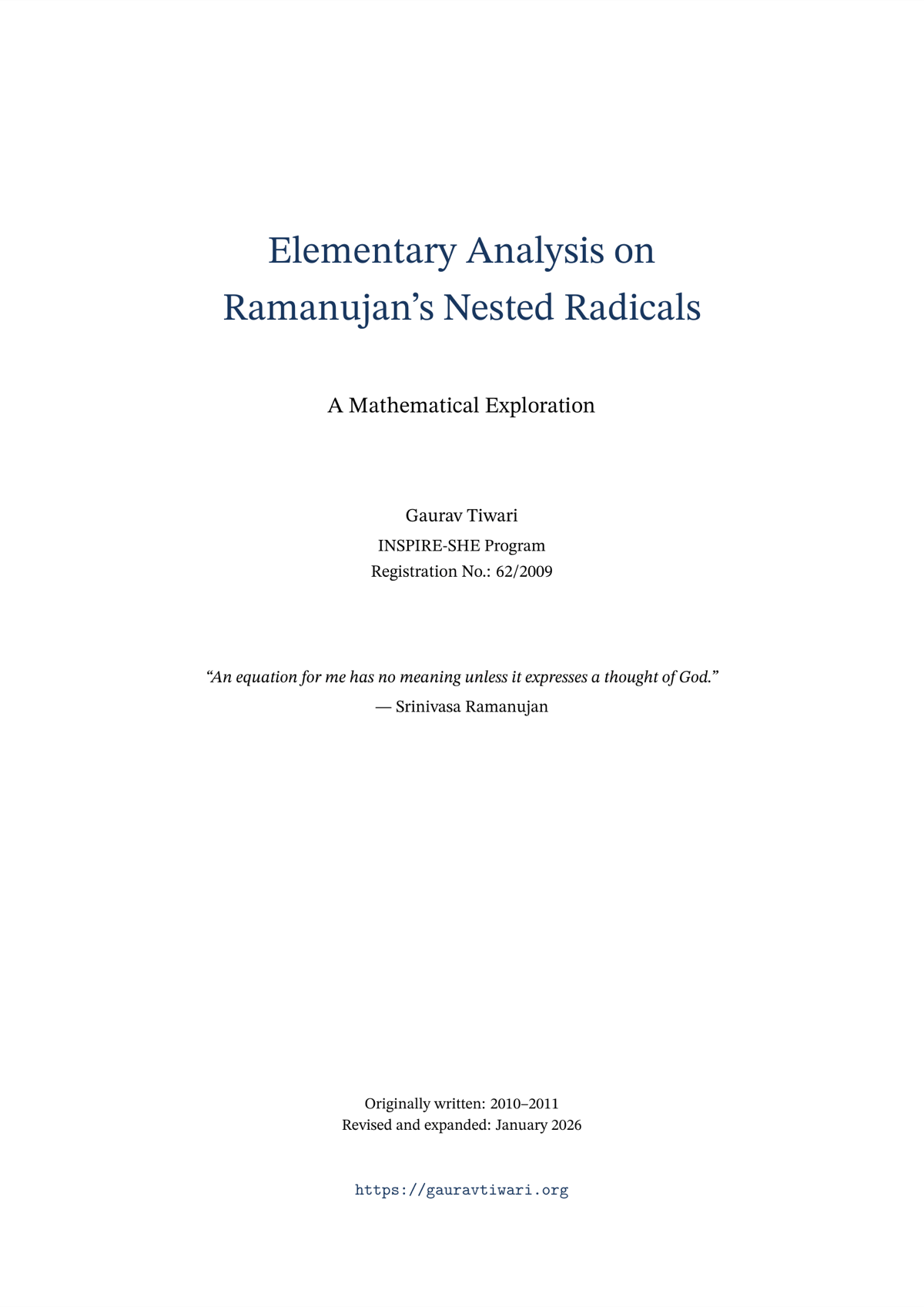
Book Preview
Preview the writing, structure, and page layout before you decide.
Get the book
Elementary Analysis on Ramanujan’s Nested Radicals
Free
22-page digital PDF · 853,233 bytes · instant delivery after free checkout
- Build denesting from definitions instead of memorizing isolated tricks
- Work through the fixed-point calculation and the missing convergence step
- Study the Ramanujan nested radicals construction and the famous radical that equals 3
- Compare nested radicals with continued fractions and Viète’s formula
- Use the bibliography to continue into Herschfeld, Landau, Berndt, and Ramanujan
- Keep the open-problem and modular-form sections in perspective
Price: 0 · active PDF download · no payment information required
Questions readers ask
Download Questions
Is it actually free?
Yes. The live product variant is active, available, and priced at 0. The checkout creates an order so FluentCart can issue the PDF download.
What exactly do I receive?
One 853,233-byte PDF titled Elementary Analysis on Ramanujan’s Nested Radicals. The current edition is 22 A4 pages and includes 13 numbered chapters, 8 references, and 2 appendices.
How much analysis do I need?
You should be comfortable with algebra, square roots, sequences, and the binomial theorem. The note introduces its notation, but Herschfeld’s criterion and the later calculus sections reward a first course in analysis.
Is this a biography of Ramanujan?
No. The historical section is brief. The rest is mathematical: denesting, fixed points, convergence, identities, continued fractions, calculus, open directions, and two appendices.
Is this a peer-reviewed research paper?
No. It is not peer-reviewed. It is a self-published mathematical exploration, not a journal article. The core references are listed, while the final open-problem and modular-form discussion should be read as direction rather than a complete research treatment.
What this book does not pretend to be
- It is not peer-reviewed. Treat it as a guided mathematical note with a bibliography, not as the final authority on every identity.
- It is not a biography. Ramanujan’s life receives context, but the book is about the mathematics.
- It is not uniformly elementary. The denesting examples are accessible; the convergence criterion, general formulas, and later extensions require slower reading.
- It is not a complete modular-forms treatment. That connection appears as a further direction, not a proved comprehensive theory.

Why I wrote this
I studied mathematics formally and taught it before my work shifted toward publishing and software. Nested radicals stayed with me because they punish a common mathematical shortcut: finding a plausible value is not the same as proving an infinite expression converges to it.
I’ve spent 18 years moving between mathematics, teaching, web publishing, and software. This note began in 2010-2011 and was revised in January 2026. I kept the route I find most useful: start with algebra you can verify line by line, then make the convergence assumptions visible before moving into Ramanujan’s broader constructions.
Free download
Check the algebra, then earn the infinite limit.
Download the 22-page PDF, begin with the denesting examples, and keep the convergence question beside every infinite radical.
Free PDF · 13 chapters · 8 references · 2 appendices
From the Workbench
Notes on WordPress, publishing, search, and independent products, sent when something real comes off my bench.