
 by
bySearch “how much does YouTube pay” and you’ll find answers anywhere from a tenth of a cent to several cents a view. Most of the bigger figures are what advertisers pay YouTube, counted before YouTube takes its share and before the views with no ads are added in, so a channel planned around them promises far more than it pays.
For a regular long video, most channels earn between $1 and $5 for every 1,000 views after YouTube’s cut. That works out to 0.1 to 0.5 cents a view, or $1,000 to $5,000 for 1 million views, while Shorts pay between 1 and 20 cents per 1,000 views.
The number that settles it for your channel is your RPM, the revenue per 1,000 views that YouTube Studio shows once you’re monetized. A finance channel watched in the US can see $10 or more, and a gaming channel watched mostly in India can see less than $1.
How Much Does YouTube Pay per 1,000 Views
YouTube calls this figure RPM, short for revenue per mille, and it’s what you earn per 1,000 views after YouTube has taken its share. The ranges below are creator-reported RPMs collected by earnings trackers, merged into one range per row. They lean toward channels with US and UK viewers, so read them as the upper shape of the market, and your own Studio number replaces them the day you’re monetized:
| Niche | Typical RPM per 1,000 views | What 1 million views pays |
|---|---|---|
| Finance and investing | $8 to $20 | $8,000 to $20,000 |
| Business, software and marketing | $5 to $14 | $5,000 to $14,000 |
| Technology and product reviews | $4 to $12 | $4,000 to $12,000 |
| Education and tutorials | $3 to $9 | $3,000 to $9,000 |
| Health and fitness | $2 to $8 | $2,000 to $8,000 |
| Food, travel and lifestyle | $1.50 to $5 | $1,500 to $5,000 |
| Entertainment and comedy | $0.50 to $3 | $500 to $3,000 |
| Gaming | $0.50 to $3 | $500 to $3,000 |
| Shorts, any niche | $0.01 to $0.20 | $10 to $200 |
Measured data runs lower. AIR Media-Tech’s 2026 study of Studio data from 300 channels, most of them with international audiences, found a median RPM of about $2.30 across all niches, with gaming and tech channels mostly between $0.70 and $3.70. That’s why I’d plan with the low end of your row. A channel that pays its bills at the bottom of the range survives January, when advertisers reset their budgets and RPM usually dips.
Where your viewers live matters as much as the topic, because advertisers bid country by country. To an advertiser, a viewer in Ohio can be worth several times a viewer in Odisha, so the same niche moves up or down with your audience mix:
| Where the viewers are | Typical RPM per 1,000 views |
|---|---|
| United States | $3 to $12 |
| Australia, United Kingdom, Canada | $2 to $9 |
| Germany, France | $1.50 to $6 |
| United Arab Emirates | $1.50 to $4 |
| Brazil, Mexico | $0.30 to $2 |
| India | $0.20 to $2 |
| Pakistan, Bangladesh, Philippines | $0.20 to $1.50 |
That’s why two channels with the same subject and the same views can be 5 times apart in income. The language you make videos in decides which of these rows you land in long before the first upload.
How Much Does YouTube Pay per View
Per view, the money is small enough that fractions of a cent are easier to picture. Nobody is paid per view in the literal sense. YouTube pays for the ads that ran, and the per-view figure is that money spread across every view, including the ones that showed no ad:
- $1 RPM: $0.001 per view, a tenth of a cent
- $3 RPM: $0.003 per view
- $10 RPM: $0.01 per view, a full cent
- Shorts at $0.05 RPM: $0.00005 per view
So a like, a comment or a new subscriber pays nothing on its own. Those help a video reach more people, and reach is what brings in the ads.
How Much Does YouTube Pay for 1 Million Views
1 million views on a regular video pays $1,000 to $5,000 for most channels. The same milestone stretches a long way depending on the audience, and these examples use a typical rate for each kind of channel:
- A gaming channel with a worldwide audience at $1.50 RPM: $1,500
- A cooking channel watched in the US and the UK at $3.50 RPM: $3,500
- A personal finance channel watched in the US at $12 RPM: $12,000
- A Hindi comedy channel watched in India at $0.40 RPM: $400
- 1 million Shorts views at $0.05 RPM: $50
The finance channel and the comedy channel can put in the same hours for the same number of people, and one earns 30 times the other. Most of that gap is decided before the first upload, by the topic and the audience it attracts.
At the very top, ad money is usually the smaller part of the income. The highest-paid YouTubers earn most of theirs from sponsorships, products and licensing, and I’d think about ad revenue the same way, as the floor a channel stands on.
CPM vs RPM
Most of the confusion about YouTube pay comes from two numbers that sound alike and measure different things. I want to ensure these are clear before the rest, because nearly every “YouTube pays $10 per 1,000 views” claim is a CPM being read as an RPM:
- CPM is what advertisers pay per 1,000 ad impressions, before YouTube’s share, counted only on the views where an ad was shown.
- Playback-based CPM spreads that cost over 1,000 playbacks that carried at least 1 ad, so it runs higher when a long video shows 2 or 3 ads.
- RPM is your total revenue per 1,000 views after YouTube’s share, counted over every view. It includes ads, YouTube Premium, channel memberships, Super Chat, Super Stickers and Super Thanks.
YouTube’s split for ads on long videos is 55% to the creator and 45% to YouTube. The gap between CPM and RPM is wider than that 45%, though, because RPM divides by every view and plenty of views never show an ad: viewers with ad blockers, people who leave before the first ad loads, videos with limited ads and countries where nobody bid. The example below walks a $10 CPM down to the RPM it usually becomes:
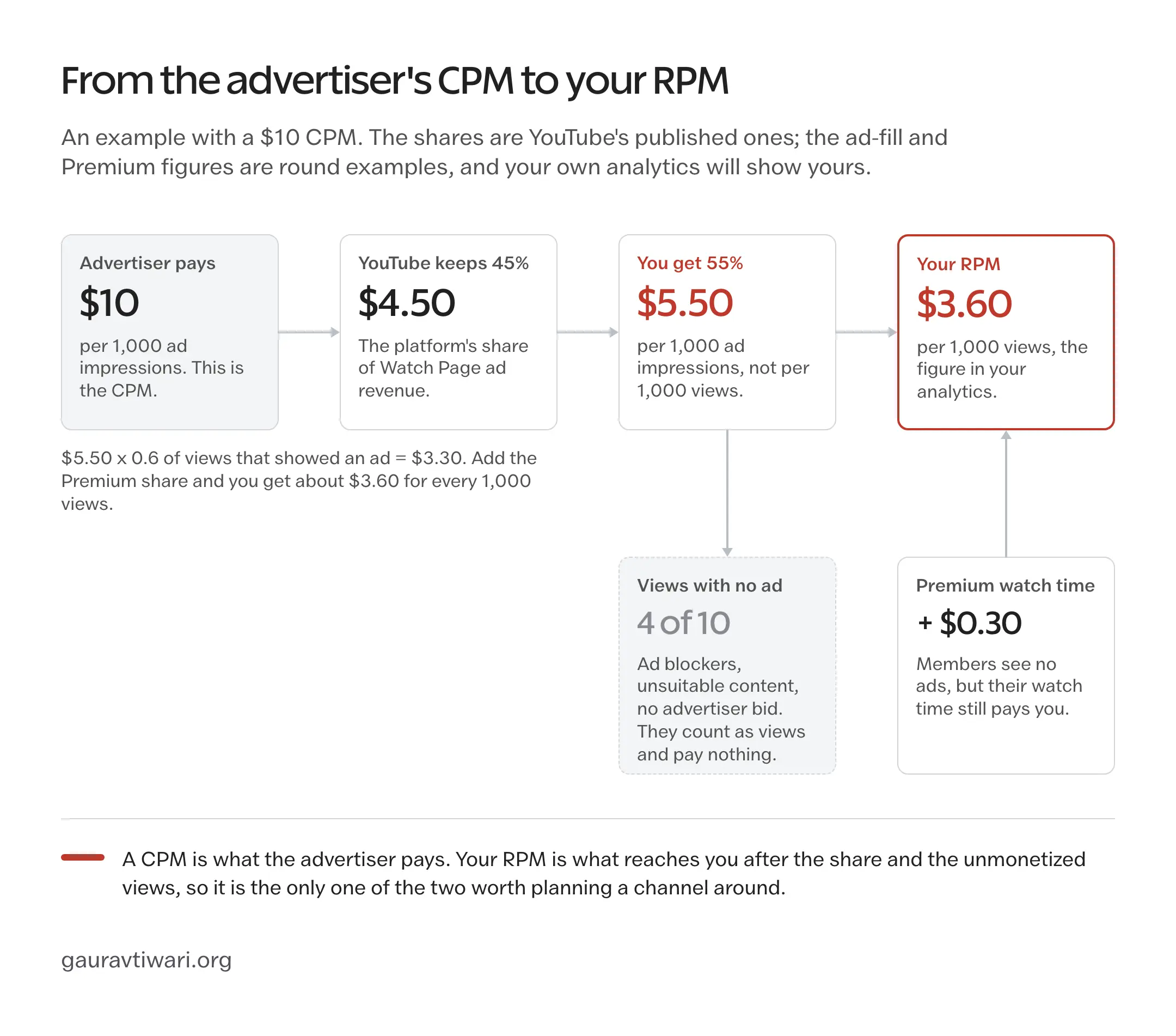
A $10 CPM turning into $3 or $4 of RPM is the normal case and says nothing bad about your channel. Advertisers, agencies and people selling courses on YouTube income quote the CPM because it’s the bigger number, and your bank account only ever sees the RPM.
What Decides Your RPM
These are the things that move the figure, roughly in order of how much they move it. The first two are hard to change once a channel is running, and they also matter most:
- Where the viewers are. Advertisers bid per country, so an audience in the US, Canada, the UK and Australia earns several times what the same video earns from viewers in India, Pakistan or Indonesia.
- What the video is about. Advertisers pay for buying intent, so a viewer choosing insurance, software or a course is worth more to them than one watching a prank.
- Whether the video runs 8 minutes or longer. Only videos of 8 minutes or more can carry mid-roll ads, which is where a second or third ad per view comes from. YouTube places them automatically, where you mark a break or both, and no slot is guaranteed to fill.
- Ad suitability. Profanity early in a video, violence, adult themes or a misleading title and thumbnail shrink the pool of advertisers willing to bid. The yellow limited-ads icon in YouTube Studio is a pay cut on that video.
- The month. Ad budgets peak from October to December and reset in January, so the same video can earn noticeably less in the first weeks of the year.
- YouTube Premium watch time. Premium members see no ads, but YouTube shares their subscription money by how long they watched your videos, downloads and background play included.
- Made-for-kids settings. Videos set as made for kids don’t get personalized ads, which usually lowers their RPM. The setting has to match the content, whatever it costs.
I wouldn’t pick a topic for its RPM alone. A finance channel you can’t keep going for a year earns less than a gaming channel you can.
How Much Does YouTube Pay for Shorts
Shorts pay far less per view, because they run on a shared pool instead of ads attached to each video. Every month, YouTube works through these steps for each country:
- It pools the revenue from ads shown between Shorts.
- It sets aside the cost of music licensing, based on how many tracks each Short used.
- It allocates what remains, the Creator Pool, to monetizing creators by their share of engaged Shorts views.
- Each creator keeps 45% of their allocation, whether or not their Shorts used music.
Reused, unedited clips from films, shows or other creators don’t qualify, and views from before you accept the Shorts Monetization Module don’t count. Reported Shorts RPM mostly sits between $0.01 and $0.20 per 1,000 views, which is a small fraction of what the same channel earns on long videos, and channels with mostly US viewers reach about $0.30.
Two changes arrive on February 1, 2027. Creator Pool earnings will need 10 million qualified Shorts views over the previous 90 days, though missing that bar doesn’t remove a channel from the Partner Program or touch its long-form earnings. And when an advertiser targets Shorts ads at 5 or fewer channels, eligible creators get a direct 45% share of that money on top of the pool.
I’d treat Shorts as the way people find a channel and long videos as the way it earns. If you’re weighing platforms, YouTube Shorts vs TikTok compares the two formats, and my guide to how much TikTok pays covers the other side of the math.
YouTube Monetization Requirements
YouTube pays nothing until you join the YouTube Partner Program, and the program opens in two tiers. The lower tier unlocks fan funding before ads:
- Fan funding tier: 500 subscribers, 3 public uploads in the last 90 days, and either 3,000 qualified watch hours in the last 12 months or 3 million qualified Shorts views in the last 90 days. It opens memberships, Super Chat, Super Stickers, Super Thanks and shopping.
- Ad revenue tier: 1,000 subscribers and either 4,000 qualified watch hours in the last 12 months or 10 million qualified Shorts views in the last 90 days. Watch time from the Shorts feed doesn’t count toward the 4,000 hours.
- Account basics: live in a country where the program is available, turn on 2-Step Verification, have no active Community Guidelines strikes and link an AdSense for YouTube account.
YouTube has announced a higher bar for new applicants from February 1, 2027: 1,000 subscribers plus 8,000 qualified watch hours in the last 365 days, or 20 million qualified Shorts views in the last 90 days. Channels already in the program keep their status, but every partner has to accept the updated terms in YouTube Studio by January 31, 2027. A channel that misses the date stays in the program and stops earning from the affected features until it accepts.
If you’re close to 4,000 watch hours now, it is wise to cross the line and apply before February 1, 2027, because a channel applying after that date needs twice the watch time. Until you qualify, there are ways to earn from YouTube videos without 1,000 subscribers, mostly through sponsorships, affiliate links and your own products.
How Many Views Do You Need to Make Money on YouTube
The formula is short: views multiplied by RPM, divided by 1,000, gives what you earn before tax and expenses. Worked backward, this table shows the views a month you’d need for three common targets:
| Monthly target | At $1 RPM | At $3 RPM | At $5 RPM | At $10 RPM |
|---|---|---|---|---|
| $100 | 100,000 | 33,000 | 20,000 | 10,000 |
| $1,000 | 1 million | 333,000 | 200,000 | 100,000 |
| $3,000 | 3 million | 1 million | 600,000 | 300,000 |
$100 matters because AdSense doesn’t send a payment until your balance reaches it. At a $3 RPM, a channel doing 10,000 views a month waits more than 3 months for its first payout.
Subscribers don’t appear in this formula at all. They get you into the program, and after that, views and RPM decide the money. Getting more views is its own job, and my guide to YouTube SEO covers how search brings them in.
When and How YouTube Pays You
YouTube pays through AdSense for YouTube once a month, and the schedule runs like this:
- Last month’s finalized earnings post to your AdSense for YouTube balance between the 7th and 12th.
- The payment goes out between the 21st and 26th if your balance on the 20th has reached the threshold, which is $100 for a USD account, and nothing is on hold.
- A balance below the threshold rolls over to the next month.
- Once your balance reaches $10, AdSense mails a PIN to verify your address, and not entering it within 4 months pauses monetization.
Tax is the easiest place to lose money by accident. Google withholds US tax on YouTube earnings, and the rate depends on the tax information you give it:
- No tax information: up to 24% of your worldwide YouTube earnings.
- A valid W-8BEN with no tax treaty: 30% of earnings from US viewers.
- A valid W-8BEN with a treaty: the treaty rate on earnings from US viewers, which is 15% for creators in India.
So submit the tax information form before your first payment. The treaty rate brings withholding on US-viewer earnings from 30% down to 15% for Indian creators, and a tax adviser can tell you how that interacts with the tax you file at home.
How to Raise Your RPM
Views are hard to double. RPM is often easier to move, and these are the changes I’d make first:
- Make long videos 8 minutes or longer when the topic needs that length, and place mid-rolls at natural breaks. Stretching a 4-minute idea to 8 costs more in lost viewers than the extra ad earns.
- Cover the buying questions in your niche, such as comparisons, reviews and “which one should I get” videos, because advertisers bid more for viewers close to a purchase.
- Keep the title, thumbnail and first minute clean, since a limited-ads icon on your best video costs more than anything else on this list.
- Turn on memberships and Super Thanks once you’re eligible, and give members something they’ll value, because that money counts in RPM at a 70% share. My guide to the YouTube membership button walks through the setup.
What Quietly Ruins It
The channels that get stuck usually trip on one of these:
- Planning around CPM. A course or a forum post says $10 per 1,000 views, and the real RPM lands at $2 or $3.
- Reused content. Compilations, reuploads and lightly edited clips from other creators can fail the Partner Program review or lose monetization later. Reaction videos and AI voices can still earn when the commentary, editing or research is your own.
- Reading one day’s RPM. RPM swings with the month and the country mix, so compare 28 days against the previous 28 days before changing the plan.
- Stuffing mid-rolls. More ad breaks don’t guarantee more impressions, and a viewer who leaves early takes the rest of your ads with them.
- Missing tax information. Without it, withholding jumps to the maximum and payments can stall until you fix it in AdSense.
- Ignoring the 2027 terms. Partners who haven’t accepted the updated terms in Studio by January 31, 2027 stop earning from the affected features on February 1, until they accept.
FAQs on YouTube Pay
How much does YouTube pay creators?
Most channels earn $1 to $5 per 1,000 views on regular videos after YouTube keeps its 45% share of ad revenue, and 1 to 20 cents per 1,000 views on Shorts. Once eligible, creators also keep 70% of memberships, Super Chat, Super Stickers and Super Thanks.
How much does YouTube pay per view in India?
Creators with mostly Indian viewers report $0.20 to $2 per 1,000 views on regular videos, which is 0.02 to 0.2 cents a view. So 1 lakh (100,000) views usually earns about $20 to $200. Channels made in English for viewers abroad can earn several times more.
Does YouTube pay for likes, comments or subscribers?
No. YouTube pays for the ad impressions that run on your videos, for the watch time of YouTube Premium members and for fan funding such as memberships and Super Thanks. Likes, comments and subscribers pay nothing directly. They matter because they help a video reach more viewers, and subscribers are one of the thresholds for joining the Partner Program.
How much does YouTube pay for 100,000 views?
Most channels earn $100 to $500 for 100,000 views on regular videos, at the typical $1 to $5 RPM. A finance or tech channel with US viewers can earn $1,000 or more, and 100,000 Shorts views usually pays $1 to $20.
How much does YouTube pay for 1,000 subscribers?
Nothing directly. 1,000 subscribers is one of the two conditions for ad revenue in the YouTube Partner Program, alongside 4,000 qualified watch hours in 12 months or 10 million qualified Shorts views in 90 days. From February 1, 2027, new applicants will need 8,000 watch hours or 20 million Shorts views with the same 1,000 subscribers.
Does YouTube pay every month?
Yes, through AdSense for YouTube, as long as your balance has reached the payment threshold ($100 for a USD account) and nothing is on hold. Earnings post between the 7th and 12th of the next month and payments go out between the 21st and 26th. A smaller balance rolls over to the next month.
Is YouTube income taxed?
Yes. Google withholds US tax based on the tax information you submit in AdSense: up to 24% of worldwide earnings with no tax information, 30% of US-viewer earnings with no treaty and the treaty rate where one applies, such as 15% for creators in India. Your own country may tax the income too, so a tax adviser should confirm how the two interact.
Final Remarks
For a new channel, $1 to $5 per 1,000 views is the safe planning range, and your own RPM replaces it as soon as you’re monetized. The topic and the country your viewers live in decide more of that number than any upload schedule or thumbnail trick.
Run your own numbers through the estimator above, and if you’re close to 4,000 watch hours, apply before February 1, 2027.
Tell Google you want more of this.
Add Gaurav Tiwari as a preferred sourceOne tap, and this site shows up more often in your own Top Stories, AI Overviews and AI Mode. Remove it any time.