
Topical Authority and Site Architecture
You’ve been publishing for a while, the posts are decent on their own and the site still reads like a pile: a bit of everything and nothing that adds up to a reason for Google, or for a reader, to trust you on any of it. This lesson is about the map you draw before you write the next post, so that the posts start working together, and about what authority means at Google, which is narrower than the phrase suggests.
Most of the confusion about topical authority starts with the phrase itself, so the phrase comes before the map. Google has never published a system by that name for blogs. What it has published is narrower and more useful, and it points at the same practice the phrase was reaching for: a site with one purpose, covered properly, page by page.
Move: Choose. 60 posts on one subject beat 200 scattered ones, and the difference is a map you draw before you write.
Your three actions for this lesson:
- Draw your content map: one core topic, its clusters, the gaps
- Mark which existing posts belong to which cluster
- Retire or merge the posts that belong nowhere
What Google Says About Authority
Google Search Central, ranking systems guide, December 2025. Google’s guide to its ranking systems says two things in one breath: its ranking systems are designed to work on the page level, using signals and systems to rank individual pages, and site-wide signals and classifiers are also used and contribute to its understanding of pages. The helpful content system, which much advice treated as a site-wide judge, became part of the core ranking systems in March 2024 and is listed in the same guide as retired. For a blogger the reading is that there is no site-wide score to earn; there is a page to rank and a site that Google reads around it.
The one system Google has named with “topic authority” in it is for news. Its May 2023 post describes a system that helps decide which expert sources are helpful for newsy queries in specialized areas such as health, politics or finance, using signals like a publication’s history of original reporting and its reputation, and it serves Top Stories and news features. It is a news system, and a blog about espresso machines is not in its scope.
So the honest translation for a blogger is this. Google ranks pages and reads the site around them, and it has said which site-level questions it asks. The clearest list is in its own self-assessment for helpful content, updated December 2025:
- Does your site have a primary purpose or focus?
- Are you producing lots of content on many different topics in hopes that some of it might perform well in search results?
- Is the content made primarily for people, or primarily to attract visits from search engines?
And in the spam policies, updated August 2026, there is the line a scattered site can cross: scaled content abuse is many pages generated primarily to manipulate rankings and not to help people, however the pages are produced, by hand, by automation or by a generative AI tool.
That’s the whole of what Google says. There’s no score in Search Console called authority, and no threshold at which a site becomes one. What there is, is a page-level ranking that reads the site, and a set of site-level questions about focus. The content map is how you answer those questions in a way that holds up page by page.
Google ranks pages and reads the site around them. A page on a site with one clear purpose starts with that purpose already understood.
Treating your own dashboard’s bounce rate, time on page, posting frequency or brand searches as trust signals Google scores. Google says it uses aggregated, anonymized interaction data across its results, as How Google Decides Now covers, and it names none of your analytics numbers as ranking inputs. The site-level questions it publishes are about focus and purpose, and the way to answer them is the map.
Focused Versus Scattered
Take two sites with the same effort behind them. The first has 200 posts across 40 subjects: one on SEO, one on a recipe, one on productivity, a web design post, a travel post. Nothing links to anything else because nothing is related to anything else. The second has 60 posts on one subject, say WordPress performance: speed testing, caching, hosting comparisons, image optimization, database cleanup, CDN setup, every angle of one thing. The second site does better for four reasons, all of them in how Google works and none of them a count it crossed.
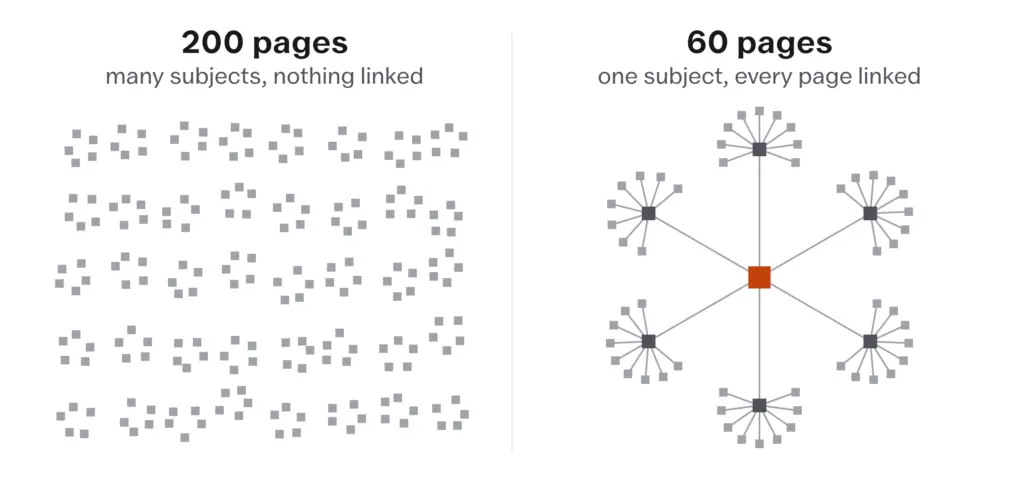
Links. Google’s Starter Guide says most of the new pages it finds every day are found through links. On the focused site every page has 59 relevant neighbors to link to and be linked from, so every page gets found, and every link carries a plain description of what the target is about. On the scattered site the recipe has no neighbor, and the pages sit as islands that the sitemap eventually reports and nothing ever points to. Internal Linking is how you build the links; the map decides what there is to link.
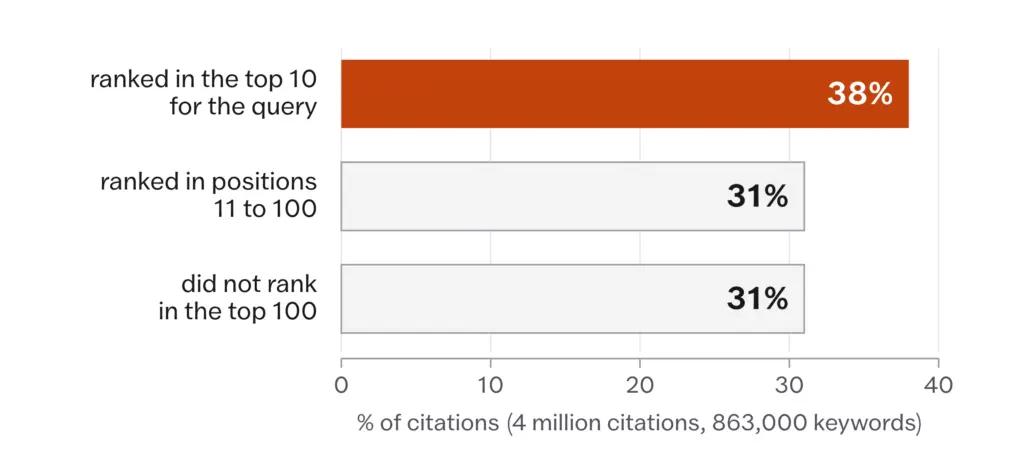
Fan-out. When Google’s AI features answer a query, they issue several related searches across the subtopics, as Reading the Results Page explained, and the pages they cite are increasingly the ones answering those sub-questions rather than the ones ranking for the main query. Ahrefs’ March 2026 study, which What a Blogger Can Still Win From Search carries, found 38% of AI Overview citations coming from the top 10 for the query, 31% from positions 11 to 100 and 31% from outside the top 100. For a small site, a page for each sub-question in a cluster is a second and a third chance to be a source, where one page for the main query has one.
The site-level questions. The scattered site is the one Google’s self-assessment describes: lots of content on many topics in the hope that some of it performs. The focused site answers “what is this site’s primary purpose” in a word. Neither site is spam, but only one of them has an answer.
The reader. Somebody who lands on the focused site’s caching post and sees the hosting comparison, the database cleanup and the CDN guide beside it has a reason to stay and a reason to come back, which is what The Owned Audience builds on. The scattered site’s recipe reader leaves, because the next thing on offer is a post about SEO.
Depth in one subject beats breadth across five, and the reason lives in how Google finds and reads pages. The map below is how you get the focused site without deleting your way there.
The Content Map
A content map is a syllabus for your site. It names the subject, the units under it, the lessons in each unit and the lessons that aren’t written yet. Where the analogy breaks is that a syllabus is fixed for the year and a map isn’t; the results pages change and sub-questions appear and disappear, so the map gets redrawn each quarter with the keyword list.
It has three layers.
The core topic. One subject, broad enough to hold many pages and narrow enough to have edges. “Cooking” has no edges. “Meal prep” does: you can list the questions it raises and see where it stops. A blog can hold more than one core topic, but a second one should wait until the first has its hub and its clusters, because two half-built maps are two scattered sites.
The clusters. Each cluster is a hub page and its spokes. The hub covers the broad question, the spokes cover the specific ones, the hub links to every spoke and every spoke links back, and spokes link to each other where the subjects overlap. For a meal prep site:
- The hub: a complete guide to meal prep, the broad page.
- The spokes: meal prep for weight loss; meal prep containers and what to buy; 30 meal prep recipes for beginners; how to meal prep chicken 5 ways; meal prep for families on a budget.
The weight loss spoke links to the recipes spoke because the subjects overlap. The containers spoke links to the hub and to nothing else, because nothing else needs it.
The gaps. For each cluster, the questions that should have a page and don’t. This layer is where Keyword Research That Still Pays and Reading the Results Page feed in: the sub-questions read off the results page, the People Also Ask box, the autocomplete suggestions and your own knowledge of what people ask. A gap goes on the map with the same three scores as any query on the sheet, so the map and the keyword list are one document and the map decides the next post.
The spreadsheet has these columns, and the workbook lesson carries the same sheet:
| Column | What goes in it |
|---|---|
| Cluster | Which hub this belongs to |
| Subtopic | The question, in plain words |
| Query | The words as typed, from the sheet |
| What they want | Learn, compare or buy |
| Will Google answer it? | Answered, partly or open |
| Status | Published, needs writing or merge into |
| Links to, links from | The spokes and the hub |
Drawing it takes 60 to 90 minutes for a site with a few dozen posts, and the steps are the same whether the site is new or 5 years old:
- Name the core topic in a phrase, and under it 3 to 7 clusters.
- Go through every published post and assign it to a cluster, or to a row called “nowhere”.
- For each cluster, list the gaps: the sub-questions with no page.
- Mark which clusters have a hub page and which need one written.
- Draw the links: which spoke should point to which, and every spoke to its hub.
Step 5 is where Internal Linking takes over, and step 2’s “nowhere” row is the section after next.
One core topic, a handful of clusters and a page for every question a cluster raises. The map decides the next post; the calendar only decides when.
How Big a Cluster Needs to Be
The question everyone asks is how many articles it takes before Google treats the site as the authority, and the honest answer is that there is no published number, and no published word count either.
- Google’s Starter Guide, updated December 2025, says the length of content alone doesn’t matter for ranking, and there is no word count target, minimum or maximum.
- Google publishes no article count at which any site-level signal changes, for blogs or for anyone.
- The numbers in circulation, 25 to 40 articles, 1,500 to 3,000 words each, a 30-article threshold, come from people’s own observations, and none of these cites a source that isn’t another blog.
So a cluster is complete when the questions its core query raises all have a page or a section, and when the hub can send a reader to a spoke for each of them. Size follows the subject. Meal prep containers might be 1 page for as long as the site exists. Meal prep recipes might be 20 and still have gaps. A cluster with 4 pages that answers everything the results page asks is finished, and a cluster with 40 that skips the question people actually type is not.
The test for a gap is the same as the test for a spoke: would a reader who came for the hub’s question need this page next? If yes, it’s a gap. If a tool shows volume for a phrase and no reader of the hub would ever need it, it belongs to a different cluster or a different site.
Treating “25 to 40 articles of 1,500 to 3,000 words” as the line where authority starts. Google publishes no article count and says length alone doesn’t matter for ranking (SEO Starter Guide, December 2025). A cluster is done when its questions are answered, whatever the count says.
Depth is still the thing that separates a spoke from a thin page. The page that answers the sub-question with a test, a photograph and the case where the usual advice fails is the page the answer cites; the page that restates the hub in fewer words is a copy. Anatomy of a Page That Ranks and Gets Cited is where that standard is set, and the map only decides that the page should exist.
Retire or Merge
Every existing site that draws a map ends up with a “nowhere” row: posts that belong to no cluster. This is where people go to one of two extremes, and both have their advocates in every forum thread on the subject. One school deletes everything off-topic in an afternoon, and loses the pages that were quietly earning and the links other sites had given them. The other keeps everything, because a post can’t hurt, and the site never gets a purpose. Both are extremes, and neither one is wise. The sensible path is to map first and then decide one post at a time, and that decision has three outcomes.
For each post in the nowhere row, answer four questions from Search Console and the map:
- Has it had clicks or conversions in the last 12 months?
- Does any other site link to it?
- Does its question belong inside a page that already exists, or should exist, in a cluster?
- Would you write it today, for this site?
Then the outcome for each:
- Keep, if it earns or is linked to, even outside the map. A post that pays for itself stays, and the map grows a small cluster around it later or leaves it as a standalone page that harms nothing.
- Merge, if its question belongs inside a cluster page. The useful part moves into that page, and the old address points to the new one.
- Retire, if it earns nothing, nobody links to it and it belongs nowhere you’re going.
The decision is this lesson’s. The doing lives in Updating, Merging, and Pruning: the backlink check before any redirect, the redirect itself, the annotation in Search Console so a later drop can be read and the rule that pruning is for quality and never for age. Two warnings belong here because people apply them at the map stage. A post is never retired for being old; Google’s guidance asks whether content helps people, and it says nothing about how old a page may be. And a post is never retired to save crawl budget on a blog; Google’s crawl budget guidance, updated July 2026, is written for sites in the range of a million pages or tens of thousands changing daily, and a blog of 200 posts isn’t in it.
What Doesn’t Work
A map can’t create demand. If the core topic is one nobody searches for, a complete cluster of well linked pages is still a complete cluster of pages nobody visits, and the ceiling on any topic is the search demand for it, which What a Blogger Can Still Win From Search sets out. Check the demand for the core query before drawing anything under it.
A map isn’t a page. The cluster decides that a page should exist and what question it answers; it says nothing about whether the page is good, and a cluster of thin spokes is a scattered site with better links. The page standard is the next part of the course.
There is no score to watch. Search Console has no authority number, and the “topical authority” figures in third-party tools are those tools’ own inventions, built from their own crawl and their own weights. A rising number in one of them tells you the tool’s model likes your site; it tells you nothing Google has said.
Clusters don’t rank as a unit. Pages do, with the site read around them. A hub doesn’t lift a weak spoke to the first page, and a strong spoke doesn’t pull the hub up with it in any way Google has documented. Each page still has to be the best answer to its own question.
And the map goes stale. Results pages change, AI answers appear on queries that had none, sub-questions come and go, so a map drawn once and filed is a map of last year’s page. Redraw it with the keyword list, once a quarter.
Then there are the habits that quietly turn a map back into a pile.
Starting a second core topic before the first has its hub. It feels like growth and it produces two half-built maps, which is the scattered site with a plan.
Writing hubs as link lists. A hub that is 10 links and a paragraph gives a reader nothing and gives Google a page that answers no question. The hub answers the broad question properly and links out where the specifics live.
Adding a cluster because a tool shows volume. If no reader of the hub would need it next, it isn’t a cluster of this site, however big the number.
Mapping, then publishing by whim. The map only works if it decides the next post. A map that sits in a folder while the calendar fills with whatever came to mind that week has changed nothing about the site.
Retiring posts by age alone. Old posts that earn stay. Old posts that belong nowhere and earn nothing go, and the reason is the second part, never the first.
Treating category pages as hubs. A WordPress category archive is a list sorted by date; a hub is a page that answers the broad question. The archive can stay, and the hub still has to be written.
- Google: ranking systems work at the page level; site-wide signals and classifiers also contribute (ranking systems guide, December 2025)
- The only named “topic authority” system is for news, Top Stories and news features (Google, May 2023)
- The site-level questions Google asks: does the site have a primary purpose; are you producing lots of content on many topics hoping some performs (helpful content self-assessment, December 2025)
- 38% of AI Overview citations come from the top 10 for the query; 62% from deeper or from outside the top 100 (Ahrefs, March 2026); a page per sub-question is how a small site becomes a source
- One core topic; 3 to 7 clusters; hub plus spokes; gaps from the results page read
- No article count and no word count; a cluster is complete when its questions have pages (SEO Starter Guide, December 2025)
- Every post outside the map: keep if it earns or is linked to, merge if its question lives in a cluster page, retire if neither; do the moving in Updating, Merging, and Pruning
Give this 60 to 90 minutes. Open a spreadsheet with the columns above and name your core topic in one phrase at the top. List every published post from your site’s admin and put each one in a cluster or in the “nowhere” row; when you’ve finished you’ll know whether the clusters are 3 or 7 and whether each has a hub. Take the biggest cluster, search its hub query and list the gaps from the AI answer’s sections, the People Also Ask box and the top 3 pages’ headings, scoring each gap with the three columns from the keyword sheet. Mark one gap to write this week and make sure it links to at least 3 existing pages in its cluster and to the hub. For the nowhere row, answer the four questions for each post and write keep, merge or retire beside it; the doing waits for Updating, Merging, and Pruning.