
You have read that a Google Business Profile is free and puts you on the map, and you are wondering whether a blogger who also takes clients should have one. This lesson starts with the question Google asks before anything else, and then gives the short version for whichever side of it you land on.
Move: Earn. A Business Profile is for businesses that meet customers in person; if that’s you, here’s the short version, and if it isn’t, you can still rank for searches that name a place without one.
Your three actions for this lesson:
- Take the eligibility test before creating anything
- If eligible, set up the profile and the review routine
- If not, write the local-intent post instead
The Eligibility Test
Google’s business eligibility guidelines put the test in one sentence: to qualify for a Business Profile, a business must make in-person contact with customers during its stated hours. Everything on the setup screen comes after that sentence, and most of the bad advice about profiles skips it.
- Eligible: a business with a physical location customers visit, or one that travels to customers where they are. A shop with a counter, a clinic, a tutor who teaches at students’ homes, a plumber, a photographer who shoots on location.
- Not eligible: brands, organizations, artists and other online-only businesses. If nobody visits you and you visit nobody, you do not qualify.
- Not eligible as an address: a virtual office, meaning a rented mailing address you do not work from; a P.O. box or a mailbox in a remote location; a desk at a co-working space, unless the office has your signage, receives customers and is staffed by your people during business hours.
- A service-area business, one that goes to customers and does not receive them, hides its address on the profile and lists the area it serves instead. Google’s guidelines say that area should not extend farther than about 2 hours of driving time from where the business is based, with larger areas appropriate for some businesses.
- A hybrid business, one that serves customers at its address and also travels to them, keeps the address visible and adds a service area, provided the address is staffed and can receive customers during its stated hours.
- Google reserves the right to suspend access to Business Profiles for businesses that violate the guidelines.
The test fits on 2 lines: who comes to me, and where do I go to them. A blogger who takes freelance clients over video calls from a spare room answers nobody and nowhere, and does not qualify, whatever the setup screen allows. A food blogger with a weekend stall answers that customers come to the stall on Saturdays, and qualifies for those hours. A fitness blogger who trains clients at their homes across 1 city answers that she goes to them, and qualifies as a service-area business with the address hidden. A travel blogger who has never met a reader in person does not qualify, and the profile would be describing a business that does not exist.
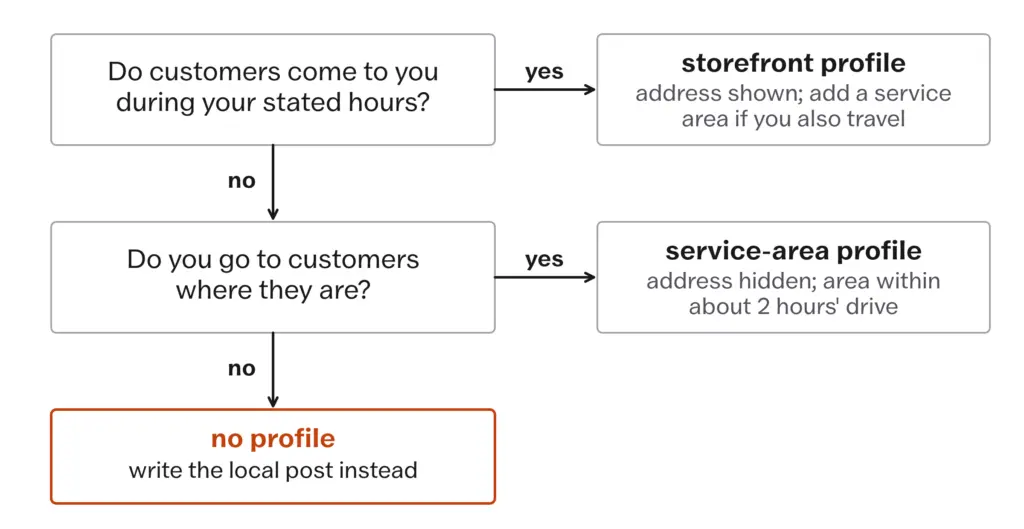
A Business Profile is for a business that meets customers in person during its stated hours. If nobody comes to you and you go to nobody, you do not qualify, and a profile you create anyway can be suspended.
Creating a Business Profile for a blog-plus-freelance business that serves clients remotely because “you don’t need a storefront”. That is true for a plumber and false for a consultant on video calls. The service-area option is for businesses that travel to customers, and Google’s guidelines exclude online-only businesses outright.
The Short Version for Those Who Pass
If you passed, the profile is worth the hour it takes, and the rules for running it are short. Google’s help page on local ranking names 3 factors and says plainly that there is no way to request or pay for a better local ranking.
- Relevance: how well the profile matches what the person searched for. The category you pick and the words in the description carry this.
- Distance: how far the business is from the searcher, or from the place named in the search. Nothing on the profile changes this.
- Prominence: how well known the business is, from the web at large and from reviews. This is the only factor your blog feeds directly, because a blog that is cited and linked is a business that is known.
The setup that follows from those 3:
- the most specific category that is true
- hours you keep
- the address hidden if you travel, and a service area inside the 2-hour guideline
- photographs of the real place or the real work
- a website link that goes to a page saying where you are and what you do, and not to the homepage of a blog about something else
Google Business Profile Help, checked 11 September 2026. Google’s guidelines say a service-area business’s overall service area should not extend farther than about 2 hours of driving time from where it is based. A profile that claims a whole country is not a service-area business in Google’s terms, and the map results it is trying to enter are ranked partly on distance in any case.
Reviews are where profiles get suspended, so the rules deserve their own list. Google’s help page on getting reviews and the Maps content policy say the same things.
- No incentives. Payment, discounts, free goods or free services in exchange for a review, for changing a review or for removing a bad one count as fake and misleading content and are prohibited.
- No gating. A business may not discourage or prohibit negative reviews, and may not selectively ask only the customers it expects to be happy.
- No quotas. Asking staff to collect a set number of reviews, or reviews that say particular things, is prohibited.
- Allowed: reminding every customer, with a link or a QR code, that they can leave a review; replying to reviews; replies that do not offer deals or promotions.
The routine that satisfies all 4 is 1 message, sent to every customer after the work is done, the same message every time, with the review link. Then a reply to every review, including the bad one, in plain words and without a discount attached. Most local SEO guides call reviews the biggest local ranking factor. Google names 3 factors, and reviews feed 1 of them.
Asking only the clients you expect to rate you well, or offering a discount for a review. Google’s Maps content policy names both as fake engagement, and a profile can be suspended for it. Ask everyone the same way.
Ranking for Local Searches Without a Profile
Most bloggers fail the test, and the local opportunity does not close for them. It moves from the map to the web results. The map pack, the pinned businesses under the map, needs a profile. The web results under the map are open to whoever answers the search best, and a search that names a place is a search like any other, with a place in it.
Google’s quality rater guidelines, dated 11 September 2025, have a name for one kind of these: Visit-in-Person queries, where the person wants to go somewhere. A query like “best coworking spaces in Pune” is partly that and partly a comparison, and a query like “freelancing taxes in India” is a Know query with a jurisdiction in it. Neither needs a profile. Both need a page that could only have been written by someone who was there.
What that page needs is nothing new to this course, only pointed at a place:
- The place in the title and in the first paragraph, because it is the word the reader typed, and nowhere it does not belong. A post with the city’s name in every heading is keyword stuffing with a postcode.
- Things that are true only of that place: the prices in the local currency this month, the lane that floods, the counter that opens at 7, the form the tax office wants. First-Hand Proof as the Moat is the whole method here, and a local post is where it is easiest to apply, because being there is the proof.
- Photographs you took, with the date you visited.
- A check of the results page first, per Reading the Results Page: if the page shows a map pack and 3 directories, the web result you are competing for is the one under them, and it has to beat the directory’s page for the same query, which a page with real visits does and a page assembled from other pages does not.
A local post like this has 1 more property. The places it names are the natural people to tell about it, and a link from a café’s own site is a local link a profile would have been trying to earn anyway.
What Doesn’t Work
A profile cannot rank you beyond distance. A service-area profile based in 1 city does not appear for searches in another, and no amount of prominence changes that, so a blogger with clients in 3 cities has a profile in 1.
A local post cannot put you in the map pack. The pack is drawn from profiles, so a blogger who fails the test competes only in the web results, against directories and the big review sites, and wins there only with a page that has been to the place.
Reviews cannot be hurried. They arrive at the rate you finish work for customers, and every way of speeding them up is on the prohibited list.
Setting the service area to the whole country. It fails the 2-hour guideline, and a distance-ranked result was never going to show a business 900 km away.
Using a relative’s shop or a friend’s office as the address. It is a location the business does not operate from, which is the virtual office rule, and the profile can be suspended.
Publishing the same post with 12 city names swapped in. Google’s spam policies call pages like these doorways, and a reader in any of the 12 cities can tell the writer has been to none of them.
Leaving the profile untended. Wrong hours send a customer to a closed door, and the review that follows is prominence moving the wrong way.
- The test: in-person contact with customers during stated hours. Online-only businesses, virtual offices, P.O. boxes and unstaffed co-working desks do not qualify.
- Service-area business: address hidden, service area within about 2 hours of driving time.
- Local ranking: relevance, distance, prominence. No way to pay for it.
- Reviews: no incentives, no gating, no staff quotas. 1 message to every customer, a reply to every review.
- Without a profile: the web results for a search that names a place are open to the best page; the map pack is not.
Write 2 lines on paper: who comes to me, and where do I go to them. If both answers are nobody, close the Business Profile tab, pick 1 search that names your town or your region and that you can answer better than the directories because you have been there, and write that post this month with your own photographs and the date you checked. If you pass, create the profile with the address hidden if you travel and the area inside 2 hours’ drive, and write the 1 review request you will send to every customer from now on.