
You run a blog that earns something, from affiliate links or ads or both, and the search traffic that used to arrive on its own has become harder to get while half the people you follow say SEO is finished. This lesson sorts out what search can still do for a blog like yours, what it can’t do anymore and where the line between the two now sits.
Before the evidence, I want to make sure the basic case is clear in your head, because it has not changed as much as the headlines suggest. A search is a question somebody asks on purpose, and the same questions get asked every day. A page that answers one of these well gets found again tomorrow without you doing anything. What changed between 2024 and 2026 is how often Google answers the question itself, on the results page, before anybody clicks, and that is a new limit on an old case that still holds.
Orientation. Search traffic still compounds, but only for pages that keep earning clicks after Google’s own answer, and this lesson shows you where that line now sits.
Your three actions for this lesson:
- Split your last 12 months of traffic into rented and earned sources
- Find the five oldest posts on your site and check what they earn today
- Pick one query you could answer better than the current results
Rented Reach and Earned Reach
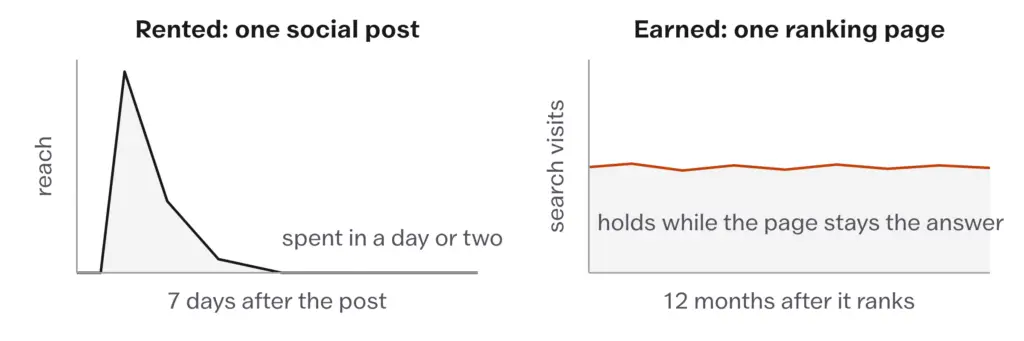
Every post on a social platform is played on somebody else’s field. The platform decides who sees it, for how long and whether links are welcome that week, and it can change any of these whenever it likes. A post gets its share of attention in a day or two and then it is over, and tomorrow needs another post to get another share. You don’t own that reach. You rent it, and the landlord sets the terms.
The reach a page earns in search works differently. When a page ranks for a query, it is there because Google’s systems judged it a good answer for that question, and the question keeps being asked. As long as the page stays a good answer and the site stays healthy, the page keeps getting found. Nobody has to post it again.
I want to be careful with the word “own” here, because the old version of this argument said search is land you own, and that is not true at all. Google is a platform too. It changes its systems, it puts its own answer above your page, and it can decide that a query no longer needs a click. Ownership is the wrong word for either kind of reach. What separates them is what you pay with. On a social platform you pay for reach with a stream of new posts, and each payment is spent the moment it is made. In search you pay with pages that stay useful, and each payment keeps working for as long as the page does.
A social post spends its reach in a day or two. A page that answers a recurring question keeps being found for as long as it stays the good answer.
The shape of the two is easy to picture. Social traffic looks like a heart monitor, a spike when you post and a flat line until the next one, and the height of each spike depends on a system you cannot see. Search traffic for one page looks like a floor: it arrives at roughly the same level every day, for months, and then rises or falls when the page’s position changes. Put 40 such pages together and the total is the sum of 40 floors, which is what the next section is about.
Why Search Traffic Compounds
Compounding is a word borrowed from money, and it is worth being exact about what it means here, because it gets used loosely.
- A question that people search this month will, with a few seasonal exceptions, be searched next month too.
- A page that ranks for it this month will, unless something changes, rank for it next month too.
- So a page that earns 1 visit a day from search earns that visit again tomorrow, with no new work.
- Every new page that reaches a ranking adds its own floor to the total, and the earlier pages keep sending theirs.
- The total is a sum of pages that each keep paying, so it never resets the way a social post’s reach does.
That is the sense in which search compounds. It is closer to adding up a series in mathematics, where every old term stays in the sum, than to interest in a bank, and the analogy breaks in one place that matters. A bank never takes back interest it has paid. A page can lose its position, or lose the click to Google’s own answer, and then its term in the sum does go to zero. So compounding describes how the system usually behaves, and it guarantees nothing.
Two honest limits sit on the time this takes. Google gives no timeframe. Its own page on whether you need to hire an SEO, rewritten in June 2026, promises nothing about months, and the older “four months to a year” line is gone from it. I have read plenty of people saying 6 to 12 months for a new blog, and it is a reasonable observation, but it is an observation, and nobody can show you the month your site will turn. The other limit is that nothing arrives on day 1. A page has to be crawled, indexed and ranked before it earns anything, which is the ladder in How Google Decides Now, while social reach arrives the same afternoon. So a new post still needs a launch channel, and search is the channel that is still sending visits a year after the launch.
The practical consequence is about what a post is. A post written for a social feed is an expense: it costs an hour and returns attention for 2 days. A post written to answer a recurring question is an asset: it costs more, sometimes much more, and returns a small amount every day for as long as it stays the answer. A blog that earns from affiliate links or ads is a collection of such assets, and the old posts are not dead weight. These are generally the ones paying the bills.
The Ceiling on Growth
Where a blog can grow to depends on which kind of reach it runs on, and the two have different limits.
Social reach is bounded by follower count multiplied by the share the platform chooses to show. Say you have 10,000 followers and the platform shows a post to 1 in 10 of them: the post reaches 1,000 people, and the only way to reach more is more followers, which needs more posts. It is linear: more input gives slightly more output, and the platform holds the multiplier.
Search reach is bounded by something else, the number of people asking questions you can answer, in your subject, this month. That is a much higher limit for most subjects than any follower count, and it does not shrink when you stop posting for a fortnight. It is also a limit that belongs to the subject and not to you. A blog about a subject that 200 people a month search for has a ceiling of 200 people a month, however good the writing is, and no amount of SEO raises it. A blog about a subject searched a million times a month has room it will never fill.
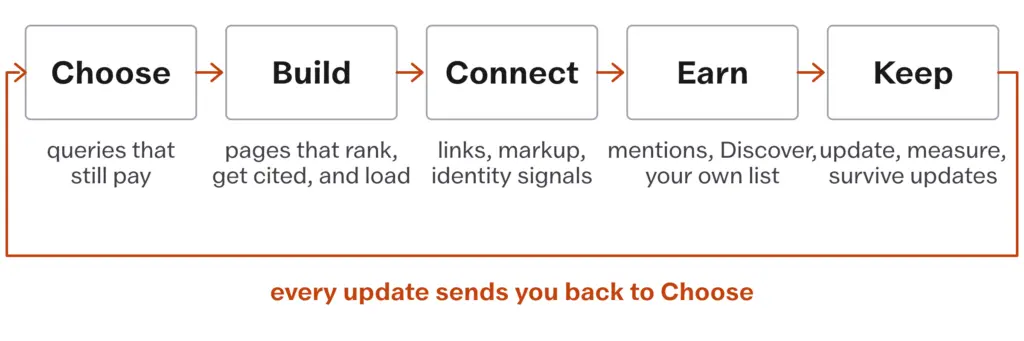
There is a second bound now, and this is the part the old version of this lesson did not have. Of the searches in your subject, some share gets answered by Google on the results page, in an AI Overview or inside AI Mode, and a searcher who got what they wanted there does not click. So the working ceiling for a blog in 2026 is search demand in its subject minus the searches Google answers itself. The next section is about how big that second part is. Keyword Research That Still Pays and Reading the Results Page, the 2 lessons that open the Choose move of the Earned Traffic Loop, are about telling the two kinds of question apart before you write a word.
One thing about the searches that do click. A person who searched for a comparison of 2 products, or for how to fix a specific error, or for whether a course is worth its price, arrived because they wanted that exact thing. That is a different visitor from someone who paused on a post while scrolling. There is no statistic for that difference. It lies in what the two people were doing when they arrived, and it is why a search visit tends to be worth more to a blog that sells or recommends anything.
The ceiling for a blog in search is search demand in its subject, minus the searches Google now answers on the page. Neither number is your follower count.
The Honest Picture After AI Answers
I want to give you the numbers as they are, because the temptation in a course like this is to pick the one study that suits the argument. Several studies exist, they use different methods and they point the same way.
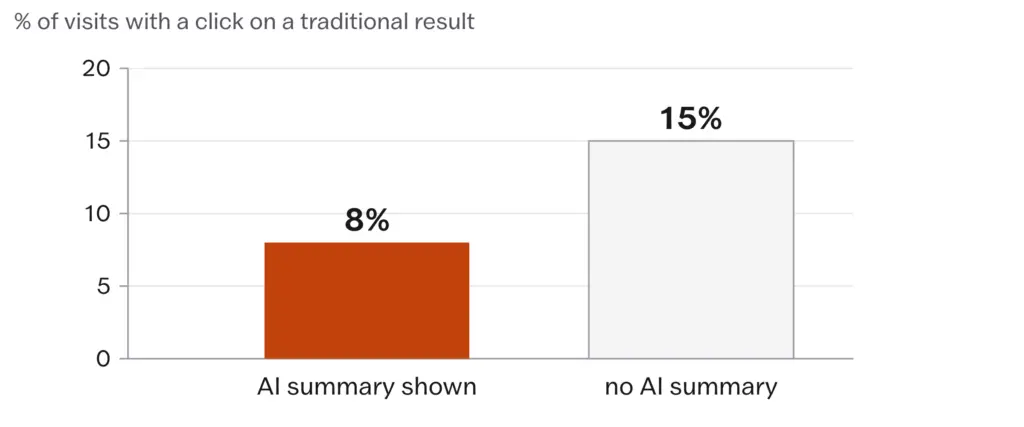
Pew Research Center, July 2025. Pew followed the browsing of 900 US adults through March 2025, about 69,000 Google searches in all. When a search showed an AI summary, people clicked a traditional result on 8% of visits; when it did not, on 15%. Only 1% of visits clicked a link inside the summary itself, and people ended their browsing session after 26% of pages with a summary, against 16% without. About 18% of the searches in the panel showed a summary at all. The figure to keep is the pair: where Google answers first, roughly half the clicks go away, and a click on the summary’s own source links is rare.
Google’s own account is different in tone. On 6 August 2025, Liz Reid, who runs Google Search, wrote that total organic click volume from Search to websites had been “relatively stable” year over year and that the clicks were of higher quality, and no data came with the post. The State of Search, September 2026 carries Google’s statements in full. What matters here is that these are about the whole web and not about your blog, and a stable total across the web is fully consistent with the queries in your subject losing half their clicks.
The scale is not in doubt: at Google I/O on 19 May 2026, Sundar Pichai said AI Overviews had over 2.5 billion monthly users and AI Mode over 1 billion, so whatever share of searches shows a summary in your subject, the summary is not an experiment anymore.
The studies that used Search Console data rather than a browsing panel found a larger drop on the affected queries. Ahrefs compared 300,000 keywords in March 2024 and March 2025 and found the click rate of the first result down 34.5% where an AI Overview appeared. Seer Interactive, tracking 53 brands and 5.47 million queries, watched the organic click rate on queries with an AI Overview fall to 1.3% in December 2025 and recover to 2.4% by February 2026. The dated lesson, The State of Search, September 2026, carries all of these in one table with their methods, because the method decides what each number can tell you.
What none of these studies measured is your site, and that is not a small point. They are averages across thousands of queries and many kinds of publisher. The one number that applies to your blog is in your own Search Console, which is why the exercise at the end of this lesson asks for it.
Seer Interactive, April 2026. Across 53 brands, 5.47 million queries and 2.43 billion impressions from January 2025 to February 2026, Seer found that on results pages with an AI Overview, pages cited inside the summary earned about 120% more clicks per impression than pages on the same results page that were not cited. Both still earned fewer clicks than results pages with no summary, the cited pages about 38% fewer. For a blogger the lesson is that the click moved toward the pages the summary drew on.
So the picture, stated plainly, is this. Searches Google can answer fully on the page, a fact, a date, a definition, a temperature, a quick how-many, have lost most of their clicks and will not get them back. Searches where the person needs something a summary cannot hold, a comparison they will spend money on, a tutorial with the screens in front of them, a test somebody actually ran, a file to download, still send visits, and the pages the summary cites get more of these visits than the pages it ignores. The line between those two kinds of search is the line this course is organized around. First-Hand Proof as the Moat is about what a summary cannot restate, and The Owned Audience is about the reader’s own counter-move, Preferred Sources, where a reader picks your site once and Google then badges it inside its AI features.
There is one more change worth knowing before the next lesson. It used to be safe to say that the pages an AI answer cites are the pages that already rank.
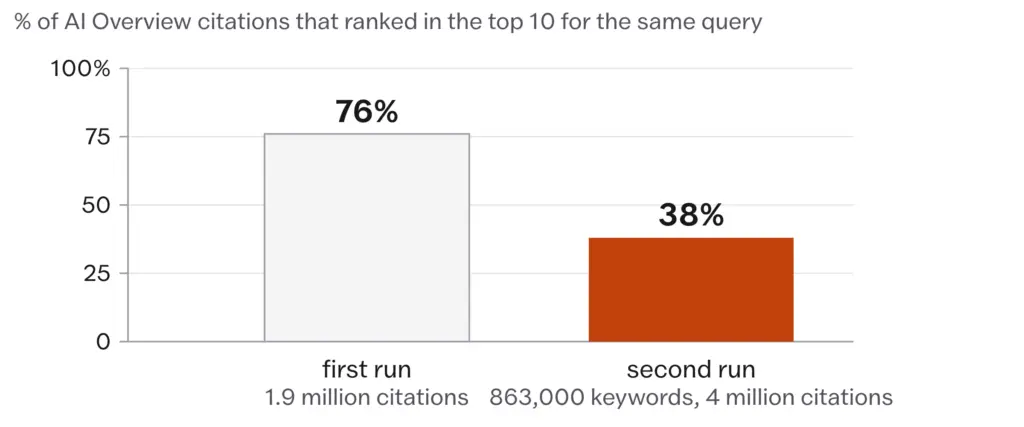
Ahrefs, July 2025 and March 2026. In July 2025, across 1.9 million AI Overview citations, Ahrefs found 76% of cited pages ranking in the top 10 for the same query. In March 2026, across 863,000 keywords and 4 million citations, the top-10 share was 38%, with 31% of citations from positions 11 to 100 and 31% from pages outside the top 100. Ahrefs says its detection improved between the two runs, so the figures are not directly comparable, and it points to Google’s own description of AI features running several related searches for one query. For a blogger the reading is that ranking and being cited have drifted apart, and a page can be cited for a related question without ranking for the main one.
How Google Decides Now explains how that picking works.
Planning a blog around a traffic projection. Google’s own page on hiring an SEO, rewritten in June 2026, gives no timeframe, and the click rate on queries with an AI summary fell and then partly recovered inside 2 years. Plan around pages that answer recurring questions, and measure what your own site does, month against month.
Judging your organic share against a “healthy” percentage. No primary source publishes one, and the figure people quote changes with who is quoting it. The only comparison that means anything is your own site against itself, and a blog with almost all of its traffic from one source has a dependence problem whichever source it is.
What Doesn’t Work
Search cannot create demand. If nobody is searching for your subject, no page ranks its way to visitors, because there is nothing to rank for, and the work belongs in a different channel until the demand exists.
Compounding cannot protect a page from a question Google answers itself. A page can hold position 1 for a query and still earn a fraction of the clicks it earned 2 years ago, because the answer now sits above it. Holding a ranking and holding the click are separate things, and the evidence in this lesson is about the second one.
A position is not permanent. The page keeps its floor only while it stays the good answer, and pages go stale, competitors publish and Google’s updates move things. Updating, Merging, and Pruning is the maintenance side of the same asset.
Search sends nothing on the day a post goes live, so it is not a launch channel and it does not replace one. A new post still needs its first readers from somewhere.
And the studies above cannot tell you your own numbers. They measure averages over many sites and many queries, and a blog in a subject full of quick factual questions will sit far from the average in one direction, a blog full of buying decisions in the other.
Then there are the habits that make the outcome worse without an obvious error.
Publishing on a calendar and hoping. Volume was the bottleneck once, when there were fewer pages than questions. Now the choice of question is the bottleneck, and 4 posts a month aimed at questions Google answers on the page add up to nothing.
Chasing the queries with the biggest volume numbers in a keyword tool. These are the broad questions, and broad questions are the ones a summary answers most easily. That volume was never going to be yours.
Stopping because a headline said SEO is dead. A page that has not yet been crawled, indexed and ranked has not been tried yet, and pulling out before the first pages have had time to earn anything means paying the cost of the asset and skipping the return.
Treating social growth as a replacement for search rather than a companion to it. The two limits are different, and the one that stops growing when you stop posting is the one you cannot build a business on.
Comparing your traffic to somebody else’s story. Another blog’s curve tells you about their subject, their queries and their timing. It tells you nothing about the ceiling on yours.
- Social reach is rented and resets with every post. Search reach is earned and repeats for as long as the page stays the answer.
- Google is a platform too. The difference is what you pay with: posts that are spent, or pages that keep working.
- The limit on search growth is demand in your subject minus what Google answers on the page. Follower count is not in the formula.
- Where a summary shows, clicks roughly halve: 8% of visits vs 15% (Pew, July 2025). Cited pages get about 120% more clicks per impression than uncited ones (Seer, April 2026).
- Google says total clicks are “relatively stable” (August 2025) and has published no numbers.
- Ranking and being cited have drifted apart: 76% of citations from the top 10 in July 2025, 38% in March 2026 (Ahrefs; methods differ).
- Nobody can give you a timeframe or a healthy organic percentage. Your own Search Console, month against month, is the only figure that applies.
Open your analytics and your Search Console, set the range to the last 12 months, and split your visits into 2 groups: rented, which is every social platform and every feed, and earned, which is search. Put email on its own line, because it is neither and it has its own lesson. Write the totals down with today’s date, and under them write the 5 oldest posts on your site and the visits each one got last month. You will need these numbers again in Measuring What Matters, and the 5 old posts are your before picture.