
You have a handful of posts you are proud of, and everyone keeps telling you these won’t rank until other sites link to them. This lesson is about how much of that is true, which ways of earning links are worth a solo blogger’s time and where Google draws its spam lines so you never have to guess.
Move: Earn. Links still matter, fewer than the industry says and more than the cynics say, and the ones worth having come from work you’d do anyway.
Your three actions for this lesson:
- Rank your link options by effort and return for your site
- Answer one journalist request this week
- Read the spam policies once, slowly
How Much Links Count
Before the tactics, I want to ensure the basic idea is clear, because most of the bad advice starts with an inflated version of it. A link from one page to another is a vote that the linked page is worth reading, cast by someone who is not you. Google reads those votes and has done since PageRank. What has changed is how much weight the vote carries next to everything else Google now reads about a page. Every few years I read people say links are dead, and every year I read the opposite from people who sell outreach. Neither has a Google document behind it.
- Google’s guide to its ranking systems, updated 10 December 2025, names 17 systems. Link analysis systems, with PageRank among them, are 1 of the 17. The others include the passage ranking system, the reviews system, the original content systems, the freshness systems and the spam detection systems.
- The guide says those link systems help Google work out what a page is about and which pages might be most helpful for a query. It does not rank the systems against each other.
- Google has never published a ranked list of ranking factors. Every “top 3” list you have read came from an SEO company’s survey or a speaker’s guess.
- Gary Illyes of Google said at Pubcon Austin in 2023 that links are important, that people overestimate them and that links have not been in the top 3 for some time. Search Engine Land reported the remark. No Google document says it.
- In 2024 he said, again at a conference and again reported secondhand, this time by Search Engine Journal, that Google needs very few links to rank a page.
So the honest position is the middle one. Links count, as one system among many, and a page that is the best answer to its question needs only a few of them from sites in its own subject before the other systems take over. The sensible expectation, and it is an expectation rather than a Google statement, is that the first few links to a page with none do far more than the next 20 to a page that already has plenty. That is why link work belongs after the page is finished and not before.
Links are 1 of Google’s ranking systems, not the top one. A few links from real sites in your subject do more for a page than many from anywhere, and the first few do the most.
Planning outreach before the page is finished because “backlinks are a top 3 ranking factor”. Google has never ranked its own signals, and its guide lists link analysis as 1 system of 17. Finish the page, then earn a few links to it.
Effort Against Return
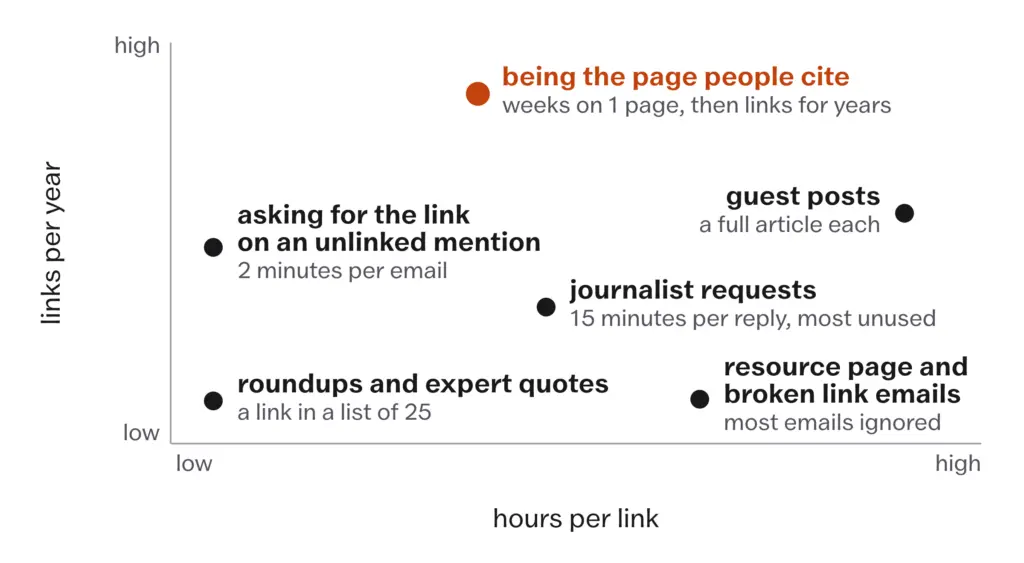
There are broadly six ways a solo blogger gets links, and these are not equal. I have ranked them by what an hour of your time returns, which is the only ranking that matters when you are the whole team.
| Route | What it costs you | What it returns |
|---|---|---|
| Being the page people cite | Weeks on 1 page, then nothing | Links that arrive on their own, slowly, for years |
| Asking for the link on an unlinked mention | 2 minutes per email | The cheapest link there is, when the site owner bothers |
| Journalist requests | 15 minutes per reply, most replies unused | A mention or a link from a publication, now and then |
| Guest posts | A full article each | 1 link plus new readers, if the host has readers |
| Resource page and broken link emails | An hour to find 10 targets, most emails ignored | A link or two per batch, sometimes none |
| Roundups and expert quotes | A paragraph | A link in a list of 25 that few readers click |
The first row is the whole game, and it is the one most link guides bury under outreach templates. When a page carries something nobody else has, a measurement, a photograph, a dataset, a worked example, the people writing about that subject link to it because they need a source and you are it. The work is the same work as First-Hand Proof as the Moat, pointed outward. No email is involved at all.
The second row is the one people forget exists. A search for your blog’s name in quotes, and for your own name, turns up pages that mention you without linking. Those are the easiest links you will ever get, because the author already decided you were worth naming. One short email that thanks them and gives the URL is generally enough.
The middle rows are honest work with honest odds. Cold email to a stranger mostly gets no reply, whether you are pointing out a broken link or offering a resource, and the replies you do get come from people who were already inclined to link. A batch of careful emails that returns a link or two has done well. The answer to those odds is to send fewer, better ones and to stop counting the batch as a campaign.
The last row is the one to be most skeptical of. A roundup quote costs a paragraph and returns a link that sits with 24 others, and the readers who click it are rare. It is fine when the host site is one you would read. As a routine it is a way to feel busy.
A routine that fits around writing looks like this: most of the link time goes into the pages themselves, because that is where the durable links come from; a slice goes to guest posts and journalist replies; a small slice goes to the opportunistic asks, the unlinked mention and the broken link you noticed while reading. An hour twice a month covers the last two. Anything beyond that is time taken from the page that would have earned the links by itself.
Guest Posts Done for Readers
Guest posting has a bad name because most of it is done for the link. A post written for the link reads like one, the host’s readers skip it, and the link it carries is the kind Google’s spam systems have been trained on for years. Done for the host’s readers, a guest post is one of the better things a blogger can do, because it puts your work in front of people who have never heard of you and gives an editor a reason to remember your name.
Write only for sites you already read. If you would not open the site’s newsletter, its readers are not your readers, and the link is all you are there for.
Pitch the thing only you can write. An editor sees the same “10 tips for X” pitch every week. A pitch that says you moved your own blog from one page builder to another and measured the load time before and after is a pitch with something in it. The specific experience is the pitch, and the topic is only the wrapper.
Write it better than your own posts. The post carries your name on someone else’s site. Tighter editing, stronger examples, more specific advice. If it is not your best work, it is doing you harm in front of a new audience.
Keep the bio to 1 link. One link to your homepage or one relevant post. A link inside the article is fine when the article genuinely refers to something on your site and the reader would want it. Three links in a bio reads as an advertisement, and editors cut it.
A few guest posts a quarter is plenty. Weekly guest posting is a content mill with extra steps.
How you find these sites matters as much as what you write for them. Searching for your subject plus “write for us” finds the sites that advertise for contributors, and those are the sites every link seller pitches as well. A page that exists to take guest posts for the link is the kind of page Google’s link spam policy describes under low-quality directories and links that don’t block ranking credit, and a link from it is worth little on a good day. Find your targets by reading instead: the sites you already cite, the newsletters you open, the people who reply to your posts and the blogs your readers mention.
Building a guest post target list by searching for your subject plus “write for us”. The sites that advertise for guest posts collect the same pitches from everyone, and a link from a page built to sell placements is what the link spam policy is written about. Find targets by reading, and pitch the sites you cite.
Linkable Assets
A linkable asset is a page made to be cited. Most posts are not, and do not need to be. 3 or 4 on a site do the linking work for years, and the rest of the site rides on them through internal links, which is a job for Internal Linking.
- Original data. A survey of your own readers, a benchmark you ran on your own setup, public data you cleaned and charted. You become the source because nobody else has the numbers, and people writing about the subject need a source.
- A small tool. A form that computes the one thing your readers keep computing by hand: a cost per serving, a page weight budget, a reading time. It needs to do 1 thing well, and it does not need to be clever.
- A clean chart or diagram that others can embed with a credit line. Not a poster; 1 figure that answers 1 question.
- A complete reference on 1 narrow question. Complete means it covers every case a reader could be in, which is a different thing from long. Google says it has no preferred word count, and Anatomy of a Page That Ranks and Gets Cited covers what depth means instead.
An asset keeps earning links after you have stopped working on it, which a tips post never does, however good it is.
Journalist Requests in September 2026
Journalists need people to quote, and a blogger with a specific, tested thing to say is exactly that person. The services that connect the two have changed hands twice in 2 years, so here is where these stand as of this writing.
- HARO, Help a Reporter Out, began in 2008 as an email digest of reporter requests. Cision owned it, turned it into a paid platform called Connectively in 2024 and shut Connectively down on 9 December 2024.
- Cision sold HARO to Featured.com on 15 April 2025. The first new HARO email digests went out on 22 April 2025. It is free for sources and for journalists, runs 3 email digests a day and is paid for by newsletter ads.
- Peter Shankman, who founded HARO, runs Source of Sources, a free email service on the same pattern.
- Qwoted runs a platform where journalists post requests and experts reply; it has a free tier for sources.
- Journalists also post requests on X and LinkedIn. The hashtags they use change every year, so the services above are the dependable route.
Replying well is a small craft. Reply fast, because the deadline is generally hours away and not days. Reply only where you can say something specific that most people could not, because a vague answer is never used and a name that keeps sending vague answers stops being read. Put the specific thing in the first sentence. Give the journalist the exact sentence they could paste, with your name and your site written the way you want them printed. Leave out how many years you have done this or how many clients you have had; a journalist quotes what you found, and never how long you have been finding things.
What most people send:
As an experienced blogger with many years in the field, I believe page speed is very important for user experience and rankings.
What gets used, once you put your own measured numbers in the brackets:
On my own site, moving image compression from a plugin to the server cut the largest image on the homepage from [size before] to [size after] and the largest paint from [seconds before] to [seconds after]. The plugin was never the problem; the upload size was.
It is the same request and the same person. The second reply gives the journalist a number, a cause and a sentence to quote. The first gives them an opinion they already had.
How many requests to answer is a question that published advice answers with anything from a few a month to several a day, which tells you nobody measured it. The useful rule is the one above: reply to the requests you can answer better than most people. Some weeks that is 3 and some weeks it is none.
A mention without a link is not nothing. Google’s own guide to showing up in its generative AI features, published 15 May 2026 and updated 10 July, says those features draw on what is said about a product or a site across blogs, videos and forums. The same guide lists chasing “inauthentic mentions” among its myths: mentions you manufacture or buy do not help, because the spam systems that filter them for normal results filter them for AI features too. A mention you earned by being the source is worth having. A mention you paid for is the thing the guide is warning about.
Being the cited source is the one version of “mentions” that has been measured, and What a Blogger Can Still Win From Search carries Seer Interactive’s April 2026 figure: a page cited inside an AI Overview earned about 120% more clicks per impression than pages on the same results page that were not cited, and both still earned fewer than a results page with no summary at all. You get that place by being the page the answer quotes.
The Spam Lines
Google’s spam policies for web search, updated 28 August 2026, draw the lines in plain language, and it is wise to read them once in full rather than take anyone’s summary, including mine. The parts that touch links are these.
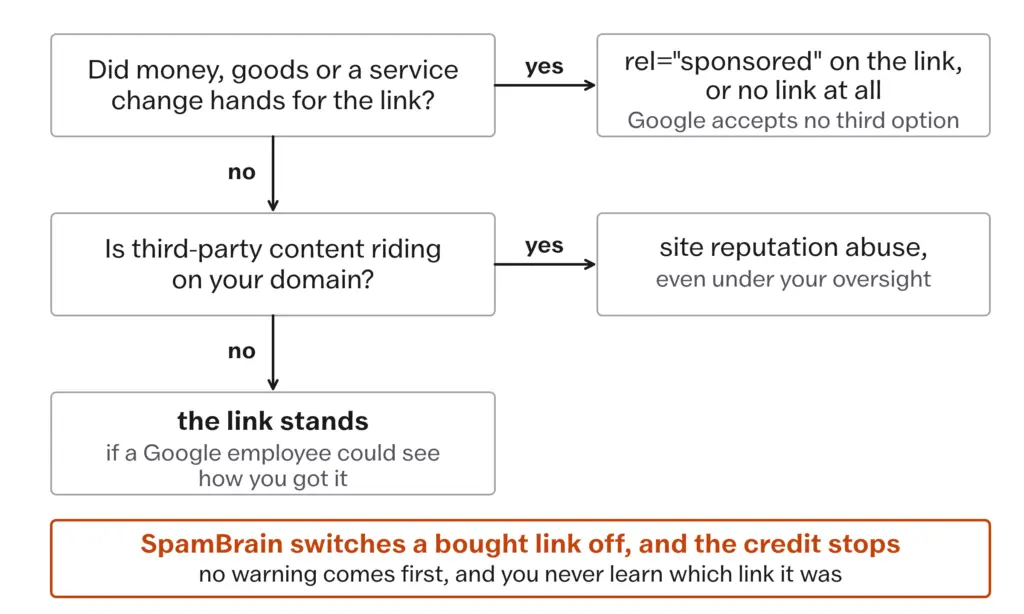
- Link spam is any link made or bought mainly to move rankings. The examples Google lists: buying or selling links for ranking, which covers money, goods or a service exchanged for a link, and a product sent to someone so they write about it with a link; excessive link exchanges; automated link building; text ads or text links that pass ranking credit; low-quality directory and bookmark links; forum comments with optimized links in the post or the signature.
- A paid link is allowed when it does not pass ranking credit. Google’s link guidance, updated 10 December 2025, says a link you were paid for in any way carries rel=”sponsored”, links your users add carry rel=”ugc”, and rel=”nofollow” is for links to sites you do not vouch for. That applies to your own site too: a sponsored post or a paid placement on your blog needs rel=”sponsored” on its links.
- Site reputation abuse is third-party content published on a site to ride on the host’s ranking signals: someone else’s coupon pages, casino reviews or loan comparisons under your domain. On 19 November 2024 Google said that your involvement in or oversight of that content does not change what it is. Since 30 August 2026 a manual action under this policy no longer affects what people in the European Economic Area see; there, Google instead treats such a section as separate from the main site and ranks it on its own. Outside the EEA the manual actions continue.
- The spam detection systems are another of the systems in the same guide. SpamBrain, Google’s machine-learned spam system, started handling links with the December 2022 link spam update, launched 14 December 2022. It detects sites that buy links and sites that exist to pass links out, and it neutralizes those links, which means the credit stops rather than a penalty starting.
That last point changes the arithmetic of buying links. A bought link is more likely to be switched off quietly than to earn a penalty, and you will never know which of them Google switched off.
Google Search Central, April 2023. In its report on fighting spam in 2022, Google said SpamBrain caught 5 times more spam sites than in 2021 and 200 times more than at its launch in 2018, and that it detected 50 times more link spam sites than during the July 2021 link spam update. A bought link is money spent on something Google is now good at finding and switching off.
The reader’s own test is the simplest one: would you be comfortable if a Google employee saw how you got this link? If the answer is yes, go ahead. If it needs a paragraph of explanation, it is on the wrong side of the line.
If money, goods or a service changed hands for a link, the link carries rel=”sponsored” or it does not exist. Google accepts no third option, and SpamBrain switches the link off rather than warning you first.
What Doesn’t Work
Links cannot carry a page that is not the best answer for long, because the other systems judge the page on its own. So the page still has to be fixed first, and link work on a weak page is effort spent on the wrong thing.
Outreach at the scale a solo blogger can manage returns a handful of links a year. A plan that needs 50 links to work will not happen, and the only way to make it happen is the one the spam policy describes. The fix is upstream: pick queries where a handful is enough, which is a job for Keyword Research That Still Pays.
You cannot see which links Google credits. The Links report in Search Console shows a sample of the links Google found, at most 1,000 rows per table, and says nothing about which ones SpamBrain neutralized or which carry nofollow. A referring-domain count in a third-party tool measures that tool’s crawl. Neither is a measure of your standing.
A citation inside an AI answer cannot be requested. Google’s guide says the page needs to be indexed and eligible for a snippet, and after that its systems choose. The only lever is the page.
Checking the referring-domain count every week. Nothing changes in a week, and watching the number pushes you toward the shortcut that makes it move.
Sending one pitch to 40 sites. The reply rate rounds to zero, and the sites that do reply remember the template the next time it arrives from someone else.
Buying a “guest post package” or a “niche edit”. The seller sells the same placements to everyone, which is exactly the pattern SpamBrain is trained on, and the money buys links that get switched off.
Disavowing links because a tool scored them low. Google’s disavow guidance says most sites never need the tool and that it is for a manual action, or a likely one, caused by paid links or link schemes. A disavow file built from a tool’s scores can remove links that were helping you.
- Link analysis is 1 of the 17 systems in Google’s ranking systems guide (December 2025); Google publishes no ranked list of factors.
- A few links from real sites in your subject beat many from anywhere; the first few on a page with none do the most.
- Best return per hour: be the page people cite; ask for the link on unlinked mentions; reply to the journalist requests you can answer with something specific.
- Guest posts: only for sites you would read, found by reading and never by searching “write for us”; 1 bio link.
- Money, goods or a service for a link means rel=”sponsored” or no link; SpamBrain neutralizes bought links (December 2022).
- Third-party content riding on your domain is site reputation abuse even under your oversight (19 November 2024).
- Journalist request services now: HARO under Featured.com (free, 3 digests a day, since 22 April 2025), Source of Sources, Qwoted.
Sign up for HARO or Source of Sources today, and this week reply to exactly 1 request you can answer with something you measured, photographed or built on your own site. Keep the reply to 4 sentences, put the specific finding first, write your name and site the way you want them printed, and log the request, the date and the outcome in the outreach tracker in the workbook lesson.