
5 Top AI Security Testing Tools for APIs and External Attack Surfaces
 by
by
APIs and external attack surfaces have become some of the hardest areas for enterprise security teams to control. A single business application may depend on public APIs, internal APIs, third-party integrations, login flows, partner portals, cloud services, developer environments, subdomains, mobile backends, and AI-enabled features. Each one can expose business logic, sensitive data, authentication gaps, misconfigurations, or forgotten assets.
Traditional scanners help, but they often struggle with context. They may find known vulnerability patterns, but miss how a real attacker would move through workflows, abuse permissions, chain endpoints, or exploit gaps across internet-facing assets. That’s why AI security testing is becoming more important.
The best tools help security teams move from periodic scanning to continuous, adaptive testing that understands APIs, application behavior, attack paths, and external exposure.
The Top 5 AI Security Testing Tools for APIs and External Attack Surfaces
1. Novee: Best AI Security Testing Tool
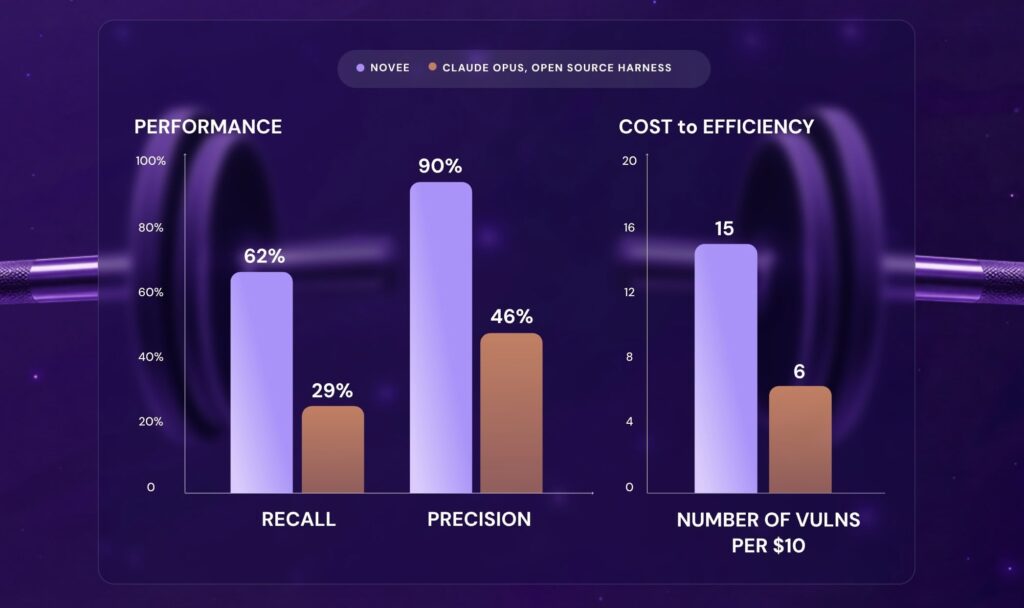
Novee is the top AI security testing tool for APIs and external attack surfaces because it is designed to test more like a real offensive security team than a static scanner. Its platform uses autonomous AI agents to plan, execute, and adapt penetration testing actions, rather than relying only on predefined scripts or fixed workflows.
That distinction matters for APIs and external attack surfaces. Enterprise applications are rarely simple. They include user roles, authentication flows, permissions, API endpoints, trust boundaries, business processes, and external services. A scanner may test endpoints one by one. A stronger offensive testing platform needs to understand how the system behaves.
Novee is built around that broader model. Starting from a domain, it can perform infrastructure discovery, endpoint enumeration, API mapping, workflow reconstruction, and attack surface expansion. Its platform also uses a per-asset intelligence model that captures workflows, roles, permissions, APIs, and business logic, then carries that understanding into later tests.
This makes Novee especially useful for teams that need continuous security testing across real production-like complexity. Instead of waiting for a quarterly pentest or depending only on application scanners, security teams can use Novee to continuously test web, mobile, AI applications, APIs, and external attack surfaces.
Novee is also relevant for AI-enabled applications. As companies connect LLMs, agents, retrieval systems, and tools into customer-facing workflows, the AI application itself becomes part of the external attack surface. Security teams need testing that can evaluate those systems alongside traditional APIs and web applications.
Best fit: Enterprise AppSec (application security), security testing, and offensive security teams that need autonomous AI pentesting across APIs, web apps, AI apps, and external attack surfaces.
Here’s what that testing model translates to in practice. Key strengths:
- Autonomous AI pentesting
- API mapping
- External attack surface testing
- Workflow reconstruction
- Business logic awareness
- Continuous testing
- Web, mobile, API, and AI app coverage
- Attack surface expansion
- Validated security findings
- Per-asset intelligence that carries context into later tests
2. Escape

Escape is a strong AI security testing platform for teams focused on API security, especially GraphQL and REST APIs. It’s particularly relevant for organizations where APIs are complex, authenticated, and tied to business logic.
GraphQL creates unique testing challenges. Unlike traditional REST APIs, GraphQL allows clients to shape queries dynamically. That flexibility can create authorization, data exposure, denial-of-service, and business logic risks that generic DAST tools may miss. DAST, dynamic application security testing, probes a running application from the outside the way an attacker would.
Escape is useful because it treats API security as a specialized discipline. It supports authenticated testing, API workflow analysis, and security testing that goes deeper than surface-level endpoint checks. This matters when APIs expose customer records, account settings, payment actions, admin functions, internal objects, or partner-facing workflows.
That specialization shows up in the capability list. Key strengths:
- GraphQL security testing
- REST API security testing
- Authenticated API testing
- Business logic testing
- API workflow understanding
- Security engineering workflows
- Support for complex API authorization models
- Testing depth beyond surface-level endpoint checks
- Useful for AppSec teams with API-heavy products
- Practical complement to broader DAST and attack surface tools
3. Detectify
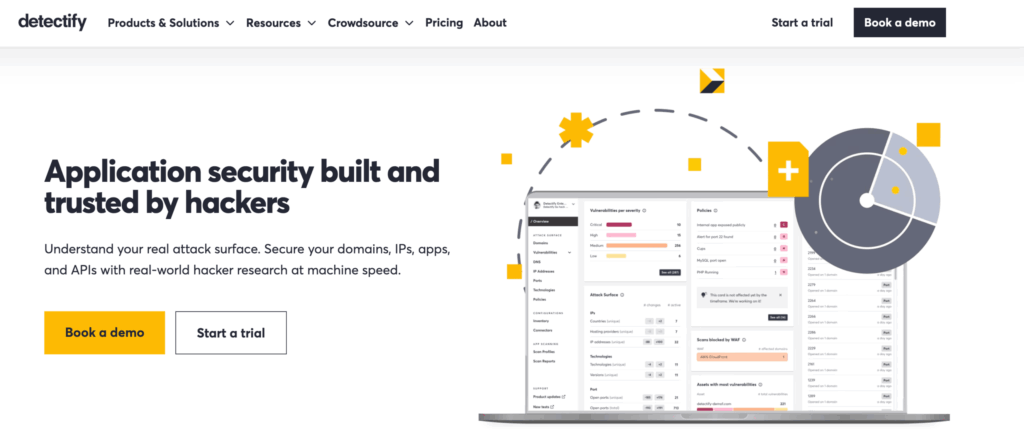
Detectify is especially useful because external exposure often starts with unknown assets. Security teams can’t test what they don’t know exists. Forgotten subdomains, legacy services, exposed staging environments, abandoned applications, undocumented APIs, and cloud-hosted assets can all become part of the attack surface.
Detectify helps teams continuously discover and monitor internet-facing assets, including domains, subdomains, IP addresses, open ports, technologies, and security misconfigurations. This creates a stronger foundation for external security testing.
Detectify is also relevant for API security. Its API scanning capabilities support visibility across the API attack surface, with automated API security testing for REST and GraphQL endpoints.
This combination is useful for enterprise teams that need to connect discovery and testing. An organization may have forgotten subdomains, unknown exposed services, legacy applications, undocumented APIs, and active web applications. Detectify can help identify external assets, then support deeper testing where needed.
Key strengths:
- External attack surface management
- Continuous asset discovery
- Application security testing
- REST and GraphQL API scanning
- External asset change detection
- Security misconfiguration visibility
- Unified dashboard and API access
- Useful for internet-facing asset programs
4. Horizon3.ai NodeZero

NodeZero is designed to execute autonomous penetration tests and prioritize attack paths with meaningful impact. It also allows teams to run tests repeatedly, so they can compare results over time and measure whether fixes reduced exposure.
For APIs, NodeZero isn’t as specialized as a dedicated API testing platform, but it’s valuable in the broader external attack surface context. APIs often sit within larger paths involving exposed services, weak credentials, cloud configurations, identity systems, and internet-facing infrastructure. NodeZero helps teams test these paths from an attacker’s perspective.
NodeZero is especially useful for organizations that want security validation, not only vulnerability discovery. A tool that can demonstrate an attack path gives security teams stronger evidence when communicating risk to IT, engineering, leadership, and asset owners.
Key strengths:
- Autonomous penetration testing
- External attack surface testing
- Attack path validation
- Weak credential and misconfiguration testing
- Repeated security posture assessment
- Fix verification
- Impact-based prioritization
- Cloud and hybrid environment relevance
5. Bright Security
Bright is designed for dynamic application and API security testing. That makes it relevant for teams that need to test running applications and APIs rather than only analyzing source code. Dynamic testing can help identify vulnerabilities that appear during runtime, including issues in authentication, authorization, input handling, API behavior, and application workflows.
Bright is also useful because modern AppSec teams need security testing to fit into development workflows. Findings shouldn’t remain isolated in a security dashboard. They need to be routed to developers with enough context to fix the issue quickly.
Bright’s AI-powered approach can support application architecture awareness, targeted testing, continuous validation, and remediation workflows. This makes it relevant for teams that want to reduce noise, improve test coverage, and support faster remediation.
Key strengths:
- AI-powered DAST
- API security testing
- Dynamic runtime validation
- Application architecture awareness
- Targeted security testing
- Continuous testing workflows
- Remediation support
- Developer-centric AppSec fit
- CI/CD alignment
Comparison Table: AI Security Testing Tools for APIs and External Attack Surfaces
| Tool | Main Strength | Use Case | Fit |
|---|---|---|---|
| Novee | Autonomous AI pentesting | Testing APIs, web apps, AI apps, workflows, and external attack surfaces with adaptive offensive AI | Enterprise AppSec and offensive security teams |
| Escape | API security specialization | Testing GraphQL, REST APIs, authentication, and business logic | API-first AppSec teams |
| Detectify | External visibility plus scanning | Discovering exposed assets and scanning APIs and web applications | External attack surface and AppSec teams |
| Horizon3.ai NodeZero | Autonomous external pentesting | Finding and validating exploitable attack paths from the outside in | Offensive security and validation teams |
| Bright Security | AI-powered DAST and API testing | Dynamic testing, runtime validation, and remediation-oriented AppSec | DevSecOps and application security teams |
What Is AI Security Testing for APIs and External Attack Surfaces?
AI security testing uses artificial intelligence, automation, security reasoning, and contextual analysis to test digital systems for exploitable weaknesses. For APIs and external attack surfaces, this usually means testing systems that are reachable from outside the organization or exposed through application workflows.
This can include:
- Public APIs
- Partner APIs
- REST APIs
- GraphQL APIs
- Web applications
- Mobile application backends
- Login and registration flows
- Customer portals
- Developer portals
- Subdomains
- Cloud-hosted services
- Internet-facing infrastructure
- AI-enabled applications
- Third-party integrations
- External authentication flows
The key difference between AI security testing and basic scanning is context. A basic scanner checks known patterns. An AI-powered testing platform can help map relationships, reason about workflows, test authenticated paths, prioritize realistic risks, and adapt testing based on what it discovers.
For enterprise security teams, the goal isn’t just to produce findings. The goal is to understand which exposures are real, which APIs create business risk, and which external assets require immediate action.
Why APIs and External Attack Surfaces Need Better Testing
APIs are often where business logic lives. They process transactions, retrieve customer data, connect products, move money, power mobile apps, and link systems that were never designed to be exposed broadly.
That creates several challenges:
- APIs change faster than security teams can manually review them.
- Shadow APIs may exist outside the official inventory.
- Authenticated APIs are difficult for basic scanners to test.
- GraphQL APIs require specialized testing logic.
- External assets may appear without security team awareness.
- Business logic flaws may not look like standard technical vulnerabilities.
- Cloud services can expand the internet-facing attack surface quickly.
- AI applications add new behavioral and tool-use risks.
Security teams need tools that can test both the API layer and the broader external surface. Testing only one side leaves gaps. A secure API can still be exposed through a misconfigured asset. A well-inventoried attack surface can still hide API authorization flaws.
Core Capabilities Enterprise Teams Should Look For
API Discovery and Mapping
Security teams need visibility into the APIs that actually exist. This includes documented APIs, undocumented APIs, shadow APIs, legacy APIs, and APIs exposed through web or mobile applications.
Authenticated Testing
Many real API risks appear only after login. Tools should support authenticated testing so they can evaluate permissions, roles, session behavior, and protected workflows.
Business Logic Awareness
APIs often fail because of flawed logic, not only because of technical bugs. Testing should consider workflows, user roles, object access, state changes, and transaction paths.
External Attack Surface Discovery
Security teams need continuous visibility into domains, subdomains, IPs, exposed services, ports, technologies, and misconfigurations.
Attack Path Validation
A finding becomes more useful when teams can see how it could contribute to a broader attack path. This helps prioritize what to fix first.
Continuous Testing
Quarterly testing isn’t enough for fast-moving environments. Security teams need continuous or repeated testing so they can detect changes quickly.
AI-Assisted Prioritization
AI can help summarize findings, identify patterns, reduce noise, prioritize exploitable risk, and help teams understand what matters most.
Remediation Workflows
Testing should connect to fixes. The best tools provide remediation guidance, ticketing context, retesting, and reporting that helps engineering teams act.
API Security Testing vs. External Attack Surface Testing
API security testing and external attack surface testing overlap, but they’re not the same.
API Security Testing
API security testing focuses on the behavior and security of API endpoints. It checks whether APIs expose data, enforce authorization, validate input, protect workflows, and handle authenticated requests safely.
This is especially important for:
- REST APIs
- GraphQL APIs
- Mobile backends
- Partner APIs
- Internal APIs exposed through gateways
- Public developer APIs
- Microservices
- SaaS application APIs
External Attack Surface Testing
External attack surface testing focuses on what an attacker can see from the outside. It looks at assets, services, domains, subdomains, cloud resources, misconfigurations, exposed technologies, and externally reachable weaknesses.
This is especially important for:
- Internet-facing infrastructure
- Public web applications
- Forgotten subdomains
- Exposed admin panels
- Cloud-hosted services
- External services and ports
- Shadow IT
- Newly deployed assets
Why Teams Need Both
An API may be secure in isolation but exposed through a forgotten host. An external asset may look low-risk until it exposes an API with weak authorization. A mature security program needs both views: deep API testing and broad external visibility.
Tell Google you want more of this.
Add Gaurav Tiwari as a preferred sourceOne tap, and this site shows up more often in your own Top Stories, AI Overviews and AI Mode. Remove it any time.