
 by
by
Most entity SEO advice stops at schema markup. That’s the easiest box to tick and the easiest one to overvalue. JSON-LD can state that a person founded a company, but it can’t turn an unsupported claim into a verified fact.
The practical goal is lower ambiguity. A search system should be able to identify the entity, connect it to the right people and products, separate it from similar names, and find support for its important relationships. More markup won’t repair conflicting names, dates, categories, or descriptions.
Use the 5C Entity Trust Audit for that job: Claim, Consistency, Corroboration, Context, and Confirmation. It turns entity SEO from a schema task into a repeatable check of what you say, who supports it, and what machines retrieve. Entity Trust is a working framework here, not the name of a Google score or ranking factor.
What entity SEO actually asks a machine to resolve
Entity SEO helps machines identify a specific person, organization, product, place, or concept and connect it to the right attributes and relationships. The hard part isn’t recognizing a word. It’s deciding which thing the word refers to and how that thing relates to everything around it.
The W3C RDF model represents a relationship as a subject, predicate, and object. You can read that as thing, connection, thing:
- Example Studio is the subject.
founderis the predicate, or relationship.- Example Founder is the object.
That structure says more than placing the two names on the same page. Co-occurrence means two terms appeared nearby. A relationship states why they belong together.
| Wording | What a machine can extract |
|---|---|
| Example Founder writes about WordPress. Example Studio builds websites. | Two entities and two topics appear nearby, but the relationship is unclear. |
| Example Founder founded Example Studio, a WordPress development company. | Founder, company, and service category are connected explicitly. |
| Example Studio was founded in 2020. Its founder is Example Founder. | The same relationship appears with a date that can be compared with other sources. |
This is why entity work reaches beyond keywords. Keywords describe the topic of a page. Entities and relationships describe the things inside that topic.
Google’s original Knowledge Graph explanation used ambiguity as the starting problem. A name such as “Taj Mahal” can refer to a monument, a musician, a casino, or a restaurant. The correct answer depends on the surrounding entities, attributes, and query context.
The same problem affects smaller brands. A generic company name, inconsistent founder title, old address, reused logo, or vague service category can point retrieval toward the wrong record. Entity optimization begins by making the intended identity hard to confuse.
Schema is a claim, not proof
Schema markup makes a claim machine-readable. It can identify an Organization, connect a Person through founder, attach a canonical @id, and point to other profiles with sameAs. That clarity matters. But the code still comes from the site making the claim.
Google’s Organization structured data guidance says the markup can help Google understand administrative details and disambiguate an organization. Notice the boundary: it can help Google understand the claim. The documentation doesn’t promise that adding an Organization block creates authority, a Knowledge Panel, or a ranking gain.
The visible page matters too. If the About page says a business started in 2018 while JSON-LD says 2020, the markup hasn’t clarified anything. It has created a second version of the fact.
| Schema can do | Schema can’t do by itself |
|---|---|
| State an entity’s preferred name and type | Prove that the entity deserves trust |
| Connect a person, company, product, and webpage | Make an unsupported relationship true |
| Supply stable IDs and profile references | Force Google to create or merge a Knowledge Graph record |
| Reduce ambiguity when visible content agrees | Repair conflicting facts across the web |
| Qualify a page for supported search features | Guarantee rankings, citations, or AI recommendations |
Treat schema as the cleanest version of your claim, not the final evidence for it. The claim should match visible copy before you look for external support.
The same restraint applies to AI search. Google’s AI features guidance says site owners don’t need special AI files or special schema to appear in AI Overviews or AI Mode. Normal Search eligibility, crawlable content, and structured data that matches visible text still form the base.
Repetition can look stronger than it is
Ten pages repeating the same sentence may represent one original source copied nine times. One origin, nine echoes. Raw mention count hides that dependency, so entity SEO needs a sharper distinction between repetition and corroboration.
Corroboration means another source supports the relationship with enough independence and relevance to add evidence. A scraped directory, syndicated press release, and auto-generated profile may all trace back to the same submission. Counting them as three confirmations would exaggerate the evidence.
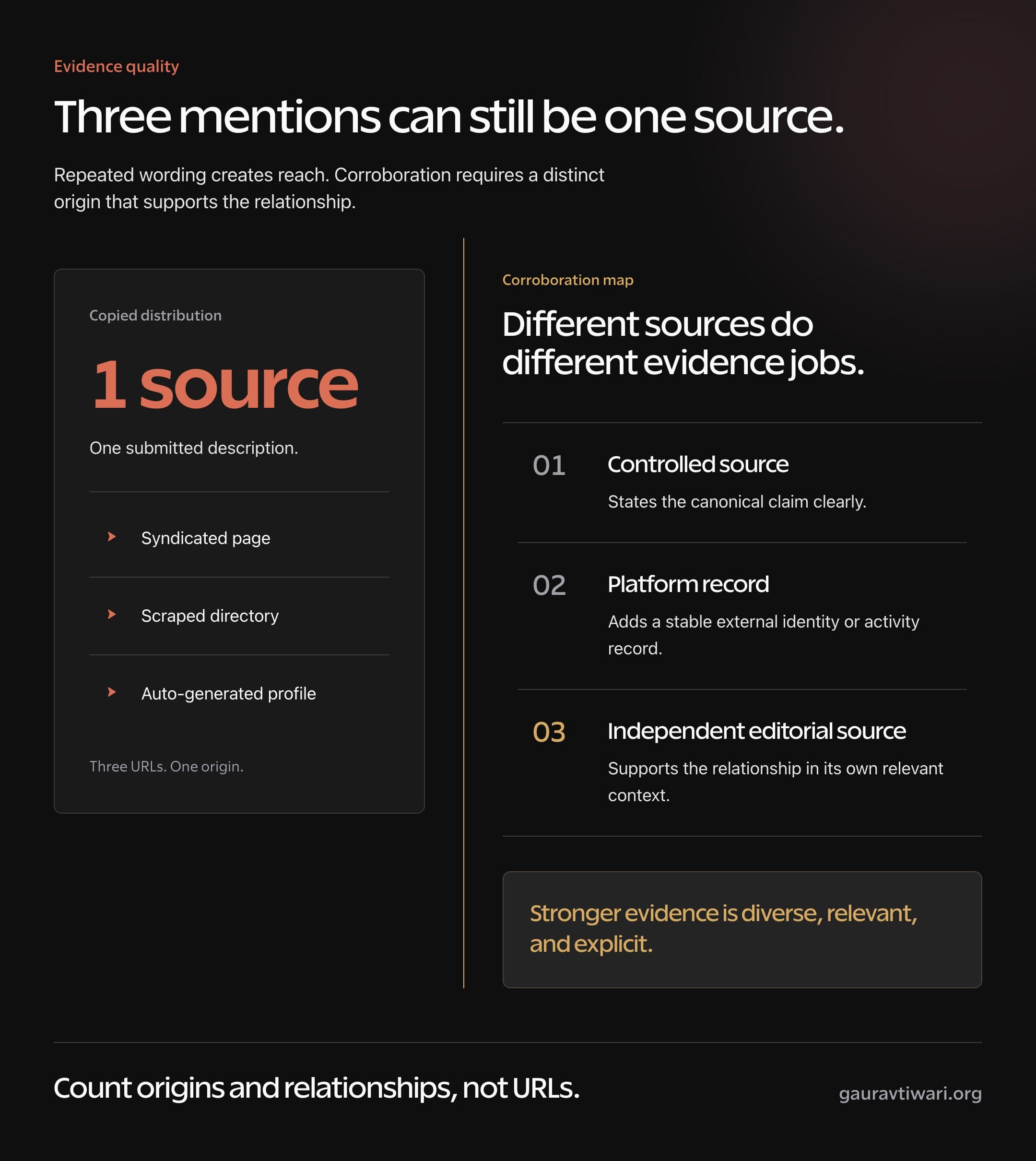
Google’s 2014 Knowledge Vault research is useful here because it describes fact extraction as probabilistic fusion, not a simple vote. The system combined web content, structured sources, extraction methods, and prior knowledge to estimate confidence. It was a research system, not current Google Search ranking documentation, but the distinction remains useful: source quality and independence matter more than a pile of identical sentences.
Separate potential support into three buckets:
| Source type | Typical examples | What it contributes |
|---|---|---|
| Controlled | Official website, author page, product page | A clear canonical claim |
| Platform-controlled | GitHub, WordPress.org, LinkedIn, government or industry directory | An external identifier, category, activity record, or relationship |
| Independent editorial | Interview, conference page, association profile, customer case study, reputable publication | Corroboration that the entity didn’t write alone |
Platform profiles sit in the middle. They are external URLs, but the entity often controls the text. They help with identity and consistency. They don’t automatically carry the same evidentiary weight as an independently written source.
And relevance matters as much as independence. A mention on a respected gardening site won’t clarify a WordPress company’s technical identity merely because the domain has authority. The surrounding topic, entities, and relationship must make sense.
Run the 5C Entity Trust Audit
The 5C audit checks one entity at a time. Start with the person, organization, or product that matters most. Mixing several entities into one sheet makes contradictions harder to see and fixes harder to prioritize.
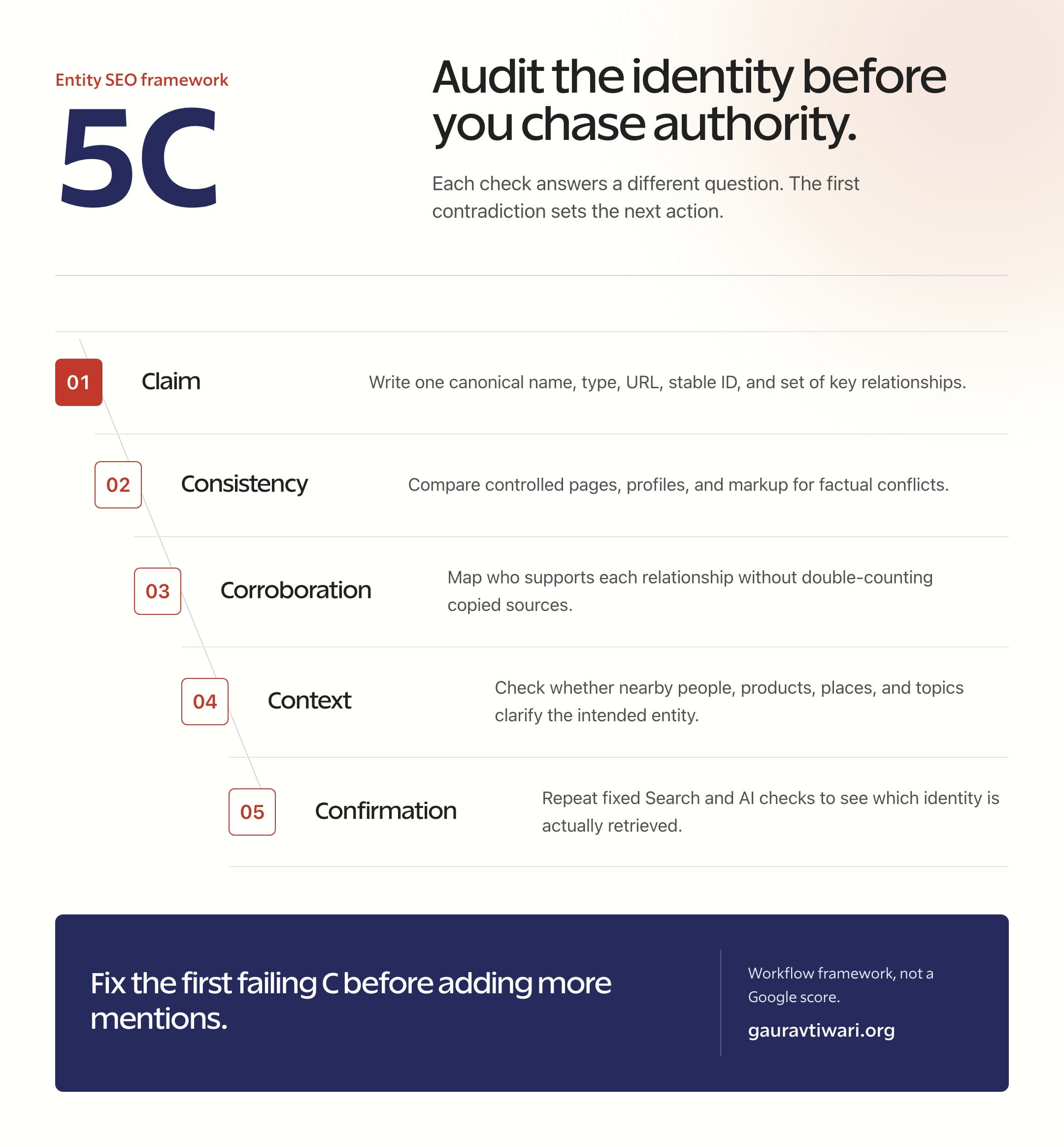
1. Claim: write the canonical record
The canonical record is the version of the entity that every controlled surface should follow. Keep it short enough to compare line by line.
Record these fields:
- Canonical name and entity type
- Canonical URL and stable
@id - Genuine alternate names or abbreviations
- Primary category and location, when relevant
- Important relationships such as founder, parent organization, owner, manufacturer, author, or service area
- Dates and role labels that can be supported
- Official profiles used as identifiers
A useful canonical statement might read: “Example Studio is a WordPress development company founded in 2020 by Example Founder.” It identifies the organization, category, founding date, and founder relationship in one sentence.
Don’t add every possible attribute. Select the facts that help a machine separate this entity from similar ones. A legal name, product owner, founder, location, or specialist category usually carries more disambiguation value than a generic slogan.
2. Consistency: compare every controlled surface
Consistency means the same important fact doesn’t change between the homepage, About page, author profile, structured data, and external profiles you control. Exact wording can vary. The underlying relationship can’t.
Check these surfaces:
- Homepage title, H1, description, and visible introduction
- About, team, author, product, and contact pages
- Organization, Person, WebSite, ProfilePage, Product, and Article markup
- Logo, image, phone, address, role, date, and category fields
- Social accounts, developer profiles, business directories, and marketplace pages
- Press kits, speaker bios, partner pages, and downloadable documents
Search for contradictions before missing fields. A wrong founding year deserves attention before an absent sameAs link because one creates conflict while the other merely leaves a gap.
If the preferred name, category, or promise is still unsettled, fix the brand identity and content relationship before distributing another description. Entity consistency can’t repair positioning that changes every month.
Also inspect duplicate nodes. Two Organization objects with different names or IDs can split what should be one identity. Use one stable @id for the same entity and reference that ID from related nodes.
3. Corroboration: map support without double-counting
Corroboration starts after the controlled record is clean. For each important relationship, list the pages that support it and mark who controls the wording.
Ask four questions:
- Did an independent party write this description?
- Does the page name the relationship explicitly?
- Is the source relevant to the entity’s category?
- Does the page add information, or copy an existing sentence?
One strong conference biography that names a speaker’s role and company can be more useful than twenty thin directories. A public code repository that connects a developer to a maintained product may add more context than a generic profile with no activity. Corroboration is a quality map, not a mention counter.
Don’t manufacture identical text across profiles. Use consistent facts, but let each source describe the relationship in language appropriate to its context. Identical wording at scale often reveals syndication rather than independent confirmation.
4. Context: inspect the semantic neighborhood
Context is the set of entities and topics that surround the target. It helps a retrieval system decide whether “Mercury” means a planet, an element, a car brand, or a newspaper.
For a business, inspect nearby people, products, services, locations, technologies, and industry terms. Then ask whether those neighbors support the intended category.
- A WordPress agency should appear near WordPress, WooCommerce, Gutenberg, PHP, web performance, and relevant products or clients.
- A local clinic should appear near its medical specialty, practitioners, city, regulator, and services.
- A software product should connect to its publisher, category, supported platforms, documentation, and release history.
Context isn’t a license to stuff entity names into every paragraph. A list of unrelated tools creates noise. Use relationships that help identify what the entity is, what it does, and how it differs from a namesake.
5. Confirmation: test the retrieved identity
Confirmation checks whether the cleaned signals produce the intended result. It doesn’t prove causation or reveal an engine’s private graph. It shows what a user can retrieve now and what still appears confused.
Use a fixed set of checks:
- Search the exact entity name in quotation marks.
- Search the name with its category, founder, product, or location.
- Inspect the title, description, sitelinks, image, and Knowledge Panel when present.
- Validate the rendered JSON-LD and confirm that it matches visible copy.
- Ask selected AI search systems the same factual questions and record their cited pages.
- Repeat the checks after meaningful corrections, using the same wording.
ChatGPT Search uses web sources and third-party search providers, while Google Search has its own indexes and knowledge systems. Don’t assume one engine’s response proves what every other engine understands.
Track the result as red, amber, or green for triage:
- Red: Wrong entity, wrong relationship, or direct contradiction
- Amber: Correct entity but missing, weak, or unstable relationship
- Green: Correct entity and relationship appear consistently across selected checks
This color is a workflow label. It isn’t a Google score.
Use this 20-check entity SEO scorecard
The scorecard makes the audit actionable without pretending to measure a hidden algorithm. Mark each check red, amber, or green and add one correction owner.
| C | Check | Pass condition | First action when it fails |
|---|---|---|---|
| Claim | Canonical name | One preferred name is documented | Choose the name used on the official site and legal or platform records |
| Claim | Entity type | Person, Organization, Product, Place, or another type is specific | Replace vague category labels |
| Claim | Stable identifier | One canonical URL and @id identify the entity |
Create a stable fragment ID, a permanent address inside your page’s code that other pages can point at |
| Claim | Key relationships | Founder, owner, product, location, or author links are explicit | Write one factual relationship sentence |
| Consistency | Visible copy | Homepage, About, and profile facts agree | Correct the highest-visibility contradiction |
| Consistency | Structured data | Markup matches visible facts | Remove duplicate or conflicting nodes |
| Consistency | Profile records | Controlled external profiles use the same core facts | Update the most trusted profile first |
| Consistency | Media assets | Name, logo, and primary image identify the same entity | Replace obsolete assets and labels |
| Corroboration | Independent source | At least one relevant source supports each important claim | Pursue a legitimate profile, interview, case study, or association record |
| Corroboration | Explicit wording | The source names the relationship, not just both entities | Request a factual correction or clearer description |
| Corroboration | Source independence | Copied and syndicated pages are grouped as one origin | Deduplicate before counting support |
| Corroboration | Topical relevance | The source belongs to the right professional or subject context | Stop chasing unrelated mentions |
| Context | Neighboring entities | Nearby people, products, and topics support the intended identity | Add specific, useful relationships |
| Context | Category clarity | The primary category is narrow enough to disambiguate | Replace generic labels such as “solutions company” |
| Context | Namesake separation | Confusable names have a role, location, product, or URL qualifier | Add a consistent differentiator |
| Context | Relationship accuracy | Connected entities and roles remain current | Remove obsolete employers, owners, or products |
| Confirmation | Brand query | Exact-name results point to the intended entity | Fix the canonical page and strongest conflict |
| Confirmation | Relationship query | Name plus role, product, or location returns the right connection | Strengthen the explicit statement and its support |
| Confirmation | Rendered markup | Saved JSON-LD is valid and matches the page | Repair the rendered output, not only the editor value |
| Confirmation | AI citation check | Answers use the right identity and cite supporting pages | Correct the cited conflict or strengthen missing evidence |
The sheet needs four working columns beside this table: Status, Evidence URL, Action, and Owner. Add Date checked only once per row. There’s no benefit in repeating the same date across several display columns.
Worked example: fix one ambiguous organization
Suppose a fictional company called Example Studio has an old homepage, a newer About page, and several profiles. The homepage calls it a design agency founded in 2019. The About page calls it a WordPress company founded in 2020. Its Organization markup uses a third name and doesn’t identify a founder.
The problem isn’t missing schema. The problem is three competing identities.
| Surface | Before | After |
|---|---|---|
| Homepage | “Example Creative builds digital experiences.” | “Example Studio is a WordPress development company.” |
| About page | Founded in 2020, founder unnamed | Founded in 2020 by Example Founder |
| Organization markup | Name: Example Creative, no stable ID | Name: Example Studio, @id: https://example.com/#organization |
| Person markup | Separate Person node with no connection | Example Founder linked through founder to the Organization ID |
| External profile | “Web design and marketing” | “WordPress development company founded in 2020” |
The after state does four things. It chooses one name, one category, one date, and one founder relationship. The wording isn’t identical everywhere, but the facts agree.
Now the corroboration check begins. An owned LinkedIn page can repeat the canonical facts and add a stable profile URL. A WordPress.org profile might connect the organization to a plugin or contributor record. An independent conference page could support the founder and company relationship. Each source does a different job.
Notice what didn’t happen: twenty new schema properties weren’t added. The strongest fix was removing contradictions and connecting the entities that already mattered.
Turn the audit into a 30-day correction plan
A useful entity SEO audit produces a prioritized fix list. Start with false or conflicting facts, then close important evidence gaps. More mentions come last.
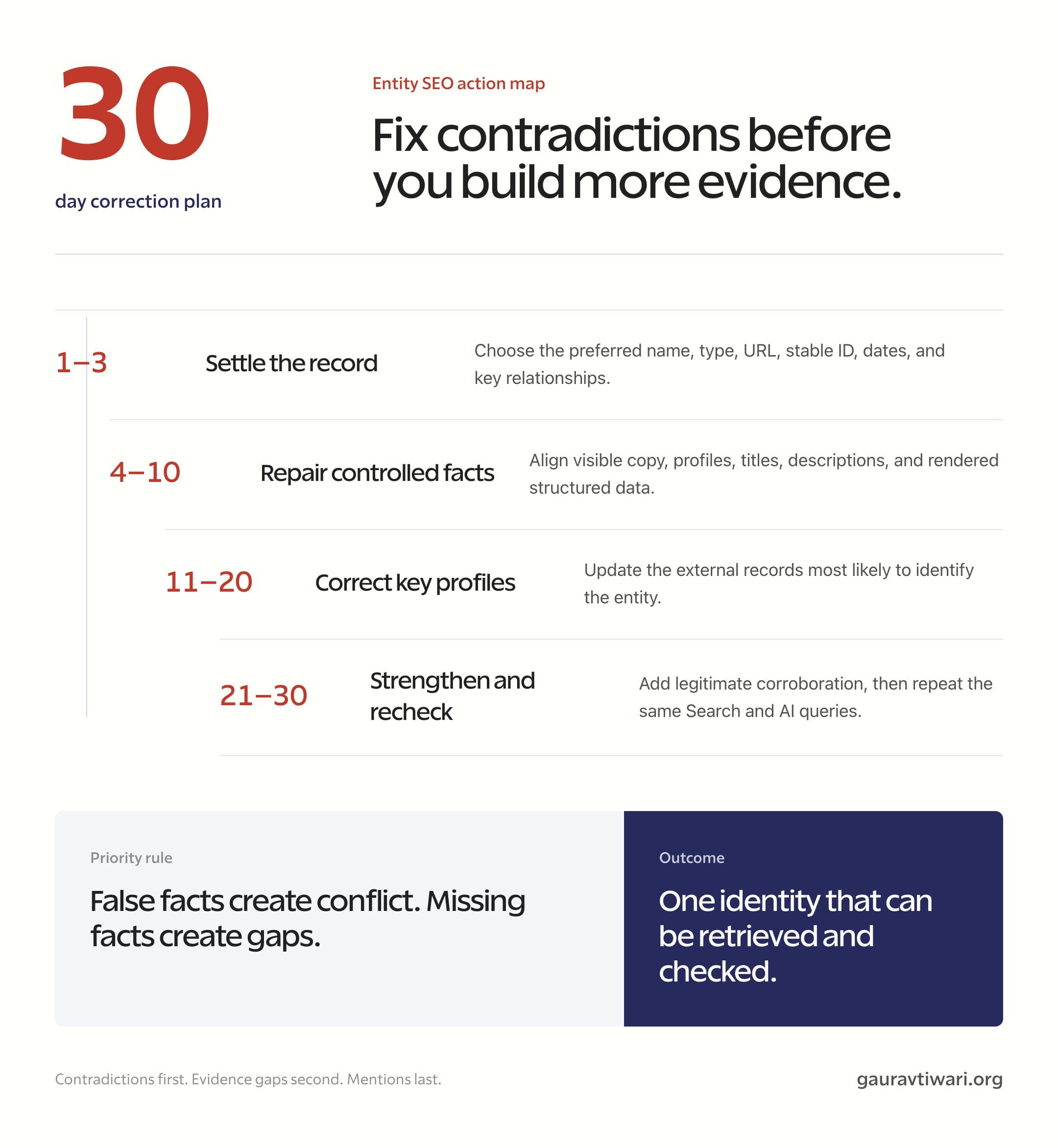
Days 1 to 3: settle the canonical record
Choose the preferred name, type, canonical URL, stable ID, category, dates, and key relationships. Then resolve internal disagreements before editing profiles across the web.
Keep the record small. If a field doesn’t help distinguish or connect the entity, leave it out of the first pass.
Days 4 to 10: repair controlled contradictions
Update the homepage, About page, author or team profiles, product pages, titles, descriptions, and structured data. Remove duplicate nodes and reuse stable IDs when one entity appears in several graphs.
Validate the rendered page, not only the value saved in a plugin field. Themes, SEO plugins, and custom code can each output schema, so the browser may receive more nodes than the editor shows.
Days 11 to 20: correct important external profiles
Update the profiles most likely to identify the entity: major social accounts, developer platforms, industry directories, marketplaces, professional associations, and partner pages.
Don’t rewrite every profile with identical promotional copy. Align the facts and relationships. Let each platform keep the detail that fits its purpose.
Days 21 to 30: strengthen corroboration and recheck retrieval
Look for legitimate places where the entity’s work already deserves a record. A partner page, conference biography, public project, customer case study, or association membership can support a relationship without turning into link spam.
Then repeat the same Search and AI queries from the Confirmation stage. Record which results improved, what remained ambiguous, and which cited page carries the conflict.
What won’t fix entity ambiguity
Several popular tactics produce more code or more mentions without improving identification.
- Adding every available schema type: More properties create more ways to disagree with visible content. Use the smallest accurate graph that represents the entity and its important relationships.
- Treating
sameAsas proof: AsameAsURL points to another identity page. The site still controls the claim, and the referenced profile may also be self-authored. - Copying one description everywhere: Consistent facts help. Identical sentences across thin profiles don’t become independent evidence.
- Buying unrelated mentions: Topical mismatch can add noise around the entity instead of clarifying its category.
- Using validation as the finish line: A green structured-data test means the syntax passed. It doesn’t prove the facts, create a Knowledge Panel, or guarantee retrieval.
- Optimizing for one engine only: Google Search, ChatGPT Search, Bing, Gemini, and Perplexity don’t expose one shared entity database. Compare the systems your audience actually uses.
The bought-mention tactic is the one that genuinely irritates me. It gets sold as entity building, and what the client actually buys is a pile of off-topic pages that make the identity harder to read, not easier.
Entity clarity also won’t rescue a weak page. Helpful content, crawlability, internal linking, source quality, and normal search eligibility still matter. That’s why entity work should sit inside a broader generative engine optimization strategy, not replace it.
For on-page extraction, use clear answers and descriptive headings alongside the graph. The AI-search formatting checklist covers that layer. Then use a fixed AI visibility tracking process to separate mentions, citations, and fetch behavior.
Frequently Asked Questions
Is entity SEO the same as schema markup?
No. Schema markup is one controlled way to state entities and relationships. Entity SEO also includes visible copy, stable identifiers, disambiguation, external profiles, independent corroboration, and retrieval checks. Valid JSON-LD can still describe the wrong or conflicting entity.
Does sameAs prove that two profiles belong to the same entity?
sameAs states that another URL represents the same entity or contains identifying information about it. It is useful for disambiguation, but the publisher still makes that connection. The referenced profile, visible facts, and surrounding evidence need to agree.
Can entity SEO create a Google Knowledge Panel?
Entity SEO can reduce ambiguity and make important relationships easier to understand. It can’t guarantee a Knowledge Panel. Google decides when to show panels and draws from web content, structured data, licensed data, and other sources.
How often should an entity audit be repeated?
Repeat the audit after a rebrand, acquisition, domain move, leadership change, product launch, address change, or major profile update. Stable entities can use a quarterly check. Fast-changing products and organizations need checks after each meaningful change.
Do AI search engines use Google’s Knowledge Graph?
There is no public basis for treating Google’s Knowledge Graph as the universal backend for every AI search system. Different engines use their own indexes, retrieval partners, models, and citation rules. Clear identity and corroborated relationships help across systems because they reduce ambiguity, not because every system shares one graph.
Fix the contradiction before chasing the mention
Start with one entity and one relationship that matters. Write the canonical claim. Remove conflicts from controlled pages and markup. Find support that is relevant and genuinely independent. Then test what Search and AI systems retrieve.
More schema isn’t the goal. Less ambiguity is.
Tell Google you want more of this.
Add Gaurav Tiwari as a preferred sourceOne tap, and this site shows up more often in your own Top Stories, AI Overviews and AI Mode. Remove it any time.