
How to Start Internet Marketing with a single website?
I’ve been doing internet marketing since 2009. Back then, you could throw up a basic WordPress site, write some articles, and watch the traffic roll in. The game has changed dramatically. AI tools have reshaped content creation. Search engines have gotten smarter. Social platforms have exploded in importance. Privacy regulations have killed third-party cookies.
But here’s what hasn’t changed: the fundamentals still work. Build something valuable. Attract the right audience. Convert that attention into income. The tactics evolve, but the strategy remains.
This guide walks you through starting internet marketing in 2026, from choosing your niche to building your first income streams. I’ll focus on what actually works now, not outdated advice from five years ago. If you’re a complete beginner, this is your roadmap.
What Internet Marketing Actually Means in 2026
Internet marketing is using online channels to promote products, services, or content and generate income. That’s the simple definition. The reality is messier.
In practice, internet marketing includes content creation (blogs, videos, podcasts), search engine optimization, email marketing, social media marketing, paid advertising, affiliate marketing, and selling your own products or services. Most successful marketers combine several of these.
The 2026 landscape has some distinct characteristics. AI tools have made content creation faster and cheaper. Privacy changes mean first-party data (your own email list, your own audience) matters more than ever. And people now discover content through AI assistants like ChatGPT, Perplexity, and Claude, not just Google.
This creates both challenges and opportunities. The barrier to creating content has dropped, which means more competition. But the marketers who build genuine relationships with their audience have a bigger advantage than ever.
Start With One Website
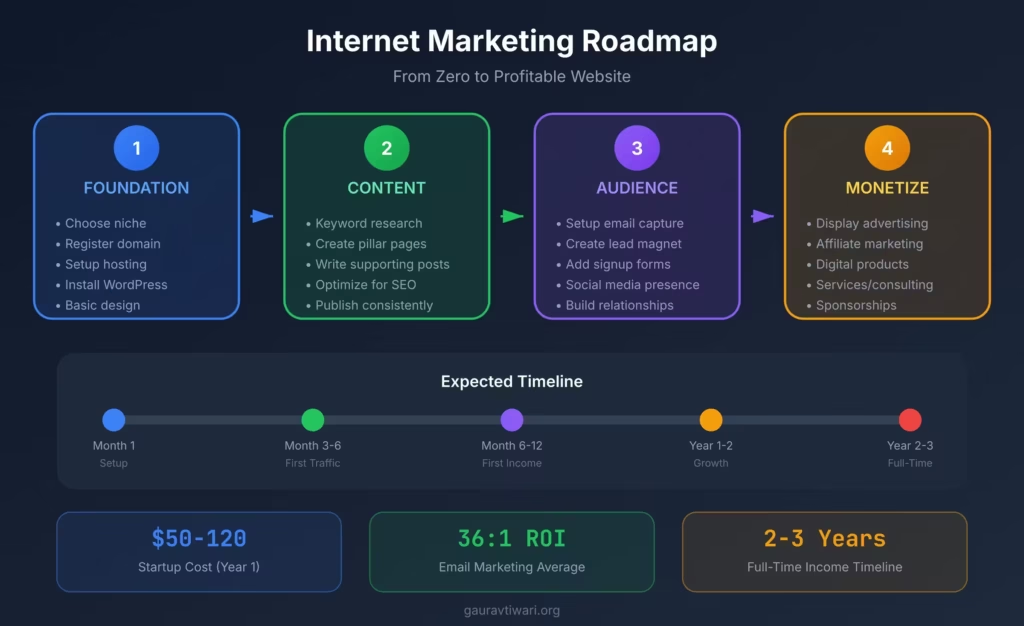
You don’t need a complex infrastructure to start. One website can serve as your central hub for everything: content, products, email signups, and affiliate offers. I built my first profitable site with nothing but WordPress, cheap hosting, and a lot of time.
Your website is the only digital asset you truly own. Social media platforms change their algorithms constantly. Email providers can shut you down. But your website, hosted on your domain, is yours to control.
Choosing Your Platform
WordPress powers over 40% of websites for good reason. It’s flexible, well-supported, and scales with you. For beginners, I recommend starting with managed WordPress hosting from providers like SiteGround, Cloudways, or WP Engine. They handle the technical stuff so you can focus on content. I’ve tested dozens of web hosting services over the years, and the difference between good and bad hosting is night and day for site speed and reliability.
Cost-wise, expect to spend ₹3,000-8,000 per year on hosting and around ₹1,000 per year on a domain name. That’s your total startup cost. You can add premium themes and plugins later as you grow.
If you’re selling products specifically, Shopify is another solid option. It’s simpler than WordPress for e-commerce but less flexible for content. Choose based on your primary goal.
Domain Name Selection
Your domain name matters more than people think. Keep it short, memorable, and easy to spell. Avoid hyphens and numbers. If your exact name isn’t available, add a word like “blog,” “hub,” or “guide” rather than compromising with a weird spelling. Check my comparison of the best domain registrars to find reliable options with fair renewal pricing.
Stick with .com if possible. It’s still the most trusted extension. Country-specific extensions like .in or .co.uk work fine if your audience is geographically focused. The registrar you choose matters less than getting your domain secured early, but avoid places that charge outrageous renewal fees.
Finding Your Niche
The biggest mistake beginners make is choosing a niche that’s too broad. “Health and fitness” is not a niche. “Kettlebell training for busy professionals over 40” is a niche. The narrower your focus, the easier it is to stand out and attract a dedicated audience.
A good niche sits at the intersection of three things: something you’re genuinely interested in, something people spend money on, and something with reasonable competition.
Interest and Knowledge
Internet marketing is a long game. If you pick a topic just because it seems profitable, you’ll burn out before seeing results. Choose something you can write about for years without getting bored.
You don’t need to be an expert when you start. Some of the best content comes from people documenting their learning journey. “Beginner learns X” is a valid angle that resonates with other beginners.
Monetization Potential
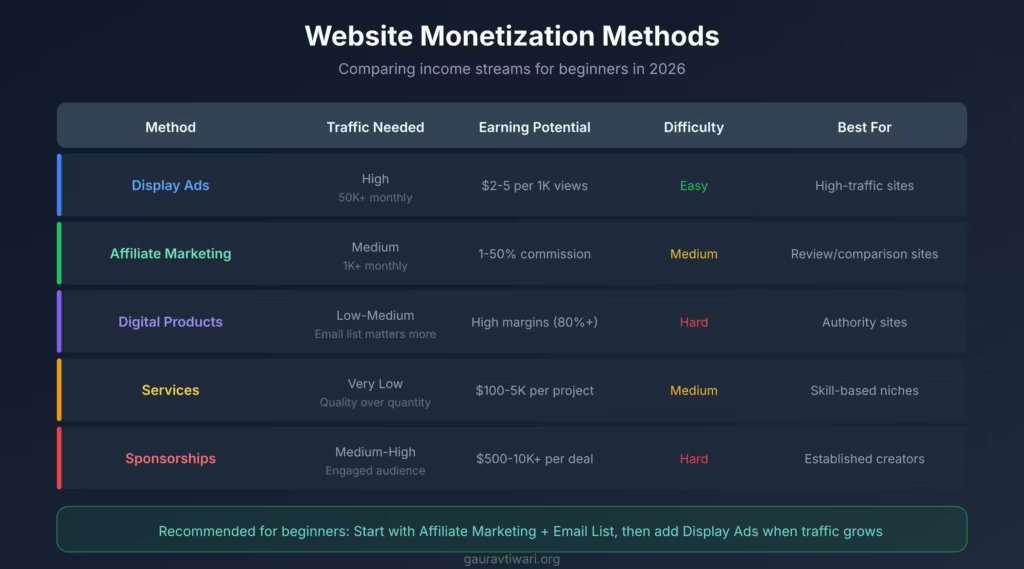
Not all topics are equally profitable. Look for niches where people actively spend money. Some indicators:
- Are there affiliate programs with decent commissions?
- Do companies buy ads related to this topic?
- Are there courses, books, or products being sold?
- Do people ask questions about buying or comparing products?
Finance, technology, health, business, and education tend to have high monetization potential. Hobbies and entertainment can work too, but often require higher traffic volumes to generate the same income.
Competition Analysis
Too little competition means there might not be money in the niche. Too much means you’ll struggle to get noticed. The sweet spot is topics with established demand but where you can offer a unique angle.
Search your potential keywords on Google. If the top results are all massive publications like Forbes, Healthline, or major media outlets, that’s a tough space. If you see smaller blogs and individual creators ranking, that’s a better sign.
Content Strategy: What Works in 2026
Content is still the foundation of internet marketing. But the approach to creating it has shifted significantly.
Writing for Humans and AI
Search has fundamentally changed. People still use Google, but they also ask ChatGPT, Perplexity, and Claude for answers. Your content needs to satisfy both traditional SEO and what’s now called GEO (Generative Engine Optimization).
In practice, this means creating comprehensive, authoritative content that answers questions thoroughly. AI assistants pull from content that’s clear, well-structured, and provides genuine value. The old tricks of keyword stuffing and thin content don’t work in either environment.
Tools like Surfer SEO and Frase now optimize for both traditional search engines and AI platforms. If you’re serious about content marketing, these tools can help identify gaps and improve your content’s visibility across all discovery channels.
Using AI Tools Effectively
About 86% of SEO professionals use AI tools in their workflow. That’s not a future trend. It’s current reality. If you’re not using AI to assist your content creation, you’re working harder than necessary.
But there’s a right and wrong way to use AI. The wrong way is generating entire articles with ChatGPT and publishing them unchanged. Google explicitly targets this kind of low-effort AI content.
The right way is using AI as a research assistant and first-draft tool. Use it to brainstorm topics, outline structures, identify questions to answer, and speed up your research. Then add your own experience, opinions, and insights. The final content should sound like you, not like a robot. I’ve written about the AI content vs human content debate in detail, and the verdict is clear: hybrid approaches win.
Content Types That Perform
Different content types serve different purposes. A solid content strategy usually includes:
Pillar content: Comprehensive guides that cover a topic thoroughly. These are 3,000-5,000+ word pieces that establish your authority. They take time to create but generate traffic for years.
Supporting articles: Shorter pieces (1,500-2,500 words) that answer specific questions and link back to your pillar content. These help you rank for long-tail keywords.
Comparison and review content: Product comparisons, tool reviews, and “best of” lists. These have high monetization potential through affiliate links.
Tutorial content: Step-by-step guides that solve specific problems. Excellent for building trust and email list growth.
Publishing Frequency
Quality beats quantity, but consistency matters. I recommend new sites aim for 2-4 high-quality posts per week initially. Once you have 50-100 solid pieces, you can slow down and focus more on updating existing content.
Content that sits unchanged for years loses value. Plan to revisit and update your best-performing pieces annually. Fresh, accurate information signals quality to both readers and search engines.
SEO Fundamentals That Still Matter
SEO has changed a lot, but the fundamentals remain important. Here’s what actually moves the needle in 2026.
Keyword Research
Start with the free tools Google provides: Google Keyword Planner, Google Search Console, Google Trends, and Google Autocomplete. These give you genuine search data without spending money.
For beginners with smaller sites, target keywords with lower competition. Tools like RankIQ specifically identify low-competition, high-value keywords that give new sites a better chance of ranking. Ubersuggest and KeywordTool.io also have free tiers that work for getting started.
Don’t obsess over search volume. A keyword with 500 monthly searches where you can rank is more valuable than a keyword with 50,000 searches where you’ll never crack page one.
On-Page Optimization
On-page SEO is the stuff you control directly on your pages. The basics:
- Include your target keyword in the title, URL, and first paragraph
- Use headers (H2, H3) to structure your content logically
- Write compelling meta descriptions that encourage clicks
- Add descriptive alt text to images
- Link to relevant internal pages on your site
- Link out to authoritative external sources
None of this is complicated. It’s just about being organized and intentional with your content structure. WordPress makes this easier with SEO plugins that guide you through optimization step by step. Install one early and let it coach you on the basics as you write.
Technical SEO
Technical SEO means making sure search engines can crawl and index your site properly. The essentials:
- Site loads fast (under 3 seconds)
- Mobile-friendly design
- HTTPS security certificate
- Clean URL structure
- XML sitemap submitted to Google Search Console
- No broken links or error pages
Good hosting and a well-coded theme handle most of this automatically. Run your site through Google’s PageSpeed Insights and fix any major issues it identifies.
Link Building
Backlinks (other sites linking to yours) remain a major ranking factor. The challenge is getting them legitimately.
Forget about buying links or participating in link schemes. Google has gotten very good at detecting these, and the penalties can destroy your site’s traffic.
Legitimate link building strategies include: creating content so good people naturally want to link to it, guest posting on relevant sites in your niche, building relationships with other creators, getting mentioned in resource roundups, and creating original research or data that journalists cite.
Link building is slow. Expect it to take 6-12 months before you start seeing significant results from SEO efforts. That’s normal.
Building Your Email List
Email marketing has the highest ROI of any digital marketing channel. According to HubSpot’s research, the average return is ₹36 for every ₹1 spent. That’s not a typo. Email crushes every other channel.
Your email list is also an asset you own. Unlike social media followers, your email subscribers can’t be taken away by algorithm changes or platform shutdowns.
Choosing an Email Platform
For beginners, I recommend starting with Beehiiv, MailerLite, or Kit (formerly ConvertKit). They’re user-friendly, affordable, and designed for content creators. All offer free tiers that work until you have several thousand subscribers. I’ve compared the best email marketing tools extensively, and these three consistently come out on top for beginners.
Don’t overthink this decision. You can always migrate later, though it’s a hassle. What matters is starting to collect emails immediately. Even getting 10 subscribers in your first month is progress.
Lead Magnets
A lead magnet is something valuable you give away in exchange for an email address. “Subscribe to my newsletter” is not compelling. “Download my free checklist for X” is much more effective.
Good lead magnets include: checklists, templates, short ebooks, video tutorials, email courses, spreadsheets, and free tools. The key is solving a specific problem your audience has.
Create one strong lead magnet to start. You can add more later as you understand your audience better.
Signup Form Placement
Put signup forms where people will see them: header, footer, sidebar, within content, and as timed popups. Don’t be shy about asking for signups. If your content is good, people want to hear from you.
Multi-step popups work well. Instead of immediately asking for an email, first ask a simple qualifying question like “Want to get better at X?” Those who click yes are more likely to complete the signup.
Keep forms simple. Just ask for the email address. Every additional field you add reduces conversions.
What to Send
The biggest mistake new email marketers make is sending only promotional content. That’s how you get unsubscribes.
Follow the 80/20 rule: 80% valuable content, 20% promotional. Share insights, tips, stories, and curated resources. When you do promote something, your audience will be receptive because you’ve built trust.
Consistency matters more than frequency. Whether you email weekly or monthly, stick to your schedule.
Monetization: How to Make Money
This is why you’re here. Let’s talk about the actual ways to turn your marketing efforts into income.
Display Advertising
Display ads are the simplest monetization method. You place banner ads on your site and earn money when visitors see or click them. It’s passive income once set up.
Google AdSense is the easiest place to start. Apply once you have some content and traffic (50-100 daily visitors is a reasonable starting point). Approval isn’t automatic. You need original content, a privacy policy, and a decent user experience.
As your traffic grows, switch to premium ad networks like Mediavine (requires 50,000 sessions/month) or AdThrive (requires 100,000 pageviews/month). They pay significantly more than AdSense. I’ve also tested various Google AdSense alternatives for sites that don’t meet those thresholds yet.
Realistic expectations: AdSense pays roughly $2-5 per 1,000 pageviews for most niches. Premium networks pay $15-30+. You need substantial traffic for display ads to generate meaningful income. The math is simple: at $5 per thousand, you need 200,000 pageviews monthly just to make $1,000.
Affiliate Marketing
Affiliate marketing means earning commissions by recommending products. When someone clicks your link and buys, you get a percentage. No inventory, no customer service, no product creation. My affiliate marketing guide for beginners covers the fundamentals in more depth.
Start with Amazon Associates. It pays low commissions (1-4% for most categories) but converts well because people trust Amazon. As you grow, add higher-paying programs from networks like ShareASale, CJ Affiliate, and individual company affiliate programs. I’ve compiled the best affiliate programs across different niches if you want specific recommendations.
The best affiliate content solves problems. “Best laptop for video editing under ₹80,000” answers a specific question and naturally includes product recommendations. Avoid creating content that feels like a sales pitch. Focus on genuinely helping your audience make good decisions.
Disclosure is legally required. Always clearly state when content contains affiliate links.
Selling Digital Products
Digital products have the highest profit margins because there’s no inventory or shipping. Once created, the cost of each additional sale is essentially zero.
Products that sell well: ebooks, online courses, templates, spreadsheets, design assets, software tools, and membership sites. The key is packaging your knowledge into something people will pay for.
Don’t create products in a vacuum. Survey your audience. Look at what questions they keep asking. Build products that solve problems they’ve already told you about.
Start with a simple product. A ₹500 ebook is easier to sell than a ₹50,000 course. Build credibility and audience trust before launching premium offerings.
Selling Services
Your content marketing can attract clients for services. If you write about web development, people who read your content may hire you to build their sites. This is how many freelancers build their client base.
Services are the fastest path to income because you’re selling your time, not waiting for traffic to scale. The tradeoff is that income is directly tied to hours worked. Use service income to fund your transition to more scalable models like products and courses.
Sponsored Content
Once you have an established audience, brands may pay you to create content featuring their products. This includes sponsored blog posts, email sponsorships, and social media partnerships.
Rates vary wildly based on your niche and audience size. A blog post sponsorship might range from ₹10,000 for a small site to ₹5,00,000+ for major publications. Email newsletter sponsorships typically pay per subscriber or per click.
Only accept sponsorships that genuinely fit your audience. Promoting irrelevant products damages trust and isn’t worth the short-term money.
Diversification Matters
The biggest mistake is relying on one income stream. If Google changes its algorithm and your traffic drops, you don’t want your entire income to disappear with it.
Aim for at least three income streams: maybe display ads, affiliate marketing, and a digital product. Or services, email sponsorships, and courses. Diversification creates stability. I wrote a detailed guide on monetizing your blog that breaks down each method with realistic earnings expectations.
Social Media: Where It Fits
Social media supports your marketing but shouldn’t be your entire strategy. Algorithms change constantly, and you don’t own your followers. Use social to drive traffic back to your website and email list.
Choosing Platforms
Don’t try to be everywhere. Pick one or two platforms where your audience actually spends time.
- YouTube: Second-largest search engine. Excellent for tutorials, reviews, and educational content. Takes significant time investment but has long content lifespan.
- LinkedIn: Best for B2B, professional services, and career-related content. Strong organic reach compared to other platforms.
- Instagram/TikTok: Visual and lifestyle niches. Short-form video is growing, but content disappears quickly.
- Twitter/X: Tech, news, and thought leadership. Good for building professional network.
- Pinterest: Underrated for DIY, recipes, home decor, and visual tutorials. Functions more like a search engine than social network.
Repurposing Content
Create once, distribute many times. A blog post can become a YouTube video, a LinkedIn article, an email newsletter, and multiple social media posts. This maximizes the value of your content creation efforts.
AI tools make repurposing faster. You can use ChatGPT to summarize a blog post into social media snippets or convert a video transcript into a blog article. Work smarter.
Realistic Timeline and Expectations
I need to be honest about timelines because too many marketing guides set unrealistic expectations.
Months 1-3
Focus on building your foundation. Set up your website, choose your niche, create your first 20-30 pieces of content, and set up email capture. Expect minimal traffic and essentially zero income. This is normal.
Months 4-6
Traffic should start trickling in from search engines. You might get your first few email subscribers. Maybe a small amount from display ads. Keep creating content consistently. This is when most people quit because they don’t see immediate results.
Months 7-12
If you’ve been consistent, you should see meaningful traffic growth. Your email list should have a few hundred subscribers. First affiliate commissions might appear. This is when things start compounding.
Year 2 and Beyond
Sites typically hit their stride in year two. By this point, you have enough content to rank for multiple keywords, an email list that generates consistent income, and clarity about what works for your specific audience.
Full-time income from a single website typically takes 2-3 years of consistent work. Some people get there faster, many take longer. Anyone promising quick riches is selling something.
Common Mistakes to Avoid
I’ve made most of these mistakes myself. Learn from them.
Trying Everything at Once
The biggest beginner mistake is spreading yourself too thin. Blogging, YouTube, TikTok, podcasting, courses, affiliate marketing all at once. You end up doing nothing well. Pick one primary channel and one monetization method. Master those before adding more.
Ignoring Email From Day One
I waited too long to build my email list. Don’t make this mistake. Set up email capture on day one, even if you’re just starting. Every visitor who leaves without giving you their email is a lost opportunity.
Chasing Trends Over Fundamentals
New tactics emerge constantly. AI this, algorithm hack that. Most of it is noise. Focus on creating genuine value for your audience, building relationships, and solving real problems. The fundamentals don’t change.
Expecting Overnight Results
Internet marketing is a long game. If you’re not willing to commit at least a year of consistent effort before seeing significant results, this isn’t for you. The people who succeed are the ones who show up day after day when no one is watching.
Copying Instead of Differentiating
It’s tempting to copy what successful sites are doing. But that creates commodity content that doesn’t stand out. Find your unique angle. Maybe it’s your specific expertise, your personality, your approach, or the audience segment you serve. Something needs to be different.
Tools You Actually Need
You don’t need a lot of tools to start. Here’s the essential stack:
Essential (Start With These)
- Web hosting: SiteGround, Cloudways, or WP Engine
- WordPress + a quality theme: Starter Theme recommendations include Kadence, GeneratePress, or Blocksy
- Email marketing: Beehiiv, MailerLite, or Kit
- Google Search Console: Free, essential for SEO monitoring
- Google Analytics: Free, tracks your traffic
Add Later (When Budget Allows)
- SEO tools: Semrush, Ahrefs, or SE Ranking
- Content optimization: Surfer SEO, Frase, or Clearscope
- AI writing assistance: ChatGPT Plus, Claude Pro, or Jasper
- Social media scheduling: Buffer or Hootsuite
- Graphic design: Canva Pro
Don’t buy tools hoping they’ll solve your problems. Tools amplify good strategy. They don’t replace it.
Taking Action
Information without action is worthless. Here’s your starting checklist:
- Choose a niche you can commit to for at least two years
- Register a domain and set up hosting
- Install WordPress and a clean theme
- Create your first 5 pieces of content
- Set up email capture with a lead magnet
- Submit your site to Google Search Console
- Commit to a content schedule and stick to it
You can complete all of this in a weekend. The rest is showing up consistently, learning from what works, and adjusting your approach over time.
Internet marketing in 2026 isn’t harder or easier than before. It’s different. The people who succeed are those who adapt to new tools and platforms while staying focused on fundamentals: create value, build audience, convert to income. Everything else is tactics.
Frequently Asked Questions
How much money do I need to start internet marketing?
You can start with ₹4,000-10,000 for the first year covering domain registration and web hosting. Premium tools and themes can wait until you’re generating income. Many successful marketers started with nothing but free tools and sweat equity.
How long does it take to make money from a website?
Expect 6-12 months before seeing meaningful income with consistent effort. First small earnings often appear around month 4-6. Full-time income typically takes 2-3 years. Anyone promising faster results is usually selling a course or program.
Is blogging still profitable in 2026?
Yes, but the approach has changed. Pure content sites face more competition. Successful bloggers in 2026 build email lists, create products, and diversify income streams rather than relying solely on display ads. Quality and audience relationships matter more than volume.
Should I use AI to write my content?
Use AI as a tool, not a replacement. AI is excellent for research, outlines, and first drafts. But publishing raw AI content without adding your expertise and voice will hurt you. Google specifically targets low-effort AI content. The best approach is AI-assisted, human-finished content.
What’s the best niche for beginners?
There’s no universally best niche. Choose something you’re genuinely interested in where people spend money. Finance, technology, health, and business have high monetization potential. But a narrower niche you’re passionate about beats a profitable niche that bores you.
How important is social media for internet marketing?
Social media supports your marketing but shouldn’t be your foundation. You don’t own your social followers, and algorithms change constantly. Use social to drive traffic to your website and grow your email list. Focus on one or two platforms rather than trying to be everywhere.
Do I need to show my face to succeed online?
No. Many successful content creators operate anonymously or use faceless content formats. Written blogs don’t require your face. Faceless YouTube channels use screen recordings, animations, or stock footage. The trend toward faceless content is growing, especially on short-form video platforms.
What’s the difference between SEO and GEO?
SEO (Search Engine Optimization) focuses on ranking in traditional search engines like Google. GEO (Generative Engine Optimization) focuses on appearing in AI assistant responses from tools like ChatGPT and Perplexity. In 2026, smart content strategy addresses both. The good news is that high-quality, comprehensive content tends to perform well in both environments.
Internet marketing offers genuine opportunity for those willing to put in the work. It’s not a get-rich-quick scheme. It’s building a real business online, one piece of content at a time. The tools have evolved, the tactics have changed, but the core principle remains: create genuine value for people, and the income follows.
Disclaimer: This site is reader-supported. If you buy through some links, I may earn a small commission at no extra cost to you. I only recommend tools I trust and would use myself. Your support helps keep gauravtiwari.org free and focused on real-world advice. Thanks. - Gaurav Tiwari