Quote to Cash for Contractors: Stop Cash Leaks Before Payroll
 by
by
Quote to cash for contractors is where profit either survives or quietly leaks out. A contractor can have booked crews, a full calendar, and signed jobs, then still struggle with payroll because estimates, approvals, change orders, invoices, and payments live in separate systems.
That is the quote-to-cash cycle, usually shortened to QTC. It covers every step from a client's first inquiry to cleared money in your account. I care about it because I have seen businesses look healthy on paper while cash sits outside the business for weeks. Busy is not the same thing as paid.
Free download: the Agency Operating System 2026
The complete playbook in one 48-page ebook: how to position, win work, deliver, and scale a small agency that runs without you in every detail. Sharp positioning, a real lead engine, proposals that close, onboarding and SOPs, delivery workflows and QA, client communication, scope control, and getting paid. Includes the Client Intake Form and Agency Hiring Checklist as appendices.
Enter your email and I’ll send the PDF straight to your inbox.
What quote to cash for contractors actually means
Quote to cash for contractors is the full operating workflow from lead capture to reconciliation. In plain English: someone asks for work, you qualify the lead, price the job, get approval, schedule the crew, complete a milestone, send the invoice, collect payment, and match that payment in accounting.
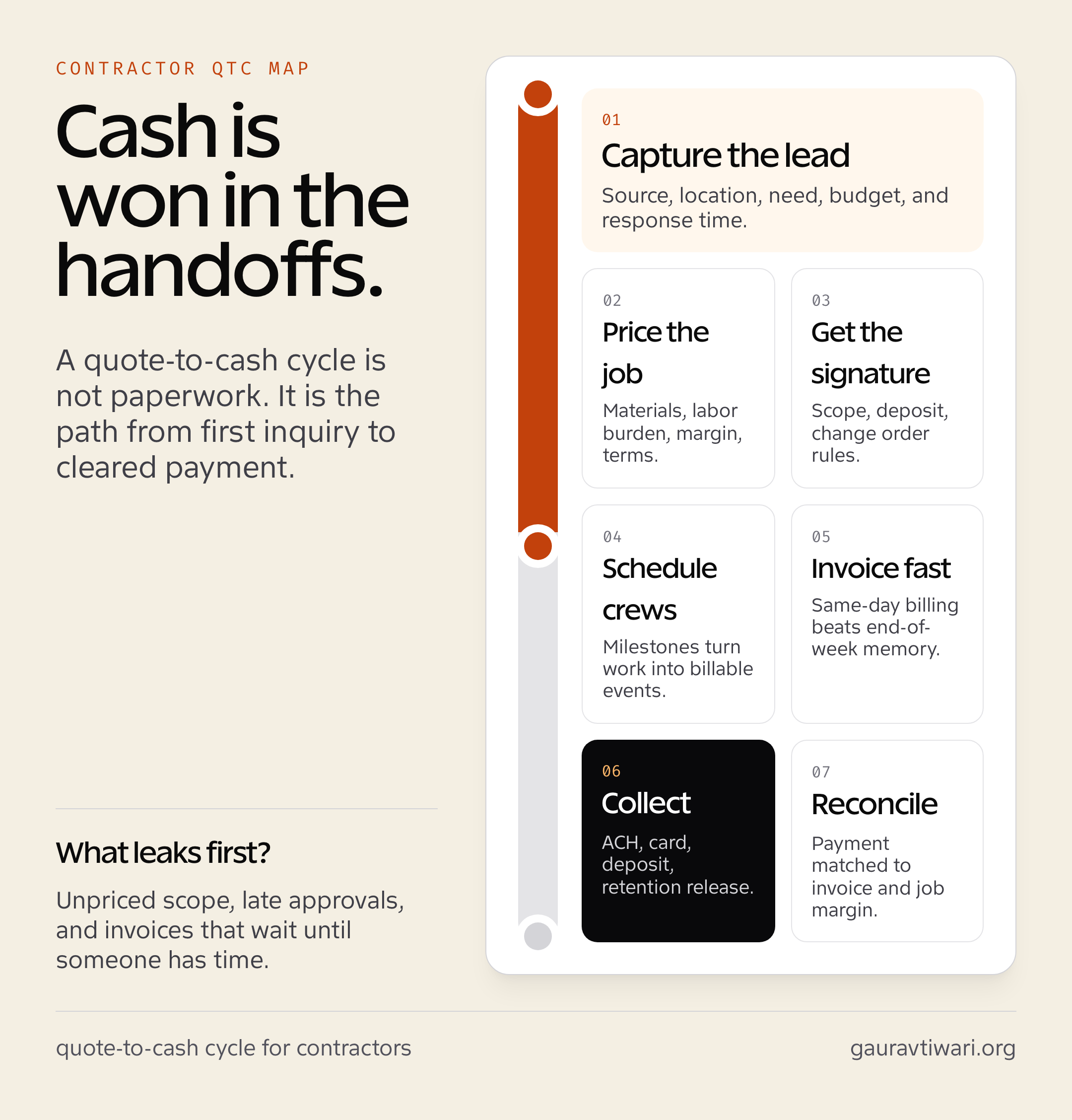
The mistake is treating those steps as separate admin tasks. They are not. Each handoff either protects margin or creates a leak. A vague estimate becomes a scope dispute. A verbal approval becomes unpaid change work. A finished milestone that is not invoiced becomes cash you cannot use.
If your contracting business uses one tool for leads, a spreadsheet for estimates, email for approvals, a calendar for scheduling, and QuickBooks for accounting, your QTC cycle depends on memory. That works when you are tiny. It breaks the moment jobs overlap.
Lead capture: qualify before the calendar fills
Revenue does not start with an invoice. It starts when the right lead enters your system with enough context to price and schedule the job. Good lead capture is not just a contact form. It is the first filter in your cash flow system.
For contractors, every inquiry should capture:
- Job type, location, and urgency
- Source of the lead, including Google Business Profile, referral, paid ads, organic search, or repeat client
- Budget range or project size when appropriate
- Photos, measurements, or site details that reduce back-and-forth
- Response time and appointment booking status
This is also where you protect your firm's income before the job exists. Bad-fit leads consume estimating time, delay qualified prospects, and make your sales pipeline look stronger than it really is.
My rule: if a lead cannot be qualified, scheduled, or disqualified inside one business day, the intake process is too loose. You do not need an enterprise CRM for this. You need one place where every inquiry lands and one owner who moves it forward.
Estimating: margin is decided before the job starts
Your estimate is not a polite price document. It is a profit forecast. For contractors, quoting too low is not a sales problem. It is a future cash flow problem disguised as a win.
Material volatility makes this worse. NAHB has reported that building material costs rose about 40% since December 2020, and its 2025 tariff analysis estimated a typical cost effect of $10,900 per home from recent tariff actions. Material price increases can punish stale estimate templates quickly.
A useful estimate should include:
- Current supplier pricing, not last quarter's saved number
- Labor burden, including payroll tax, insurance, benefits, supervision, and travel
- Equipment, disposal, permits, and subcontractor costs
- A visible markup policy tied to target margin
- Payment terms, deposit rules, and milestone billing triggers
- Change order language that makes extra work billable before it starts
For smaller residential jobs, I would rather see a slightly slower estimate that protects scope than a fast PDF that wins the work and loses the margin. Speed matters, but clarity matters more.
Digital tools should connect the cash path
If you are still building quotes in spreadsheets and emailing PDFs, you are adding friction to your own payment cycle. Modern estimating tools for contractors can connect estimates, signatures, invoices, deposits, card payments, ACH payments, and customer history in one workflow.
That does not mean every contractor needs a huge software stack. It means the data should move without someone retyping it. A lead becomes an estimate. An estimate becomes a signed agreement. A signed agreement becomes an invoice. The invoice becomes a payment record. The payment lands in accounting.
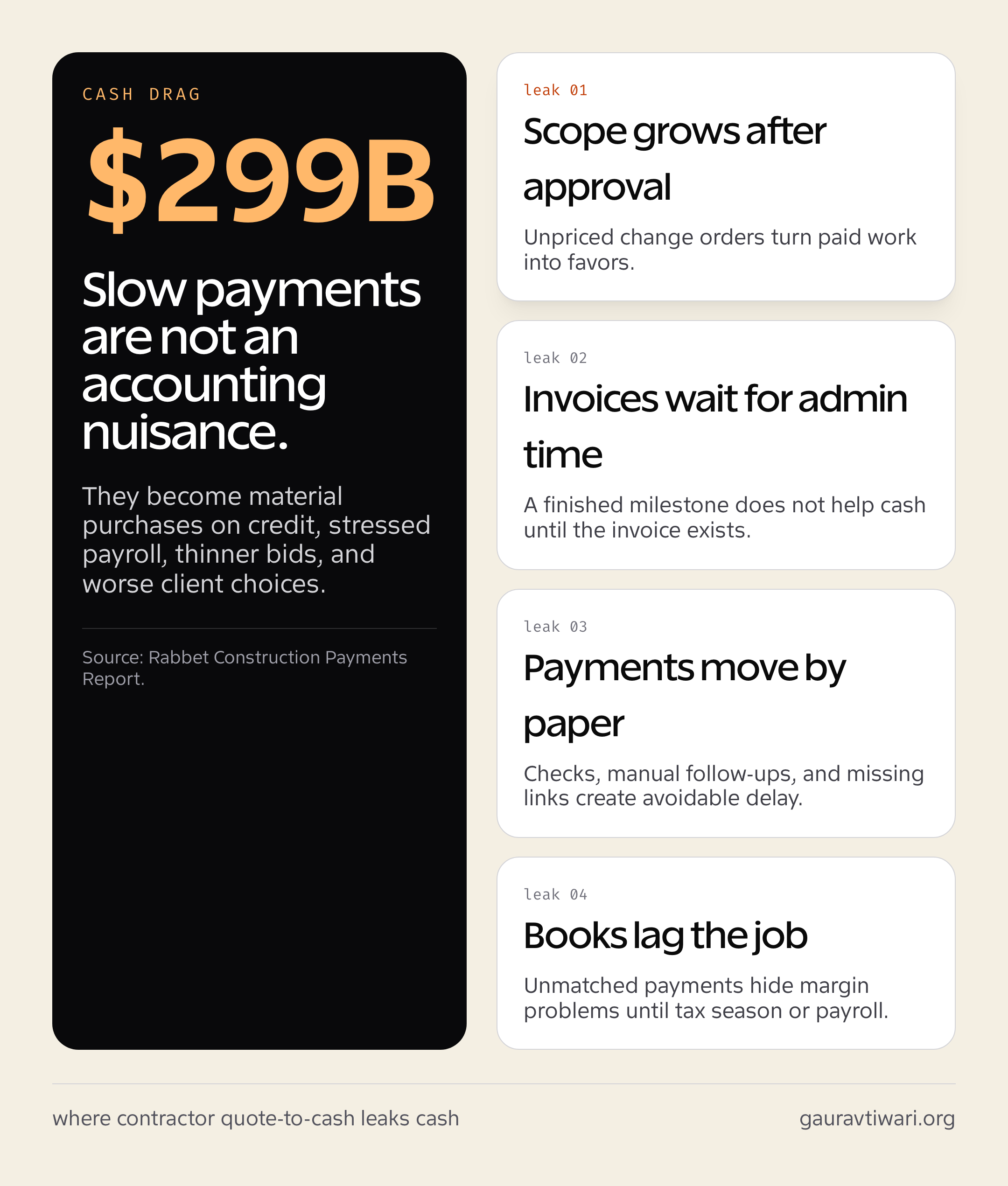
The payment side deserves attention because construction is still too manual. A 2025 PYMNTS and American Express construction payments report noted that 69% of construction companies still make payments using paper checks, while only 23% had made a virtual card payment in the previous 12 months. The same report cited 86% of general contractors reporting faster payment processing when developers used digital tools.
Use tools where they shorten the handoff:
- CRM for lead source, follow-up, and appointment status
- Estimating software for reusable scopes, supplier pricing, and margin rules
- E-signature for approvals and deposits
- Job management for milestones and field status
- Payment links for card, ACH, and deposits
- QuickBooks, Xero, or another accounting tool for reconciliation
The goal is not to buy software for the sake of it. The goal is to remove the places where cash waits for someone to remember the next step.
Approval and change orders: stop doing free work
A verbal yes feels good. It does not protect your margin. Contractor quote-to-cash systems need written approval before work starts and priced change orders before extra work starts.
This is where a lot of small crews get hurt. The client asks for "one small change." The crew does it because they are already on site. Nobody prices it. Nobody signs it. At invoice time, the client remembers it as included.
Your approval workflow should make four things painfully clear:
- What is included
- What is excluded
- What deposit or milestone payment is due
- What happens when the scope changes
Do not hide this inside legal fog. Use plain language. If a client cannot understand the scope and payment schedule before signing, the agreement is not ready.
Scheduling and job execution: the hidden cash driver
Scheduling looks operational, but it is a cash flow lever. When a crew slips by three days, the invoice slips by three days. When a milestone is not marked complete, billing waits. When the schedule lives in one person's head, revenue forecasting becomes guesswork.
This is not just a small-contractor problem. SmartPM's 2025 State of Construction Scheduling Report, summarized by For Construction Pros, analyzed more than 70,000 schedules and reported that 88% of baseline schedules failed quality benchmarks. It also found that only one in four teams updated schedules on time and 63% of professionals reported limited understanding or use of project schedules. Industry research shows the schedule is often used for decisions even when the underlying data is weak.
For quote to cash, you do not need a perfect enterprise schedule. You need the cash-relevant milestones to be visible:
- Deposit received
- Materials ordered
- Crew assigned
- Rough-in completed
- Inspection passed
- Client approval received
- Milestone invoice sent
- Final payment collected
Every milestone should answer one question: can we bill now?
Invoicing and payment collection: bill the same day
An unbilled job is not revenue. It is a memory test.
Slow payment is expensive across construction. Rabbet's 2025 Construction Payments Report says slow and inconsistent payments act like a hidden 14% tax on U.S. construction, costing an estimated $299 billion in 2025. It also says general contractors lose 65 hours each month to payment administration. That is a lot of expensive time spent chasing cash that should already be moving.
For small and mid-sized contractors, the practical fix is boring and powerful:
- Invoice the same day a milestone is hit
- Put a direct payment link on every invoice
- Offer card and ACH options
- Require deposits for material-heavy work
- Use net-15 or net-30 terms with specific late fees
- Follow up before the due date, not two weeks after it passes
This is also where days sales outstanding matters. DSO tells you how long it takes to collect after invoicing. If your DSO keeps climbing, your sales pipeline can look great while your bank account gets weaker.
Reconciliation: close the loop in accounting
The final QTC step is reconciliation: matching payments to invoices, deposits to jobs, bank activity to accounting records, and final revenue to project margin.
This step is easy to disrespect because it happens after the sale. Do not make that mistake. Reconciliation tells you whether the job actually made money.
At minimum, track:
- Unapplied payments that have not been matched to invoices
- Open change orders that affect final billing
- Retainage balances and release dates
- Sales tax by jurisdiction
- Refunds, chargebacks, and disputed invoices
- Estimated margin versus actual job margin
If QuickBooks, Xero, or your accounting tool is not connected to invoicing and payments, someone has to rebuild the truth later. That is where errors enter. That is also how cash flow problems stay hidden until tax season, loan applications, or payroll week.
Quote-to-cash KPIs contractors should track
If you do not measure your contractor QTC cycle, you are guessing. You do not need a complicated dashboard. You need a few numbers that show where cash gets stuck.
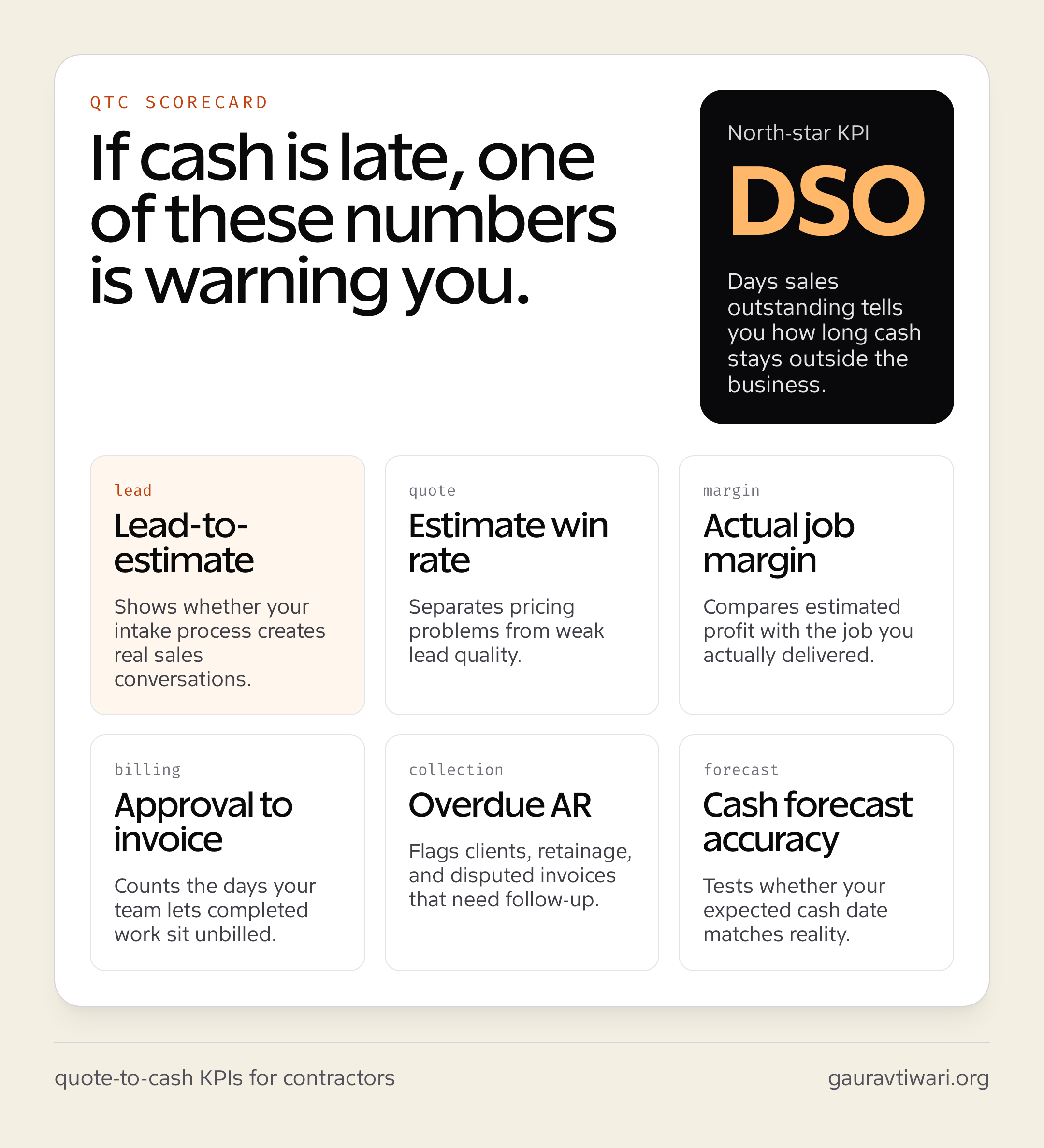
Track these every month:
- Lead-to-estimate conversion rate: how many qualified inquiries become estimates
- Estimate win rate: how many estimates become approved jobs
- Average project margin: whether actual jobs match the estimate
- Approval-to-invoice time: how long completed work waits before billing
- Days sales outstanding: how long clients take to pay
- Overdue accounts receivable: how much money is past due
- Cash forecast accuracy: whether expected cash dates match reality
I would rather see a contractor track these seven numbers consistently than stare at a prettier dashboard with 40 vanity metrics. If a number does not change what you do next week, it is probably not a QTC KPI.
A 30-day quote-to-cash cleanup plan
You do not need to rebuild your entire operation in a month. Start with the leaks closest to cash.
Week one: map your current quote-to-cash workflow from lead to reconciliation. Write down the tool, owner, and handoff for each step. If a step has no owner, that is a leak.
Week two: fix estimating and approval. Update supplier pricing, add labor burden, tighten scope language, and require signed approval before scheduling. This is where margin protection starts.
Week three: fix invoicing. Build milestone invoice triggers, add payment links, set clear terms, and schedule follow-ups. Same-day invoicing should become normal.
Week four: fix reconciliation and reporting. Match payments weekly, review DSO, check overdue AR, and compare estimated margin against actual margin. This connects your QTC cycle to the broader cash flow killers that sink otherwise healthy businesses.
The big shift is mental. Quote to cash for contractors is not an accounting phrase. It is the operating system that turns work into money. Tighten the handoffs, automate the boring parts, and measure the places where cash slows down. That is how a contractor stops being busy and starts being paid.
Frequently Asked Questions
What is quote to cash in simple terms?
Quote to cash is the process from a client's first request for a quote to the moment their payment is collected and matched in your accounting system. For contractors, it includes lead capture, estimating, approvals, scheduling, invoicing, payment collection, and reconciliation.
Why does quote to cash matter for contractors?
Quote to cash matters because contractors often spend money on labor, materials, permits, and subcontractors before final payment arrives. A weak QTC cycle creates cash flow gaps even when the business has plenty of work.
What is the biggest quote-to-cash leak for small contractors?
The most common leak is delayed invoicing after a milestone or job completion. Scope creep and unpriced change orders are close behind. Both problems turn completed work into cash that sits outside the business.
Which tools help contractors manage quote to cash?
Contractors usually need a CRM for leads, estimating software for quotes, e-signature for approvals, payment links for collection, and QuickBooks or Xero for accounting. Joist is useful for smaller contractors because it connects estimating, invoicing, and payments in one workflow.
What KPIs should contractors track for quote to cash?
Track lead-to-estimate conversion, estimate win rate, average project margin, approval-to-invoice time, days sales outstanding, overdue accounts receivable, and cash forecast accuracy. These KPIs show where cash gets stuck.
How fast should contractors send invoices?
Contractors should send invoices the same day a milestone is completed or the job is finished. Waiting until the end of the week or month adds avoidable delay and increases the chance of disputes or forgotten details.
Is quote to cash only for large construction companies?
No. Small contractors often benefit the most because they have less financial buffer. One missed change order, late invoice, or slow payment can affect payroll, material purchases, and scheduling for weeks.
Tell Google you want more of this.
Add Gaurav Tiwari as a preferred sourceOne tap, and this site shows up more often in your own Top Stories, AI Overviews and AI Mode. Remove it any time.