
The State of Digital Marketing in 2026: Platforms, Pitfalls, and What’s Next
 by
by
The state of digital marketing in 2026 is not a story about marketing disappearing. It is a story about distribution getting harder to own. Search can answer before it sends a click, social platforms can bury reach overnight, and paid traffic stops the moment the budget does.
That changes the job. You still need search, paid media, social, email, and analytics, but channel activity is not the same as a marketing system. A useful system connects discovery to a business outcome, shows which assumptions failed, and leaves you with an audience or asset you still control after the campaign.
My position: build around owned relationships and first-party evidence, then use rented channels for reach. The data below shows why. On this site, search impressions contracted far more sharply than clicks across two equal 180-day periods. Reach weakened, but click efficiency improved. A single traffic number would have hidden that split.
Table of Contents
The State of Digital Marketing Today

Digital marketing now operates under two opposing forces: more money flows through digital channels, while individual teams face tighter budget discipline. The Gartner’s 2025 CMO Spend Survey reported marketing budgets at 7.7% of company revenue, flat from 2024. In the same survey, 59% of respondents said the budget was insufficient to execute their strategy.
- The sample matters: Gartner surveyed 402 CMOs and marketing leaders in North America, the United Kingdom, and Europe. Most worked at companies with more than $1 billion in annual revenue, so 7.7% is not a small-business budget rule.
- Paid media still absorbs money: it accounted for 30.6% of the surveyed marketing budgets.
- AI is being judged as an operating tool: respondents most often reported time efficiency, cost efficiency, and increased production capacity as returns.
Meanwhile, the IAB/PwC full-year 2025 report put U.S. internet advertising revenue at $294.6 billion, up 13.9% year over year. That is a revenue benchmark for U.S. publishers and platforms, not proof that an individual advertiser became more efficient. More spending and better marketing are different claims.
The Numbers That Define 2026
The most useful digital marketing statistics come with a sample, timeframe, and limitation. These four benchmarks describe the market without pretending that one study represents every country, query, or company.
| Measure | Result | What it actually tells you |
|---|---|---|
| U.S. internet ad revenue, 2025 | $294.6B, up 13.9% | Digital ad revenue is still growing; it does not measure your return on ad spend. |
| Marketing budget, 2025 | 7.7% of company revenue | Enterprise CMO allocation in Gartner’s 402-person sample, not a universal target. |
| Traditional-result click with an AI summary | 8% of observed visits | Pew’s U.S. panel clicked a standard result less often when an AI summary appeared. |
| Traditional-result click without an AI summary | 15% of observed visits | A comparison within Pew’s March 2025 browsing sample. |
Pew Research Center analyzed browsing data from 900 U.S. adults during March 2025. Its Google AI summary click study found:
- AI summaries appeared in 18% of the Google searches observed.
- Users clicked a traditional search result in 8% of visits with an AI summary, compared with 15% without one.
- Users clicked a source cited inside the AI summary in 1% of visits that showed a summary.
- The result describes one U.S. panel and one month. It should not be converted into a universal site-level CTR forecast.
That is a real discovery shift, but the responsible response is not to declare search dead. It is to measure reach, clicks, qualified actions, and owned-audience growth separately.
A first-party 360-day search comparison
I compared two equal 180-day windows in Google Search Console for gauravtiwari.org. The property, search type, daily aggregation, and date boundaries stayed the same.
| Metric | Aug 1, 2025 to Jan 27, 2026 | Jan 28 to Jul 26, 2026 | Change |
|---|---|---|---|
| Impressions | 10,199,637 | 4,750,553 | -53.4% |
| Clicks | 55,251 | 38,774 | -29.8% |
| Aggregate CTR | 0.542% | 0.816% | +50.6% |
| Impression-weighted position | 19.71 | 23.86 | 4.15 positions worse |
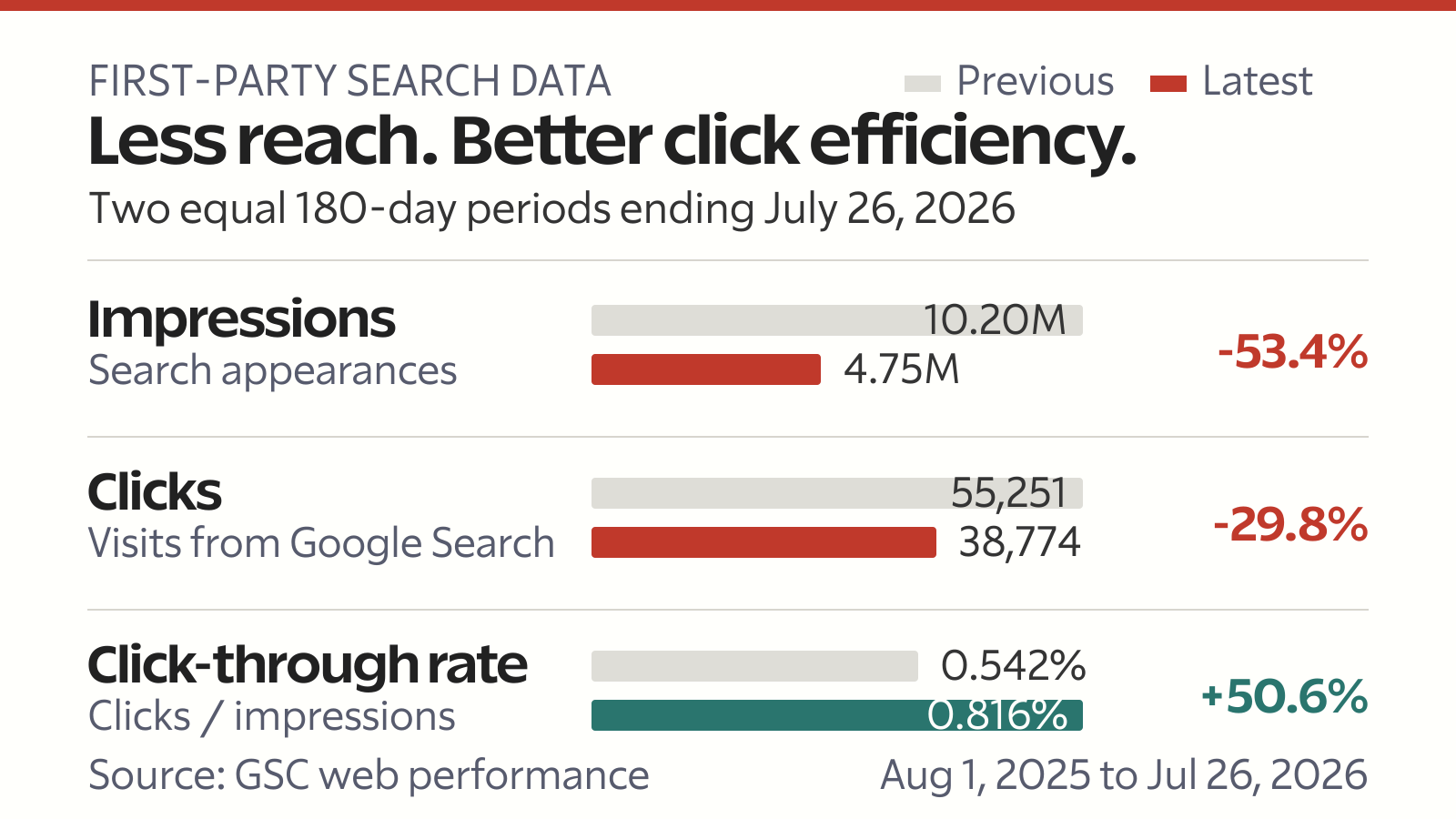
The interpretation is uncomfortable but useful. Search exposure fell by more than half and average position worsened, yet clicks fell by less than a third because aggregate CTR improved. This does not prove AI summaries caused the loss. Search Console cannot establish that causal link from these totals, and this export does not isolate AI feature traffic.
Device data adds another decision signal for the latest window:
| Device | Impressions | Clicks | Aggregate CTR |
|---|---|---|---|
| Desktop | 3,058,555 | 18,611 | 0.608% |
| Mobile | 1,607,500 | 18,699 | 1.163% |
| Tablet | 84,498 | 1,464 | 1.733% |
Desktop produced 64.4% of impressions but 48.0% of clicks. Mobile produced 33.8% of impressions and 48.2% of clicks, with a CTR about 1.9 times the desktop rate. That is enough evidence to prioritize mobile snippets and landing-page checks, not enough to assume mobile users generated more revenue.
Recurring Challenges in Modern Marketing
The platform names change, but the operating failures are remarkably stable. Four of them waste more money than a missing trend report.
Overreliance on Paid Advertising
Paid media buys controlled reach, which is valuable. It does not create compounding distribution by itself. If every campaign ends with a purchase but no reusable audience, search demand, retargeting permission, or useful content, the next sale starts from zero again.
Pair paid acquisition with a content marketing strategy that compounds over time. For specialized campaigns such as beauty brands scaling on Amazon, insist on a category-level baseline, contribution margin, branded-search lift, repeat-purchase window, and a stop condition before increasing spend.
Disconnected Tools
A stack becomes a problem when the same customer, campaign, and conversion have different names in each system. The cure is not automatically one giant platform. Start with a shared event dictionary, campaign naming rules, an owner for each metric, and a documented source of truth. Consolidate software only when it removes a real handoff or reconciliation step.
Surface-Level Metrics
Impressions, followers, and clicks describe movement, not value. A channel can lose impressions while improving CTR, as the first-party study above did. It can also gain clicks while sending people who never complete the next step. Pair channel metrics with qualified leads, activation, retention, revenue, and the specific bottleneck addressed by conversion rate optimization.
Reactive Approach to Platform Changes
Reacting to every update creates motion without learning. Use a change log for your own deployments and campaigns, keep control groups where practical, and wait for enough data to separate a site problem from normal volatility. Emergency action is for indexing failures, tracking loss, broken checkout, policy risk, or a verified revenue drop, not every ranking wobble.
The Trends Reshaping the Channel Mix
The channel mix in 2026 should respond to structural changes, not fashionable tool lists. These are the shifts that change how you allocate attention and measure results.
| Shift | Evidence | Practical response |
|---|---|---|
| AI-mediated search | Pew observed lower result-click rates when an AI summary appeared. | Publish extractable answers, original evidence, clear entities, and pages strong enough to deserve indexing. |
| Costly rented reach | U.S. digital ad revenue grew 13.9% in 2025 while surveyed CMO budgets stayed flat as a share of revenue. | Set loss limits and capture email, login, or other permission when paid reach creates demand. |
| More content supply | AI lowers production cost, so generic coverage becomes easier to copy. | Compete with tests, datasets, expert decisions, useful tools, and documented limitations. |
| Fragmented discovery | Search, social feeds, marketplaces, and AI answers expose different parts of the same buying journey. | Give each channel one job and measure the handoff, not just the channel’s native dashboard. |
| Owned-data premium | Platforms control delivery; your consented customer data and direct audience remain portable. | Invest in email quality, preference data, CRM hygiene, and retention before adding another acquisition channel. |
The important analytical move is to stop asking which channel is best. Ask which job is under-covered: demand creation, demand capture, conversion, retention, or referral. Then fund the channel that can do that job with a measurable handoff.
The Role of Next-Gen Marketing Platforms
A modern digital marketing stack should reduce decision latency. It should not merely collect more dashboards. The minimum useful stack connects acquisition data, content and campaign operations, customer records, and business outcomes without erasing the raw data you may need later.
For social operations, SocialPilot, CoSchedule, Crowdfire, and Vista Social cover overlapping scheduling, publishing, collaboration, curation, engagement, and reporting needs. Do not subscribe to all four. Map the workflow, pick the smallest tool that removes its bottleneck, and test the export and cancellation path before committing.
Keep a dependable email marketing platform in the system because permission, deliverability, segmentation, and audience history matter more than another social dashboard. The platform still needs clean consent, suppression, and attribution rules. Software cannot repair ambiguous definitions.
Case Study: Ahrefs as a Unified System for Smarter Marketing
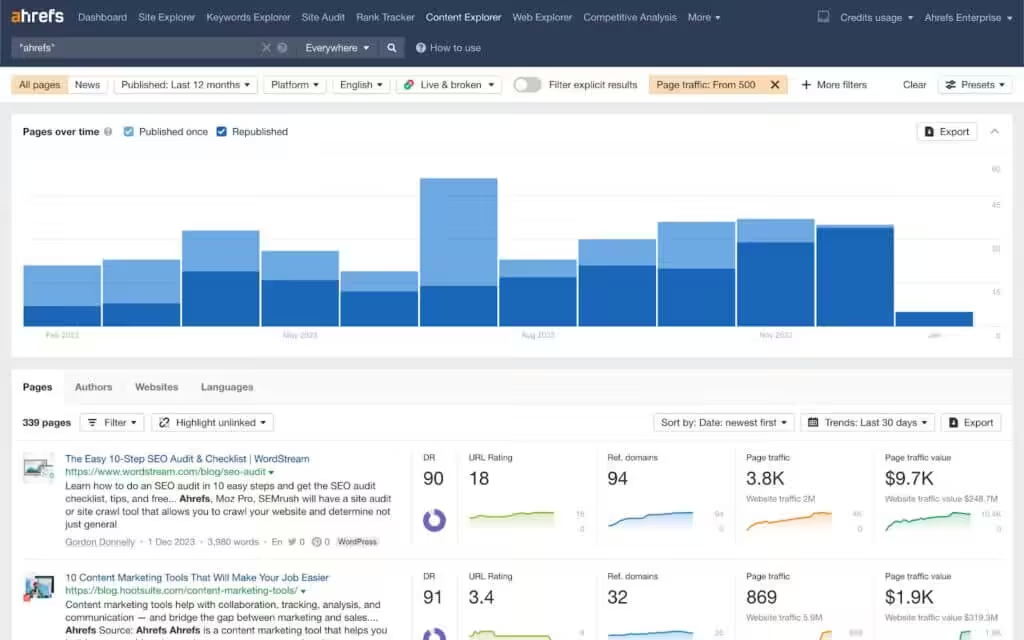
Ahrefs is a useful consolidation example because it puts keyword research, rank tracking, backlink analysis, technical audits, and content discovery in one environment. That can remove handoffs inside an SEO workflow. It does not replace analytics, CRM, experimentation, email delivery, paid-platform records, or business accounting.
Use the tool as a case study, not a promise. Evaluate Ahrefs against the decisions your team actually makes:
- Coverage: does the database represent your market, language, country, and competitors well enough?
- Freshness: how recently were the keyword, backlink, and crawl observations updated?
- Reproducibility: can another analyst repeat the filter and export the underlying rows?
- Integration: can you join the SEO evidence to Search Console, analytics, leads, and revenue without manual guesswork?
- Decision value: which action changes because the platform surfaced the information?
- Limits: what is estimated, sampled, missing, or outside the tool’s scope?
The Content Explorer image above shows one research surface, not an end-to-end marketing system. Consolidation is worth paying for when it reduces the time from evidence to decision without hiding methodology or locking away your data.
What To Do About It Now
A strategy becomes useful when it specifies order, ownership, and a stop rule. Run these five moves over the next quarter.
- Define one business outcome. Pick qualified pipeline, revenue, activation, retention, or another result the team can verify. Assign a metric owner and a data source.
- Give every channel one job. Search may capture demand, paid media may test an offer, social may create repeated exposure, and email may convert or retain. Write down the handoff.
- Publish evidence competitors cannot cheaply copy. Use tests, original datasets, screenshots, decision tables, and limitations. That is the practical core of high-quality content that ranks and gets cited.
- Protect the downside. Set a spend ceiling, test duration, success threshold, and rollback condition before launch.
- Review the system monthly. Compare reach, response, qualified action, cost, and owned-audience growth. Do not let one improving metric hide a collapsing one.
Google’s guidance for generative AI features is refreshingly conservative: foundational SEO still applies, pages need to be indexed and snippet-eligible, and there is no special AI schema or magic machine-readable file. Unique, useful, non-commodity content is a better investment than producing dozens of thin fan-out pages.
What Discovery Looks Like Beyond the Search Engine
Discovery is now a sequence, not a single search box. A buyer may notice a name in a social feed, ask an AI assistant to compare options, search the brand, read a review, join an email list, and convert later on another device. Last-click reporting gives the final step too much credit and often erases the work that created the demand.
| Channel job | Leading signal | Business check | Loss limit |
|---|---|---|---|
| Create demand | Qualified reach and repeat exposure | Brand search, direct visits, assisted conversions | Frequency or cost ceiling |
| Capture demand | Relevant impressions and clicks | Qualified action rate and value | Minimum conversion or contribution threshold |
| Convert demand | Activation and checkout progress | Revenue, pipeline, or completed goal | Error, abandonment, or acquisition-cost threshold |
| Retain demand | Engagement and product usage | Renewal, repeat purchase, or retention | Churn or complaint threshold |
Your digital marketing strategy should therefore preserve identity across channels while allowing each channel to do a different job. Use consistent entities, offers, proof, and positioning. Adapt the format and measurement to the platform instead of copying the same asset everywhere.
Sustaining Brand Visibility in a Changing Digital Environment
The state of digital marketing in 2026 rewards teams that can separate reach from response and response from business value. The first-party Search Console comparison made that visible: impressions, clicks, CTR, and average position moved in different directions. No single KPI could explain the result.
Build a small measurement spine, keep the raw evidence, own the customer relationship where you can, and make every rented channel earn a specific place in the journey. Use AI to remove repetitive work, but put human judgment into claims, priorities, experiments, and the decision to stop.
If you need the broader channel map, the complete internet marketing guide connects search, content, email, social, and conversion. Start with one outcome and one broken handoff. Fix that before buying another platform.
Tell Google you want more of this.
Add Gaurav Tiwari as a preferred sourceOne tap, and this site shows up more often in your own Top Stories, AI Overviews and AI Mode. Remove it any time.
Disclaimer: This site is reader-supported. If you buy through some links, I may earn a small commission at no extra cost to you. I only recommend tools I trust and would use myself. Your support helps keep gauravtiwari.org free and focused on real-world advice. Thanks. - Gaurav Tiwari