
Stainless Steel Centrifugal Pump Selection: 7 Checks Before You Buy
Choose a stainless steel centrifugal pump by checking fluid chemistry, wetted materials, seals, certifications, NPSH, and the pump curve before buying.
 by
by
A stainless steel centrifugal pump can look perfect on a quote and still be wrong for the job. The casing may survive while the seal swells, a weld pits, or the motor spends its life far from the efficient part of the curve. That isn’t bad luck. It’s a selection problem.
The safest way to choose one is to work from the liquid outward. Define the worst fluid chemistry, temperature, solids, cleaning cycle, duty point, suction conditions, and certification needs first. Then select the wetted alloy, seal package, surface finish, impeller, and motor. If a supplier asks only for flow and head, the specification is incomplete.
How Do You Select a Stainless Steel Centrifugal Pump?
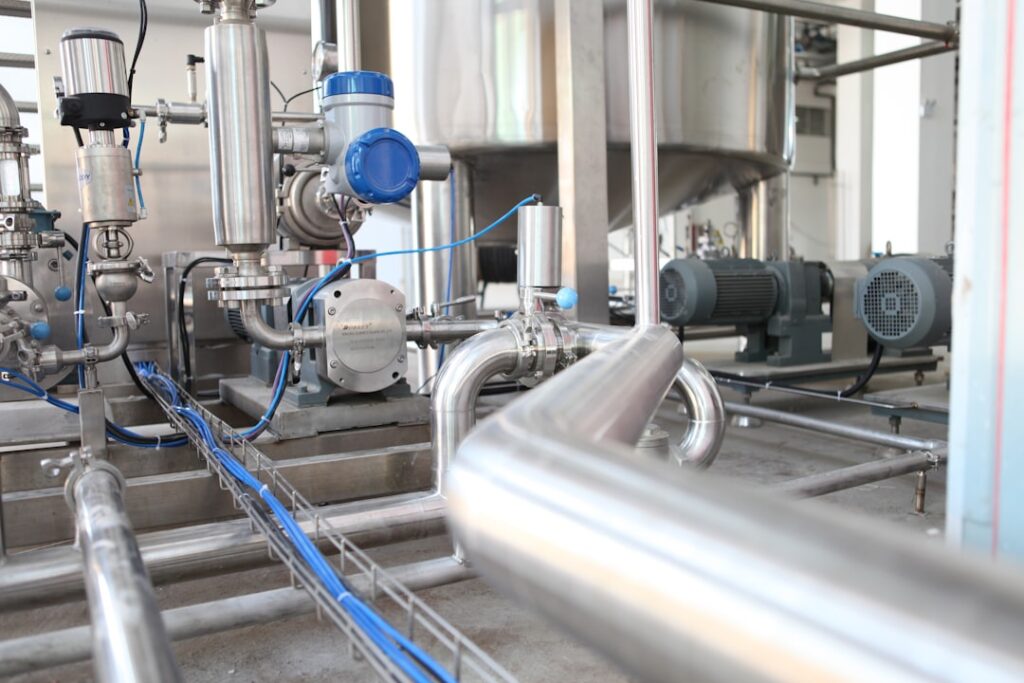
Select a stainless steel centrifugal pump by matching every wetted component to the complete operating envelope, not the normal operating point. The right choice accounts for fluid chemistry, concentration, pH, temperature, solids, viscosity, cleaning chemicals, pressure, flow, head, NPSH, certification, and maintenance access.
That order matters. Material selection and hydraulic selection aren’t separate buying decisions. They interact. A corrosive liquid can force a different alloy or seal. A viscous liquid can shift the expected performance. A poor suction condition can make a chemically compatible pump cavitate itself to death.
“Stainless steel” isn’t a complete material specification. Your purchase order should name the grade for the casing, impeller, shaft, fasteners, and other wetted parts, plus the seal faces and elastomers.
I would treat any one-line recommendation based on “water service” or “chemical service” as a starting point, not an approval. The same liquid name can hide large changes in chloride content, temperature, dissolved oxygen, cleaning concentration, and exposure time. Those details decide whether the pump lasts.
Start With the Actual Fluid, Not Its Short Name
A fluid description such as city water, brine, juice, detergent, or wastewater isn’t enough. You need a current composition and the worst condition the pump will see. A batch that is harmless at room temperature may become aggressive when heated. A short cleaning cycle may expose the pump to a stronger chemical than the product it moves all day.
Collect these facts before comparing pump models:
- Liquid composition: Main fluid, dissolved salts, chlorides, oxidizers, acids, alkalis, and trace contaminants.
- Concentration range: Normal, startup, shutdown, cleaning, and upset conditions.
- Temperature range: Include clean-in-place cycles, steam exposure, and seasonal peaks.
- Physical properties: Specific gravity, viscosity, vapor pressure, particle size, and solids percentage.
- Operating pattern: Continuous or intermittent duty, dry-run risk, starts per hour, and expected service life.
Use the worst credible combination, not an annual average. Corrosion doesn’t average itself out. Neither do vapor pressure, solids, or a hot cleaning solution. If the chemistry changes by batch, put the full range on the data sheet and ask the supplier to state the basis of selection.
Pay special attention to shutdowns and transitions. A rinse can dilute the process liquid but introduce chlorinated water. A drained line can leave concentrated residue around a seal or low point. A tank change can pull air into the suction. These short events may control corrosion and reliability even when the normal duty looks easy.
And don’t forget solids. Their size, hardness, shape, and concentration affect the impeller, clearances, seal faces, and wear rate. A liquid with a small percentage of soft suspended material is different from one carrying hard crystals. If the solids settle, describe the startup condition after a long stop as well as the steady flow.
304 vs 316 Stainless Steel Pumps: What Changes?
Type 304 is a practical general-purpose stainless steel for many clean, mild liquids. Type 316 adds molybdenum, which improves resistance to chloride pitting and crevice corrosion. That makes 316 the safer starting point for many salty, coastal, food, beverage, and chemical applications, but it still isn’t immune to corrosion.
The numbers need context. The Penflex guide uses about 100 ppm chloride as guidance for 304 or 304L in fresh water and about 2,000 ppm for 316 or 316L. It also gives free-chlorine guidance of 2 ppm for 304-class alloys and 4 ppm for 316-class alloys. Penflex is clear that these are guidelines, not guarantees.
Temperature, pH, oxygen, flow velocity, deposits, crevices, stress, and exposure time can move the risk sharply. A polished open surface may stay clean while a gasket crevice pits. A warm stagnant shutdown can be worse than normal circulation. That’s why a chloride number alone can’t approve a stainless steel centrifugal pump.
| Selection factor | 304 or 304L | 316 or 316L | What to verify |
|---|---|---|---|
| Chloride resistance | Lower | Higher because of molybdenum | Concentration, temperature, pH, oxygen, crevices, and exposure time |
| Typical material cost | Lower | Higher | Compare total ownership cost, not casing price alone |
| Welded fabrication | Prefer 304L when welding matters | Prefer 316L when welding matters | Welding procedure, filler metal, heat tint removal, and passivation |
| Hygienic service | Possible for suitable mild duties | Common starting point | Surface finish, drainability, cleanability, seal design, and certification |
| Saline or aggressive liquid | Often a poor fit | Better, but may still be inadequate | Check duplex, higher alloys, or nonmetallic materials with a corrosion specialist |
There is no prize for buying 316 when 304 is fully suitable. There is also no saving in buying 304 if one unplanned shutdown costs more than the alloy upgrade. Ask for the cost difference, expected exposure, and documented compatibility. Then make the tradeoff with the full lifecycle in view.
Also check what “stainless” covers. Some pumps use a stainless casing with a different shaft, fastener, wear ring, or seal gland. Mixed metals can create localized problems, especially when the design includes tight crevices or conductive liquid. The grade cast or stamped on the casing doesn’t tell you the full wetted-material story.
When neither 304 nor 316 has enough margin, stop treating the decision as a two-column comparison. Duplex stainless, nickel alloys, titanium, lined construction, or engineered plastics may suit the service better. Material price rises quickly, but so does the cost of leakage, contamination, and repeated replacement. Get a corrosion review for high-consequence service.
What Does the “L” Grade Actually Change?
The “L” in 304L and 316L means low carbon. It reduces the risk of sensitization during welding, where chromium carbides can form near the heat-affected zone and leave nearby metal less resistant to corrosion. That matters for welded casings, piping connections, and fabricated assemblies.
Low carbon doesn’t make every surface automatically more corrosion-resistant. It mainly protects welded areas from a specific metallurgical problem. The final result still depends on the welding procedure, filler metal, shielding, heat tint removal, pickling, passivation, and inspection.
This is one of the easiest details to lose in purchasing. A drawing may specify 316L for the casing but say nothing about the impeller, shaft, weld filler, or fasteners. The pump can then contain a mix of alloys with different corrosion behavior. Ask for a material list for every wetted component and keep it with the equipment record.
Food, Beverage, and Potable Water Need More Than 316L
For hygienic service, alloy grade is only one part of the design. Cleanability depends on surface finish, weld quality, drainability, internal geometry, gasket fit, seal design, and whether cleaning fluid reaches every product-contact area. A 316L casting with rough pockets can be a worse hygienic choice than a properly finished and documented assembly.
Many hygienic specifications use a product-contact surface finish of 0.8 micrometers Ra or smoother, but don’t copy that number blindly. The product, cleaning method, applicable standard, and customer specification control the requirement. Ask how the finish is measured, which surfaces are included, and whether the supplier provides a finish certificate.
For drinking-water service, verify whether the complete pump or relevant components need certification to NSF/ANSI/CAN 61 or another local requirement. Material grade by itself isn’t certification. A finished product can include coatings, elastomers, lubricants, adhesives, and other contact materials that also affect compliance.
A surface-finish value also needs a measurement method and location. A supplier may quote one polished sample while leaving welds, bores, or shadowed areas at a different condition. For critical hygienic duty, define which product-contact surfaces are measured, how many readings are taken, and what records must ship with the pump.
Electropolishing can improve cleanability and surface condition, but it can’t rescue poor geometry or a bad weld. Drainable orientation, minimal dead legs, correct gasket compression, and complete cleaning coverage remain essential. Treat the finish, fabrication, and cleaning process as one sanitary design system.
Put the required standard, surface finish, test report, and certificate on the purchase order. If a requirement exists only in an email, it is much easier to lose during fabrication or substitution.
The Seal Can Fail Before the Stainless Casing
A stainless steel centrifugal pump is a system of materials. The casing and impeller may be compatible while the mechanical seal faces, O-rings, gaskets, or shaft sleeve aren’t. Many early leaks blamed on “the pump” begin with a seal package that was never matched to the liquid and temperature.
Seal faces such as carbon, silicon carbide, and tungsten carbide behave differently with abrasive solids, poor lubrication, heat, and chemical exposure. Elastomers such as EPDM, FKM, nitrile, and PTFE also have different limits. There isn’t one best combination for every fluid.
Ask these questions before choosing the seal:
- Will the liquid crystallize, polymerize, dry out, or leave abrasive deposits at the seal faces?
- Can the pump lose prime or run dry during startup, draining, or tank changeover?
- Does the seal need a flush, quench, double-seal arrangement, or barrier fluid?
- Are the elastomers compatible with the process liquid and the cleaning chemical at the highest temperature?
- Can maintenance staff replace the seal without removing half the piping system?
The purchase price rarely shows the cost of seal access, spare availability, or repeated alignment work. Add those details to the comparison. A pump that is slightly more expensive but easier to service can be the cheaper machine within its first shutdown.
Size the Pump Around the System Curve
After the material and seal package are credible, size the pump for the actual system. You need a duty point with required flow and total dynamic head, plus the shape of the system curve. Static head, pipe friction, fittings, filters, control valves, elevation, and expected fouling all belong in the calculation.
Don’t choose a pump only because its curve passes through one flow-and-head point. Check where that point sits relative to the best efficiency point. Review the allowable operating region, absorbed power, motor margin, efficiency, minimum continuous stable flow, shutoff head, and runout condition.
Suction conditions deserve equal attention. Compare net positive suction head available, or NPSHa, against the manufacturer’s NPSH required, or NPSHr, with a suitable margin for the application. NPSHa can fall when liquid temperature rises, the tank level drops, a suction strainer plugs, or vapor pressure increases. A stainless steel centrifugal pump can’t fix a bad suction layout.
Also ask which liquid was used for the published curve. Standard water-test data may need corrections for viscosity, specific gravity, or solids. If the process liquid is unusual, request a documented performance correction or test condition rather than assuming the water curve transfers unchanged.
Check the motor at every expected operating point, not only the design point. The absorbed power can change across the curve, and specific gravity changes the power demand. Confirm the motor enclosure, insulation, ambient-temperature rating, hazardous-area classification, starting method, and service factor for the installation. A correct hydraulic selection with the wrong motor package is still the wrong pump.
Parallel operation needs another pass. Two pumps on the same header don’t simply deliver twice the flow because the system curve moves the operating point. Review check valves, control logic, minimum flow, and what happens when one unit stops. If redundancy matters, define whether one pump must carry the full duty or only a reduced emergency duty.
Use Pump Affinity Laws as a Check, Not Permission
The affinity laws estimate how a geometrically similar centrifugal pump responds to speed changes. Flow varies roughly with speed, head with the square of speed, and power with the cube of speed. That last relationship matters because a modest speed increase can demand a much larger increase in power.
Toolgrit explains the relationships and the limits that get missed in quick sizing exercises. The equations don’t replace the pump curve, system curve, efficiency map, NPSH check, or motor limit. They are local estimates under similar operating conditions.
Impeller trimming is even more model-specific. There isn’t a universal percentage that makes every trim safe or accurate. Trimming can change efficiency, vane geometry, radial load, the relationship with the volute, and the reliable operating range. Use the manufacturer’s trim curve and minimum-diameter limit. If the required point needs a large correction, a different pump size may be the better answer.
A variable-frequency drive can widen the useful operating range, but it doesn’t remove hydraulic limits. Check minimum speed, motor cooling, resonance, seal behavior, bearing load, minimum flow, and the control strategy. The goal isn’t merely to hit a number. It is to operate reliably across the expected range.
The 7-Point Stainless Steel Centrifugal Pump Checklist
A good request for quotation makes assumptions visible. Send the same complete data set to every supplier, then compare their exceptions and guarantees instead of comparing model numbers alone.
- Define the full liquid envelope. State composition, concentration, pH, temperature, vapor pressure, viscosity, specific gravity, solids, particle size, gases, and cleaning chemicals. Include normal and upset conditions.
- Specify every wetted material. Name the required grade for the casing, impeller, shaft, sleeve, fasteners, and connections. Ask the supplier to list any exceptions or mixed alloys.
- Choose the seal as carefully as the casing. Match seal faces, elastomers, flush plan, and dry-run tolerance to the process and cleaning cycle. Confirm spare availability and service access.
- Write down hygienic and regulatory needs. Include surface finish, drainability, connection type, documentation, inspection, material traceability, and applicable product certification.
- Calculate the complete system curve. Provide required flow, total dynamic head, static head, friction range, control method, minimum and maximum duty, and expected fouling.
- Check suction and operating margins. Document NPSHa across tank levels and temperatures. Review NPSHr margin, best efficiency point, allowable operating range, minimum flow, and motor power.
- Get the selection in writing. Keep the curve, impeller diameter, speed, motor rating, efficiency, material list, seal code, test standard, and supplier exceptions with the purchase order.
If the application suits a stainless steel centrifugal pump and you need configurable fittings, mounting, motor enclosures, performance, or seal-face combinations, American Stainless Pumps is worth discussing with an engineer. The company says it water-tests every pump before shipping and can tailor several configuration details. Ask it, or any supplier, to confirm wetted-material and seal compatibility for your exact fluid in writing.
That final sentence is the important one. A configurable pump isn’t automatically a compatible pump. The value comes from giving the engineer enough information to make a defensible selection and keeping the approved details attached to the order.
Frequently Asked Questions
These answers cover the questions that usually surface when material grade, seals, and pump curves reach the same purchase decision.
Is 316 stainless steel always better than 304 for a pump?
316 usually offers better resistance to chloride pitting because it contains molybdenum, but it also costs more and can still corrode. Use 304 when the documented chemistry and temperature support it. Use 316, a higher alloy, or another material when the complete exposure demands it.
What is the difference between 316 and 316L in a stainless steel centrifugal pump?
316L has lower carbon, which reduces sensitization risk in welded heat-affected zones. It doesn’t make every unwelded surface more corrosion-resistant. Welding procedure, filler metal, heat tint removal, passivation, and the grades of other wetted parts still matter.
Can a 316 stainless steel pump handle salt water?
Not automatically. Chloride concentration, temperature, oxygen, pH, crevices, deposits, and exposure time affect the risk. Warm or stagnant salt water can pit 316. Ask a corrosion specialist to assess the exact service and consider duplex, higher alloys, or nonmetallic materials when needed.
Does a food-grade pump have to be 316L?
Not in every application, but 316L is a common starting point for hygienic service. Food-grade suitability also depends on surface finish, weld quality, drainability, gasket design, seal materials, cleanability, and the standard or customer specification that applies to the process.
How much can you trim a centrifugal pump impeller?
There is no safe universal percentage. Use the manufacturer’s trim curve, minimum impeller diameter, and model-specific limits. Trimming can change efficiency, vane geometry, radial load, and the useful operating range. A different pump size may be better when a large trim is required.
What information is needed to size a stainless steel centrifugal pump?
Provide required flow, total dynamic head, the system curve, liquid temperature, vapor pressure, viscosity, specific gravity, solids, suction level, pipe losses, control method, duty range, and NPSHa. Also state the expected operating hours and startup pattern.
Why does a stainless steel centrifugal pump seal fail early?
Common causes include incompatible elastomers, poor lubrication, dry running, abrasive solids, crystallization, heat, misalignment, cavitation, and the wrong flush arrangement. Match the complete seal package to both the process liquid and the strongest cleaning chemical at the highest temperature.
Make the Specification Do the Hard Work
Most expensive pump mistakes aren’t hidden. They begin as missing information: an average chloride value instead of a maximum, a casing grade without an impeller grade, a duty point without a system curve, or a food-service label without a finish certificate.
Fix the specification first. Collect the fluid envelope, materials, seal requirements, certifications, system curve, NPSH margin, and test documents. Then ask each supplier to mark every exception. That gives you a stainless steel centrifugal pump you can defend before purchase and maintain after installation.
Tell Google you want more of this.
Add Gaurav Tiwari as a preferred sourceOne tap, and this site shows up more often in your own Top Stories, AI Overviews and AI Mode. Remove it any time.