
 by
by
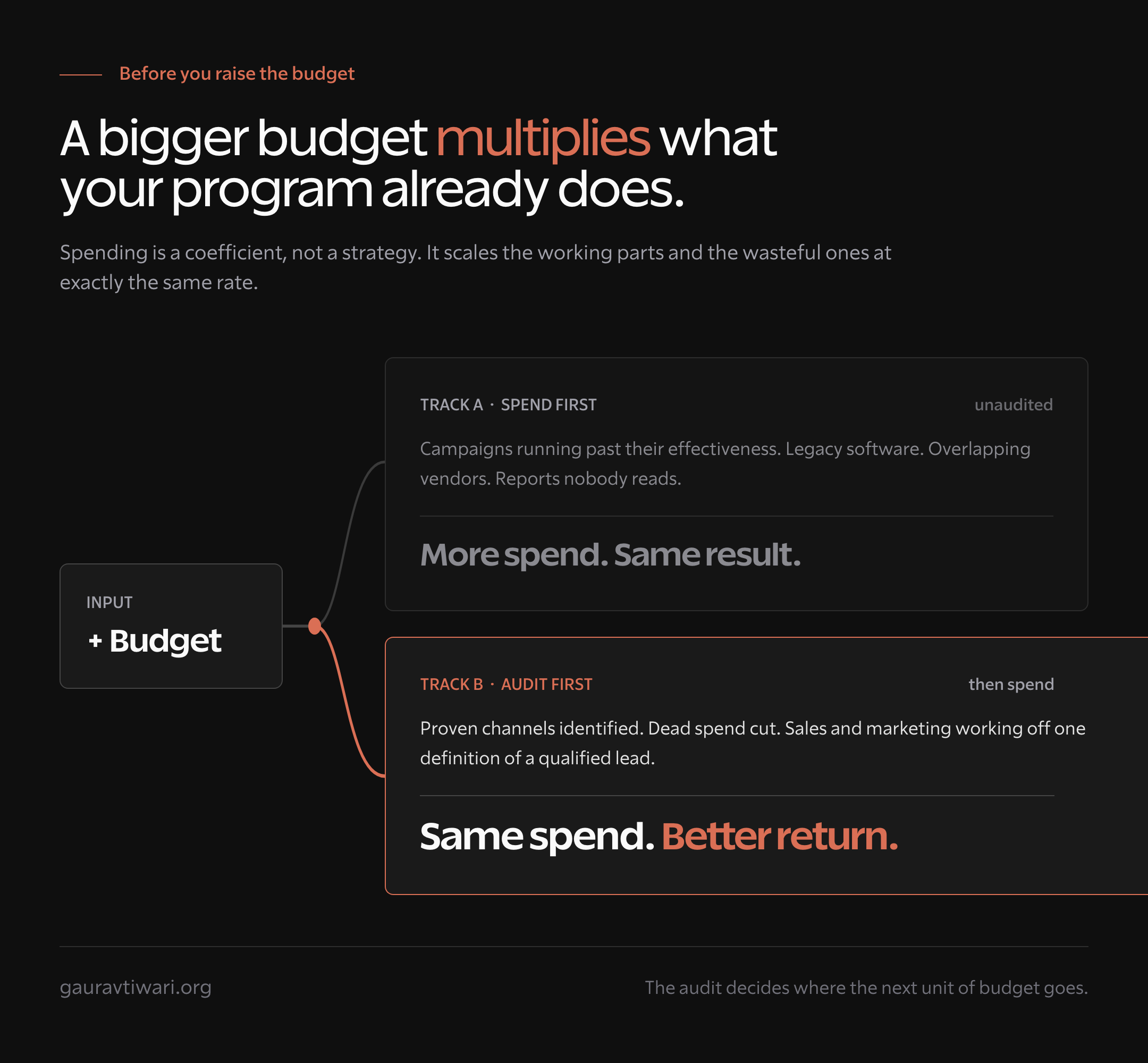
If your marketing strategy isn’t paying the dividends you were hoping for, you might be tempted to increase your budget. After all, increasing spending can get you access to new channels, bigger audiences, and entirely new segments.
But before simply increasing budget, businesses should take a step back to conduct a thorough marketing audit.
A Bigger Budget Can’t Fix a Weak Strategy
Marketing performance depends on far more than spending. Even a substantial budget may produce disappointing results if the underlying strategy lacks focus. Businesses may be targeting the wrong audience, emphasizing the wrong messaging, investing in ineffective channels, or measuring success using metrics that don’t align with broader business objectives.
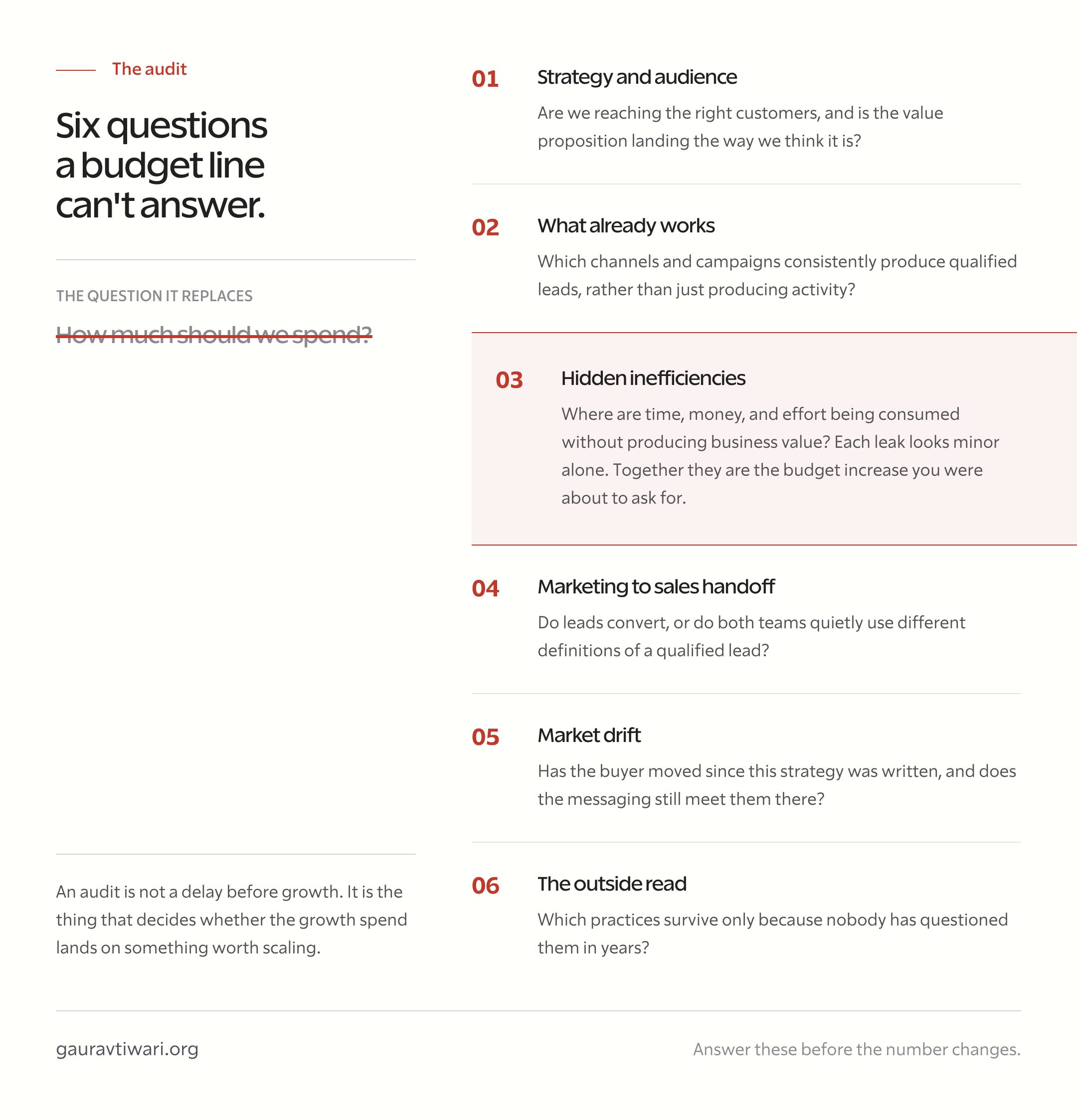
A marketing audit, under the direction of a skilled marketing leader, helps uncover these strategic issues. Rather than asking, “How much should we spend?” the audit asks more fundamental questions:
- Are we reaching the right customers?
- Is our value proposition clearly communicated?
- Which campaigns consistently generate qualified leads?
- Which initiatives consume resources without producing meaningful results?
These questions often reveal opportunities that additional spending alone would never address.
Understanding What Is Already Working
One of the greatest advantages of a marketing audit is that it identifies existing strengths. Many organizations operate numerous marketing initiatives simultaneously. All of these may contribute to lead generation:
- Search engine optimization
- Paid advertising
- Email marketing
- Social media
- Content marketing
- Referral programs
- Trade shows
- Public relations
- Outbound sales efforts
Without careful evaluation, it can be difficult to determine which activities are producing the strongest results. A marketing audit examines available data to identify successful campaigns, high-performing channels, and effective messaging. These insights allow organizations to invest additional resources where they are most likely to generate meaningful returns. Growth becomes more intentional rather than simply more expensive.
Finding Hidden Inefficiencies
Marketing budgets often contain inefficiencies that develop gradually over time:
- Campaigns continue running long after their effectiveness declines
- Legacy software remains in use despite limited value
- Multiple vendors perform overlapping functions
- Reports are generated but rarely influence decision-making
- Content is created without a clear distribution strategy
These inefficiencies may go unnoticed because each individual issue appears relatively minor. Collectively, however, they can significantly reduce marketing performance. A comprehensive audit helps identify where time, money, and effort are being consumed without producing corresponding business value. Eliminating or improving these areas may free resources that can be redirected toward more productive initiatives.
Sometimes the most effective way to increase marketing performance is not by spending more but by spending smarter.
Marketing and Sales Should Work Together
An effective marketing audit extends beyond marketing activities alone. One important question is whether marketing and sales operate as an integrated system. Marketing may generate large numbers of leads while the sales team struggles to convert them into customers. Alternatively, sales representatives may repeatedly hear objections or questions that marketing materials fail to address. Lead qualification standards may differ between departments, creating frustration on both sides.
Evaluating these relationships can uncover opportunities to improve the customer journey. When marketing and sales align around shared objectives, businesses often see improvements in lead quality, conversion rates, and overall efficiency. Additional advertising dollars can’t fully compensate for disconnects between these functions.
Customer Behavior Changes Over Time
Markets evolve. Customer expectations shift, competitors introduce new offerings, technology changes, and economic conditions influence purchasing behavior. A marketing strategy that performed exceptionally well several years ago may no longer produce the same results today. A marketing audit provides an opportunity to reassess these changing conditions.
Organizations can evaluate whether their target audience has evolved, whether customer needs have changed, and whether messaging still resonates with prospective buyers. They can also examine competitive positioning and identify emerging opportunities that may not have existed previously. Regular evaluation helps ensure that marketing strategies continue reflecting current market realities rather than outdated assumptions. And adaptability is often crucial for sustained growth.
An Outside Perspective Can Be Valuable
Organizations sometimes become so familiar with their own marketing processes that they overlook opportunities for improvement. Internal teams may continue established practices simply because they have always been done that way. Long-standing assumptions may go unchallenged, and inefficiencies can gradually become accepted as normal. A marketing audit (particularly one conducted by an experienced outside advisor) can provide fresh perspective.
An objective review may identify blind spots, emerging trends, or overlooked opportunities that internal teams have not recognized. External specialists often bring experience from multiple industries and organizations, allowing them to compare current practices against broader market standards.
Build on a Strong Foundation
Increasing a marketing budget can be an effective growth strategy, but only when the underlying marketing program is operating efficiently. Investing additional resources into campaigns that lack clear direction or measurable performance may simply amplify existing weaknesses rather than improve results.
Rather than viewing a marketing audit as a delay before growth, businesses may benefit from seeing it as the foundation that makes future growth more effective.
Tell Google you want more of this.
Add Gaurav Tiwari as a preferred sourceOne tap, and this site shows up more often in your own Top Stories, AI Overviews and AI Mode. Remove it any time.