
Use this 50/30/20 budget calculator to split take-home income into needs, wants, and goals, then compare the targets with your actual monthly spending.
Calculate the default targets and compare them with your actual monthly buckets.
Your result
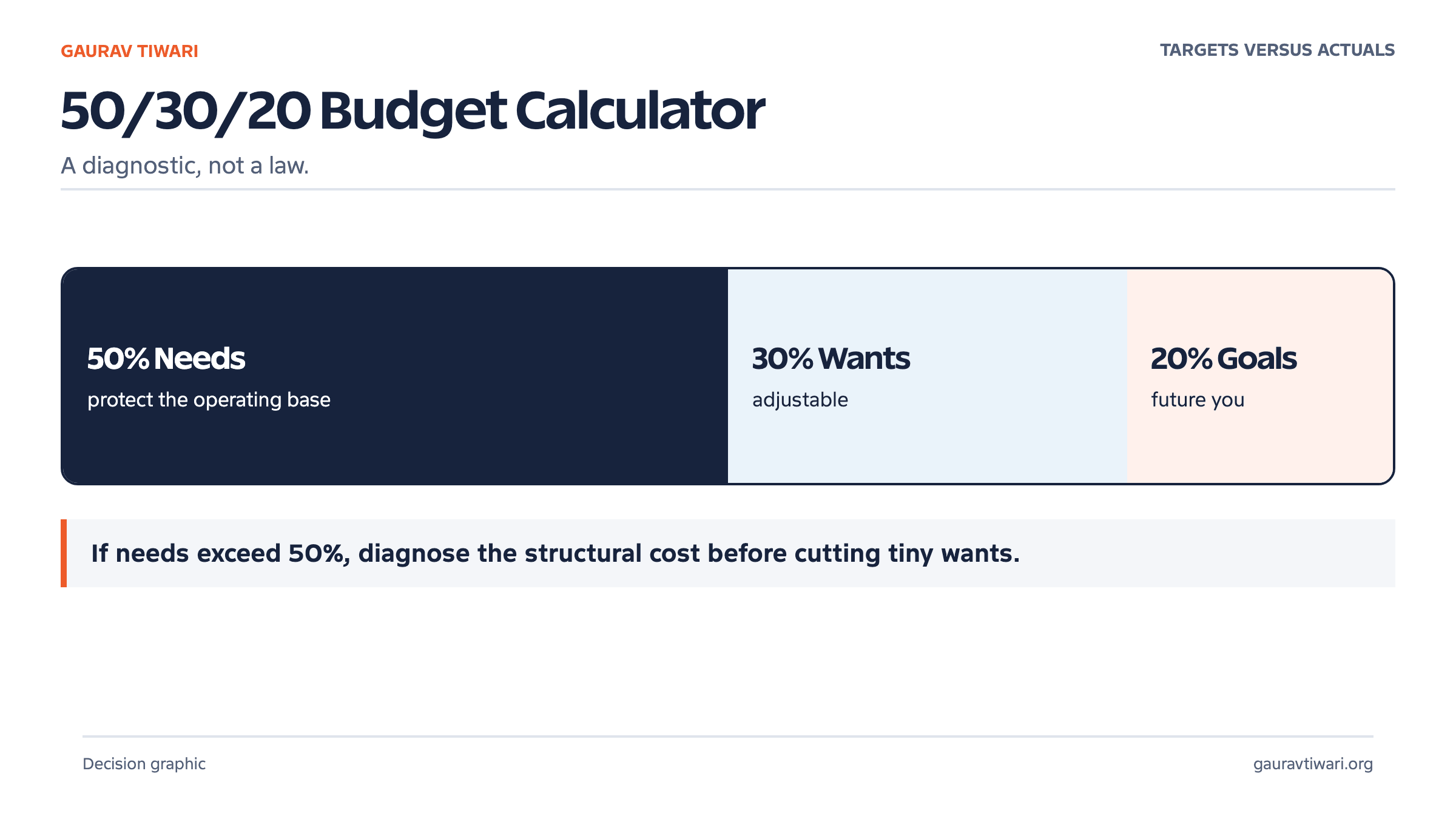
The 50/30/20 budget calculator splits take-home income into 50% for needs, 30% for wants, and 20% for savings and extra debt payments. This version also compares those targets with what you actually spend.
Use the result as a diagnostic. If rent alone consumes half your income, the calculator has found a structural problem, not a character flaw.
What belongs in needs, wants, and goals?
The 50/30/20 budget calculator groups spending by whether a cost is required, flexible, or building a future goal.
| Bucket | Usually includes | Target |
|---|---|---|
| Needs | Housing, basic food, utilities, transport, insurance, minimum debt payments | 50% |
| Wants | Dining out, entertainment, upgrades, optional subscriptions, leisure travel | 30% |
| Goals | Emergency savings, investing, and debt payments above the minimum | 20% |
A car can be a need. An unnecessarily expensive car payment is partly a want. The labels are decision tools, not moral categories.
Why the percentages sometimes fail
The 50/30/20 budget calculator exposes whether essential costs can fit inside half of take-home income. That assumption is not true in every city, family, or income band.
- High housing or childcare costs can push needs above 50%.
- Low income can make nearly all spending essential.
- Aggressive debt repayment may push goals above 20%.
- A temporary medical or family burden can distort one month.
- Irregular income can make monthly percentages unstable.
When needs are high, first separate temporary pressure from a recurring structural gap. A structural gap needs a housing, income, transport, or debt decision, not another round of tiny subscription cuts.
How to adapt the rule
Keep the three-bucket model but change the targets to match reality. The categories matter more than loyalty to the original percentages.
- Use 60/20/20 while fixed costs are high.
- Use 50/20/30 when debt payoff or saving is the priority.
- Use quarterly averages for variable income.
- Move minimum debt payments to needs and extra principal to goals.
- Recalculate after a major income or housing change.
The Consumer Financial Protection Bureau: My spending rule to live by presents 50/20/30 as one spending rule and explicitly encourages people to create a personal rule that works for their situation.
What to do with the result
Pick the largest meaningful gap. If wants are 4 points high, one deliberate category change may fix it. If needs are 18 points high, focus on the underlying fixed cost or income constraint.
For a category-by-category plan, use the published budget guide. If you need every dollar assigned, use a zero-based plan instead of forcing these percentages.
Frequently asked questions
Is the 50/30/20 rule based on gross or net income?
Use take-home income after taxes and payroll deductions. That is the money actually available to assign.
Are minimum debt payments needs or savings?
Treat required minimum payments as needs. Count payments above the minimum in the 20% goals bucket.
What if my needs are more than 50%?
Do not hide the result. Decide whether the pressure is temporary or structural, then target the largest fixed cost or income constraint.
Can I change the percentages?
Yes. The three-bucket framework is more important than the exact split. Use targets that challenge you without making the plan impossible.
The next step
Run the 50/30/20 budget calculator with take-home income and actual spending, then work on the largest meaningful gap. Change the percentages when fixed costs make the default split unrealistic.