Copywriting & Marketing Wisdom · Kindle
Your copy isn’t boring. It’s written for everyone, which is the same thing.
Most website copy fails in a specific, fixable way. It describes a thing instead of speaking to a person, and the reader leaves without ever being addressed. This 27-page primer fixes that, in the order you’d apply it.
Kindle edition · 27 pages · free to read on Kindle Unlimited · Amazon shows the price before you buy
Rated 4.7 out of 5 from 5 ratings on Amazon.in, the only rated book on this shelf
Read it on:
Why this primer
Writing for everyone reads as writing for nobody.
Broad copy is a hedge. It avoids excluding anyone, and in doing so it stops speaking directly to the person who would have bought.
How web copy usually gets written
the default- Describe the thing. Features and specifications, with no line addressed to a reader.
- Hedge the audience. Written broadly to avoid excluding anyone, which excludes everyone equally.
- Keywords bolted on. Optimization applied after the fact, so it reads like it was applied after the fact.
- One call to action, at the bottom. Placed where a reader who already left will never see it.
- Long because long feels thorough. Length used as a proxy for value.
- No revision pass. First draft published, with the throat-clearing paragraph still at the top.
How this guide does it
the primer- Audience first. Work out who you’re talking to before you decide what to say.
- Structure that carries. How a page should move a reader, section by section.
- Keywords woven in. Optimization as part of the writing rather than a pass afterwards.
- Calls to action that fit. What to ask for, where, and how to phrase it without pressure.
- Named mistakes. The specific errors that cost conversions, listed so you can check against them.
- Blog copy as well. Posts that resonate, not just landing pages.
What’s inside
Six chapters, in the order you’d actually apply them.
Twenty-seven pages covering the decisions that determine whether a page converts, with practical examples throughout.
Audience
- Working out who you’re writing for
- Tailoring a message to a real reader
- Speaking to needs rather than features
Website copy
- Writing effective website copy
- Structure that moves a reader
- Clarity over cleverness
Blog copy
- Posts that resonate
- Openings that hold
- Writing for return readers
SEO
- Keyword optimization inside the writing
- Ranking without writing for machines
- Titles and headings that work twice
Conversion
- Writing for conversions
- Compelling calls to action
- Turning visitors into followers or customers
Mistakes
- Common copywriting mistakes
- What quietly costs you readers
- What to check before publishing
27 pages across six chapters. Read it in one sitting, then rewrite your worst page.
Before you buy anything else
Most of what people buy first, they don’t need.
Four things people acquire before fixing the actual writing.
You don’t need a copywriting course
The decisions that matter fit in a short guide. A course sells you a curriculum around them.
You don’t need to be a natural writer
Audience, structure, and a clear ask are mechanical. Charm is optional and mostly overrated on a landing page.
You don’t need to choose between SEO and readability
The keyword chapter is about weaving optimization into the writing rather than trading one against the other.
You don’t need to be pushy to convert
The call-to-action section is about clarity and placement. Pressure tactics are a different, worse strategy.
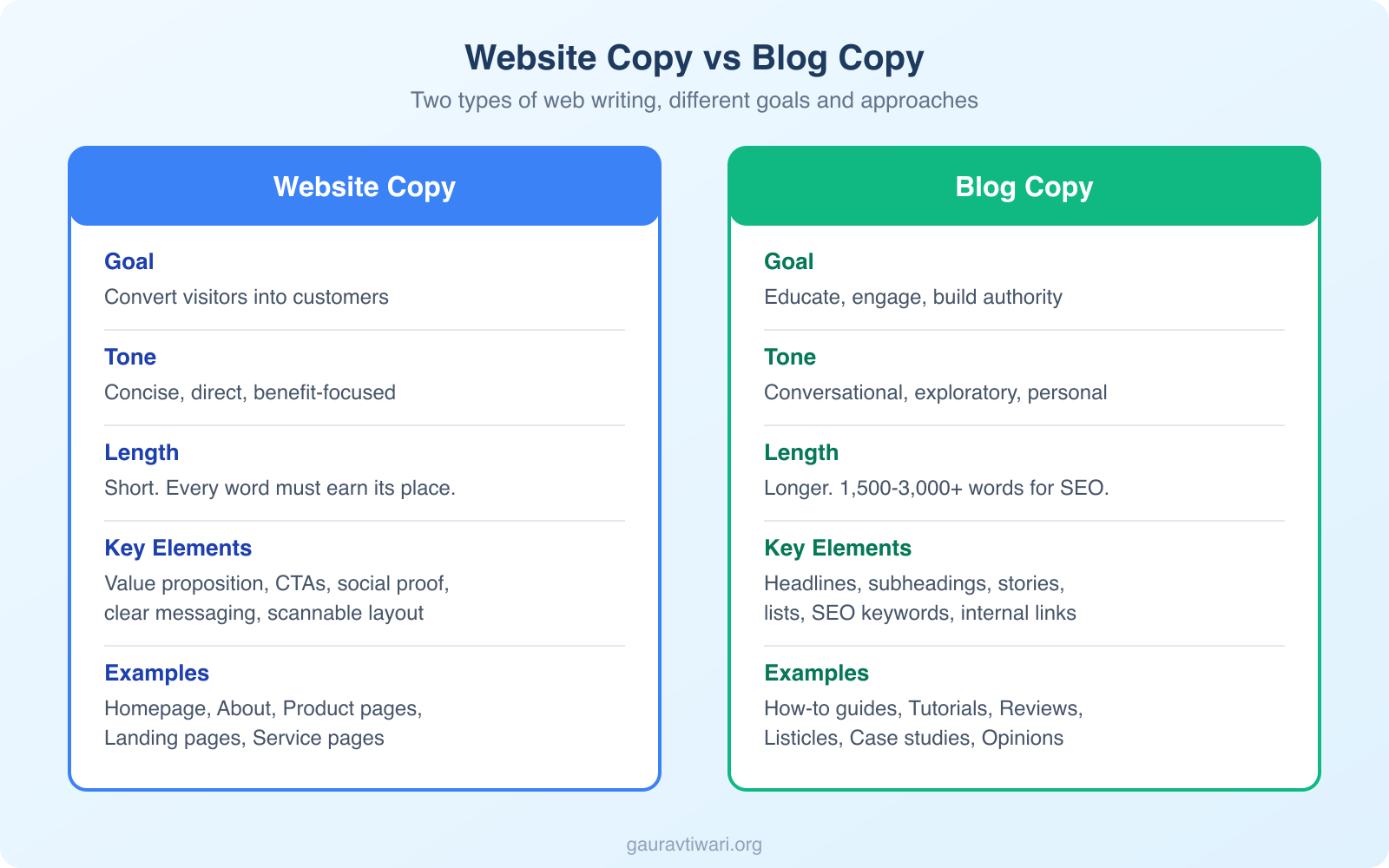
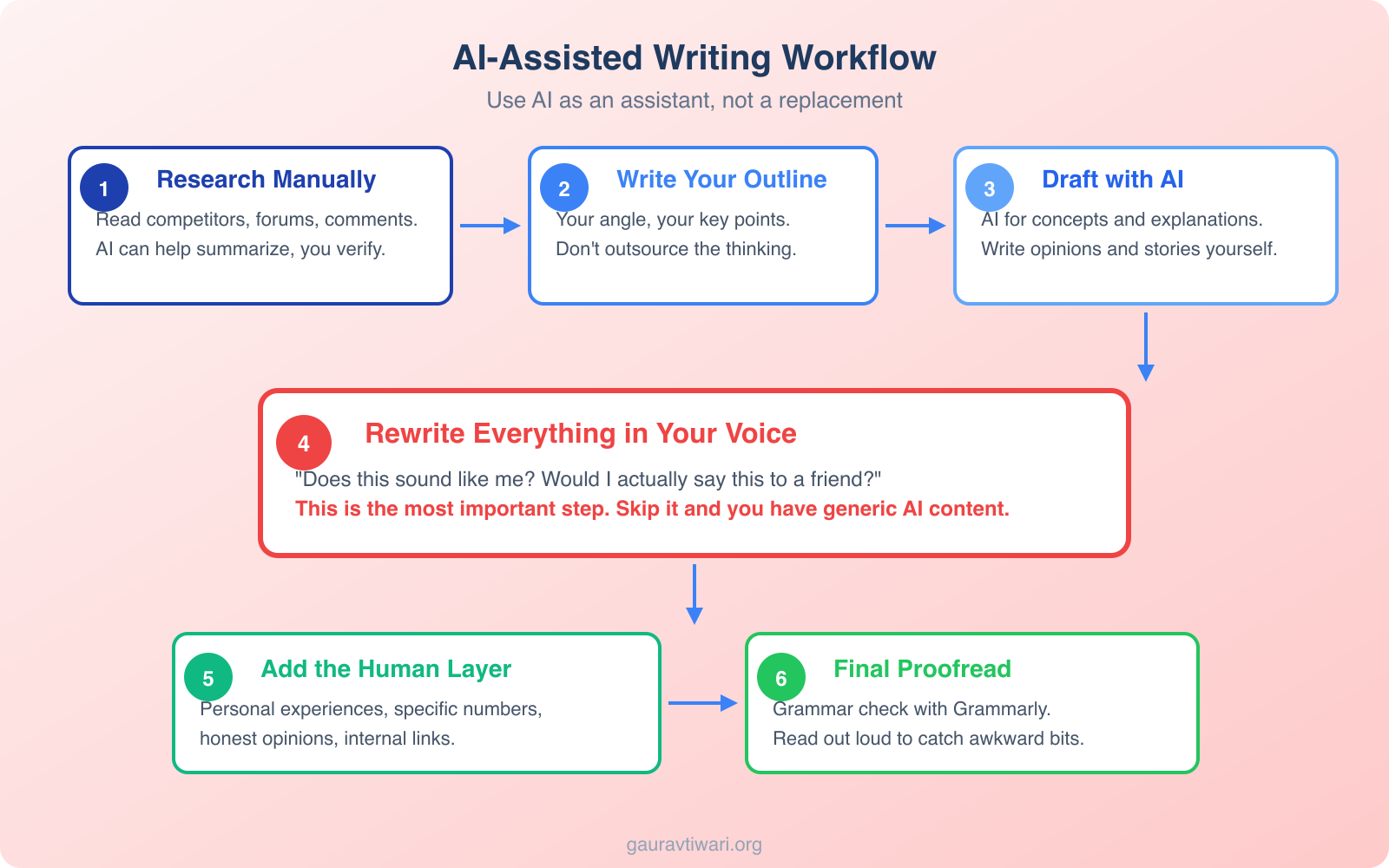
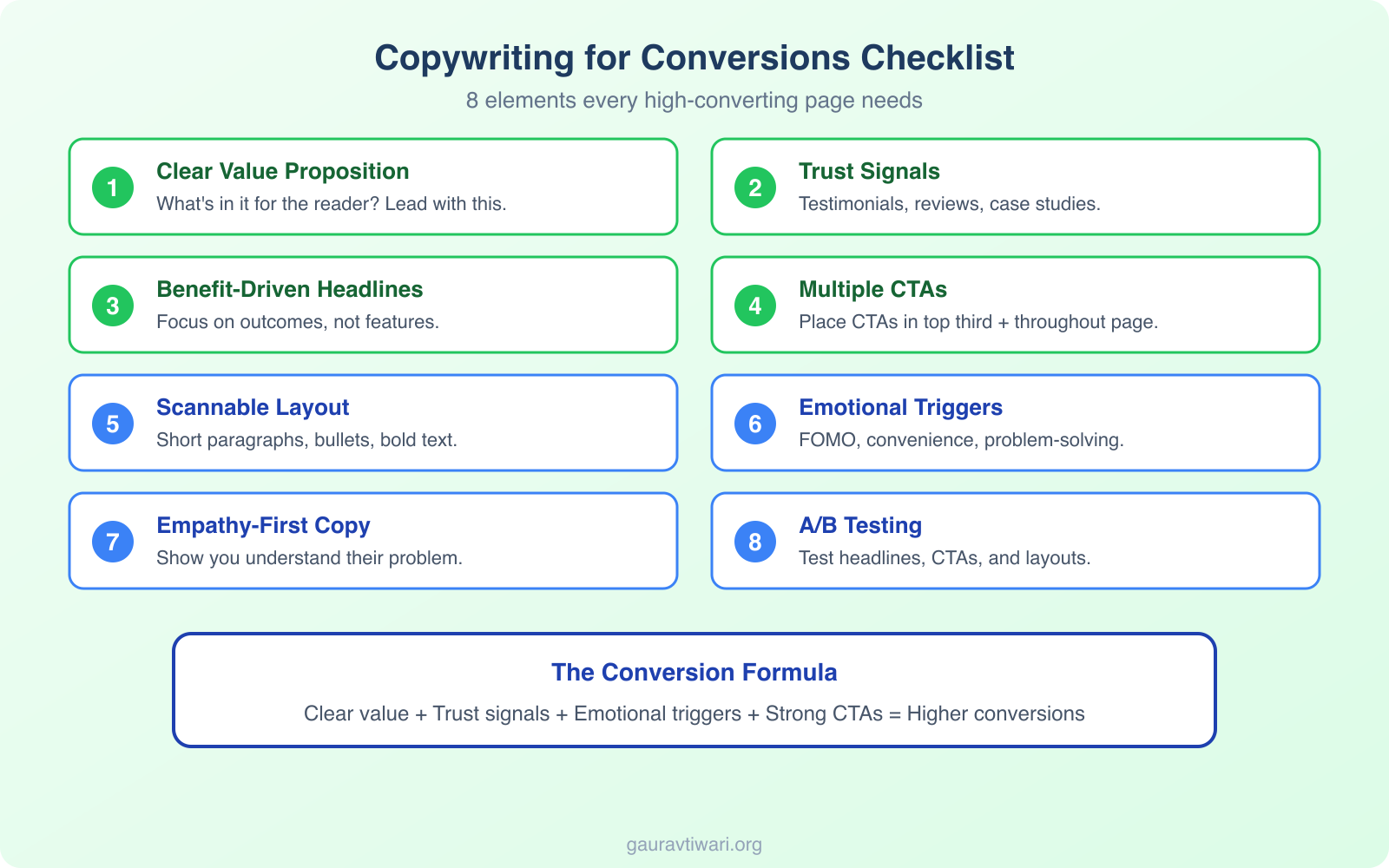
See the framework.
These visual references show how the material is organized before you use it.
Get the book
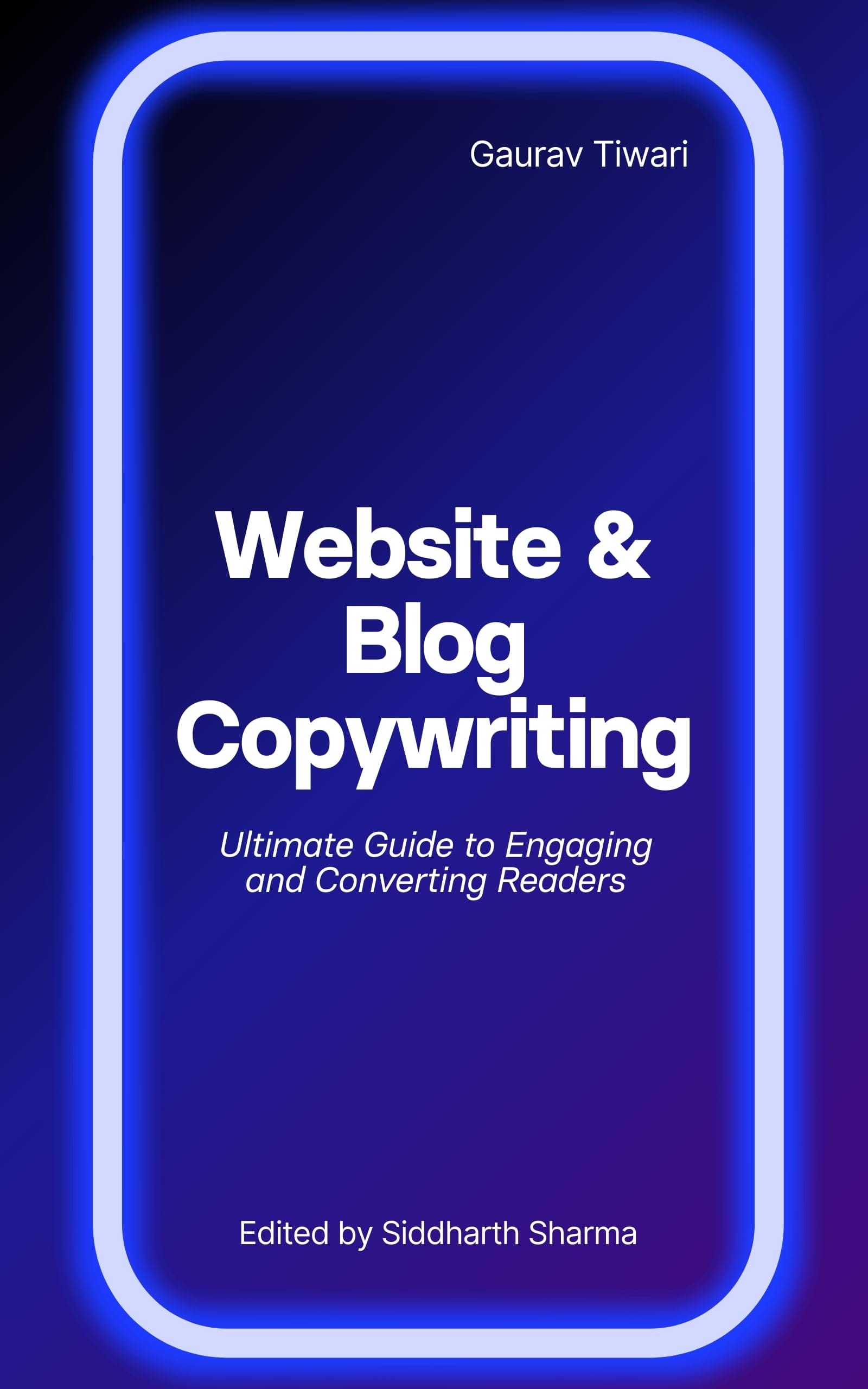
Website and Blog Copywriting
Free on Kindle Unlimited
Kindle edition · 27 pages · published 10 September 2024 · Amazon shows the current price before you buy
- Define the specific reader a page is for before writing a line of it
- Structure a page so it moves someone from arriving to acting
- Work keywords into copy without the writing announcing that you did
- Write a call to action that’s clear about what happens next
- Rewrite a page that describes a product into one that addresses a person
- Check a draft against the named mistakes before you publish it
A copywriting course runs $200 to $2,000 and sells you a curriculum around the same decisions. This is the primer version: the decisions themselves, at the price of a coffee. Rating, page count, and Kindle Unlimited status checked on Amazon.in, July 27, 2026.
Payment and delivery happen on Amazon. These are affiliate links, so I earn a small commission at no extra cost to you.
How to actually use it
The value is in applying it to a page you already have.
1. Read it in one sitting
It’s short enough that stopping halfway costs you the thread.
You leave with: the decisions laid out in order.2. Pick your worst page
Take the page with traffic and no conversions. That’s where the guide pays for itself fastest.
You leave with: one page worth fixing.3. Rewrite for one reader
Define who it’s for, then rewrite the whole thing addressed to that person.
You leave with: copy that speaks to somebody.4. Check against the mistakes
Run the finished draft past the common-mistakes list before publishing.
You leave with: a revision pass you can repeat.Questions readers ask
Buying Questions
Twenty-seven pages? Really?
Yes, and it’s the highest-rated thing I’ve published. It was written as a primer and it does one job: it gets someone who writes web copy by instinct to write it deliberately instead.
Is the 4.7 rating meaningful?
It’s real, and it comes from five ratings on Amazon.in. Five is a small sample. I’m showing you the sample size because a rating without one is close to meaningless.
Is it actually free on Kindle Unlimited?
Yes. If you have a Kindle Unlimited subscription, it costs nothing extra to read. Without one, Amazon shows the Kindle price before you buy.
Does it cover writing for AI search?
No. It was published in September 2024 and predates the AI search shift. The fundamentals in it haven’t dated, but there’s nothing in here about getting cited by ChatGPT or AI Overviews.
Who is it NOT for?
Professional copywriters. If you write copy for a living, you already know what’s in it. It’s aimed at the person writing their own site copy for the first or second time.
Do I need anything else with it?
A page of your own to rewrite. If you want the fuller strategic picture around the writing, Marketing Essentials for Bloggers covers positioning, topic strategy, and conversion at 270 pages.
What I’m not going to claim
This is the shortest thing on this shelf at 27 pages, and it’s a primer. If you write copy professionally, you already know what’s in it. It’s aimed at the person writing their own site copy for the first or second time.
It’s also the oldest, published on 10 September 2024, and it’s co-written with Siddharth Sharma rather than written alone. The fundamentals in it haven’t dated, but it predates the AI search shift, and there’s nothing in here about writing for that.
The 4.7 out of 5 is real and it comes from five ratings on Amazon.in. Five is a small sample. Every other book on this shelf has no ratings at all, so I’d rather show you the number and the sample size than just the number.

Hey, I’m Gaurav 👋
I spent years writing web copy that described what I’d built and wondered why nobody responded to it. The fix, when it finally landed, was embarrassingly simple: decide who the page is for and write to that person. This guide is that lesson, compressed, co-written with Siddharth Sharma.
The numbers, since you probably won’t read a full bio:
- 18 years building on the web, and a WordPress core contributor
- 2,000+ articles published since 2008, most of them web copy in some form
- 850+ clients, where these copy decisions were made repeatedly before they got written down
Want the strategy around the writing? Marketing Essentials for Bloggers covers positioning, topic strategy, and conversion at 270 pages.
Read it tonight
Rewrite the page that’s been quietly losing you readers.
One sitting to read. One evening to rewrite your worst page for one specific reader.
Kindle · free to read on Kindle Unlimited · price shown on Amazon before you buy