
Tips to find a reputable online marketing agency for your business
Finding a marketing agency is easy. Finding one that actually delivers results? That’s where most businesses stumble. I’ve seen companies burn through $10,000-$30,000 on agencies that produced nothing but fancy reports and empty promises. The problem wasn’t that these agencies didn’t exist. The problem was that the businesses didn’t know how to evaluate them properly.
Digital marketing agencies offer everything from SEO and content creation to social media management and paid advertising. The sheer number of services can overwhelm you if you don’t know what your company actually needs. This guide will help you identify your requirements, spot the red flags, evaluate portfolios, understand pricing, and ask the right questions before signing anything.
Identify Your Business Needs First
Before you contact a single agency, sit down and define exactly what you need. “We need more customers” isn’t specific enough. Think about what’s actually missing from your marketing:
- Lack of online visibility? You need SEO and content marketing to rank in search results and attract organic traffic.
- No social media presence? You need social media management, content creation, and possibly paid social campaigns.
- Not converting visitors to customers? You need conversion rate optimization, landing page design, and possibly email marketing.
- No leads coming in? You need a combination of content, SEO, paid ads, and lead generation strategy.
- Outdated website? You need web design and development before marketing can be effective.
The more specific you are about your needs, the better you can evaluate whether an agency is the right fit. An agency that specializes in SEO might not be great at paid ads. One that excels at social media might have weak content writing. Knowing your priorities helps you filter out agencies that don’t match.
Write down your top 3 marketing priorities, your monthly budget range, and the specific outcomes you expect (e.g., “increase organic traffic by 50% in 6 months” or “generate 20 qualified leads per month”). This becomes your evaluation criteria.
Red Flags That Should Make You Walk Away
Before I tell you what to look for in a good agency, let me tell you what should send you running in the other direction. I’ve encountered every one of these, and they always end badly.
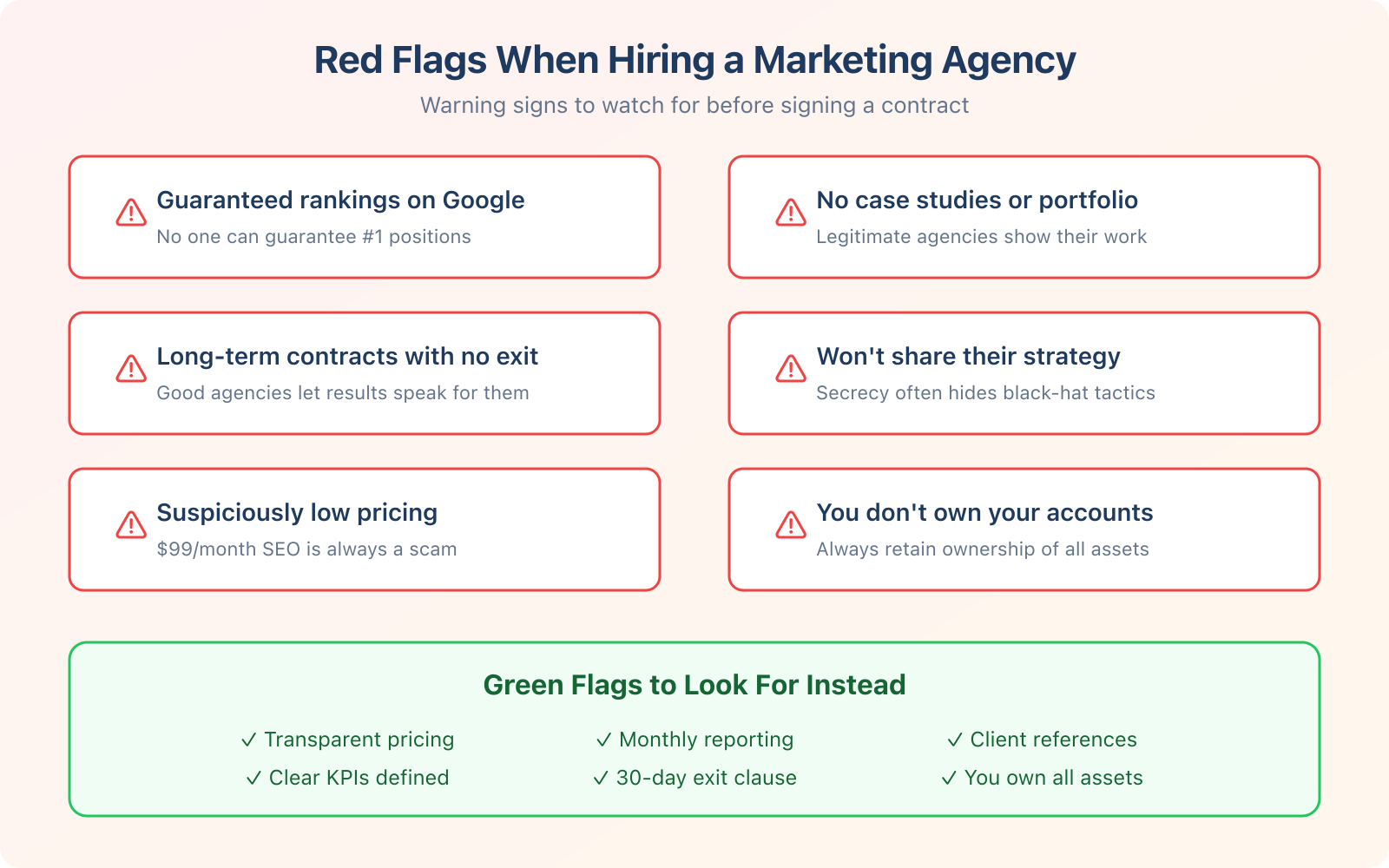
Guaranteed rankings. Any agency that promises “we’ll get you to #1 on Google” is either lying or using black-hat techniques that will get your site penalized. Google’s algorithm changes constantly. No one can guarantee specific rankings. A reputable agency will promise a strategy, a process, and transparent reporting, not specific positions.
No portfolio or case studies. If an agency can’t show you examples of their work and the results they’ve achieved for other clients, that’s a major red flag. Legitimate agencies are proud of their results and happy to share them.
Long-term contracts with no exit clause. Good agencies let their results speak for themselves. They offer month-to-month agreements or short-term contracts with 30-day exit clauses. If an agency requires a 12-month commitment with no way out, they’re banking on you being locked in even if results disappoint.
Refusal to explain their strategy. “We have a proprietary method” is code for “we don’t want you to know what we’re doing.” Ethical agencies explain their approach clearly and keep you informed about every tactic they use on your behalf.
Suspiciously low pricing. If an agency offers “full-service digital marketing” for $299/month, they’re either outsourcing to the cheapest freelancers they can find or delivering automated junk. Quality marketing costs real money. SEO alone typically starts at $1,000-$2,000/month for legitimate agencies.
Always ask who will be working on your account. Some agencies sell you on their senior team during the pitch, then hand your account off to junior staff or offshore contractors. Get the names of your actual team members in writing before signing.
How to Evaluate an Agency’s Portfolio
A portfolio tells you more than any sales pitch. Here’s how to evaluate it properly:
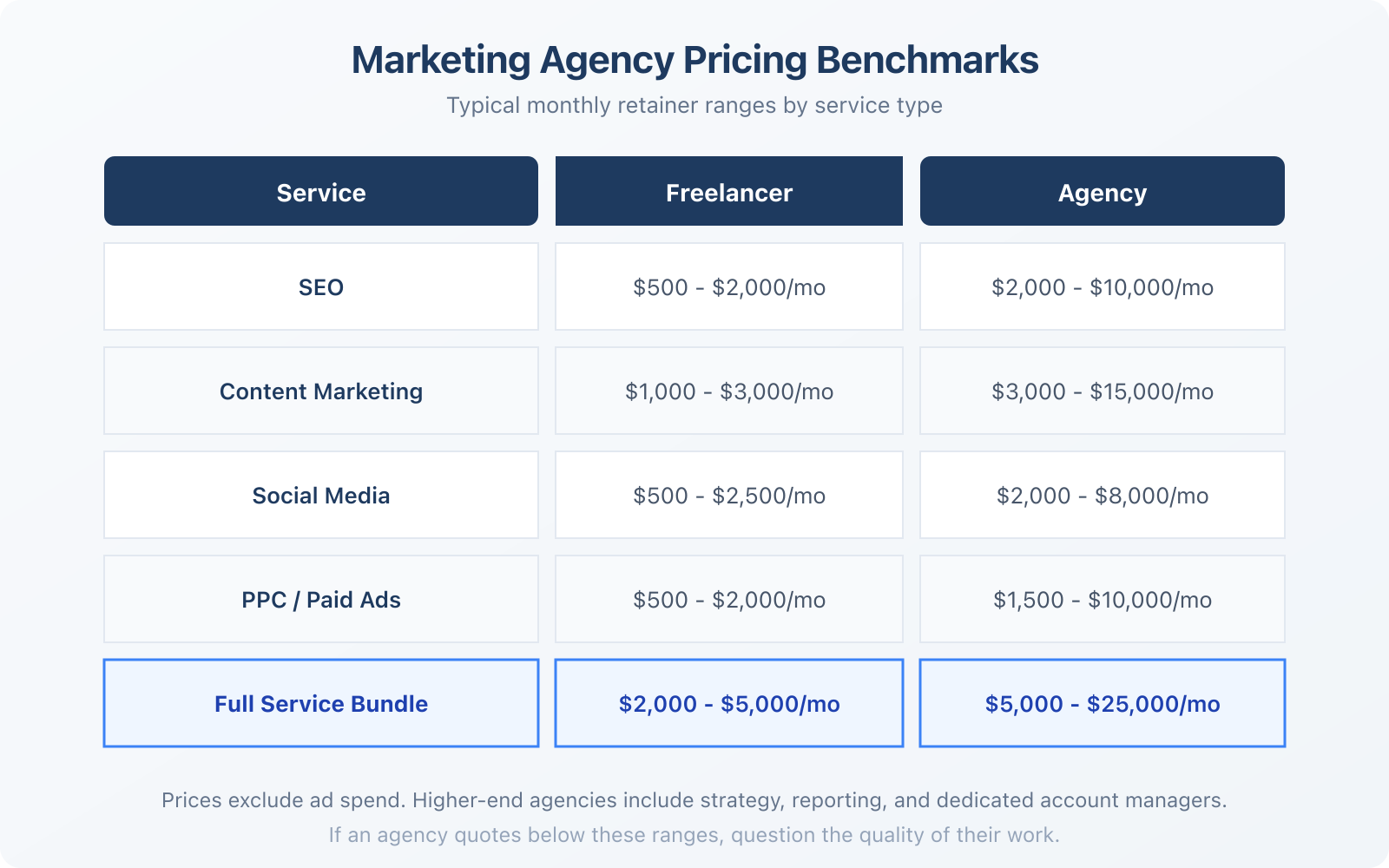
Look for results, not just visuals. A beautiful website redesign means nothing if it didn’t increase conversions. A polished social media feed is pointless if it didn’t generate leads. Ask for specific metrics: traffic growth percentages, conversion rate improvements, revenue impact, cost per acquisition.
Check for industry relevance. An agency that’s built successful campaigns for B2B software companies might struggle with a local restaurant chain. Look for experience in your industry or similar verticals. They should understand your audience’s behavior, language, and buying patterns.
Verify the claims. Ask for client references and actually call them. Don’t just read the testimonials on the agency’s website, those are curated. A 15-minute phone call with a current or past client will tell you more than hours of research.
Study their own marketing. How does the agency market itself? Is their website well-designed? Does their blog have genuinely useful content? Are they ranking for competitive keywords in their own industry? An agency that can’t market itself well probably can’t market your business well either.
Technical Skills to Look For
Beyond portfolio and reputation, a reputable marketing agency should demonstrate competence in these technical areas:
- Analytics setup and reporting. They should be proficient with Google Analytics 4, Google Search Console, and reporting tools. If they can’t set up proper tracking, they can’t measure results.
- SEO fundamentals. Technical SEO audits, keyword research methodology, on-page optimization, and link building strategies that follow Google’s guidelines.
- Content strategy. Not just “we’ll write blog posts” but a documented strategy that ties content to buyer journeys, keyword targets, and business goals.
- Paid advertising management. Certifications in Google Ads and Meta Business Suite, with demonstrated experience managing budgets similar to yours.
- CRO knowledge. Understanding of A/B testing, heatmap analysis, and conversion funnel optimization. Conversion rate optimization is where most agencies fall short.
You don’t need an agency that does everything. You need one that does your specific requirements well. A specialized agency that excels at SEO and content will outperform a generalist agency that offers 15 services at a mediocre level.
Understanding Pricing and Packages
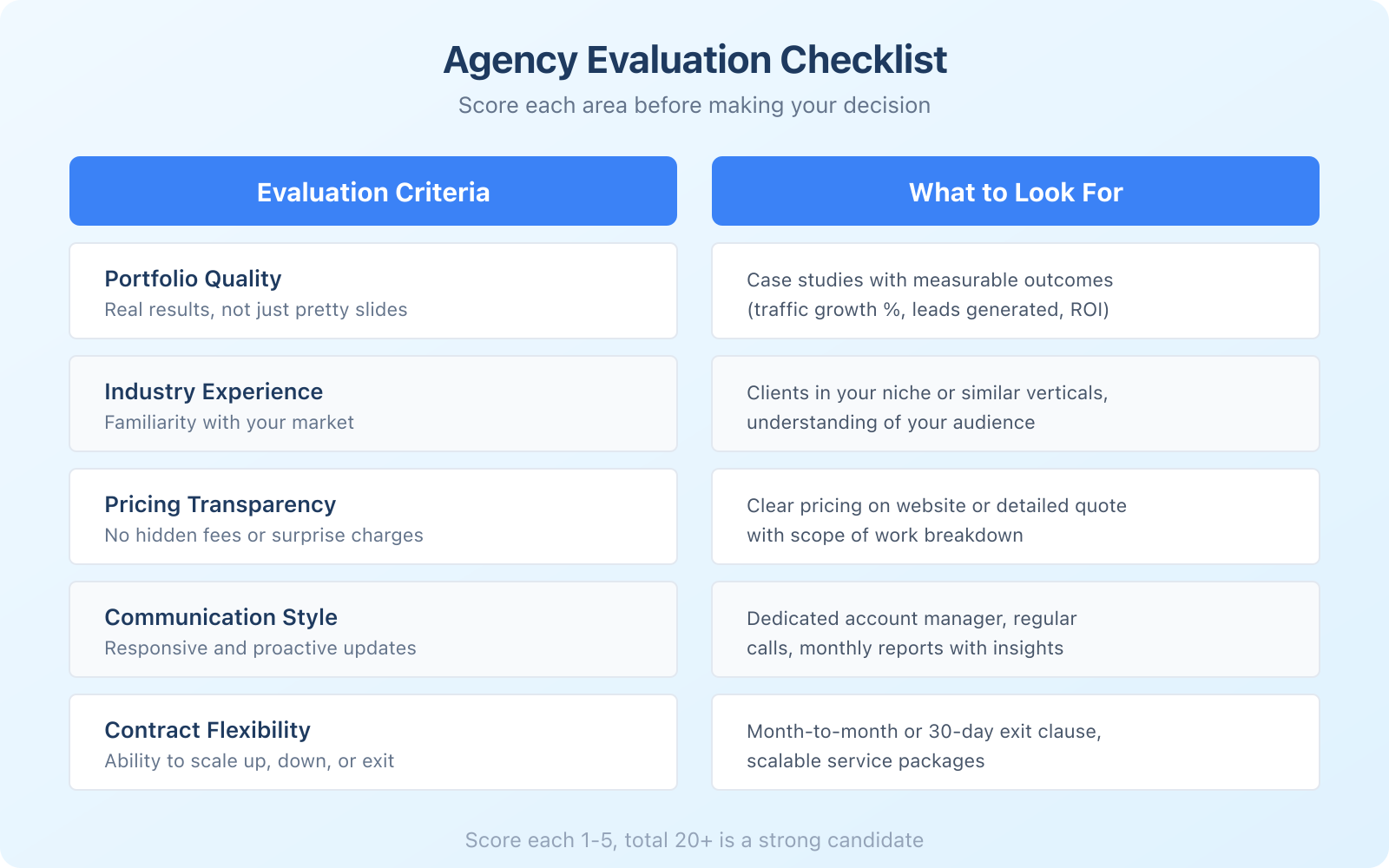
Marketing agency pricing varies wildly, and understanding the ranges helps you avoid overpaying or falling for unrealistically cheap options.
Typical monthly retainer ranges:
- SEO only: $1,000-$5,000/month (freelancer) to $3,000-$10,000/month (agency)
- Content marketing: $1,500-$5,000/month for 4-8 pieces of quality content
- Social media management: $1,000-$4,000/month per platform
- PPC management: $500-$2,000/month plus ad spend (usually 10-20% of ad budget)
- Full-service digital marketing: $3,000-$15,000/month
When evaluating packages, look at what’s included. A $2,000/month SEO package should specify: number of keywords targeted, content pieces created, technical audits performed, backlinks built, and reporting frequency. Vague deliverables like “SEO optimization” without specifics are meaningless.
Some agencies offer starter packages designed to let you test their services before committing to a larger engagement. This is a green flag. An agency confident in its work has no problem letting you start small.
Questions to Ask Before Signing
Once you’ve shortlisted 2-3 agencies, schedule a meeting and ask these questions. The answers will tell you everything you need to know:
- “Who specifically will work on my account?” Get names, experience levels, and roles. You should know your day-to-day contact person.
- “Can I speak with 2-3 current clients?” If they hesitate or refuse, walk away.
- “What does your reporting look like?” Ask to see a sample report. It should show clear metrics tied to your business goals, not vanity metrics like impressions or followers.
- “What’s your onboarding process?” Good agencies have a structured onboarding that includes brand discovery, competitor analysis, strategy development, and approval workflows.
- “What happens if I want to leave?” Understand the exit process, notice period, and whether you retain ownership of all content, accounts, and data.
- “How do you measure success?” Their KPIs should align with your business objectives. If you care about leads, they shouldn’t be measuring success by social media likes.
- “What won’t you do?” Honest agencies tell you their limitations. If they claim to do everything perfectly, they’re overselling.
Contract Dos and Don’ts
Before you sign anything, review the contract carefully. Here’s what to insist on and what to push back against:
Do insist on:
- A 30-day exit clause (or month-to-month terms)
- Ownership of all content, accounts, and creative assets
- Clear deliverables with deadlines
- Monthly reporting with agreed-upon KPIs
- A named point of contact
- Data access to all analytics and ad accounts
Don’t accept:
- Contracts longer than 6 months without a performance review clause
- Vague deliverables (“ongoing SEO optimization” instead of specific monthly tasks)
- Agency-owned accounts (your Google Ads, social media, and analytics accounts should be yours)
- Automatic renewal without notice
- Non-compete clauses that restrict you from hiring another agency
Always retain ownership of your domain, hosting, Google Analytics, Google Ads, and social media accounts. Some agencies set up these accounts under their own credentials, which means you lose access if you leave. This is a deal-breaker. Make sure everything is created under your email and billing information.
How to Manage the Relationship After Hiring
Hiring the agency is just the beginning. Managing the relationship effectively is what determines whether you get results.
Set expectations early. During onboarding, agree on communication frequency, reporting format, approval processes, and escalation procedures. Most failed agency relationships die from misaligned expectations, not bad work.
Review reports critically. Don’t just glance at the monthly report. Ask questions. “Traffic increased 20%” sounds great, but is it the right traffic? Are those visitors converting? What was the cost per lead? Good agencies welcome these questions.
Give them time. SEO and content marketing don’t produce results overnight. Give an agency at least 3-4 months before evaluating performance. Paid advertising should show results within 30-60 days. If you’re 6 months in with no measurable progress, it’s time for a serious conversation.
Be responsive. Agencies need timely feedback, approvals, and information from you. If you take two weeks to approve a blog post, don’t blame the agency for slow content production.
Frequently Asked Questions
How long does it take to see results from a marketing agency?
It depends on the service. Paid advertising can show results within 2-4 weeks. Social media growth typically takes 2-3 months to gain momentum. SEO and content marketing usually need 4-6 months before showing significant organic traffic improvements. Any agency promising instant results for organic channels is misleading you.
Should I hire a local agency or is remote fine?
Remote agencies work perfectly well for most businesses. The quality of work matters far more than physical proximity. However, if your business serves a specific local market, a local agency may understand your community better. For local SEO specifically, an agency familiar with your area can be an advantage. For everything else, choose based on quality and fit, not location.
What’s the minimum budget I need for a marketing agency?
For a single service like SEO or social media, expect to spend at least $1,000-$2,000 per month for quality work. Full-service digital marketing typically starts at $3,000-$5,000 per month. If your budget is under $1,000 per month, you’re better off hiring a skilled freelancer for a specific task rather than spreading a thin budget across an agency’s full-service package.
How do I know if my marketing agency is actually doing good work?
Track these indicators: organic traffic growth month over month, keyword rankings for your target terms, number of leads or conversions attributed to their work, cost per lead or cost per acquisition, and engagement metrics on content they produce. A good agency ties their reporting to your business KPIs, not vanity metrics. If they only report impressions and followers without connecting to revenue, push for better reporting.
Can I use both a freelancer and an agency at the same time?
Yes, this is actually a smart approach for many businesses. Use an agency for your core strategy and ongoing campaigns, and hire freelancers for specialized tasks like graphic design, video production, or technical SEO audits. Just make sure everyone is aligned on strategy and not working at cross-purposes. Clear communication and shared access to project management tools prevent overlap and confusion.
Choosing the right marketing agency can transform your business. Choosing the wrong one can waste months of budget and momentum. Take the time to define your needs, evaluate portfolios with a critical eye, ask the hard questions, and protect yourself with a fair contract. The best agency relationships are partnerships built on transparency, clear expectations, and mutual accountability. When you find that fit, the results speak for themselves.