Taylor Series Calculator
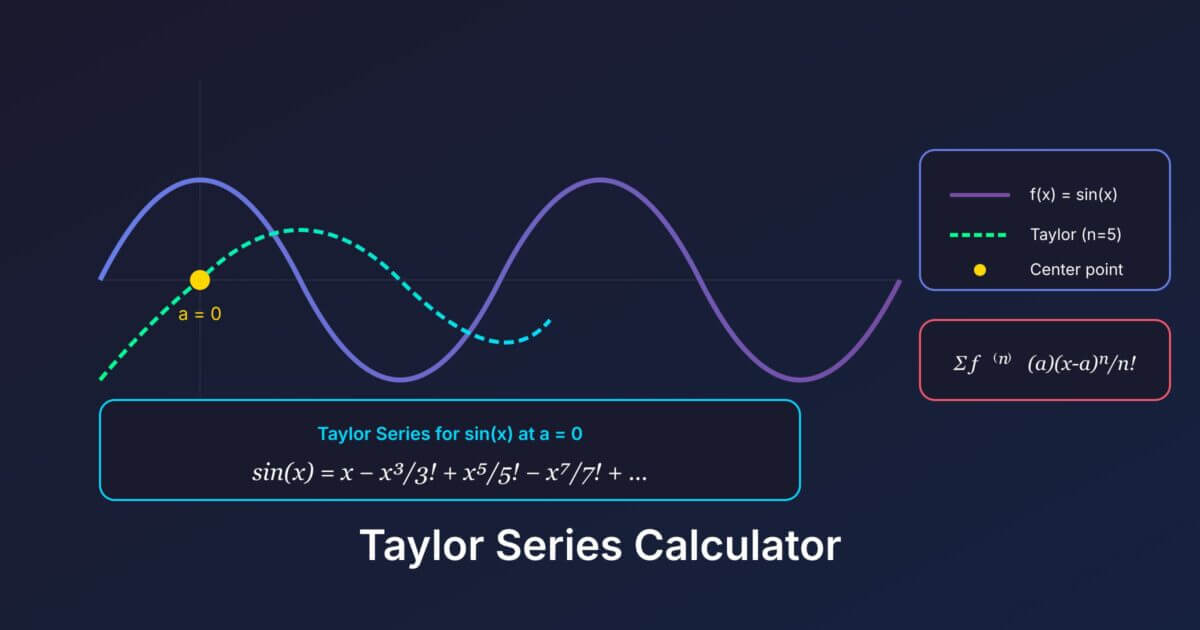
Use this free Taylor Series Calculator to expand any function into a Taylor or Maclaurin polynomial around a chosen center point. Enter your function, select the number of terms, and instantly see the series expansion, coefficient table, and interactive graph comparing the original function with its approximation.
Generate Taylor or Maclaurin series expansions for any function.
Taylor Series Expansion
Graph
Coefficients
What Is a Taylor Series?
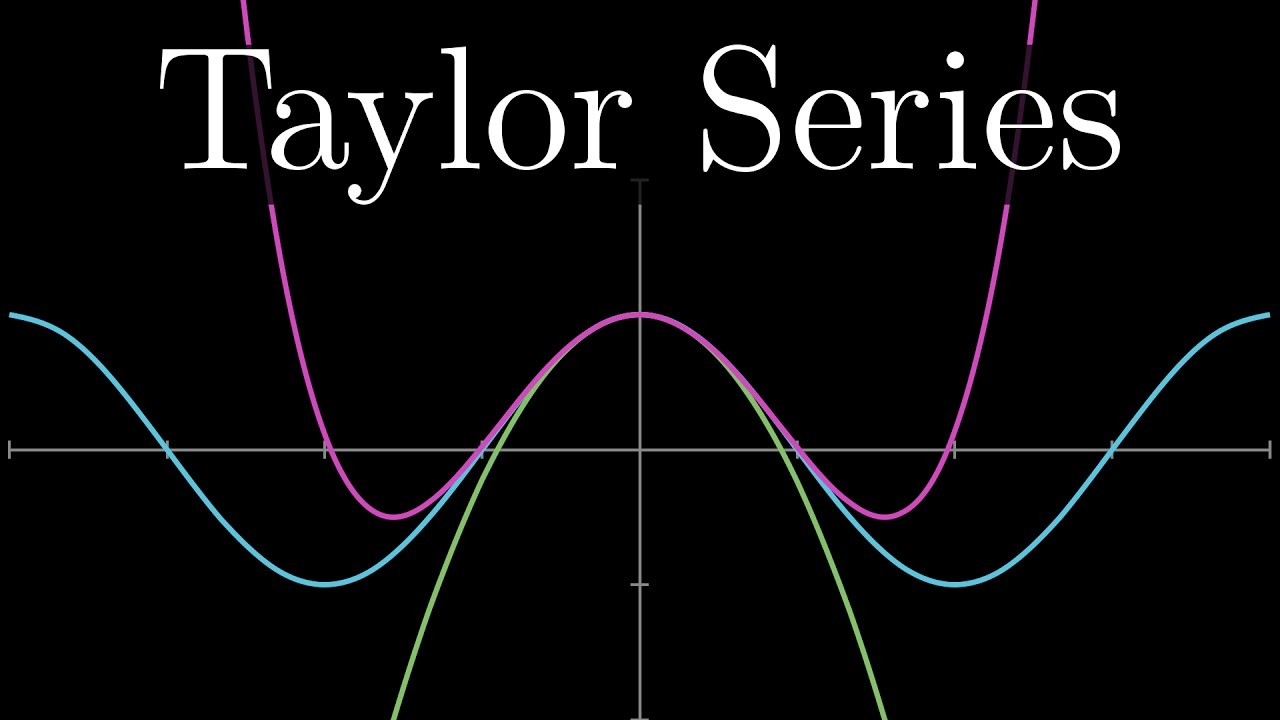
A Taylor series represents a function as an infinite sum of terms calculated from the function’s derivatives at a single point. Named after mathematician Brook Taylor, this powerful tool lets you approximate complex functions using simple polynomials.
The general formula for a Taylor series centered at point \( a \) is:
$$f(x) = \sum_{n=0}^{\infty} \frac{f^{(n)}(a)}{n!}(x-a)^n = f(a) + f'(a)(x-a) + \frac{f”(a)}{2!}(x-a)^2 + \cdots$$
When the center point \( a = 0 \), the series is called a Maclaurin series.
Common Taylor Series
Exponential Function
$$e^x = 1 + x + \frac{x^2}{2!} + \frac{x^3}{3!} + \frac{x^4}{4!} + \cdots = \sum_{n=0}^{\infty} \frac{x^n}{n!}$$
Converges for all real \( x \).
Sine Function
$$\sin(x) = x – \frac{x^3}{3!} + \frac{x^5}{5!} – \frac{x^7}{7!} + \cdots = \sum_{n=0}^{\infty} \frac{(-1)^n x^{2n+1}}{(2n+1)!}$$
Converges for all real \( x \).
Cosine Function
$$\cos(x) = 1 – \frac{x^2}{2!} + \frac{x^4}{4!} – \frac{x^6}{6!} + \cdots = \sum_{n=0}^{\infty} \frac{(-1)^n x^{2n}}{(2n)!}$$
Converges for all real \( x \).
Natural Logarithm
$$\ln(1+x) = x – \frac{x^2}{2} + \frac{x^3}{3} – \frac{x^4}{4} + \cdots = \sum_{n=1}^{\infty} \frac{(-1)^{n+1} x^n}{n}$$
Converges for \( -1 < x \leq 1 \).
Geometric Series
$$\frac{1}{1-x} = 1 + x + x^2 + x^3 + \cdots = \sum_{n=0}^{\infty} x^n$$
Converges for \( |x| < 1 \).
Why Taylor Series Matter
In Engineering
Engineers use Taylor approximations to simplify complex calculations in control systems, signal processing, and structural analysis. Small-angle approximations (\( \sin \theta \approx \theta \)) come directly from Taylor series.
In Computing
Calculators and computers use Taylor series to compute transcendental functions like sin, cos, and exp. The series provides a way to calculate these values using only addition and multiplication.
Convergence
Not all Taylor series converge everywhere. The radius of convergence determines how far from the center point the series accurately represents the function. For some functions like \( e^x \), the series converges everywhere. For others like \( \ln(1+x) \), it only converges within a limited interval.
Error Estimation
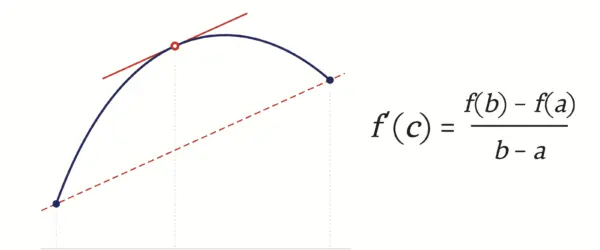
The error in a Taylor polynomial approximation can be bounded using the remainder term:
$$R_n(x) = \frac{f^{(n+1)}(c)}{(n+1)!}(x-a)^{n+1}$$
where \( c \) is between \( a \) and \( x \).
Building and checking a Taylor series
A Taylor series about x=a uses derivatives at a: \(f(x)=\sum f^{(n)}(a)(x-a)^n/n!\). A Maclaurin series is the special case a=0.
Check the first few coefficients directly from the function and its derivatives. Substituting x=a into the polynomial must reproduce \(f(a)\), and differentiating the polynomial should reproduce the corresponding derivative values at a.
A truncated polynomial is an approximation. Its accuracy depends on degree and distance from the center. The remainder term or a numerical comparison at several points shows whether another term is needed.
A formal series can exist without converging to the function everywhere. Check the radius and interval of convergence when using an infinite series rather than a local polynomial approximation.
For \(e^x\) about zero, every derivative equals 1, so the series begins \(1+x+x^2/2!+x^3/3!\). At x=0.1, only a few terms are needed for a close approximation because the point is near the center.
For functions with a nearby singularity, the convergence radius is the distance from the center to the closest complex singularity. A polynomial can still give a local approximation even when the infinite series does not converge at a distant point.
Common mistakes to avoid
- Forgetting the factorial in the denominator
- Using x instead of x-a
- Assuming more terms always help outside the convergence interval
- Rounding coefficients before evaluating the polynomial
Useful calculus books and tools
For Taylor series, label the center, degree, and remainder so an approximation is not mistaken for an identity. Calculus answers are easier to trust when you can connect the symbolic work to a graph, an estimate, and the theorem behind the method.
- Practice beyond one example: Browse calculus textbooks and workbooks on Amazon. Look for worked problems, review exercises, and clear treatment of limits and applications.
- Sketch before calculating: Browse graph-paper notebooks on Amazon. A quick graph often reveals sign errors, incorrect bounds, and unreasonable answers.
As an Amazon Associate, I earn from qualifying purchases.
FAQs
What’s the difference between Taylor series and Maclaurin series?
A Maclaurin series is a Taylor series centered at a = 0. The general Taylor series uses any center point a, while Maclaurin always expands around zero. Maclaurin series are simpler because (x-a) becomes just x. The series for eˣ, sin(x), and cos(x) are typically written as Maclaurin series since they’re naturally centered at zero.
How do you find the Taylor series of a function?
Calculate successive derivatives at the center point: f(a), f'(a), f”(a), etc. Each term is f⁽ⁿ⁾(a)/n! times (x-a)ⁿ. For sin(x) at a=0: f(0)=0, f'(0)=1, f”(0)=0, f”'(0)=-1, cycling with period 4. This gives x – x³/3! + x⁵/5! – … The pattern in derivatives determines the pattern in coefficients.
What is the radius of convergence?
The radius of convergence R is the distance from the center where the series converges. For |x-a| R, it diverges. At |x-a| = R, you must test individually. Use the ratio test: R = lim|aₙ/aₙ₊₁|. For eˣ, R = ∞ (converges everywhere). For 1/(1-x) centered at 0, R = 1 because of the singularity at x = 1.
Why do calculators use Taylor series?
Computers can only do arithmetic: add, subtract, multiply, divide. Taylor series convert transcendental functions into polynomials that use only these operations. To compute sin(0.5), evaluate the polynomial 0.5 – 0.5³/6 + 0.5⁵/120 – … until you reach desired precision. Modern implementations use optimized variants (Chebyshev, CORDIC) but the core idea is the same.
How many terms do you need for a good approximation?
It depends on how far x is from the center and the required accuracy. Near the center, few terms suffice. For eˣ at x=0.1, three terms give 6 decimal places. At x=2, you need about 10 terms. The error bound R_n helps estimate: if |f⁽ⁿ⁺¹⁾(c)| ≤ M, then |error| ≤ M|x-a|ⁿ⁺¹/(n+1)! Use enough terms until this bound meets your accuracy needs.
What is the small-angle approximation?
For small angles (in radians), sin(θ) ≈ θ and cos(θ) ≈ 1 – θ²/2. These come from keeping just the first non-constant term of each Taylor series. Physics uses these constantly: pendulum period derivation, optics calculations, wave equations. ‘Small’ typically means |θ| < 0.1 radians (about 6°) for good accuracy, though sin(0.2) ≈ 0.2 is still within 1%.
Can every function be represented by a Taylor series?
No. The function must be infinitely differentiable at the center point, and the series must converge to the function. f(x) = e^(-1/x²) (with f(0)=0) has all derivatives equal to zero at x=0, so its Taylor series is just 0—but the function isn’t zero elsewhere. Functions with discontinuities, sharp corners, or singularities can’t have Taylor series at those points.
How are Taylor series related to Euler’s formula?
Euler’s formula e^(ix) = cos(x) + i·sin(x) can be derived by substituting ix into the Taylor series for eˣ. The real terms give the cosine series; the imaginary terms give the sine series. This beautiful connection shows that exponential, sine, and cosine are deeply related through complex numbers. It’s one of the most important formulas in mathematics.