You set it up carefully, the numbers came out close to the accepted value, and you understood what was happening the whole way through. Then the report came back with comments about your graph axes and something about your discussion being descriptive.
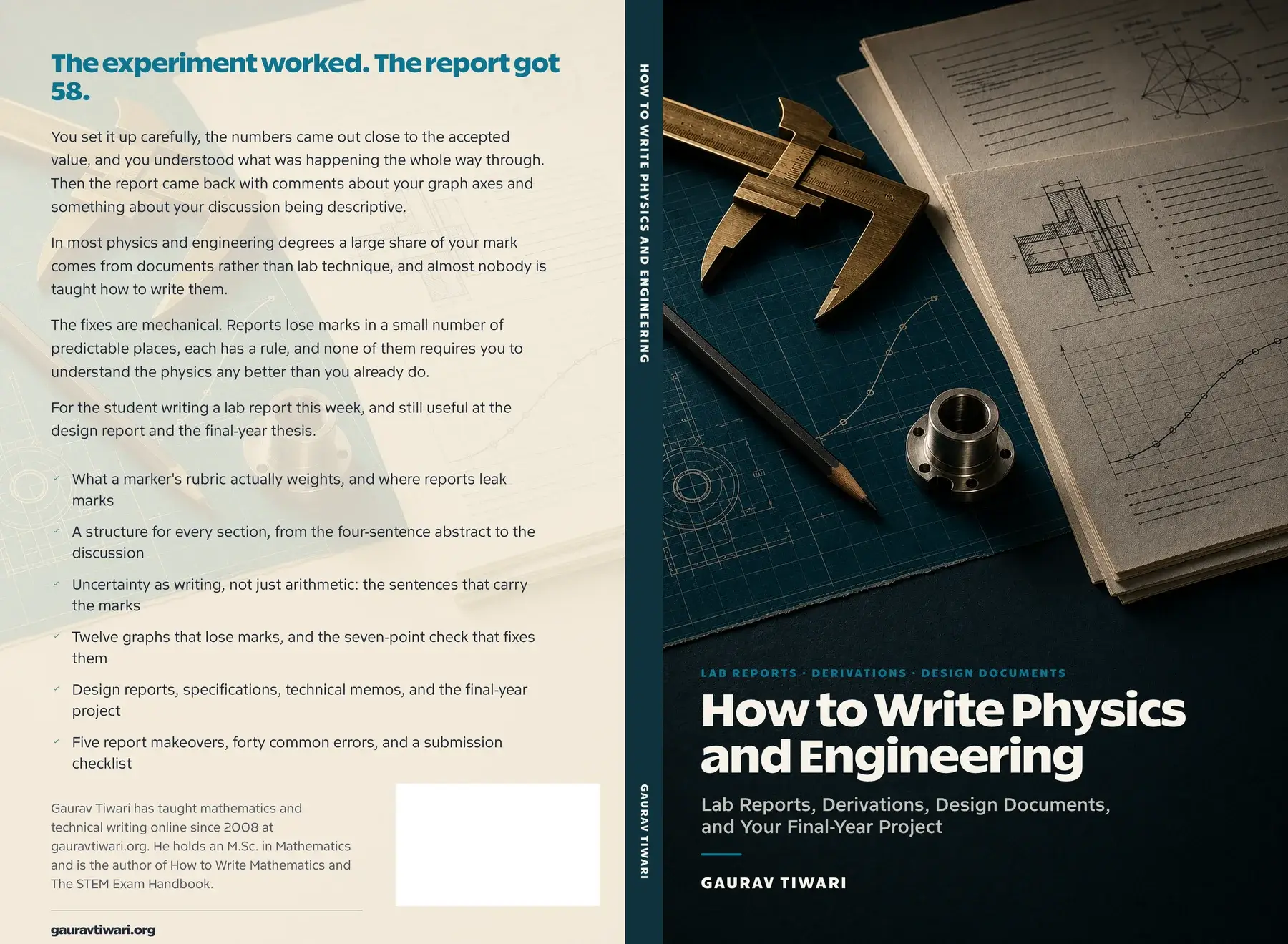
Paperback wrap: back cover, spine, and front cover.
In most physics and engineering degrees a large share of your mark comes from documents rather than lab technique, and almost nobody is taught how to write them.
The fixes are mechanical. Reports lose marks in a small number of predictable places, each has a rule, and none of them requires you to understand the physics any better than you already do.
What You Will Learn
What a marker’s rubric actually weights, and where reports leak marks
A structure for every section, from the four-sentence abstract to the discussion
Uncertainty as writing, not just arithmetic: the sentences that carry the marks
Twelve graphs that lose marks, and the seven-point check that fixes them
Design reports, specifications, technical memos, and the final-year project
Five report makeovers, forty common errors, and a submission checklist
Inside the Book
The downloadable editions include the complete chapters and toolkit listed below.
What a Report Is For
The Reader Is a Replicator
Why Reports Are Marked the Way They Are
Where Report Marks Leak
The Sections
Title, Abstract, and Aim
Theory: The Derivation That Earns Its Place
Method: Past Passive, and What to Leave Out
Results: The Data, Not the Discussion
Uncertainty: Writing It, Not Just Computing It
Discussion: Comparison, Not Narration
Conclusion, and What It May Not Contain
Numbers, Tables, and Figures
Units, Significant Figures, and Notation
Tables That Get Marked
Graph Forensics
Captions That Stand Alone
Derivations and Computation
Writing a Derivation Somebody Can Follow
Symbols, Nomenclature, and Notation
Computational Work: Code, Simulation, and Reproducibility
The Big Documents
Design Reports and Specifications
Technical Memos and Executive Summaries
The Final-Year Project Report
Writing With Other People
Finishing
Revision, Proofreading, and Submission
References, Data, and Honesty
Toolkit
Five Report Makeovers
Skeletons for Six Documents
The Uncertainty Phrasebook
Forty Common Errors
The Submission Checklist
Further Reading, Honestly Annotated
Two PDF editions are included
Both layouts are free to download from this page. Use the 6 × 9 edition when you want the paperback reading experience or a compact printout. Use the A4 edition for a larger screen page and easier home or office printing.
A4 screen edition
PDF · 113 pages · 358 KB
A larger page for reading on screen, and the easier one to print at home or in an office.
Lab Reports, Derivations, Design Documents, and Your Final-Year Project
Author
Gaurav Tiwari
Publisher
Gaurav Tiwari Publications
Formats
6 × 9 PDF and A4 PDF
Language
English
I Build Tools That Pay for Themselves And Give Away the Ones That Can’t
Everything here is quick to set up, light on your pages and built to do one real job well. I only charge for the tools that can make you money. The rest are free.