Paperback · 172 pages
Every LaTeX guide assumes you already know LaTeX. This one starts at zero.
LaTeX is the standard for academic and scientific publishing. It’s also taught almost entirely by people who forgot what not knowing it feels like, which is why most students bounce off it twice before it sticks.
Paperback · 172 pages · Amazon.com only · Amazon shows the price before you buy
#128 in Software Design Tools on Amazon
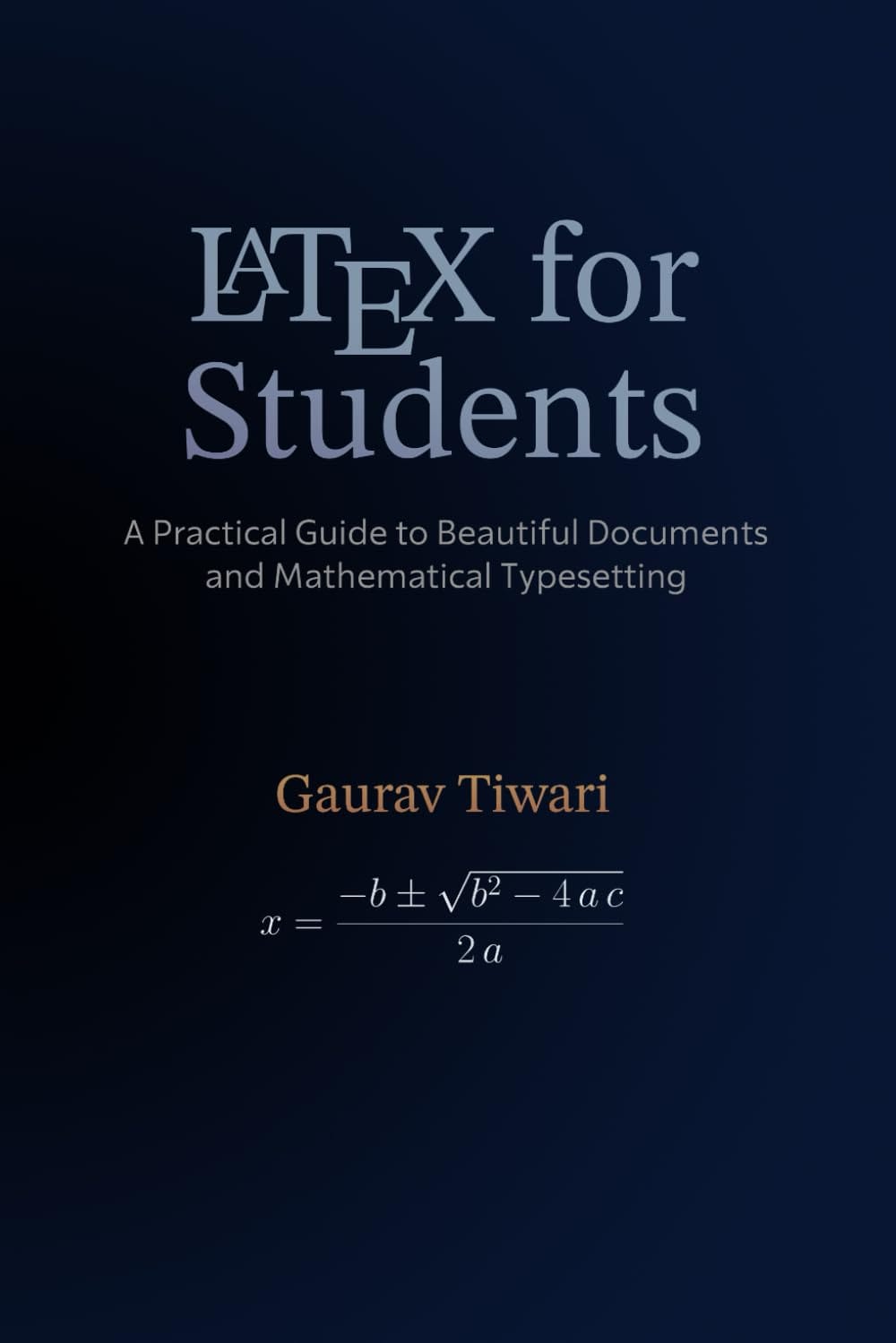
Available as:
Wait, what?
A typesetting book that spends its last two parts outside the .tex file?
Yes. Because that’s where most students actually need the mathematics. Learning LaTeX to write a thesis is one job. Getting a clean equation into a WordPress post, a Notion page, an Obsidian vault, or a Jupyter notebook is a completely different one, and it’s the job nobody writes about.
Most guides stop at the PDF. Parts IV and V cover MathML, KaTeX, and MathJax, then walk through the tools you already use. You learn the notation once and take it everywhere.
Why this book
Most people quit LaTeX in the first hour. Not because it’s hard.
Because the first hour is taught badly. The tooling isn’t the hard part. The hard part is that nobody explains what the machine is doing, so every error message looks like a wall.
How LaTeX usually gets taught
the default- Copy this preamble. Fifteen lines you don’t understand, which break in ways you can’t diagnose.
- Prerequisites nobody states. The guide assumes a compiler, a package manager, and a mental model you don’t have.
- Screenshots of the output only. You see the result without the code that produced it, so you can’t reproduce it.
- Symbols by search engine. You look up the same twelve commands every session and never build a reference.
- Fonts and layout as “advanced”. Left for later, so your documents look like everyone else’s for years.
- It stops at the PDF. Nothing about getting that equation onto your site, your notes, or your notebook.
LaTeX for Students
this book- Zero prerequisites. Starts at “what is LaTeX”, and explains what the compiler is doing under the hood.
- Local or Overleaf. Both setups covered, so you can start writing in minutes or install properly.
- Code left, output right. Every example shows exactly what to type and exactly what you get.
- A reference you keep. A full symbol and notation section, so the lookups stop being a search-engine habit.
- Typography as a chapter. XeLaTeX, custom fonts, page layout, headers, footers, and margins.
- Math beyond the PDF. MathML, KaTeX, and MathJax, plus WordPress, Notion, Obsidian, Jupyter, and static sites.
What’s inside
Five parts, from first document to published mathematics.
Parts I to III are traditional LaTeX, from installation to a polished document ready for submission. Parts IV and V go past the .tex file and into the tools you already write in.
Part I · Getting started
- What LaTeX is and how it works
- Installing locally, or starting on Overleaf
- Document structure and classes
- Your first compiled document
Part II · Mathematics
- Fractions, exponents, roots, and Greek letters
- Multi-line equations and alignment
- Matrices and theorem environments
- Custom notation
Part III · Design
- Typography and font control with XeLaTeX
- Page layout, headers, footers, and margins
- Figures and tables
- Creating your own graphics with TikZ
Part IV · Math on the web
- MathML and accessibility
- KaTeX
- MathJax
- Choosing a renderer
Part V · In your tools
- WordPress, Notion, Obsidian
- Jupyter notebooks
- Static site generators
- Publishing and sharing your work
Reference
- A complete symbol and notation reference
- Pro tips throughout
- Common mistake callouts
172 pages across five parts and a reference, starting from no prior knowledge.
Before you put it off
Learning this is not hard.
Four reasons students put LaTeX off, none of which survive contact with the first chapter.
You don’t need a computer science degree
You need to type text and follow a pattern. The book explains what the compiler does so the error messages stop being mysterious.
You don’t need to install anything
Overleaf runs in a browser and the book covers it alongside a local setup. You can be writing in minutes.
You don’t need to memorize symbols
There’s a full notation reference in the back. Nobody memorizes them, they look them up in one place instead of six.
You don’t need to be writing a thesis
Assignments, lab reports, blog posts, and lecture notes all get better. The thesis-scale problems have their own book.
Get the book
LaTeX for Students
Paperback
172 pages · 6 x 9 · published 9 February 2026 · Amazon.com shows the current price before you buy
- Set up LaTeX locally or start writing in Overleaf within an afternoon
- Typeset fractions, matrices, multi-line equations, and theorem environments correctly
- Define your own notation instead of fighting the defaults every time
- Control fonts, margins, headers, and page layout with XeLaTeX
- Draw your own diagrams with TikZ rather than pasting in a screenshot
- Put properly rendered mathematics into WordPress, Notion, Obsidian, or a Jupyter notebook
Payment and delivery happen on Amazon. These are affiliate links, so I earn a small commission at no extra cost to you.
How to actually use it
Write something real from the first day.
Reading about LaTeX teaches nobody LaTeX.
1. Get a document compiling
Overleaf in the browser or a local install. Part I gets you to a working PDF before it explains anything clever.
You leave with: a document that builds.2. Move your next assignment
Take real work and set it in LaTeX, using the code-and-output examples as patterns.
You leave with: one finished document you wrote yourself.3. Make it look like yours
Fonts, margins, headers, and a TikZ figure instead of a pasted screenshot.
You leave with: a layout you control.4. Take the math off the page
Put an equation into your site or your notes with KaTeX or MathJax.
You leave with: notation that works everywhere you write.Questions readers ask
Buying Questions
Do I need to install anything first?
No. Overleaf runs in a browser and the book covers it alongside a proper local install. Either way, Part I gets you to a working PDF before it explains anything clever.
Is there a Kindle edition?
No, this one is paperback only, and it’s listed on Amazon.com rather than Amazon.in. If you’re ordering from India that means an import, which is slower and costs more.
I already write some LaTeX. Is this for me?
Probably not. It’s a beginner’s book. If you’re comfortable and what you actually have is a thesis, buy LaTeX for Theses and Dissertations instead. There’s overlap in Parts I to III and you’d be paying for it twice.
Does it cover math on the web, or just PDFs?
Both. Parts IV and V cover MathML, KaTeX, and MathJax, then walk through WordPress, Notion, Obsidian, Jupyter notebooks, and static site generators.
Is it a reference manual?
No. 172 pages gets you writing well and confidently. It doesn’t replace the package documentation, and the further reading section says where to go when you outgrow it.
Do I need a computer science degree?
No. You need to type text and follow a pattern. The book explains what the compiler is doing, which is what turns error messages from mysteries into locations.
What I’m not going to claim
This one is paperback only, and it’s listed on Amazon.com rather than Amazon.in. If you’re ordering from India that means an import, which is slower and costs more. I’d rather say that plainly here than have you find it at checkout.
It’s also a beginner’s book. If you already write LaTeX comfortably and you’re looking for thesis-scale structure, bibliographies, and university formatting rules, buy LaTeX for Theses and Dissertations instead. There’s overlap in Parts I to III and you’d be paying for it twice.
And it isn’t a reference manual. 172 pages gets you writing well and confidently. It doesn’t replace the package documentation, and the further reading section says where to go when you outgrow it.

Hey, I’m Gaurav 👋
I learned LaTeX badly, twice. The first attempt died in a preamble somebody handed me with no explanation. The second died on an error message I couldn’t read. It stuck on the third try, when I finally understood what the compiler was actually doing, and this book puts that understanding first instead of last.
I have an M.Sc. in Mathematics and I’ve spent years typesetting my own technical work, so the notation chapters come out of writing rather than out of a manual. The web chapters exist because I publish mathematics online constantly and every existing guide stopped at the PDF. Before any of that I taught competitive-exam students, which is where the habit of starting at zero comes from.
The numbers, since you probably won’t read a full bio:
- 18 years building on the web, and a WordPress core contributor
- 2,000+ articles published since 2008, a lot of them mathematics set for the web
- 850+ clients since 2008
Already comfortable with LaTeX and staring at a long document? LaTeX for Theses and Dissertations picks up where this one stops, with thesis-scale structure, bibliographies, and university formatting rules.
Start tonight
Have a real document compiled by the weekend.
Start on the first chapter tonight. Part I gets you to a working PDF before it explains anything clever, and the rest builds from there.
Paperback · 172 pages · Amazon shows the price before you buy