Twelfth-century mathematics, rebuilt in modern notation. Bhaskara II wrote Lilavati as a book of story problems about bees, peacocks and broken bamboo, and this 29-page companion maps its topics and works through 11 of those problems step by step.
topics from Lilavati, mapped from definitions to the net of numbers
11
story problems worked through in modern notation
4
methods explained: Rule of Three, Kuttaka, surds and Chakravala
4
practice problems for you to solve on your own
29
A4 pages, with ten references and a timeline
What's Inside
Each worked problem states the setup in Bhaskara's words and follows it with a modern symbolic solution, so you can check every step.
Section 4
The 13-topic map
Definitions and operations, fractions, zero and negative numbers, roots, progressions, plane and solid geometry, the shadow of the gnomon, combinations and the net of numbers.
Section 5
The famous problems
The Beautiful Maiden's Riddle, the Peacock and the Snake, the Bees and the Lotus, the Broken Bamboo, the Lotus in the Pool, the Monkey and the Tree, and the Division of Gems.
Section 6
The methods
The Rule of Three, the Kuttaka (pulverizer) for indeterminate equations, Bhaskara's treatment of surds and the Chakravala method as companion material.
Section 7
Ideas ahead of their time
How Lilavati treats zero, negative numbers and iterative algorithms, with a cautious note on rate-of-change ideas in Bhaskara's astronomy.
Sections 8 to 11
The wider story
How the work travelled to the Islamic world and Europe, how it compares with Greek and Chinese mathematics, and why the problems still teach well.
Appendices
Tools to keep
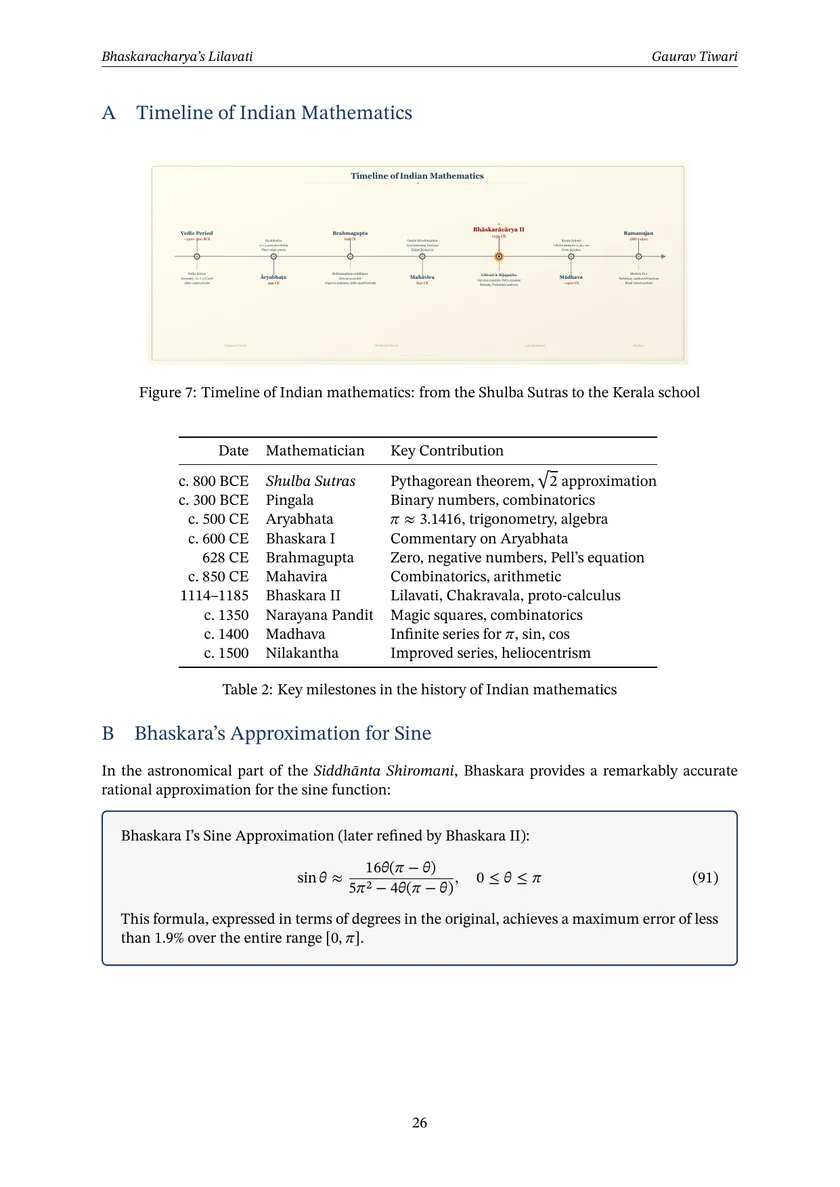
A timeline of Indian mathematics from the Sulba Sutras to the Kerala school, Bhaskara's approximation for sine and four practice problems.
This is a reconstruction in modern notation, not a scholarly translation of the Sanskrit. Methods and astronomical notes from beyond Lilavati's arithmetic are clearly labeled as companion material.
Look Inside
Every problem comes with a worked solution, and the methods come with diagrams. You can open any page at full size.
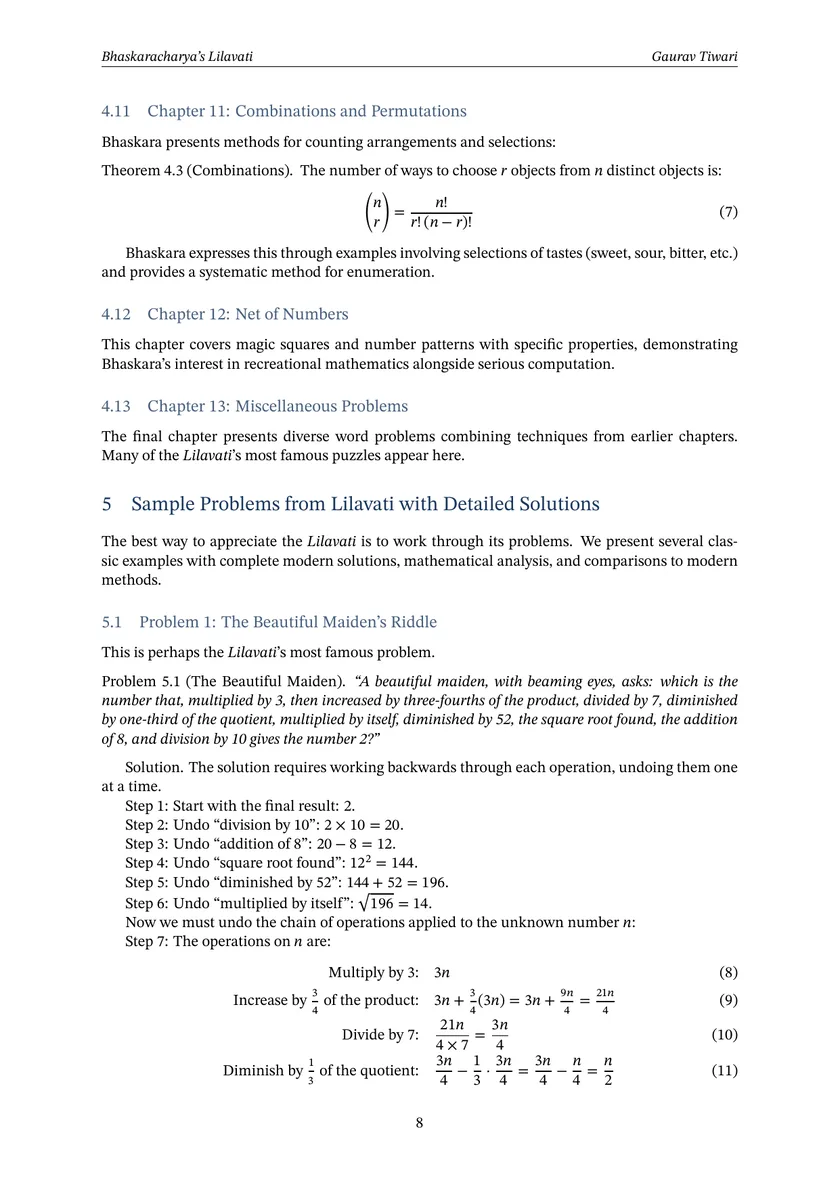
Problem 1. The Beautiful Maiden's Riddle, solved by undoing each operation in reverse.
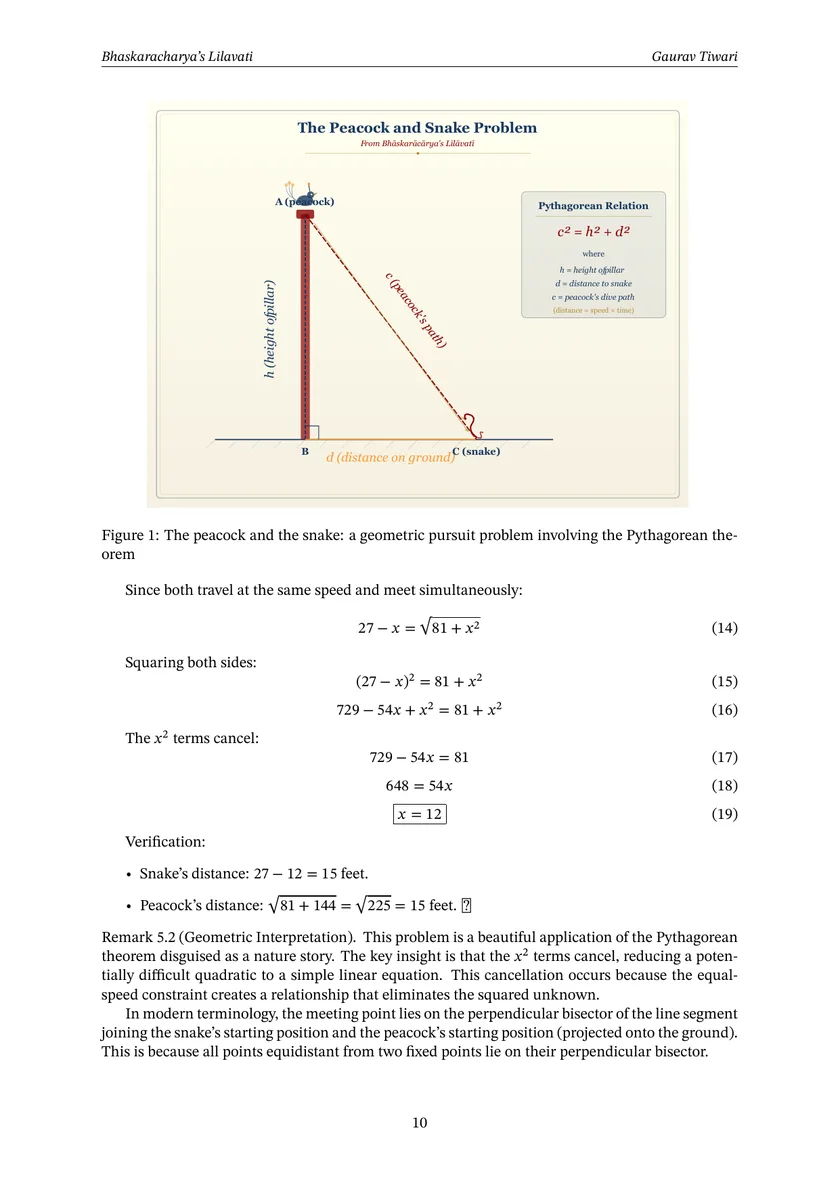
Problem 2. The Peacock and the Snake as a right triangle, with the Pythagorean solution.
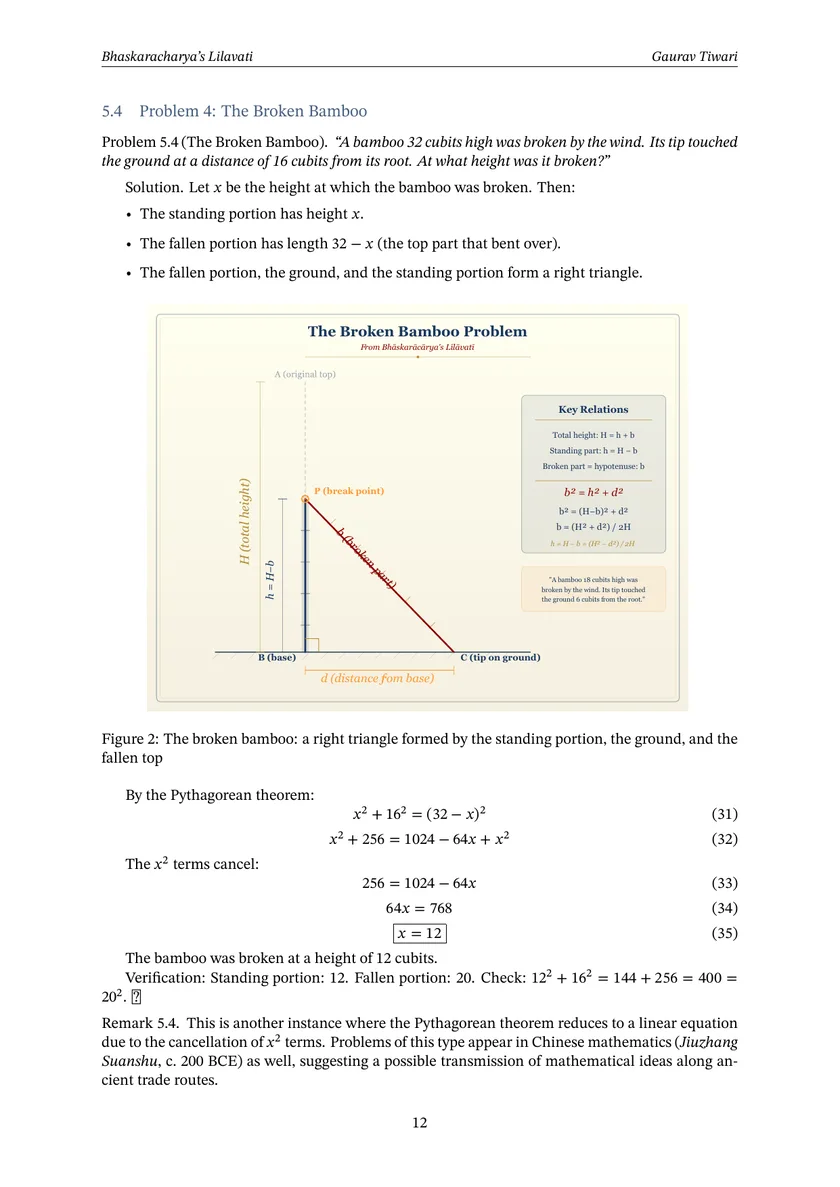
Problem 4. The Broken Bamboo: the standing and fallen parts drawn as one triangle.
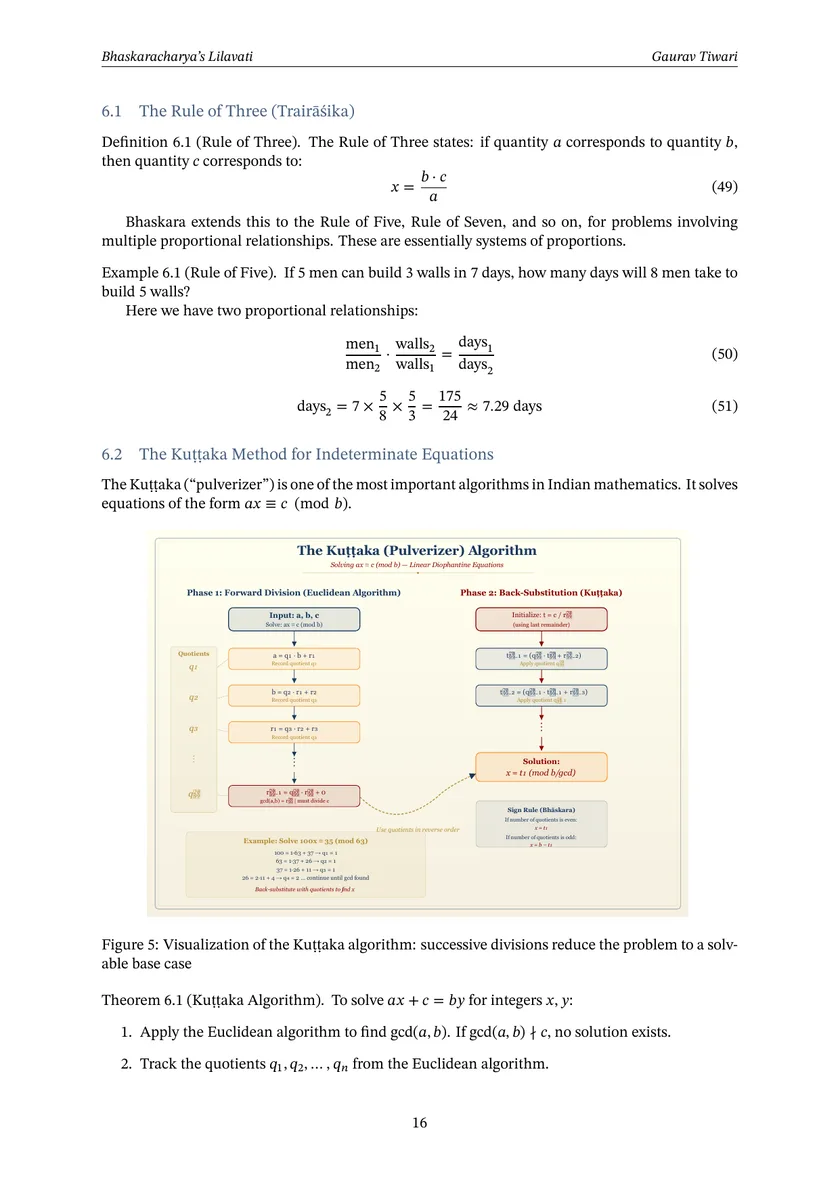
Section 6. The Rule of Three and the Kuttaka algorithm, with its successive divisions drawn out.
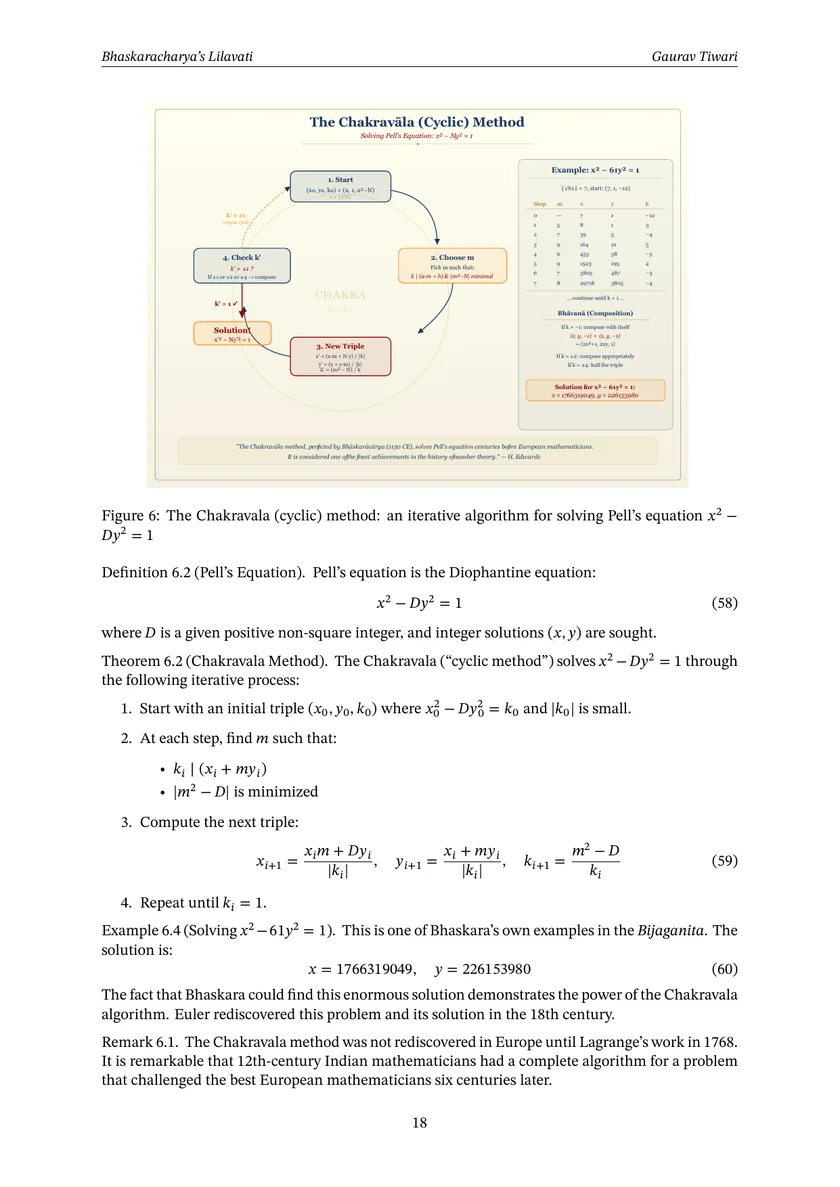
Section 6. The Chakravala method as an iterative algorithm for Pell's equation.
Appendix A. A timeline of Indian mathematics, from the Shulba Sutras to the Kerala school.
Swipe for more pages.
What Each Part Leaves You Holding
The book moves from the story to the solving to the methods, so the history makes sense once you have done the mathematics.
Sections 1 to 4
Meet the book
Who Bhaskara II was, the legend behind the name Lilavati and how the work is organized into 13 topics.
You leave with: a map of what Lilavati covers before you start solving.
Section 5
Solve the problems
Seven famous story problems, each with the original setup and a modern solution you can follow line by line.
You leave with: the problems solved, and the habit of checking an answer against the story.
Sections 6 and 7
Learn the methods
The Rule of Three, the Kuttaka, surds and the Chakravala, then the ideas that ran ahead of their time.
You leave with: methods you can reuse on new problems.
Sections 8 to 12 and the appendices
See the bigger picture
Four more problems, the book’s influence, comparisons with Greece and China, and a timeline.
You leave with: the context, ten references to check and four problems to try alone.
Table of Contents
Each group opens to its sections, and the filter finds a topic or a problem across all of them.
25 sections and appendices
Sections 1 to 4The Book and Its Author4 items
Who wrote Lilavati, the legend behind it and how it is organized.
1IntroductionWhy a 12th-century arithmetic book is still worth reading.
2Bhaskaracharya: The Mathematician Behind LilavatiA biographical overview, his mathematical achievements and the Siddhanta Shiromani.
3The Legend of LilavatiThe story behind the name, and how much of it to believe.
4The Structure of LilavatiThe 13 topics, from definitions and fractions to the net of numbers.
Section 5The Famous Problems7 items
Seven story problems with their original setups and modern solutions.
5.1The Beautiful Maiden's RiddleWorking backwards through every operation.
5.2The Peacock and the SnakeA geometric pursuit solved with the Pythagorean theorem.
5.3The Bees and the LotusFractions of a swarm, and one bee left over.
5.4The Broken BambooWhere did a 32-cubit bamboo break?
5.5The Lotus in the PoolFinding the depth of a pool from a bending lotus.
5.6The Monkey and the TreeFive cubits up, two back: how many leaps to the top?
5.7Division of Gems300 gems shared as an arithmetic progression.
Sections 6 and 7Methods and Ideas5 items
The tools behind the problems, and the ideas that ran ahead of their time.
6.1The Rule of Three (Trairasika)Proportion as a computing method.
6.2The Kuttaka MethodThe pulverizer for indeterminate equations.
6.3Bhaskara's Treatment of SurdsWorking with irrational square roots.
6.4The Chakravala MethodA cyclic algorithm for Pell's equation, as companion material.
7Concepts Ahead of Their TimeZero, negative numbers, iterative algorithms and early rate-of-change ideas.
Sections 8 to 12Influence and Context5 items
Where the work travelled and how it compares.
8Lilavati's Influence on World MathematicsThe Islamic world, Europe and its long life as a textbook.
9Additional ProblemsThe Merchant's Profit, the Square and the Diagonal, Combinations of Tastes and the Cistern.
10Comparison with Other TraditionsIndian, Greek and Chinese mathematics side by side.
11The Lilavati in Modern PerspectiveWhy the problems still teach well.
12ConclusionWhat to take from a 900-year-old textbook.
Back matterReferences and Appendices4 items
Ten references and three appendices.
RReferencesTen sources to check every claim against.
ATimeline of Indian MathematicsFrom the Shulba Sutras to the Kerala school.
BBhaskara's Approximation for SineA rational formula from the Siddhanta Shiromani.
CPractice ProblemsFour unsolved problems for you to try.
Nothing matches that yet. Try a broader word such as problem, method or geometry.
Who This Book Is For
It is written for people who want to work the problems. If you need a critical edition, it isn't that book.
A good fit if you are
a student who wants mathematics with a story attached
a teacher looking for problems that make a class lean in
curious about how Indian mathematicians computed before modern notation
comfortable with school algebra and the Pythagorean theorem
looking for a short, honest introduction you can finish in an evening or two
Look elsewhere if you need
a Sanskrit edition or a line-by-line scholarly translation
philology or a critical edition of the text
a complete history of Indian mathematics
a source to cite as a specialist history; use the ten references instead
Get the Book Free
The free checkout keeps the PDF in your account, so you can download it again on any device. It asks only for your name and email.
There is no payment anywhere in the flow. The checkout creates your order and your download link instantly.
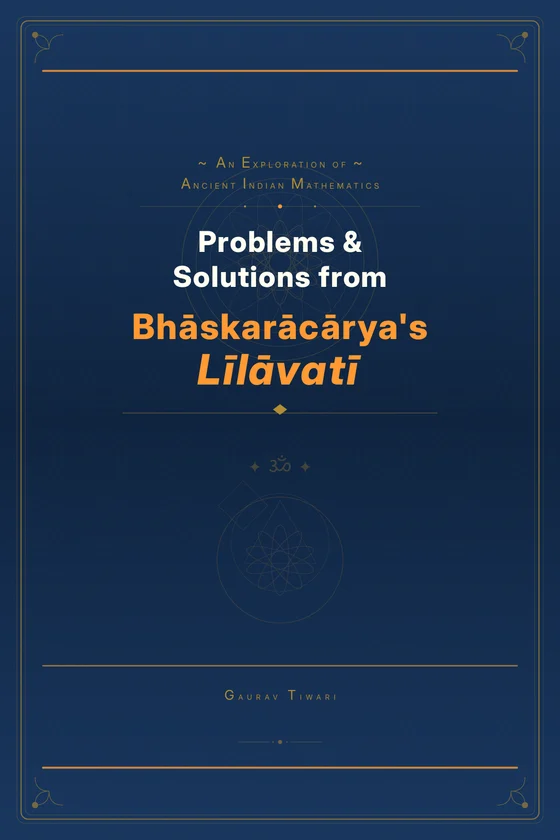
Bhaskaracharya's Lilavati
Problems and Solutions in Modern Notation
FreeInstant download · DRM-free PDF
29-page A4 PDF, easy to read on screen or print
A 13-topic map of Lilavati
11 worked problems in modern notation and 4 to try yourself
The Rule of Three, Kuttaka, surds and Chakravala explained
Ten references, a timeline and Bhaskara's sine approximation
Download link appears right after the free checkout and stays in your account.
I Build Tools That Pay for Themselves And Give Away the Ones That Can’t
Everything here is quick to set up, light on your pages and built to do one real job well. I only charge for the tools that can make you money. The rest are free.
18+years building websites, plugins and stores, since 2008
I obsess over performance
Switch a feature off and it loads nothing. What does load stays small. A tool that replaces a plugin shouldn’t make your pages slower.
I care how it feels
Clear screens, sensible defaults and settings written in plain English. If you need a tutorial for the basics, that’s my design mistake, not yours.
Aa
I build for everyone
Full keyboard support, visible focus, proper labels and text you can actually read. When more people can use your store, more people can buy from it.
I build tools that earn
My paid tools help you sell, renew, license or convert. If one just sits in your stack, I haven’t done my job.
$0
If it can’t earn, it’s free
I won’t charge for anything that can’t make you money. The free tools get the same care as the paid ones, down to the last setting.
FAQs on Lilavati
Still unsure? Open a few pages in the gallery above, or ask me through the contact page.
Is it really free?
Yes. There is no payment anywhere. The free checkout creates your order and keeps the PDF in your account.
Why is there a checkout for a free PDF?
The checkout puts the file in your account, so the link keeps working and you can download it again later. It needs a name and an email address and no payment details.
Do I need Sanskrit or a history background?
No. The PDF uses English and modern notation. It is an educational companion, not a Sanskrit edition or a line-by-line scholarly translation.
Is this a history book or a mathematics book?
Mathematics first. The context is there, with comparisons to Greek and Chinese traditions and a timeline from the Sulba Sutras onward, but the core of the book is working through the problems and the methods.
What is the Chakravala method?
Chakravala is a cyclic method from the wider Indian tradition for solving indeterminate equations such as Pell's equation. The PDF treats it as companion material, alongside Kuttaka, without claiming every method discussed belongs to Lilavati itself.
What math do I need first?
School algebra and the Pythagorean theorem cover nearly everything. A few method notes use more symbols, and you can skip those on a first read.
Solve a Problem That's 900 Years Old Tonight
The Broken Bamboo has been waiting since the 12th century. The PDF is free, and the download takes a minute.