by
by
The NEET UG exam is the entrance test used for undergraduate medical and dental admission in India, including MBBS and BDS. It also applies to the prescribed AYUSH courses. If you’re preparing for it, start with the official syllabus: an old chapter list can send you into material you don’t need while prescribed topics remain unfinished.
I recommend keeping a syllabus tracker beside your study plan and using questions to check what you’ve understood. Your next session should address a specific gap, whether that’s a concept you haven’t learned, a fact you can’t recall or an error you keep making under time pressure.
NEET UG Exam Updates
NEET 2026 has reached the results and admission stage. Registration is closed, and the original May schedule was followed by a re-examination. NTA’s re-examination notice and result release record:
- Re-examination: 21 June 2026.
- Result declaration: 16 July 2026.
- Scorecards and final answer keys: available through the official NTA website.
The official NEET website currently links the 2026 bulletin and syllabus. If you’re preparing for 2027, those documents are a starting reference; confirm dates, mode, fees and any changed rules from the applicable new NTA notification. A timetable circulating online is not an official announcement.
NEET UG Eligibility
You need to check the qualification route that matches your studies before applying. The 2026 information bulletin lists qualifying examination codes for recognized school and equivalent qualifications.
- The required subjects include Physics, Chemistry, Biology or Biotechnology and English, with the practical examinations specified for the qualification route.
- Class 12 appearing candidates could apply in 2026, but had to pass the qualifying examination by the required admission stage.
- The 2026 minimum age was 17 by 31 December 2026, corresponding to birth on or before 31 December 2009. NTA specified no upper age limit.
- Indian nationals, NRIs, OCIs and foreign nationals must also meet the applicable document and admission conditions.
Candidates who study the required subjects as additional subjects after Class 12 can use the routes described in the bulletin, provided the board is duly recognized and they have the required documentary evidence. You should check the qualification code and practical requirements; the title of a certificate alone doesn’t establish eligibility.
School qualification requirements and the NEET qualifying percentile are separate checks. The qualification code and the applicable course’s admission regulations determine the school requirements. Meeting the NEET percentile threshold doesn’t replace those checks.
NEET UG Exam Pattern
The 2026 bulletin specifies 180 questions for a maximum of 720 marks. Biology includes Botany and Zoology.
| Subject | Questions | Maximum Marks |
|---|---|---|
| Physics | 45 | 180 |
| Chemistry | 45 | 180 |
| Biology | 90 | 360 |
| Total | 180 | 720 |
The usual marking rule is:
- Correct answer: +4 marks.
- Incorrect answer: -1 mark.
- Unanswered question: 0 marks.
There is no optional section choice. You can still leave a question unanswered, so a difficult question doesn’t require an unsupported guess merely because it appears in the paper.
The 2026 exam used pen-and-paper mode. The bulletin’s test duration was 3 hours, while NTA’s later June timing notice provided a 195-minute window from 2:00 PM to 5:15 PM, including mandatory examination formalities. Use the instructions for your particular sitting and any approved accommodations.
Paper Languages
The 2026 exam was conducted in 13 languages. Your language choice affects the booklet you receive:
- English medium: an English booklet.
- Hindi medium: English and Hindi.
- A regional-language medium: English and the selected language.
Choose the medium carefully during the application. The bulletin states that the selected option cannot subsequently be changed.
Calculate Your Score
For a hypothetical mock under the usual marking rule:
- 140 correct answers earn 560 marks.
- 25 incorrect answers lose 25 marks.
- 15 unanswered questions add 0 marks.
- Your score is 560 – 25 = 535 out of 720.
Changing an incorrect answer into a correct one improves that score by 5 marks. When reviewing a test, you should identify what caused the wrong answer so the next practice session addresses it.
NEET UG Syllabus
The prescribed syllabus determines what you need to study. The official NMC syllabus published through NTA has 20 Physics units, 20 Chemistry units and 10 Biology units for 2026. The lists below are unit summaries; the PDF contains the detailed scope.
Physics
Physics preparation needs both an understanding of the model and practice applying it to a question. The official units are:
| Unit | Topic |
|---|---|
| 1 | Physics and Measurement |
| 2 | Kinematics |
| 3 | Laws of Motion |
| 4 | Work, Energy and Power |
| 5 | Rotational Motion |
| 6 | Gravitation |
| 7 | Properties of Solids and Liquids |
| 8 | Thermodynamics |
| 9 | Kinetic Theory of Gases |
| 10 | Oscillations and Waves |
| 11 | Electrostatics |
| 12 | Current Electricity |
| 13 | Magnetic Effects of Current and Magnetism |
| 14 | Electromagnetic Induction and Alternating Currents |
| 15 | Electromagnetic Waves |
| 16 | Optics |
| 17 | Dual Nature of Matter and Radiation |
| 18 | Atoms and Nuclei |
| 19 | Electronic Devices |
| 20 | Experimental Skills |
Experimental Skills needs a place in your tracker alongside the theory units. For measurement questions, you can revise significant figures; for electrostatics, the Gauss’s law examples explain how symmetry affects the calculation.
Chemistry
Chemistry includes numerical work, factual recall and reaction reasoning. Keep those tasks visible when planning practice. Its official units are:
| Unit | Topic |
|---|---|
| 1 | Some Basic Concepts in Chemistry |
| 2 | Atomic Structure |
| 3 | Chemical Bonding and Molecular Structure |
| 4 | Chemical Thermodynamics |
| 5 | Solutions |
| 6 | Equilibrium |
| 7 | Redox Reactions and Electrochemistry |
| 8 | Chemical Kinetics |
| 9 | Classification of Elements and Periodicity in Properties |
| 10 | p-Block Elements |
| 11 | d- and f-Block Elements |
| 12 | Coordination Compounds |
| 13 | Purification and Characterisation of Organic Compounds |
| 14 | Some Basic Principles of Organic Chemistry |
| 15 | Hydrocarbons |
| 16 | Organic Compounds Containing Halogens |
| 17 | Organic Compounds Containing Oxygen |
| 18 | Organic Compounds Containing Nitrogen |
| 19 | Biomolecules |
| 20 | Principles Related to Practical Chemistry |
Principles Related to Practical Chemistry includes detection, preparation, titration and qualitative-analysis topics. Some ideas from older chapter lists remain within these prescribed topics, so check the exact scope before deciding that an entire subject area can be skipped. The chemical-equilibrium guide can help with a specific gap in that unit.
Biology
Biology revision should preserve the precise terms and conditions used in the source chapter. The official units are:
| Unit | Topic |
|---|---|
| 1 | Diversity in Living World |
| 2 | Structural Organisation in Animals and Plants |
| 3 | Cell Structure and Function |
| 4 | Plant Physiology |
| 5 | Human Physiology |
| 6 | Reproduction |
| 7 | Genetics and Evolution |
| 8 | Biology and Human Welfare |
| 9 | Biotechnology and Its Applications |
| 10 | Ecology and Environment |
Use diagrams and processes to check recall, then compare your answer with the book. The DNA-replication notes are useful when revising molecular inheritance; they supplement the prescribed chapter.
Track Your Progress
A topic is ready for revision when you’ve learned it and attempted its questions. Keep separate records of practice and retesting so reading a chapter doesn’t become the only completion check.
| Topic | Learned | Questions Practiced | Revised | Retested |
|---|---|---|---|---|
| Selected syllabus topic | Date | Set and result | Date | Result |
An unsupported chapter-weightage list can leave gaps in your coverage. I would prioritize an unfinished prerequisite or a repeated diagnostic error while keeping every prescribed topic in the plan.
NEET Study Materials
Start with the relevant NCERT chapter and its exercises, then attempt questions that test it. A supplementary resource earns its place when it helps you understand or practice a task you’re struggling with.
| Resource | What It Helps You Do | What to Check |
|---|---|---|
| NCERT Classes 11 and 12 | Read the core explanation and complete exercises | Match the chapter to the prescribed syllabus |
| Recent papers and final keys | Practice exam questions and check answers | Use the correct year, sitting and booklet code |
| A selected question resource | Get further practice and explanations | Check the edition, syllabus coverage and solution quality |
| Topic notes | Repair a gap or revisit an explanation | Return to the chapter and attempt questions afterwards |
You can download textbooks through the official NCERT portal, or use the site’s NCERT books guide to find the relevant class. Compare textbook coverage with the NMC syllabus, including experimental and practical material.
If you need a practice book, the NEET books guide covers the choices. Check the exact edition before buying. Adding another reference makes sense when it supplies an explanation or question set you need and can realistically complete.
For free supplementary explanations, OpenStax provides Chemistry 2e and Concepts of Biology through its own book pages. Their scope is broader than the NEET syllabus, so use them for selected concepts. You can also use the science study-note hub for targeted revision.
NEET Previous-Year Papers
Previous papers help you practice how a question is framed and how much working it needs. Pair a paper with its matching final key. A key for another booklet code can make a correct answer appear wrong.
NTA’s June 2026 question-paper notice records publication of all 4 re-examination sets. The official final keys below identify their sitting and booklet codes.
| Sitting | Official Resource | Use |
|---|---|---|
| 21 June 2026 re-examination | Final answer keys | Check the corresponding June paper and booklet code |
| 4 May 2025 exam | Final answer keys | Check the corresponding 2025 paper and booklet code |
These older files remain available for additional question practice:
- You can download the 2021 English paper bundle.
- The older English paper collection provides further questions.
- The older bilingual paper collection includes English and Hindi material.
- The 2018 paper collection is another optional practice resource.
Older papers may contain a different pattern or topics absent from the current syllabus. Filter their questions against the prescribed scope before using them as a timed mock. Practice the reasoning rather than expecting a past question to repeat verbatim.
NEET Preparation Plan
Before following a NEET 2026 timetable, check the latest notified syllabus and the time you actually have. School, coaching and your current understanding affect the plan. A fixed minimum of 8-10 hours every day doesn’t tell you which work needs doing.
You should begin with a short diagnostic question set and record why each error occurred. The preparation sequence is straightforward:
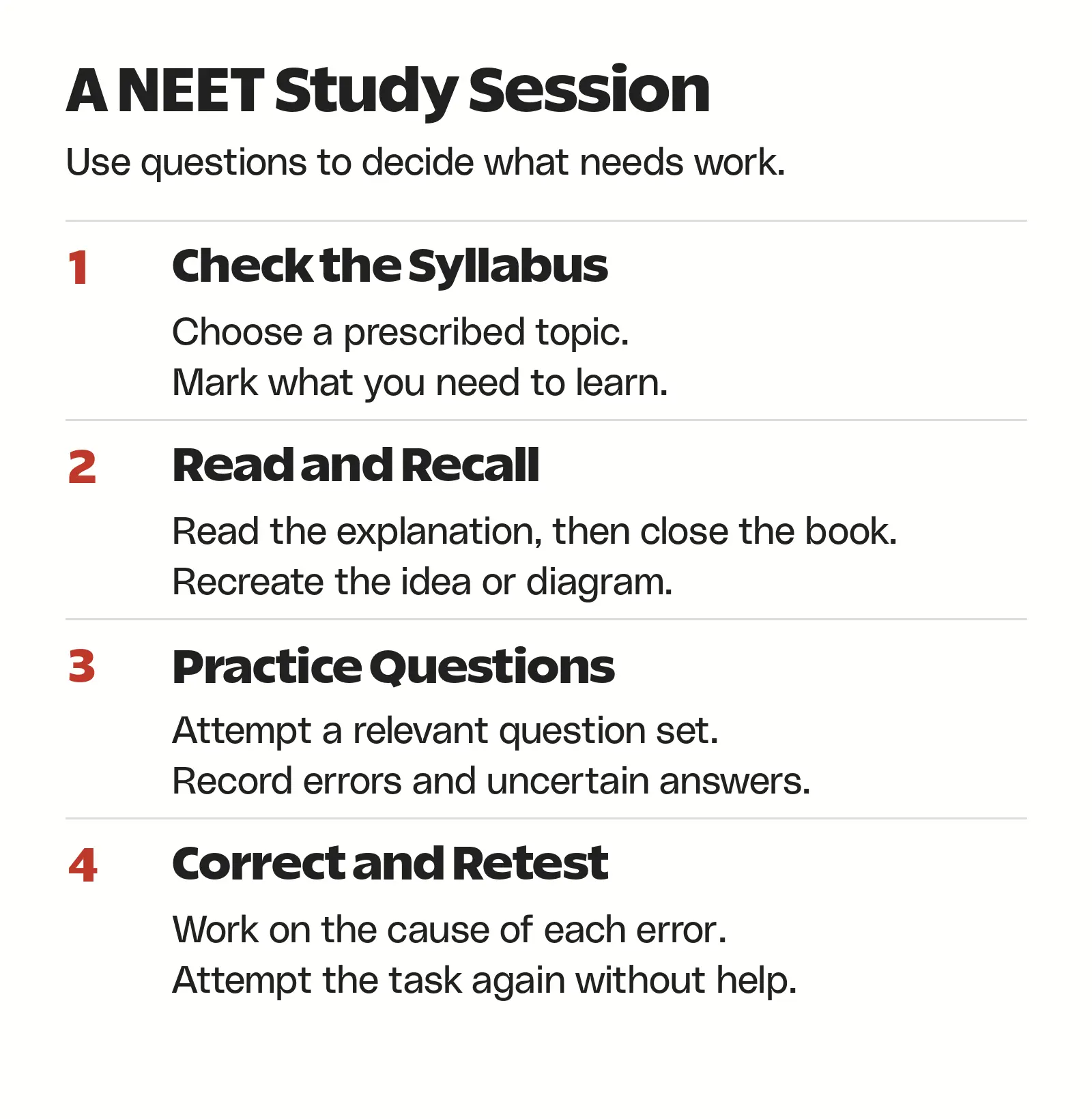
Study Alongside School
Your self-study plan should fit around school and other commitments, with tasks you can check when the session ends. Leave time for corrections as well as new material.
For example, if you have 180 minutes available for self-study, a starting plan could be:
| Task | Minutes | Completion Check |
|---|---|---|
| Biology reading and recall | 60 | Recreate the selected process or diagram, then check omissions |
| Physics practice | 60 | Solve the selected questions and explain each correction |
| Chemistry practice | 45 | Complete the chosen questions and review wrong answers |
| Error-log review | 15 | Retest questions from a previous session |
This is a hypothetical plan, not a minimum requirement. Breaks are additional, and the subject balance should change when your results show a different need. The Class 12 NEET preparation guide covers planning alongside school in more detail.
Recall and Revision
Simply reading and re-reading a chapter leaves the recall task unchecked. You should try to produce an answer before opening the book again.
For a Biology process, you can follow this sequence:
- Read the selected explanation and diagram.
- Close the book and recreate the sequence or labels.
- Check the missing terms and incorrect connections.
- Attempt related questions and record the corrections.
- Revisit the task later without looking at the answer first.
Short notes, formula sheets and diagrams are useful when they support this work. The biology note-taking guide explains how to make notes that remain usable during revision.
Mock-Test Review
A mock test gives you a score and a record of decisions to inspect. Before taking another test, review wrong answers, skipped questions and correct answers that came from guessing.
For example, suppose 24 wrong answers fall into these categories:
| Cause | Hypothetical Count | Next Action |
|---|---|---|
| Concept gap | 7 | Relearn the idea and solve a small related set |
| Recall gap | 8 | Recall the fact without the book, check it and retest later |
| Reading error | 6 | Identify the missed condition and practice similar stems |
| Calculation error | 3 | Redo the working and check units or arithmetic |
You can track timing problems separately, including questions left because time ran out. Record the question, cause, correction and retest result. If the same error returns, the next study session should address it before you add more test volume.
If you’re choosing online explanations or tests, the online NEET preparation guide can help you compare resources by the task you need them for.
Free JEE & NEET Study Companion
The 48-page study companion covers planning, revision and mock-test review, with a printable syllabus tracker, weekly timetable and mock-test log.
Enter your email and I’ll send the PDF straight to your inbox.
NEET Application and Exam Day
Applications and exam-day instructions depend on the sitting. Use the current bulletin, subsequent notices and your admit card together; later instructions can change an earlier arrangement.
Application Checklist
The application should be completed through the official NEET portal. Before starting:
- Check the qualification code, category and identity requirements.
- Prepare the photographs, signature, impressions and certificates specified in the bulletin.
- Enter and verify your details before submitting each part.
- Pay the applicable fee through an accepted method.
- Download the confirmation page and retain the payment record.
- Read official correction-window notices if a submitted detail needs changing.
The 2026 bulletin allowed identity routes other than Aadhaar, including the specified government identity documents. A live photograph was also required. Follow the requirements for the identity route you choose.
The 2026 base application fees were:
| Category or Centre | Base Fee |
|---|---|
| General, in India | Rs. 1,700 |
| General-EWS/OBC-NCL, in India | Rs. 1,600 |
| SC/ST/PwBD/PwD/Third Gender, in India | Rs. 1,000 |
| Outside India | Rs. 9,500 |
Applicable processing charges and taxes were additional. These are historical 2026 fees; confirm the next cycle’s charges in its bulletin. The final 2026 application deadline was extended to 11 March, with separate submission and payment closing times, as stated in the extension notice.
Exam-Day Checklist
Your admit card provides the reporting time and required documents. Check the details before exam day and contact the NTA helpdesk promptly if particulars are incorrect.
- Carry the printed admit card and the identity documents and photographs specified for your sitting.
- Carry the relevant disability, scribe or other certificates if they apply to you.
- Check the permitted clothing and items against the latest advisory.
- Leave enough time for reporting and security checks.
For the June 2026 re-examination, the dress-code advisory permitted transparent water bottles and allowed full sleeves or articles of faith under advance-reporting and frisking conditions. Electronic devices, heavy jewellery and the other specified restricted items were prohibited. These June instructions shouldn’t be treated as a permanent rule for every future sitting.
NEET Results and Cutoffs
Qualifying NEET means you have met the applicable exam threshold. College allotment also depends on the admission process and the seats available to your rank, category and quota.
- Your score is the number of marks you earned out of 720.
- The qualifying percentile is the category’s exam threshold. The 50th percentile does not mean 50% of 720 marks; NTA publishes the corresponding marks with the results.
- All India Rank records your place in the merit list and is used in the admission process.
NTA’s 2026 result data records:
- Registered candidates: 22,79,743.
- Candidates who appeared: 19,99,895.
- Candidates who qualified: 11,21,185.
Those groups measure different stages of the exam; qualification does not tell you how many received a particular college seat.
The historical 2026 minimum qualifying marks were:
| Category | Qualifying Percentile | 2026 Minimum Marks |
|---|---|---|
| UR/EWS | 50th | 213 |
| SC/ST/OBC | 40th | 177 |
| UR/EWS PwBD | 45th | 194 |
| SC/ST/OBC PwBD | 40th | 177 |
When comparing colleges, you should look for the closing rank for the same course, quota, category and counselling round. A historical closing rank helps you assess a choice; it doesn’t guarantee a seat in another year. The medical-college guide can help you start comparing institutions.
Answer-Key and OMR Challenges
An answer-key challenge asks whether the proposed answer is correct. An OMR response challenge concerns the recorded response. Their notices can specify different windows and refund conditions.
| 2026 Process | Fee | Refund Condition |
|---|---|---|
| June answer-key challenge | Rs. 200 per question | Refundable for accepted challenges |
| July recorded-response challenge | Rs. 200 per response | Non-refundable |
The answer-key notice and OMR notice give the separate procedures. Both 2026 windows have closed. For another cycle, use its notice and submit through the specified portal within the deadline.
NEET Counselling
After the result, you need to identify the authority responsible for the seats you’re considering. NTA conducts the exam and provides the result; counselling and allotment are separate processes.
| Route | Authority | Where to Start |
|---|---|---|
| Covered MBBS/BDS AIQ and institutional routes | Medical Counselling Committee | MCC UG counselling |
| State and other state-managed seats | Relevant state counselling authority | The state authority’s official notices and seat matrix |
| Covered AYUSH AIQ routes | Ayush Admissions Central Counseling Committee | AACCC |
The 15% AIQ and 85% state-quota description is useful for the relevant state-government college seats. It doesn’t describe every central, deemed, private or institutional route. Check the seat matrix and eligibility rules for the route you’re using.
The usual admission tasks are:
- Register with the relevant counselling authority and complete its fee and document requirements.
- Review the available courses, seats and eligibility conditions.
- Fill choices in an order you can justify by course, cost, location and fit.
- Read the allotment result and follow the instructions for the applicable round.
- Complete reporting and document verification within the deadline.
You should check the official schedule before each step. A counselling registration or an allotment result can still have reporting conditions you need to complete.
NEET UG FAQs
Can I Apply Before My Class 12 Results?
Yes. The 2026 bulletin allowed Class 12 appearing candidates to apply and take the test, but admission required passing the qualifying examination by the specified stage. Check the corresponding rule in the bulletin for your exam year.
Can I Take Biology as an Additional Subject?
The 2026 qualification rules permit recognized-board additional-subject routes, subject to the required subjects and documentary evidence. Your qualification must meet the applicable code and practical-examination requirements.
Does a Gap Year Make Me Ineligible?
A gap year isn’t itself listed as a bar in the 2026 qualification codes. You still need to meet the applicable age, qualification and admission requirements. Check the current bulletin for your circumstances.
Is NCERT Enough for NEET?
NCERT should be your starting point for core reading, but you should check every prescribed syllabus topic and practice exam questions. If you can recall the chapter but can’t solve its questions, you need further explanation or practice in that topic.
Does Qualifying NEET Guarantee a Medical Seat?
No. Allotment depends on your rank, category, quota, choices and seat availability, as well as eligibility. Government, private and deemed-university routes can have different fees and admission conditions.
Do I Need NEET for Medical Study Abroad?
The 2026 bulletin requires Indian citizens and OCIs intending undergraduate medical or dental study abroad to qualify NEET. You also need to meet the foreign institution’s admission requirements and the applicable rules for later registration in India.
Are the Next NEET Dates Confirmed?
Treat a date as confirmed only when NTA publishes the applicable schedule or notice. The official NEET site currently links the 2026 bulletin and syllabus; confirm the next cycle through its new notification before relying on a date or mode change.
Start Your NEET Preparation
You should begin by marking the official syllabus against what you’ve learned and practiced. Choose a topic that needs work, attempt a short question set and record why each answer went wrong. Those corrections give you a useful task for tomorrow’s study session.
Tell Google you want more of this.
Add Gaurav Tiwari as a preferred sourceOne tap, and this site shows up more often in your own Top Stories, AI Overviews and AI Mode. Remove it any time.