
Elements of Integral Equations: Free PDF Book
Integral equations appear everywhere in applied mathematics, physics, and engineering. This free book is a structured introduction that takes you from the definitions to the core methods, and it builds the functional analysis foundation on the way instead of assuming it.
Free PDF · direct download · no email, no checkout
Want exercises and a full course? Explore my premium Integral Equations book.
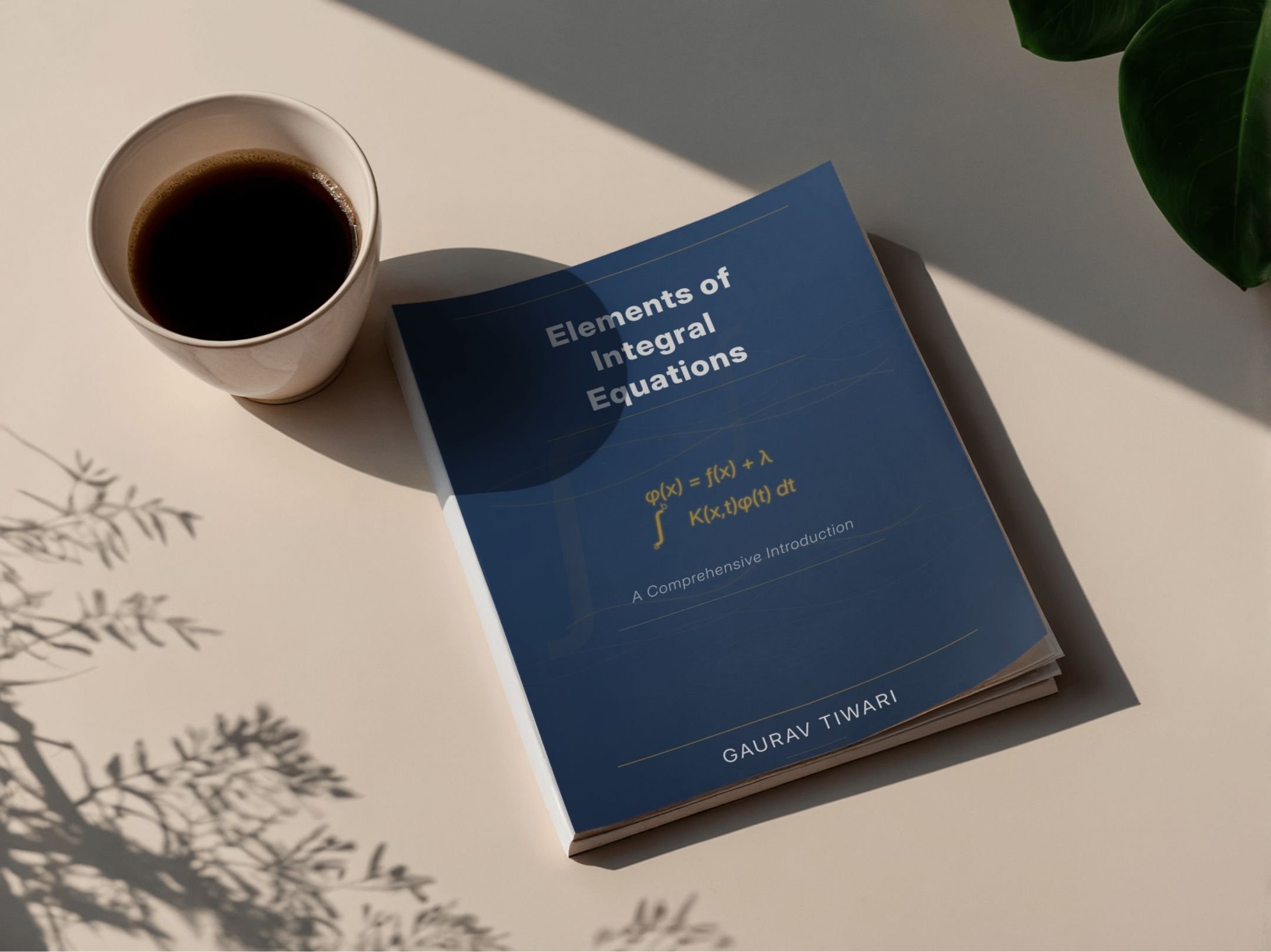
Format:
Inside the Book
The order matters: you can name every equation type before you solve one, and the analysis is in place before anything leans on it.
Classification
chapter one- Fredholm and Volterra equations of the first, second, and third kind
- Singular and convolution-type equations
- Eigenvalues and eigenfunctions
- The Leibniz rule for differentiation under the integral sign
Foundations
chapter two- Square integrable functions, inner products, and orthogonality
- Norms and the Cauchy-Schwarz inequality
- The trial method for verifying solutions, with worked examples
- A preview of the Neumann series
The core
the payoff- Converting differential equations to integral equations, and back
- Initial value problems and boundary value problems, both covered
- The Green’s function connection, made explicit
The theory
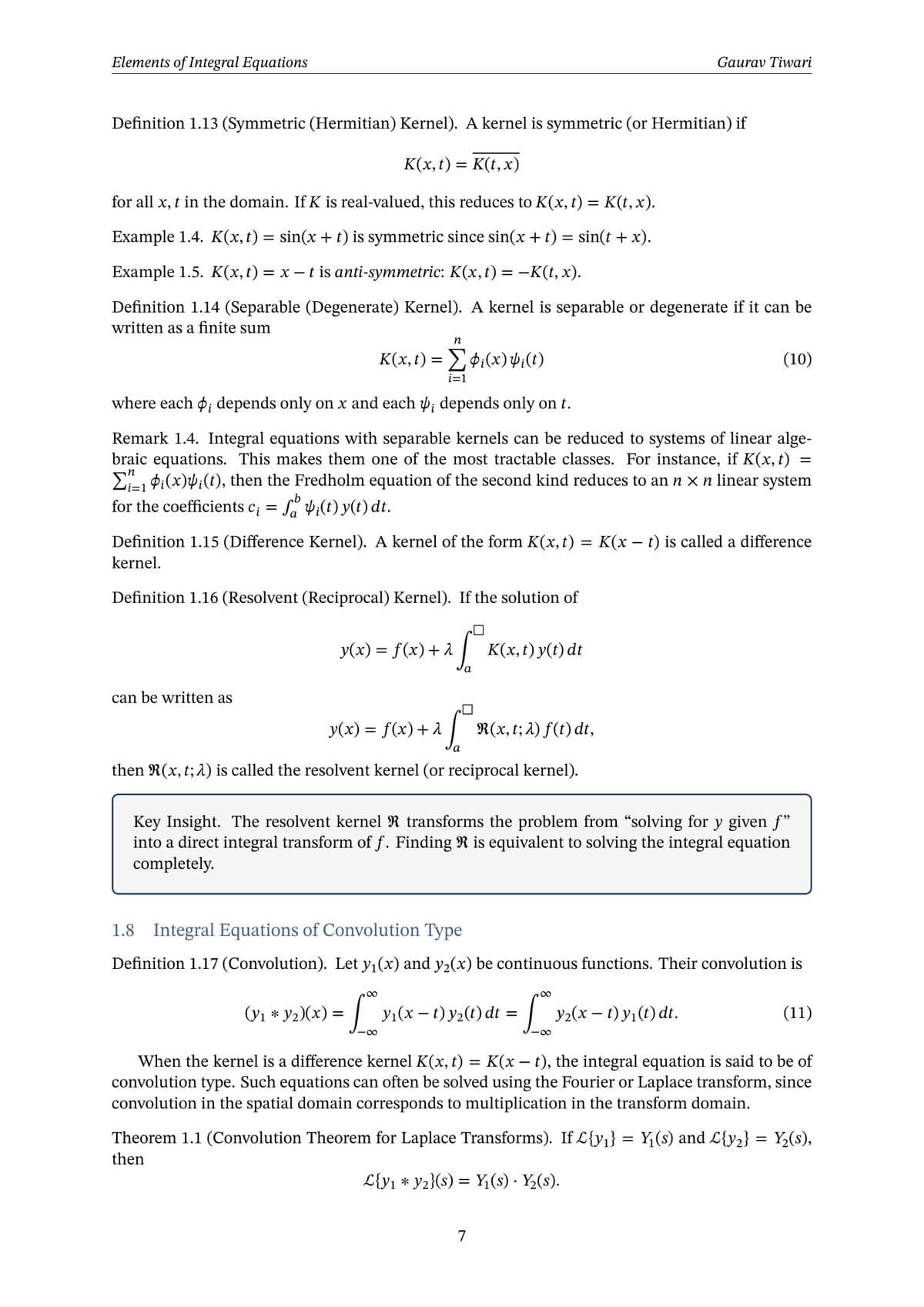
- Kernels: symmetric, separable, singular, and convolution-type
- Existence and uniqueness theorems
- A Fredholm theory overview
The conversion between differential and integral equations is the core of the book, and it runs in both directions.
What Is an Integral Equation?
An integral equation is an equation in which the unknown function sits under an integral sign. A common linear form is φ(x) = f(x) + λ∫ab K(x, t) φ(t) dt, where K(x, t) is the kernel, f(x) is known, and φ(x) is the function to determine. Fixed limits of integration give a Fredholm equation; a variable upper limit gives a Volterra equation.
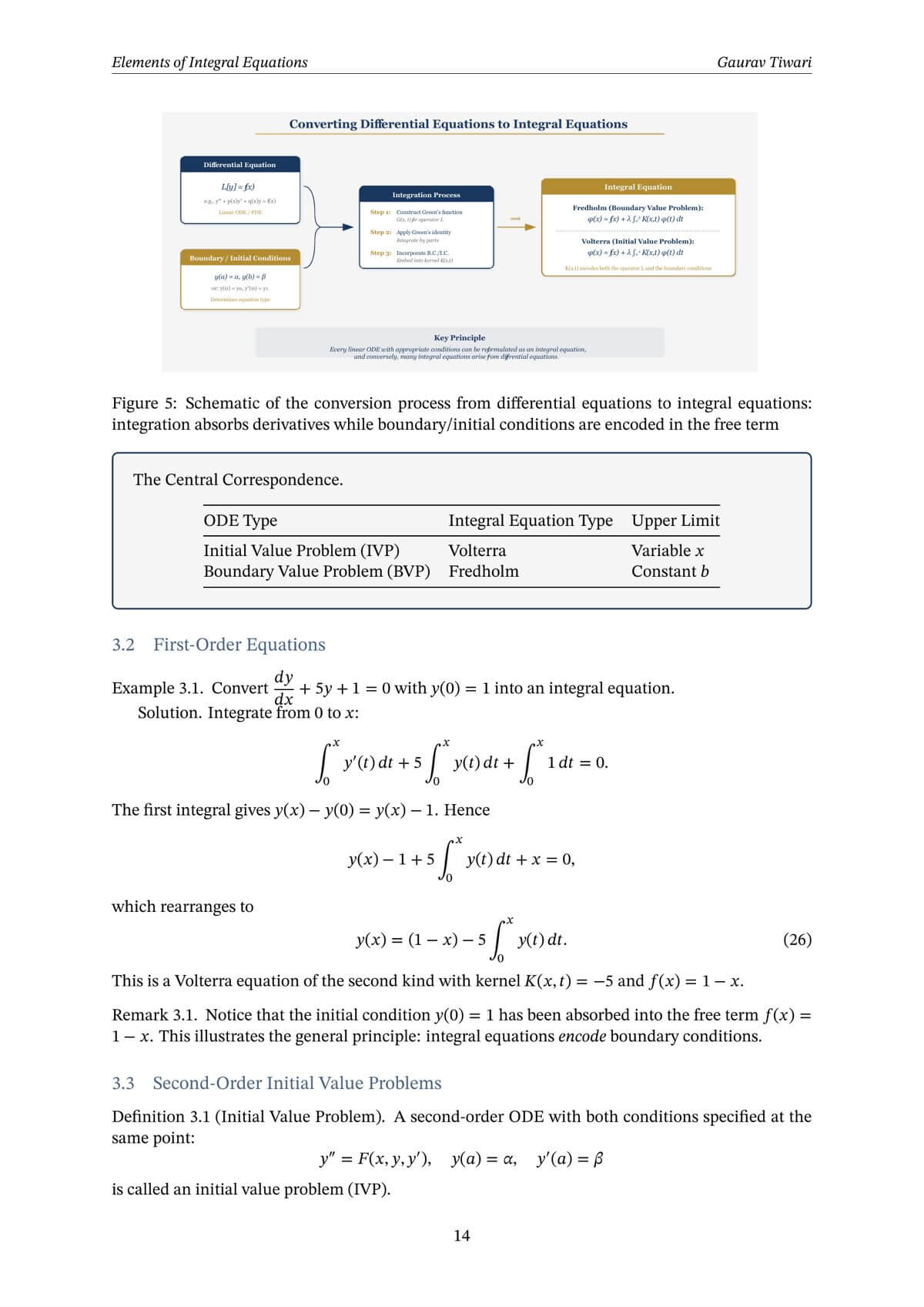
Here’s the move the whole book runs on. Take y′ + 5y + 1 = 0 with y(0) = 1. Integrate from 0 to x and the differential equation and its initial condition collapse into one statement: y(x) = 1 − x − 5∫0x y(t) dt, a Volterra equation of the second kind. That conversion, run in both directions, is chapters 3 and 4 of the book.
Book Preview
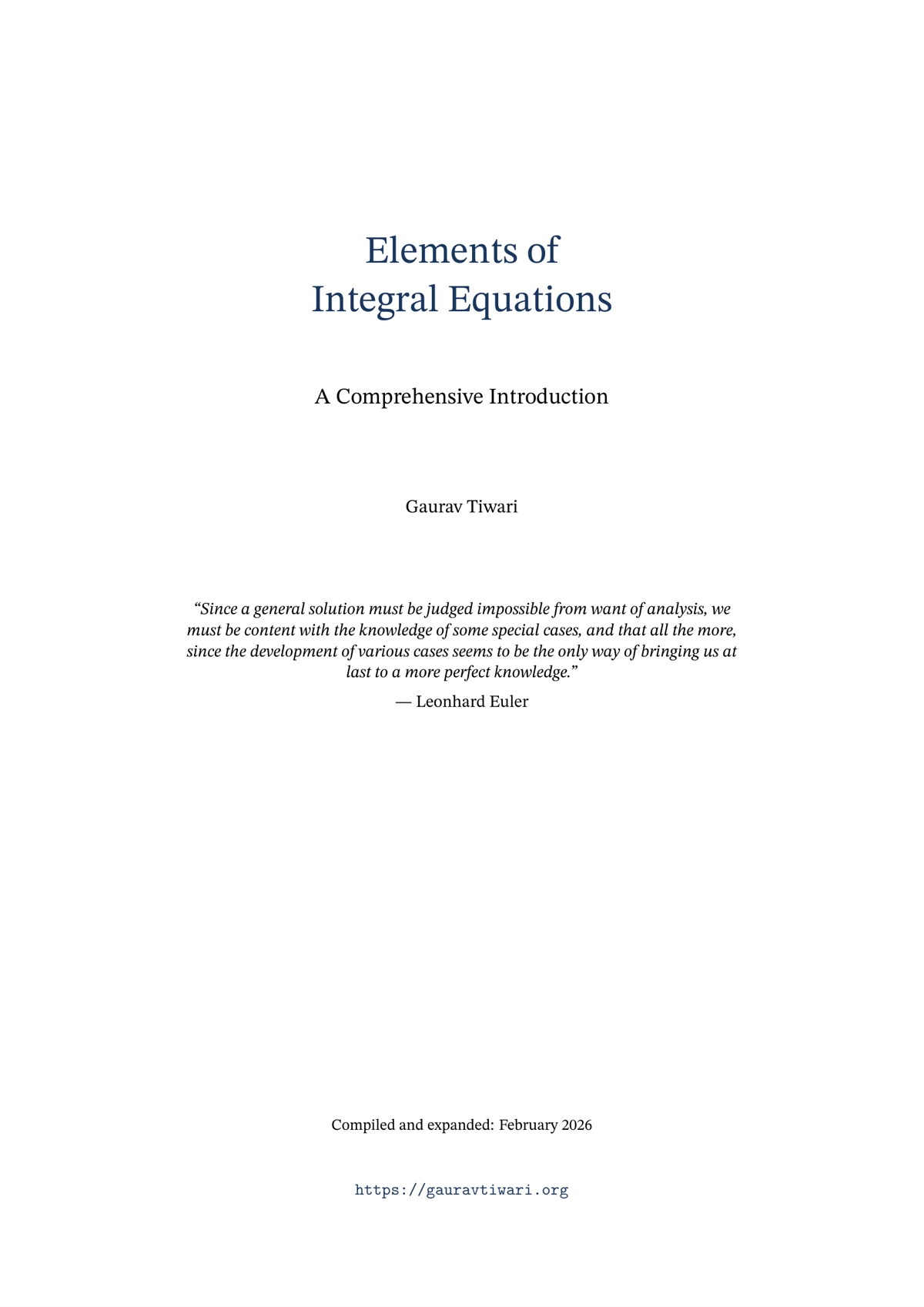
Preview the writing, structure, and page layout before you decide.
One book, two editions
Elements of Integral Equations is the revised and expanded February 2026 edition of my 2014 course notes, originally published as Solving Integral Equations: The Interactive Way!. The 2026 edition reorganizes the classification, builds the square-integrable foundation with the Schwarz and Minkowski inequalities, and adds the Neumann series preview, Green’s functions, existence and uniqueness results, and a short Fredholm synopsis. It also retypesets everything, down to correcting Leibnitz to Leibniz. Both files stay downloadable here: the current edition for reading, the original for anyone who saved or cited it.
The 2014 file is superseded and kept as an archive. If you’re starting fresh, take the 2026 edition.
| Detail | Answer |
|---|---|
| Title | Elements of Integral Equations |
| Author | Gaurav Tiwari |
| Edition | Revised and expanded, February 2026 |
| Original edition | 2014, as Solving Integral Equations: The Interactive Way! |
| Format | Searchable PDF, digital only |
| Pages | 25 |
| File size | 858 KB (2014 edition: 264 KB) |
| Language | English |
| Level | Final-year B.Sc. and M.Sc. mathematics; physics and engineering students meet the same material |
| Prerequisites | Calculus and ordinary differential equations |
| Chapters | 5, plus references |
| Worked examples | 26 |
| Exercises | None; explanatory reference, not a workbook |
| License | Free for personal study and classroom sharing with attribution; no modification or resale |
| ISBN | None |
| Price | Free |
Elements of Integral Equations
Free
Digital PDF · direct download · no printed copy
- Classify Fredholm and Volterra equations of all three kinds
- Recognize symmetric, separable, singular, and convolution-type kernels
- Work with square integrable functions, norms, and the Cauchy-Schwarz inequality
- Verify solutions with the trial method, through worked examples
- Convert initial and boundary value problems into integral equations and back
- Connect Green’s functions to integral equations explicitly
No payment, no email. The button downloads the PDF directly.
Download Questions
Is it actually free?
Yes. The button downloads the PDF directly. No payment, no email address, no account. That’s the entire transaction.
What do I need to know before starting?
Calculus and some differential equations, since converting between differential and integral equations is the core of the book. The functional analysis you need, square integrable functions, inner products, norms, is built in chapter two rather than assumed.
Does it skip the proofs?
It keeps the theory visible without drowning you in it. The Schwarz and Minkowski inequalities are proved, the existence and uniqueness results are stated with their main arguments, and 16 theorem statements anchor the chapters. The emphasis sits on 26 worked examples with every computation shown; the deep Fredholm machinery is summarized, not derived.
How deep does the Fredholm theory go?
It’s an overview, and the book says so. You get the classification, the kernels, the conversions, and the vocabulary and foundational ideas to approach a fuller course or textbook afterward. The full Fredholm machinery is a book of its own.
Is this the same book as the 2014 Solving Integral Equations PDF?
Same project, grown up. The 2014 notes became this book: the four-chapter spine was reorganized into 5 chapters, and Green’s functions, existence and uniqueness results, and a Fredholm synopsis were added. Both PDFs are downloadable above, and the 2026 edition is the one to read.
Are there exercises and solutions?
No exercise sets. This edition is an explanatory reference built around 26 worked examples with every computation shown. The intended practice is redoing the examples with the book closed.
Can teachers print or share it?
Yes. It’s free for personal study and classroom distribution with attribution: print it, share it with a class, put it on your course page. Don’t modify it, resell it, or strip the author and source information. Cite it as: Gaurav Tiwari, Elements of Integral Equations, revised edition, February 2026, gauravtiwari.org.
What I’m not going to claim
No ratings to show you. Free PDFs don’t collect them, and I’m not going to pretend otherwise.
The title says Elements and it’s honest. This is a structured introduction: classification, foundations, conversions, Green’s functions, and an overview of Fredholm theory. The full theory goes further than this book does.
You’ll also need to bring calculus and some differential equations with you. Chapter two builds the functional analysis, but it can’t build everything.
There are no exercise sets either. This edition is an explanatory reference, not a problem workbook: 26 worked examples with every computation shown, and the practice is redoing them with the book closed.
License, plainly: free for personal study and classroom distribution with attribution. Don’t modify it, resell it, or remove the author and source information.
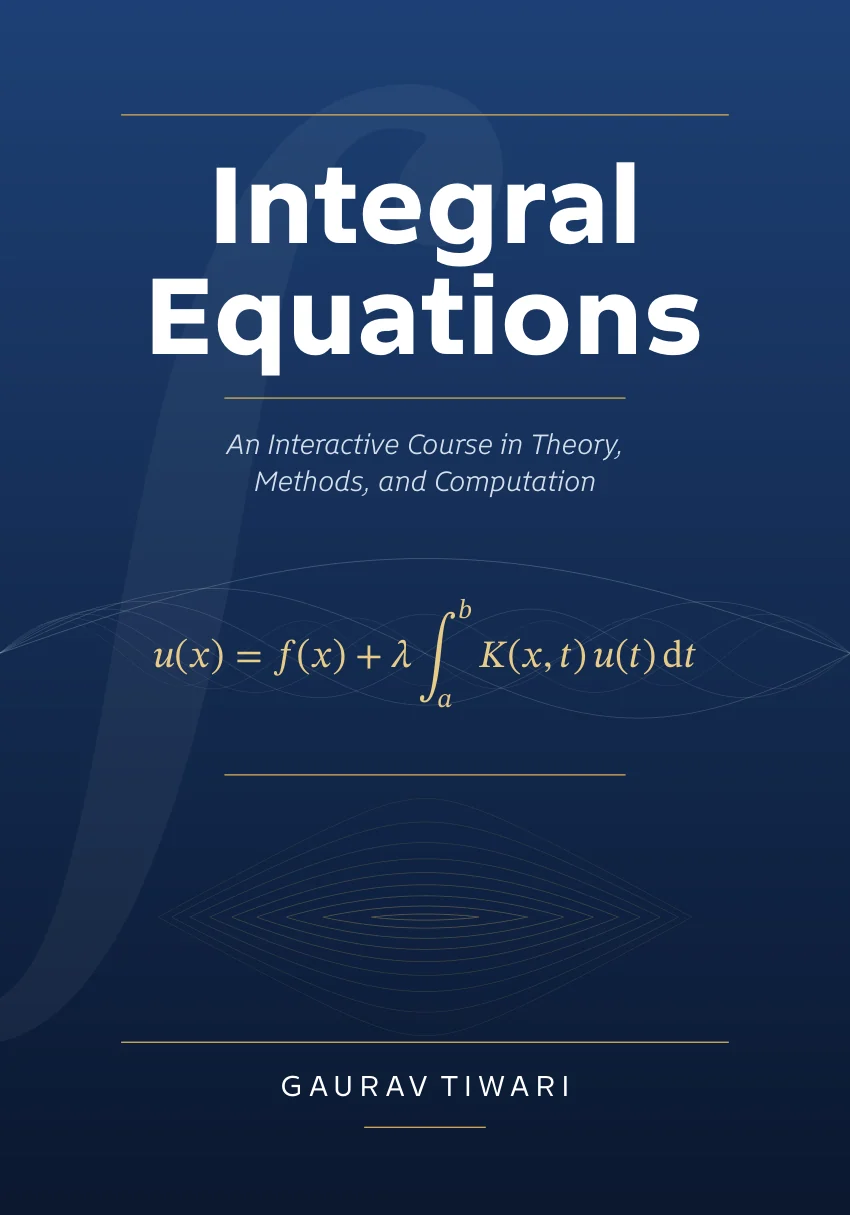
The Full Integral Equations Course
If you want problems to solve after the introduction, my premium Integral Equations book gives you a full course in theory, methods and computation.
- 24 chapters in 6 parts, from classical Fredholm and Volterra methods to spectral theory, numerical methods and regularization.
- 321 exercises with hints or answers, plus a free companion PDF with complete worked solutions to every exercise.
- 60 figures and diagrams to support the theory and calculations.
- 6 recurring benchmark problems, so you can compare different methods on equations you already know.
Keep Elements as a concise reference. Choose the full book when you want a structured course with exercises and more depth.
Available as Kindle and paperback through Amazon.

Hey, I’m Gaurav 👋
When I taught mathematics in 2013 and 2014, integral equations was the course where prepared students still got lost, usually because the functional analysis underneath was assumed instead of taught. This book puts that foundation in chapter two, before anything depends on it.
The background that matters for this book:
- M.Sc. in Mathematics, and the 2014 course notes this book grew out of
- Degree-level mathematics teaching in 2013 and 2014, where these gaps kept showing up
- Mathematics notes published online since 2008, 18 years of writing and errata-fixing on the web
Start at the classification, end at Green’s functions.
One structured pass through the subject, 26 worked examples included. The download costs a click.
Free PDF · direct download · no email, no checkout
From the Workbench
Notes on WordPress, publishing, search, and independent products, sent when something real comes off my bench.