
Use this break-even point calculator to find break-even units, revenue, contribution margin, and margin of safety from costs and selling price.
Calculate contribution margin, break-even units and revenue, and the margin of safety.
Your result
This break-even point calculator shows the sales units and revenue needed to cover costs. It also calculates contribution margin and the margin of safety at your expected sales volume.
The formula is simple. The quality of the result depends on whether fixed, variable, and owner costs are classified honestly.
Break-even formulas
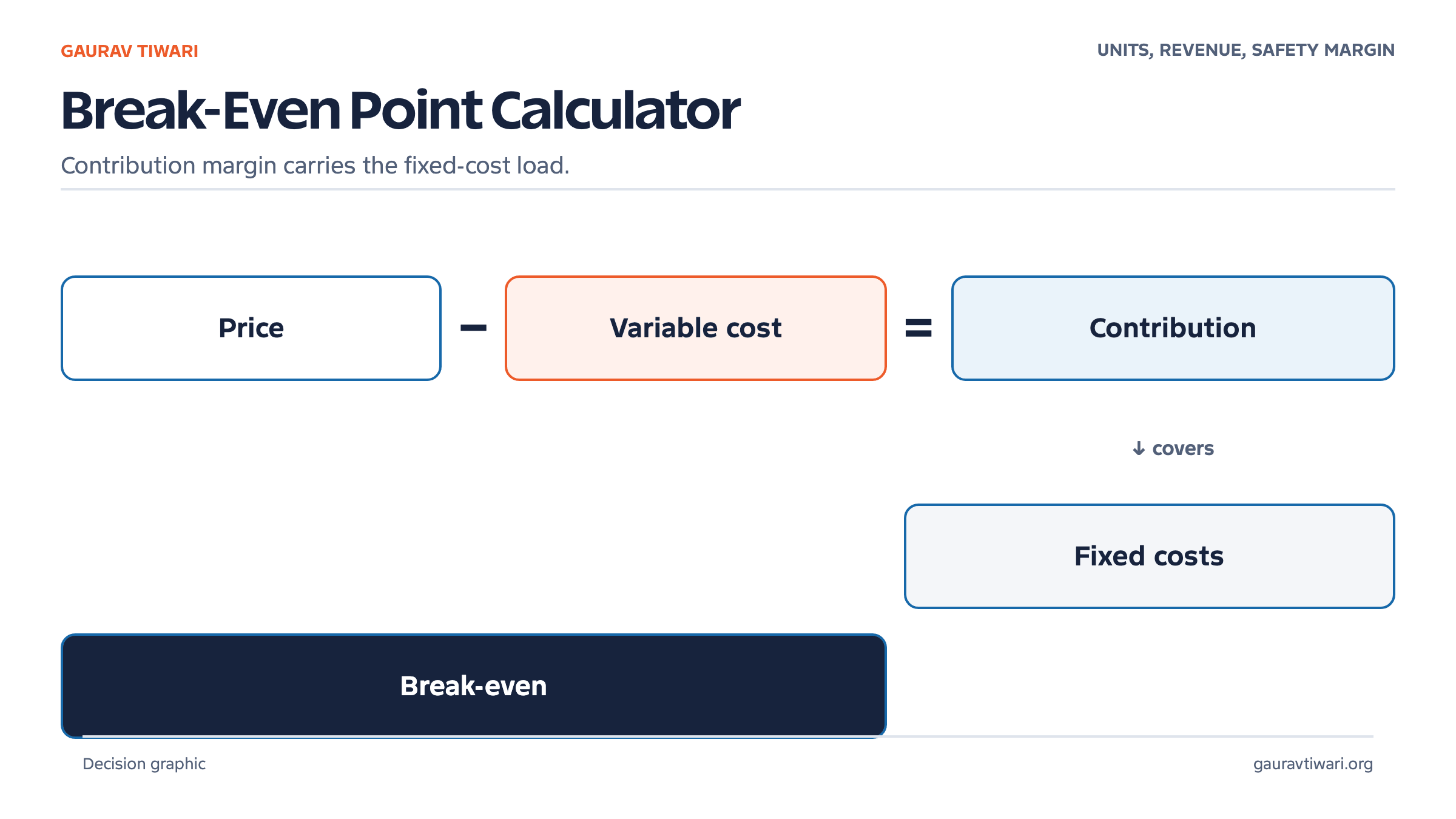
Break-even units = fixed costs / (price per unit – variable cost per unit).
Break-even revenue = break-even units x price per unit.
The break-even point calculator treats price minus variable cost as contribution margin per unit. If that number is zero or negative, selling more cannot cover fixed costs.
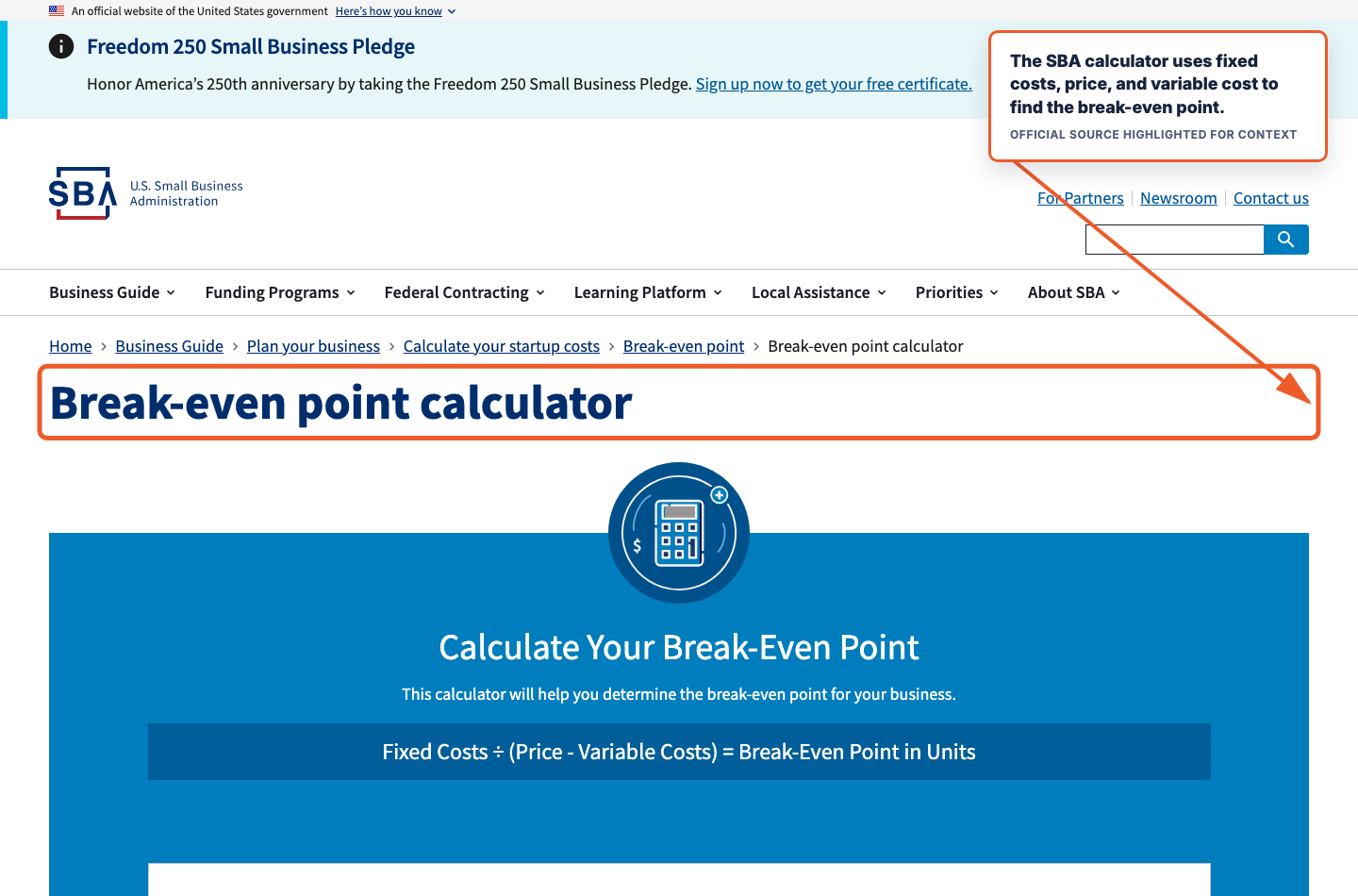
The formulas match the method used by the U.S. Small Business Administration: Break-even point calculator.
What counts as fixed and variable cost?
| Cost type | Examples | Test |
|---|---|---|
| Fixed | Base rent, core salaries, insurance, software minimums | Does it stay roughly unchanged within the sales range? |
| Variable | Materials, shipping, payment fees, sales commissions | Does it rise with each unit or sale? |
| Semi-variable | Overtime, tiered software, utilities, fulfillment minimums | Does it change after a threshold? |
A worked example
- Monthly fixed costs: $12,000.
- Price per unit: $80.
- Variable cost per unit: $32.
- Contribution margin per unit: $48.
- Break-even point: 250 units.
- Break-even revenue: $20,000.
At 300 expected units, the margin of safety is 50 units, or about 16.7%. That buffer can disappear quickly if discounting lowers the average selling price.
The costs most businesses forget
- A realistic owner salary or draw.
- Returns, refunds, and payment-processing fees.
- Customer support and fulfillment labor that rises with volume.
- Warranty, rework, or bad-debt allowance.
- Marketing spend needed to produce the expected sales.
- Tax and financing costs when the decision depends on them.
Do not use a break-even result as proof that demand exists. It tells you what must be sold, not whether customers will buy it.
Run sensitivity checks before a decision
Run the break-even point calculator for at least three cases: current price, a discounted price, and a higher variable cost. The result will show which assumption carries the most risk.
For a full operating plan, use the published business budget guide after checking the unit economics here.
Frequently asked questions
What is the break-even point formula?
Break-even units equal fixed costs divided by price per unit minus variable cost per unit.
What if variable cost is higher than price?
The contribution margin is negative, so there is no finite break-even volume. Price, variable cost, or the offer must change.
Should owner salary be included in fixed costs?
Yes if the business must support that pay level. Excluding owner labor can make an unsustainable model look viable.
What is margin of safety?
It is expected sales minus break-even sales, often shown as units and as a percentage of expected sales.
The next step
Run the break-even point calculator with a base case, a lower selling price, and a higher variable cost. If the decision fails under a plausible second case, the model needs work before you commit.