
 by
by
Most TikTok marketing strategies fail for a simple reason: they chase formats before choosing an audience and a useful promise. TikTok can surface a small account beyond its follower base, but only when people watch, share, search, or return for more.
The practical approach is to build for three surfaces at once: the For You feed, TikTok Search, and the path from a video to a profile, shop, website, or email list. These 12 TikTok marketing strategies turn that idea into a weekly system you can measure and repeat.
Why TikTok Marketing Still Matters
TikTok is useful because discovery isn’t limited to people who already follow you. TikTok says follower count and past viral videos aren’t direct recommendation factors, although a larger follower base can still create more initial views.
That makes TikTok valuable for a focused small business. A useful video can reach new viewers through the For You feed, appear for a specific search, and send an interested person to the next step. The catch is that reach without a clear offer or owned destination is rented attention. The strongest TikTok marketing strategies connect discovery to that next step.
- Discovery: reach people outside your follower list.
- Search: answer a query people already type into TikTok.
- Community: turn comments and replies into the next video.
- Conversion: move qualified viewers to a profile action, product, or email list.
TikTok explains its recommendation system in its official recommendation guide. That documentation is a better foundation than recycled claims about a secret viral formula.
How the TikTok Recommendation System Works
TikTok recommends content using three broad groups of signals: user interactions, information about the content, and information about the viewer. The weight changes by surface and over time, so fixed percentage charts and claims about a 200-person test batch shouldn’t drive your plan.
- User interactions: watches, full views, skips, likes, shares, comments, follows, and searches.
- Content information: the topic, caption, sounds, hashtags, location, and other details TikTok can understand.
- User information: language, country, device, time zone, and account settings.
For the For You feed, watch behavior and other interactions often matter more than device settings. For search, TikTok says the match between the content and the query usually carries more weight. That leads to a simple rule: make the topic obvious, deliver the answer quickly, and cut anything that gives viewers a reason to skip.
What doesn’t work: treating likes as the only signal, copying a trending format with no audience fit, or assigning fake weights to ranking factors TikTok hasn’t quantified.
TikTok SEO: How to Get Found in Search
TikTok SEO helps a video appear when someone searches for a problem, product, place, or how-to. TikTok’s own Creator Search Insights tool shows popular topics, content gaps, related searches, and search performance for your posts.
Here’s how to optimize your TikTok content for search:
Keyword research for TikTok
Start with Creator Search Insights. Compare a topic’s search popularity with its content gap, then use TikTok autocomplete to capture the exact wording people use. Cross-check a promising phrase with Semrush only when the same topic could also earn Google traffic.
For each piece of content, target one primary keyword phrase. Don’t try to rank for everything in a single video.
Where to place keywords
- Caption text. Include your target keyword naturally in the first line of your caption. TikTok’s AI reads this.
- On-screen text. Add text overlays that include your keyword. TikTok’s OCR (optical character recognition) reads these.
- Spoken words. TikTok transcribes your audio automatically. Say your keyword out loud in the video.
- Hashtags. Use 3-5 relevant hashtags that include your keyword and related terms. Don’t stuff 30 hashtags, it looks spammy and doesn’t help.
Think of TikTok SEO like you’d think about optimizing blog posts for search. Match user intent, deliver value quickly, and make it clear what your content is about within the first 2 seconds.
TikTok Shop and the Conversion Path
TikTok Shop can shorten the path from demonstration to purchase, but its features, eligibility, and market availability change. Treat the shop as one possible conversion surface, not the foundation of the whole content strategy.
- Choose a product that can be understood visually in a few seconds.
- Show the problem, the product in use, and the result without hiding a material limitation.
- Use the product tag or shop feature only if the account and market are eligible.
- Track product clicks, completed orders, refunds, and contribution margin, not views alone.
Check the current rules in the TikTok Shop Seller Center before publishing market-specific setup advice. If Shop isn’t available, send viewers to one focused landing page instead of a crowded homepage.
12 TikTok Marketing Strategies That Work in 2026
The list starts with audience fit and watch behavior, then moves to production, community, distribution, and measurement.
1. Hook viewers in the first 1-2 seconds
Useful opening formats include a direct promise, a visible problem, a result shown before the explanation, or a question the viewer already wants answered.
- “Stop scrolling if you…” followed by a specific pain point
- Starting with the result, then showing the process (reverse order)
- On-screen text with a bold claim that creates curiosity
- POV format that puts the viewer in a situation they relate to
Don’t waste the first 3 seconds on a logo animation or intro. Get to the point immediately. The brands that do this well consistently see 60%+ video completion rates.
2. Post consistently (but quality beats quantity)
The ideal posting frequency in 2026 is 1-3 videos per day for growth phase, and 3-5 per week for maintenance. But here’s what matters more than frequency: don’t post filler content just to hit a number. One great video that gets 500K views is worth more than 30 mediocre clips that get 200 views each.
Check the best times to post on TikTok for your specific audience. TikTok Pro analytics shows you when your followers are most active, and posting during those windows gives your content the best initial push.
3. Leverage trending sounds and formats
Trends still matter on TikTok, but the approach has changed. In 2021, you could jump on any trending sound and get views. Now, the algorithm rewards creators who add original value to trends rather than just copying them.
The strategy: take a trending sound or format and adapt it to your niche. If there’s a trending “day in the life” format, do a “day in the life” of your product’s customer. If a comedic sound is trending, use it to highlight a real pain point your product solves.
Check TikTok’s Creative Center (ads.tiktok.com/business/creativecenter) for trending sounds, hashtags, and creator videos. This is the most underused free tool TikTok offers.
4. Use TikTok for competitor research
Use this competitor-research process:
- Find 5-10 competitors or similar accounts in your niche
- Sort their videos by “Most Liked” (go to their profile, tap the sort icon)
- Analyze the top 10 videos from each: what format, hook, length, and topic performed best?
- Look at their comment sections for audience questions and feedback
- Create your own version that’s better, more specific, or targets a slightly different angle
Use hashtag analytics tools to track which hashtags your competitors use most and which ones drive the most engagement in your niche.
5. Build a content series
Content series are TikTok’s version of appointment viewing. Instead of random one-off videos, create a recurring format that people look forward to. Examples that work well:
- “Myth or fact” series about your industry
- “Tool of the week” reviews
- “Behind the scenes” of your business
- “Reply to comments” where you answer audience questions in video format
Series keep people coming back to your profile, which builds follower loyalty and signals to the algorithm that your account produces consistent value.
6. Go live regularly
TikTok Live gets a visibility boost from the algorithm because TikTok wants to promote real-time engagement. Live streams appear at the top of followers’ feeds and in the dedicated Live tab.
For brands, Live is especially powerful for product demonstrations, Q&A sessions, and live shopping events. TikTok Shop integrations during live streams let viewers purchase products with a single tap while watching. Some TikTok Shop sellers generate 50-70% of their revenue from live streams alone.
Minimum viable live strategy: go live once a week for 30-60 minutes during peak hours. Have a loose agenda, engage with every comment, and pin your best product or CTA.
7. Collaborate with creators (not just influencers)
The distinction matters. Traditional influencer marketing often means paying someone with a large following to post about your product. On TikTok, the most effective collaborations are with smaller creators (10K-100K followers) who have high engagement rates and niche audiences.
Choose creators by audience fit, recent content quality, credible comments, brand safety, usage rights, and measurable outcomes. A smaller relevant creator can be more useful than a large account whose audience doesn’t match the offer.
Use TikTok’s Creator Marketplace to find creators in your niche. You can filter by audience demographics, engagement rate, content category, and location.
8. Use TikTok Ads strategically
TikTok’s ad platform has matured considerably. The ad formats that deliver the best ROI in 2026:
- Spark Ads. Boost your own organic content or a creator’s post as an ad. This is the best-performing format because it looks native and carries social proof (likes, comments, shares).
- In-Feed Ads. Standard ads in the FYP. Works well for direct response if your creative is strong.
- TikTok Shop Ads. Product-specific ads that drive directly to checkout. Conversion rates are high because the purchase happens inside TikTok.
- Lead Generation Ads. Built-in lead forms so users don’t leave TikTok. Good for service businesses and B2B.
The key with TikTok ads: don’t make them look like ads. The best-performing paid content is indistinguishable from organic TikTok content. Use UGC-style creative, real people, and natural lighting. Polished, corporate-looking ads consistently underperform on TikTok.
9. Optimize your profile for conversion
Your TikTok profile is your landing page. When someone discovers your video on the FYP and visits your profile, you have about 3 seconds to convince them to follow or click your link.
- Bio: One clear sentence about what you do + who you help. No emojis overload.
- Profile picture: Your face (for personal brands) or clean logo (for businesses). Avoid text-heavy images.
- Link in bio: Use a link in bio tool that lets you feature multiple destinations. Send people to your shop, email list, or best-performing content.
- Pinned videos: Pin your 3 best-performing or most important videos at the top of your profile grid.
10. Interact with your audience (comments are content)
Comments on TikTok aren’t just engagement metrics. They’re content opportunities. TikTok’s “Reply to Comment with Video” feature lets you create new videos that directly respond to questions or feedback from your audience.
Reply-to-comment videos work because the question supplies both the topic and the audience language. They also show that the account is listening.
Dedicate 15-20 minutes after posting to reply to early comments. This signals to the algorithm that the video is generating conversation, which helps push it to more people.
11. Cross-promote and repurpose content
Every TikTok video you create should live on multiple platforms. The same short-form video can work on Instagram Reels, YouTube Shorts, LinkedIn (yes, short video works there), and Pinterest Idea Pins.
Always download your TikTok videos without the watermark before uploading to other platforms. Instagram and YouTube actively suppress content with TikTok watermarks. Use CapCut for editing, as it natively exports clean video files without watermarks.
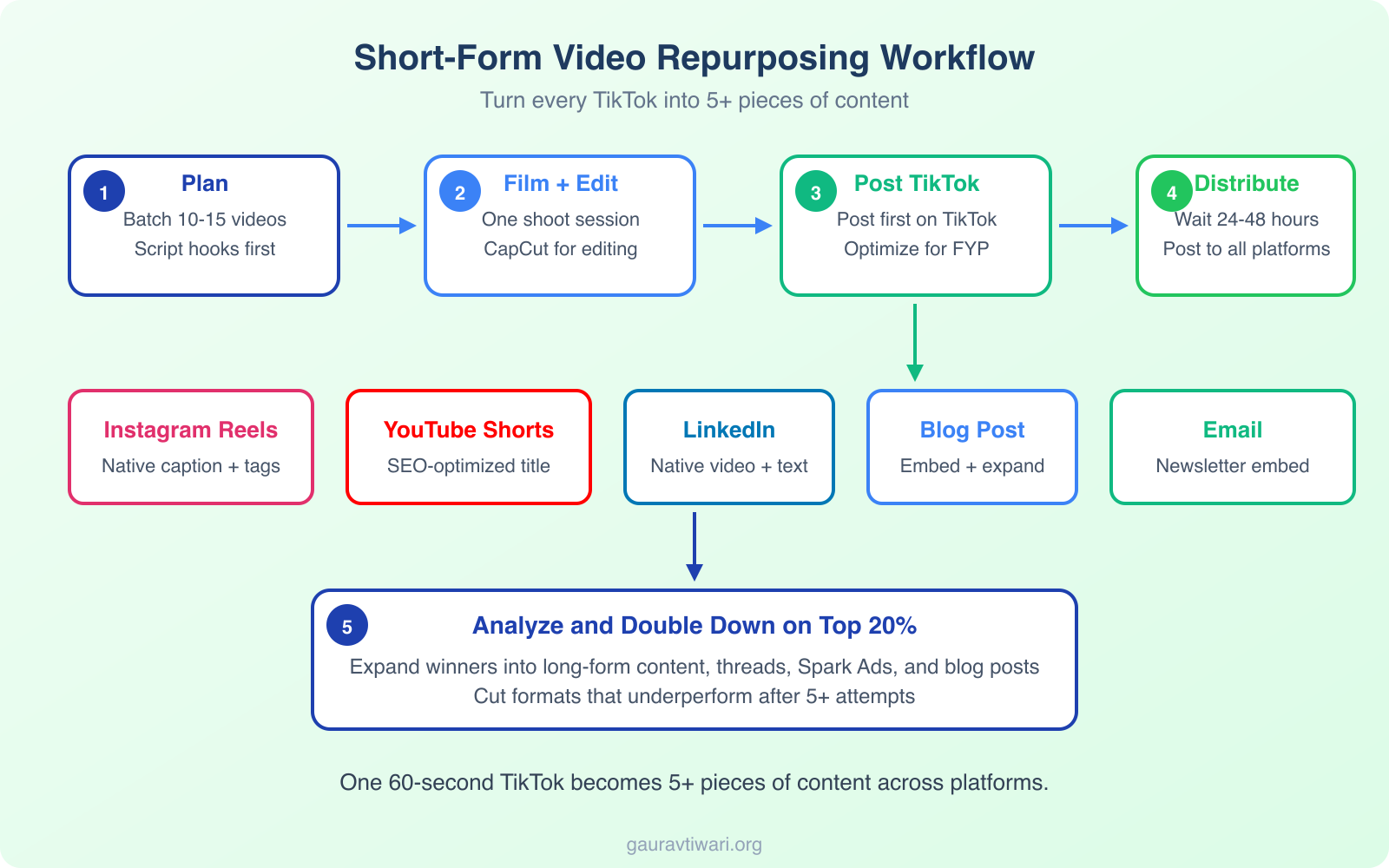
Use this repurposing workflow:
- Create a clean vertical master at the length required to deliver one complete idea
- Export without watermark via CapCut or download before posting
- Post to Instagram Reels with Instagram-native caption and hashtags
- Upload to YouTube Shorts with a keyword-optimized title
- Share to LinkedIn as native video with a text post for context
- Embed on your blog post or create a blog article around the video topic
One 60-second TikTok video can become 5+ pieces of content across platforms. That’s how you maximize ROI on every video you produce. For more on this approach, check my guide on content distribution.
12. Track analytics and iterate
TikTok Studio provides the account-level evidence needed to improve the strategy. Start with watch behavior, traffic source, shares, profile actions, and conversions:
- Average watch time. This tells you if your hooks and content are holding attention. Aim for 70%+ of video length.
- Profile visits from videos. High profile visits mean people are curious about your brand. If this is low, your videos aren’t creating enough interest in who you are.
- Qualified follower growth. Compare which topics bring followers who return, engage, and take the intended next step.
- Share rate. The percentage of viewers who share your video. This is the strongest predictor of virality.
- Traffic source breakdown. Shows whether views come from FYP, search, following feed, or profile. If search is growing, your TikTok SEO is working.
Review your analytics weekly. Double down on content formats that drive high watch time and shares. Cut formats that consistently underperform after 5+ attempts.
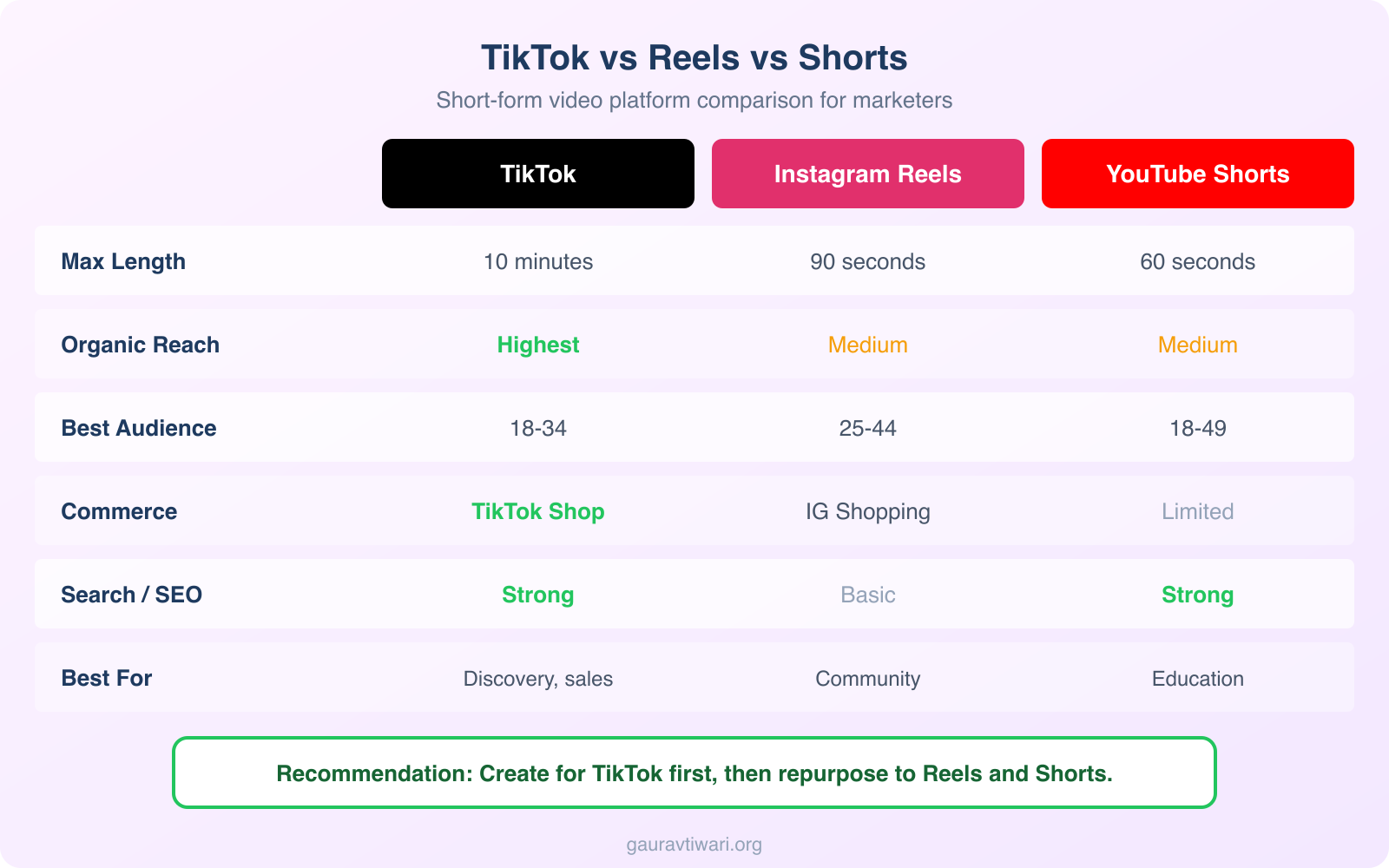
TikTok vs Instagram Reels vs YouTube Shorts
Choose the first platform by audience and business path, not by a universal winner. The same clean vertical master can work across all three, but the discovery surface and useful next action differ.
| Platform | Discovery strength | Best next step | Use it first when |
|---|---|---|---|
| TikTok | For You and TikTok Search | Profile, shop, website, or follow | Fast topic testing and native discovery matter most |
| Instagram Reels | Reels, Explore, Search, and existing relationships | Profile, DM, product, or website | The brand already uses Instagram for community or commerce |
| YouTube Shorts | Shorts feed, Search, and the wider YouTube catalog | Related video, channel, or website | Short videos should support searchable long-form content |
Don’t compare raw view counts across platforms as if they use the same definition or audience. Compare engaged viewing, followers or subscribers, qualified visits, leads, sales, and the work required to produce each result.
Video Creation Tools for TikTok Marketing
You don’t need expensive equipment or a production team to create TikTok content. A smartphone with good lighting is enough to start. But as you scale, the right tools save hours of editing time.
Editing tools
- CapCut supports captions, templates, reframing, and fast mobile edits. Check the current free and paid feature split before choosing it for a recurring workflow.
- InVideo AI is excellent if you want to generate videos from text prompts. Give it a script or topic, and it produces a complete video with stock footage, text overlays, and voiceover. Great for repurposing blog content into TikTok videos quickly.
- Canva Video works well for animated text videos, carousel-style content, and branded templates. The drag-and-drop interface makes it accessible for non-designers.
Equipment essentials
For 90% of TikTok creators, this is all you need:
- A phone with a decent camera (iPhone 13+ or equivalent Android)
- A ring light or desk lamp for consistent lighting ($20-50)
- A clip-on microphone for clear audio ($15-30)
- A simple tripod or phone mount ($15-25)
Total investment: under $100. The content matters far more than production quality on TikTok. A well-lit, clearly audible video shot on a phone outperforms a poorly scripted video shot on a $3,000 camera.
Short-Form Video Repurposing Workflow
The smartest TikTok marketers don’t just post and hope. They build a system that turns every video into multiple assets across platforms. Here’s the workflow I recommend for maximizing output from your TikTok content:
Step 1: Plan content in batches
Set aside one day per week (or two days per month) to film 10-15 videos at once. This is more efficient than creating one video per day. Script your hooks and talking points in advance. Having a content marketing strategy prevents the “what should I post today?” problem.
Step 2: Film and edit
Film all videos in the same session. Change your shirt between takes if you don’t want them to look batched. Edit in CapCut: add captions (TikTok’s auto-captions are good, but CapCut’s are more customizable), on-screen text, and trending sounds.
Step 3: Post and distribute
Post the TikTok version first. Wait 24-48 hours (to let TikTok’s algorithm fully distribute it), then post the same video to Instagram Reels and YouTube Shorts. This staggering avoids platform cross-detection and gives each version time to perform independently.
Step 4: Repurpose top performers
After a week, check which TikToks performed best. Take the top 20% and:
- Expand into a full blog post or tutorial
- Turn the script into a Twitter/X thread or LinkedIn post
- Create a longer YouTube video expanding on the topic
- Include the video in your email newsletter
- Use the best clip as a Spark Ad
This approach means you’re always putting resources behind content that’s already proven to resonate with your audience.
Common TikTok Marketing Mistakes to Avoid
These mistakes weaken otherwise useful TikTok marketing strategies:
- Making ads, not content. If your TikTok looks like a TV commercial, it will get scrolled past immediately. Think “value first, promotion second.”
- Ignoring trends entirely. You don’t have to chase every trend, but completely ignoring them means missing easy visibility boosts.
- Posting inconsistently. The algorithm rewards consistency. Going viral once and then disappearing for two weeks kills your momentum.
- Not using captions. 80% of TikTok is watched with sound off in certain contexts (commuting, at work). Auto-captions are non-negotiable.
- Buying followers or engagement. Fake activity violates platform rules, distorts your audience signals, and makes the account harder to evaluate.
- Only posting product content. Follow the 80/20 rule: 80% educational, entertaining, or relatable content. 20% promotional.
- Neglecting TikTok SEO. Make the searched topic clear in the spoken answer, on-screen text, caption, and relevant hashtags so TikTok can match the video to the query.
Frequently Asked Questions
What are the best TikTok marketing strategies for a small business?
Start with one audience, one repeated content series, and one conversion action. Use TikTok Search to choose topics, make the subject clear in the opening seconds, and review watch time, skips, shares, profile visits, and conversions each week.
How does TikTok decide what to recommend?
TikTok says its systems use user interactions, content information, and user information. Watch behavior often carries more weight in the For You feed, while content-query relevance is especially important in search.
How often should a business post on TikTok?
There is no universal posting quota. Choose a pace you can sustain without lowering the usefulness of each video, then compare performance by format and topic over several weeks.
Do hashtags help TikTok SEO?
Relevant hashtags can help TikTok understand the topic, but they don’t replace a clear spoken answer, on-screen text, a descriptive caption, and strong watch behavior. Use only the hashtags that accurately classify the video.
Should I post the same video to TikTok, Reels, and Shorts?
Reuse the same clean vertical master, but adapt the first seconds, caption, sound, and call to action for each platform. Avoid visible watermarks and compare each format using its own analytics.
Is TikTok Shop available everywhere?
No. TikTok Shop availability, seller eligibility, and features vary by market and account. Check the current Seller Center documentation for your country before planning a shop-led campaign.
Start Building Your TikTok Strategy Today
TikTok marketing in 2026 comes down to three things: understand the algorithm, create content people want to watch, and build a system for consistent output. The brands that treat TikTok as a “nice to have” are getting outpaced by those who treat it as a primary marketing channel.
Start with the basics. Set up your profile properly, research your competitors, and commit to posting 3-5 times per week for 30 days. Track what works and iterate. Use CapCut for editing, repurpose your best-performing content across platforms, and don’t be afraid to experiment with new formats.
The opportunity on TikTok is real, and it won’t stay this accessible forever. As more brands invest and ad costs rise, the advantage goes to those who started building their presence early.
Tell Google you want more of this.
Add Gaurav Tiwari as a preferred sourceOne tap, and this site shows up more often in your own Top Stories, AI Overviews and AI Mode. Remove it any time.
Disclaimer: This site is reader-supported. If you buy through some links, I may earn a small commission at no extra cost to you. I only recommend tools I trust and would use myself. Your support helps keep gauravtiwari.org free and focused on real-world advice. Thanks. - Gaurav Tiwari