
79 Internet Marketing Statistics in 2026 that Might Change the Way You Think
Numbers don’t lie, but they do surprise. Every year I dig through the latest internet marketing research, and every year a few statistics completely change how I think about strategy. These aren’t just interesting data points. They’re signals that tell you where to invest your time and budget in 2026.
I’ve gathered 50 of the most compelling numbers across SEO, PPC, content marketing, social media, email, and e-commerce. Whether you’re a marketing pro or a business owner trying to figure out where your next dollar should go, these statistics will give you clarity.
Digital Marketing Landscape
The big picture tells a clear story: digital marketing isn’t just growing, it’s dominating.
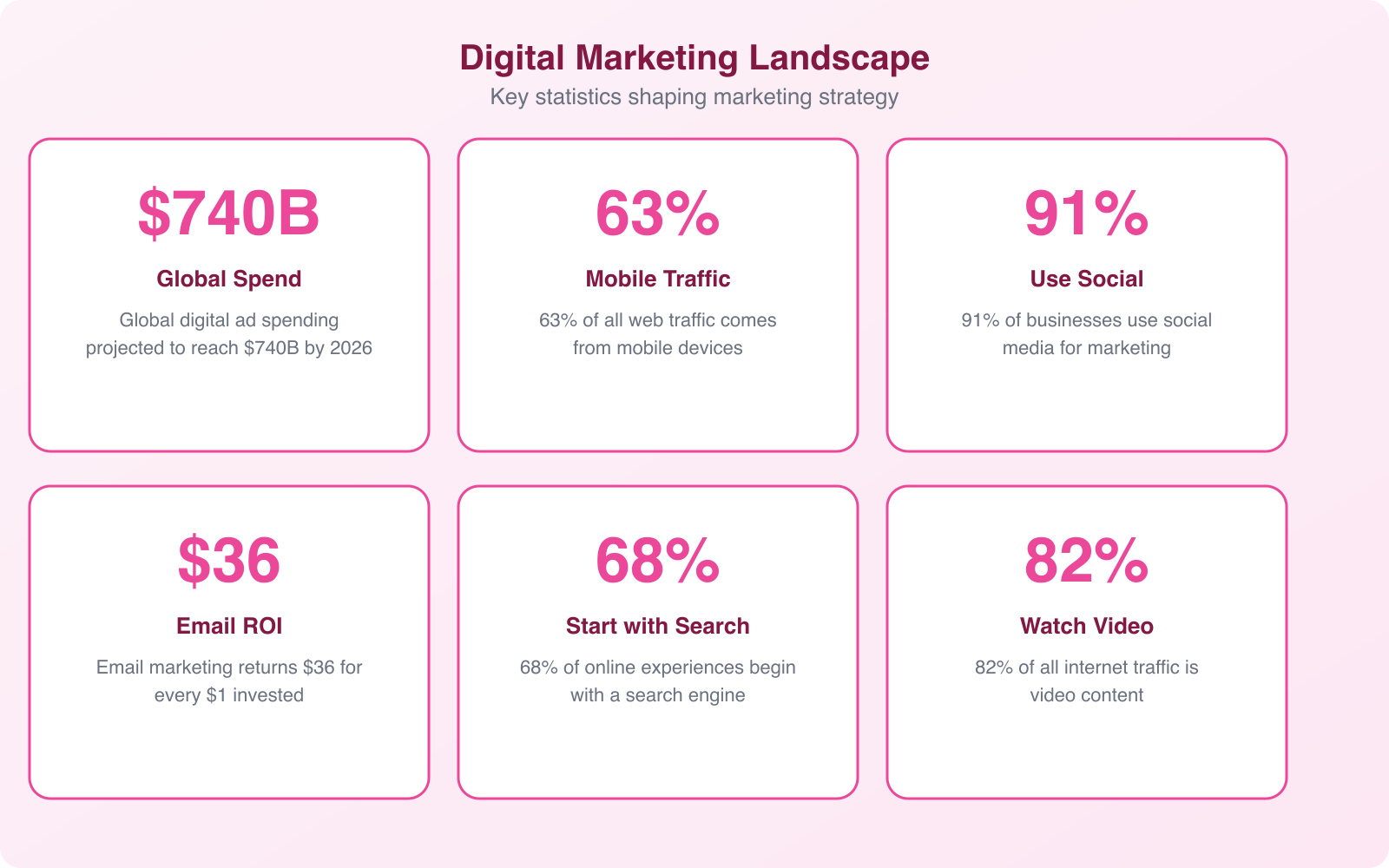
- Global digital advertising and marketing spending is projected to exceed $870 billion by 2026, up from $350 billion in 2020.
- Digital ads now account for over 73% of total global advertising spend, with traditional media continuing to shrink.
- The digital marketing industry’s compound annual growth rate sits at approximately 9-11% through 2026.
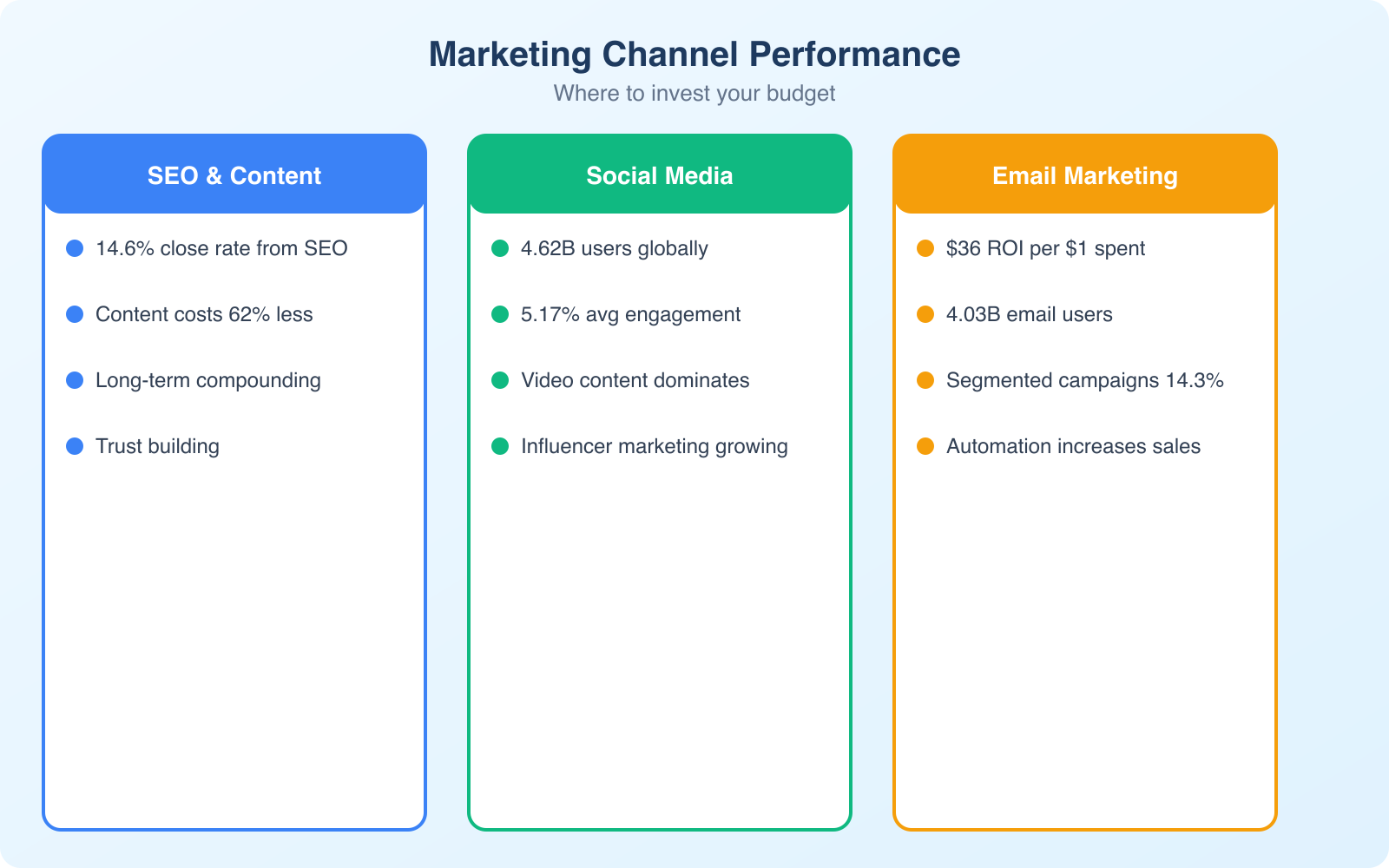
- Email marketing generates $36-42 for every $1 spent, making it the highest-ROI marketing channel available.
- Over 5.5 billion people are actively online, representing roughly 68% of the global population.
The $36-42 ROI on email marketing is an average. Businesses with segmented email lists and automated sequences routinely see $50-70 returns per dollar. If you’re not segmenting your email list, you’re leaving money on the table.
Video Marketing
Video has moved from “nice to have” to “table stakes” for businesses of all sizes.
- 93% of businesses now use video as a marketing tool, up from 91% in 2023.
- 87% of video marketers say video has directly increased traffic to their website.
- Short-form video (under 60 seconds) generates 2.5x more engagement than long-form content on social platforms.
- 42% of video marketers spend less than $500 on an average video, proving you don’t need Hollywood budgets.
- Video on landing pages can increase conversions by up to 86%.
Mobile and Social Media
Mobile isn’t the future. It’s been the present for years. If your marketing isn’t mobile-first, you’re missing the majority of your audience.
- 5.6 billion people use mobile phones globally, representing 70% of the world’s population.
- Social media marketing’s global market size has surpassed $85 billion.
- Over 93% of businesses use social media for marketing in some capacity.
- Facebook maintains 3+ billion monthly active users, making it the largest platform by reach.
- 73% of B2B buyers say they’re more receptive to salespeople who reach out through LinkedIn.
- 90% of Instagram users follow at least one business account on the platform.
- TikTok users spend an average of 52 minutes per day on the app, the highest of any social platform.
SEO and Content Marketing
SEO remains the most cost-effective long-term marketing strategy. Content marketing amplifies it.
- Websites that maintain active blogs see a 55% increase in visitor numbers compared to those without blogs.
- 49% of businesses say organic search delivers the best marketing ROI of any channel.
- SEO generates more than 10x the search traffic compared to organic social media marketing.
- 92% of potential buyer traffic is captured by businesses on the first page of search results.
- Content marketing generates 3x more leads at 62% less cost than traditional advertising.
- Long-form content (2,000+ words) receives 77% more backlinks than short-form articles.
- The average first-page Google result contains 1,447 words.
Email Marketing
Email is the quiet workhorse of digital marketing. It doesn’t get the hype of social media, but it consistently outperforms everything else in ROI.
- The email marketing industry is projected to reach $17.9 billion by 2027, up from $9.62 billion.
- The average ROI for email marketing is $36 for every $1 spent, with top performers exceeding $50.
- 87% of businesses use email marketing to distribute content.
- Personalized subject lines increase open rates by 50%.
- Segmented email campaigns see 14.31% higher open rates than non-segmented ones.
- Automated email sequences generate 320% more revenue than non-automated emails.
E-commerce
Online shopping isn’t slowing down. The shift to e-commerce that accelerated during the pandemic has become permanent.
- Global e-commerce sales are projected to surpass $8 trillion by 2026.
- 95% of retail transactions are expected to take place online by 2040.
- 75% of consumers expect free shipping as standard.
- 44% of shopping cart abandonments are caused by shipping delays or high shipping costs.
- Mobile commerce accounts for 73% of total e-commerce sales globally.
Consumer Behavior and Preferences
Understanding how consumers make decisions online is the foundation of effective marketing.
- 63% of businesses increased their digital marketing budgets in the past year.
- 93% of people read online reviews before making a purchase.
- 49% of consumers want weekly promotional emails from their favorite brands.
- 70% of people actively ignore paid digital ads (ad blindness is real).
- 88% of consumers trust online reviews as much as personal recommendations.
Advertising and ROI
- PPC returns $2 for every $1 spent on average, though top-performing campaigns reach $8+ per dollar.
- Facebook Ads and Google Ads remain the paid channels with the highest reported ROI.
- Digital ads can increase brand awareness by 80%, even when users don’t click.
- The average cost per click across Google Ads industries is $2.69 for search and $0.63 for display.
Influence and Engagement
- 91% of consumers say a positive review influences their purchase decision.
- 82% of consumers are willing to buy based on a micro-influencer recommendation.
- The global influencer marketing industry is valued at over $24 billion in 2026.
- User-generated content gets 4x higher click-through rates than branded content.
Technology and Innovation
- Over 150 million consumers now use AR/VR tools for online shopping.
- Mobile devices account for 50% of B2B sales triggers.
- The SEO industry is worth over $90 billion globally.
- AI-powered marketing tools are used by 61% of marketers, up from 37% two years ago.
Challenges and Opportunities
Not everything is rosy. These statistics highlight where marketers are struggling and where opportunities exist for those willing to do the work.
- 90.63% of web pages receive zero organic traffic from Google. That’s not a typo. Over 90% of content gets no search traffic at all.
- Digital ad fraud costs advertisers over $20 billion annually.
- Less than 20% of marketers use landing page A/B testing to improve conversion rates.
- Only 33% of businesses have a documented content marketing strategy.
That 90.63% statistic should reframe how you think about content. Publishing more content isn’t the answer. Publishing better content that targets keywords with realistic competition levels is. One well-researched, well-optimized article that ranks on page 1 is worth more than 50 articles that sit on page 10.
Future Projections
These forward-looking statistics point to where the industry is headed.
- The generative AI market in marketing is expected to exceed $40 billion by 2028, fundamentally changing how content is created, personalized, and distributed.
- US businesses are allocating over $35 billion toward social video advertising in 2026.
- Global digital marketing investment is projected to approach $900 billion by 2027.
AI and Automation in Marketing
AI went from buzzword to business necessity faster than any marketing technology in history. The adoption curve has been steeper than social media’s was in 2010-2012.
- 88% of marketers now use AI tools daily, and 92% of businesses plan to invest in AI soon. Two years ago, that daily usage number was 37%.
- The AI marketing market hit $47.32 billion in 2025 and is growing at 36.6% CAGR, expected to reach $107.5 billion by 2028.
- Generative AI deployment in marketing surged 116% year-over-year, now covering 15.1% of all marketing activities versus 7% the year before.
- Organizations using AI in marketing report a 41% average revenue increase and 32% reduction in customer acquisition costs compared to traditional approaches.
- The top three AI use cases in marketing: email and newsletter copy (47%), text-based social media (46%), and video-based social media content (46%).
- Despite strong adoption, 74% of companies still struggle to achieve and scale value from their AI marketing initiatives. Buying AI tools is easy. Getting real ROI from them is a different game.
Podcast and Audio Marketing
Podcasting quietly became one of the most effective marketing channels while everyone was arguing about TikTok. The listener numbers and ad engagement rates explain why brands are pouring money into audio.
- 619 million people listen to podcasts worldwide in 2026, a 6.83% year-over-year increase. In the US alone, 158 million people are monthly listeners.
- Global podcast ad spending hit $4.46 billion in 2025 (up 10.95% from 2024) and is projected to reach $5.03 billion by 2027.
- 81% of podcast listeners actively pay attention to ads, and 95% have taken action after hearing one. No other ad format comes close to those attention numbers.
- 49% of podcasters now earn at least $1,000 per month, up from 36% in 2023. The creator economy in audio is maturing fast.
- 55% of the US 12+ population are now monthly podcast listeners, an all-time high. Active podcasts more than doubled year-over-year to 533,943 shows producing fresh content.
Local SEO
If your business serves a geographic area, local SEO might be the single highest-ROI marketing investment you can make. The conversion numbers are unlike anything else in digital marketing.
- 98% of consumers search online to find local businesses, up from 90% in 2019. If you don’t show up in local search, you functionally don’t exist for most potential customers.
- 76% of people who search “near me” visit a business within 24 hours, and 28% of those searches result in a direct purchase.
- Businesses in the Google Map Pack receive 126% more traffic than those ranked in organic positions 4-10. The Map Pack is now the most valuable real estate in local search.
- 88% of consumers who do a local search on their smartphone visit or call a store within the same day. Local search intent is among the highest-converting traffic in all of marketing.
- 40% of local business queries now trigger Google’s AI Overviews, fundamentally changing how businesses need to think about local visibility and content strategy.
Privacy and First-Party Data
The privacy landscape is reshaping how marketers collect, use, and think about data. The brands getting ahead of this shift are building a serious competitive moat.
- 67% of US adults have turned off cookies or website tracking to protect their privacy, and that number grows every year. Your audience is actively opting out of being tracked.
- 71% of publishers recognize first-party data as their key source of positive advertising results, up from 64% in 2024. 85% expect its importance to increase further in 2026.
- Safari and Firefox already block third-party cookies by default, affecting roughly 30% of web traffic. Contextual ads now match cookie-based behavioral targeting within 5-8% on click-through rates and conversion quality.
- Consent Mode v2 adoption exceeds 90% among EEA advertisers. Privacy enforcement fines have hit hundreds of millions of dollars for major violations. This isn’t theoretical anymore. It’s operational reality.
First-party data is the new competitive advantage. Build email lists, create accounts, and give people reasons to share their information directly with you. Every email address you collect is worth more than a thousand cookie-tracked visitors you can’t reach next year.
What These Statistics Mean for Your Strategy
Looking at these 50 statistics as a whole, a few clear themes emerge for your marketing strategy in 2026.
Email is underrated. With the highest ROI of any channel, email deserves more of your budget and attention. Build your list, segment it, and automate sequences. If you’re spending 80% of your time on social media and 20% on email, flip those numbers.
SEO compounds. While 90% of pages get no traffic, the ones that do generate consistent, free visitors for years. Investing in SEO today pays dividends for the next 3-5 years. No other channel offers that kind of compounding return.
Video is non-negotiable. With 93% of businesses using video and consumers clearly preferring it, you need a video strategy even if it’s just simple talking-head videos and screen recordings.
Trust is the ultimate asset. Reviews, word-of-mouth, and earned media consistently outperform paid advertising in consumer trust. Build systems that generate reviews and encourage sharing. The marketing that works best is the kind other people do for you.
AI is a multiplier, not a replacement. With 88% of marketers using AI daily but 74% struggling to scale its value, the winners aren’t the ones buying the most tools. They’re the ones integrating AI into workflows that already work. Use AI to do more of what’s proven, faster.
Own your audience data. With 67% of consumers blocking tracking and third-party cookies disappearing, first-party data is the new competitive moat. Every email subscriber, every account signup, every direct relationship you build is an asset that appreciates while cookie-based targeting depreciates.
Local SEO is criminally underused. When 76% of “near me” searches lead to a visit within 24 hours, any local business not investing in Google Business Profile and local content is leaving the highest-converting traffic on the table.
Frequently Asked Questions
What is the most effective digital marketing channel in 2026?
Email marketing and SEO consistently deliver the highest ROI. Email marketing returns an average of $36 for every $1 invested, making it the most cost-effective channel. Organic search (SEO) delivers compounding returns over time, with leads that close at 14.6% compared to 1.7% for outbound channels. For paid channels, Google Search Ads typically outperform social media ads for direct response. The most effective strategy combines email, SEO, and targeted paid ads rather than relying on any single channel.
How much should a small business spend on digital marketing?
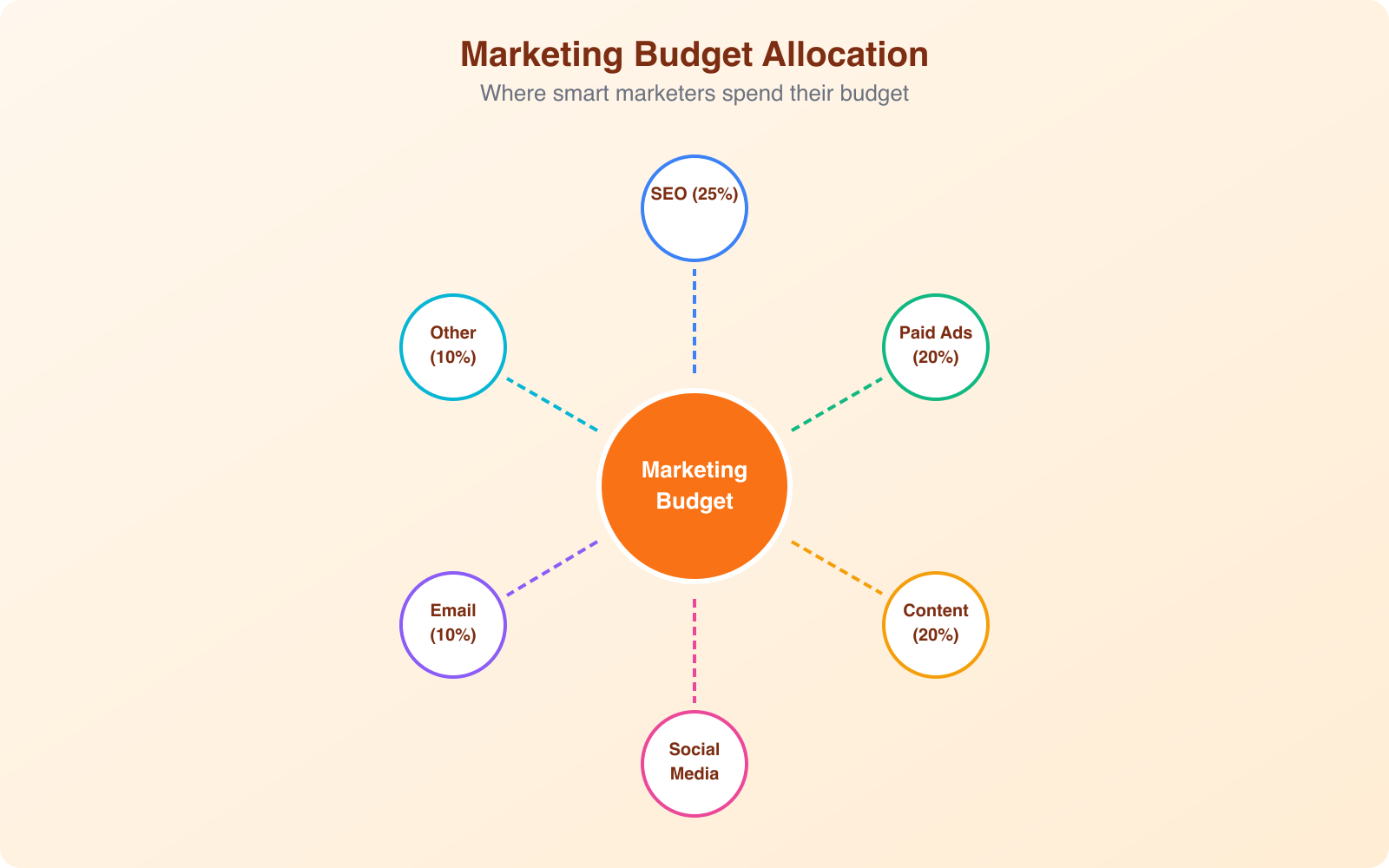
Small businesses should allocate 7-12% of gross revenue to marketing. For businesses earning under $5 million, the SBA recommends 7-8%. Newer businesses or those in competitive markets may need to invest 12-20% during growth phases. Within that budget, allocate roughly: 25% to SEO and content, 20% to paid advertising, 20% to social media, 15% to email marketing, and 20% to tools and technology. Adjust based on which channels deliver the best returns for your specific business.
Is SEO still worth investing in with AI search changing results?
Absolutely. While AI Overviews change how some search results appear, they don’t eliminate organic traffic. In fact, SEO leads remain among the highest-quality leads for most businesses. AI search actually increases the value of quality, authoritative content because AI models prefer citing well-structured, credible sources. The key is adapting your SEO strategy to include GEO (Generative Engine Optimization) alongside traditional tactics. Sites that optimize for both traditional and AI search are winning on both fronts.
What percentage of marketing budget should go to paid ads?
A common starting allocation is 20-30% of total marketing budget to paid ads, though this varies significantly. Early-stage businesses or those with limited organic presence may invest 40-50% in paid to drive immediate results while building organic channels. Established businesses with strong SEO and email lists can often reduce paid ad spend to 15-20%. The key metric is ROAS (Return on Ad Spend). If your paid campaigns consistently return 3x or more, it’s worth increasing the allocation.
How important is video marketing for small businesses?
Very important. Video content now accounts for over 80% of internet traffic, and consumers are 73% more likely to buy after watching a product video. Short-form video (Reels, Shorts, TikTok) doesn’t require expensive production. A smartphone, natural lighting, and authentic content often outperform polished productions. For small businesses, video testimonials, behind-the-scenes content, and product demonstrations deliver the best engagement. Start with one video per week and scale based on what resonates with your audience.
These 50 statistics paint a clear picture: the businesses winning in 2026 are the ones that invest in email marketing, SEO, and video while building trust through reviews and authentic content. The data doesn’t change based on opinions. It shows you exactly where the opportunities are. The question is whether you’ll act on it.
Sources
www.globaldata.com
www.forbes.com
www.precedenceresearch.com
www.mckinsey.com
www.statista.com
www.hubspot.com
www.semrush.com
www.ahrefs.com
www.litmus.com
www.mckinsey.com/ai
www.seo.com
salesgroup.ai
www.allaboutai.com
backlinko.com
www.brightlocal.com
seoprofy.com
secureprivacy.ai
adtelligent.com
www.learningrevolution.net
www.iab.com