
Going Mobile: The Future of Tabletop Gaming
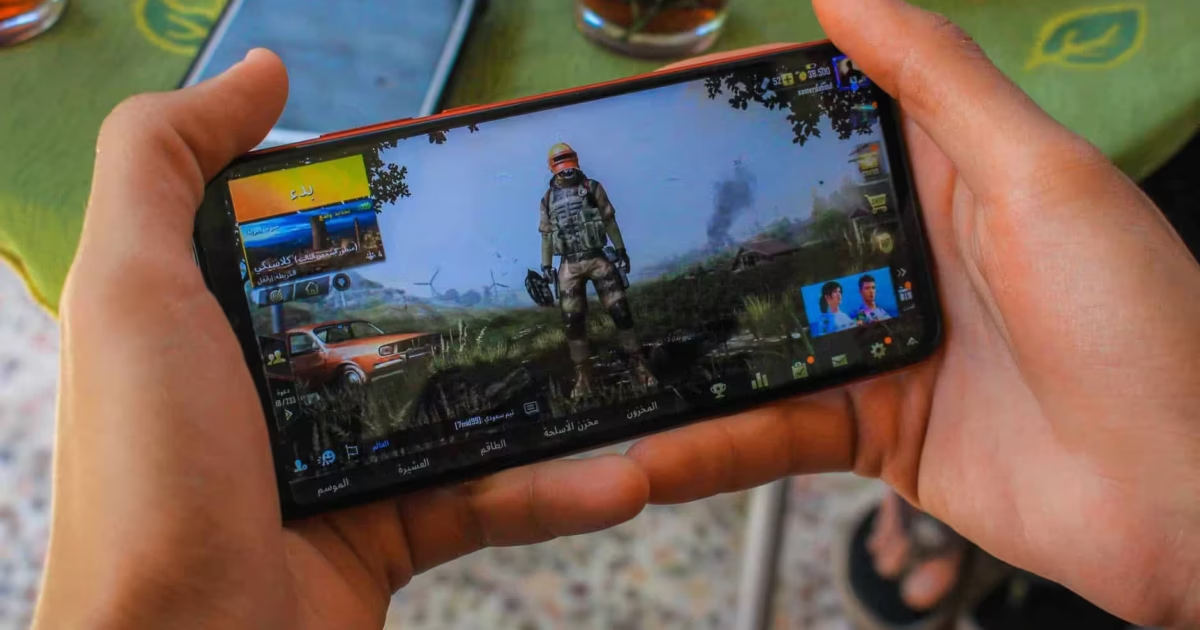
Tabletop gaming is going mobile, and the shift is reshaping how millions of people play. The board game market is set to hit roughly $17.45 billion in 2026, up from $15.83 billion in 2025, yet the fastest growth isn’t in cardboard alone. It’s in the apps, companion tools, and virtual tabletops that now sit beside the dice. After two decades watching games move from the dining table to the computer and now to the phone in your pocket, I’m convinced mobile is where most new players will meet tabletop gaming first.
Here’s my verdict up front. Mobile and digital tools are expanding tabletop gaming, not killing it. The phone handles the bookkeeping, the setup, and the solo nights. The physical table still owns the thing that matters most, which is people in a room reacting to each other. The future isn’t digital instead of physical. It’s both, stitched together.
What I’m working from: 18 years building and writing about web and software, plus a personal habit of running Mansions of Madness with the companion app and testing virtual tabletops like Roll20 and Foundry VTT for remote game nights. The board game market reaches $17.45 billion in 2026 (Fortune Business Insights), the tabletop RPG segment sits near $2.4 billion (Strategic Market Research), and Foundry VTT now supports 475 approved game systems, up 30% year over year. The numbers below are sourced, not guessed.
The case for mobile tabletop gaming
The move toward playing on a phone or tablet has drawn fair criticism, and some of it lands. Play a board game on a screen and you lose part of the ritual: the box, the shuffle, the reach across the table. But mobile carries real advantages that explain why digital tabletop adoption keeps climbing.
Modern tabletop games are heavy. A typical mid-weight box ships with miniatures, tokens, mats, reference cards, and a rulebook thick enough to prop a door. Those components add immersion, but they cost money and they get lost. The app version asks for one thing: your device. Everything else lives in software, including the parts that used to eat 20 minutes of setup. Smartphones and tablets are essentially pocket computers, so the audio and visuals hold up well, and newer features like augmented reality hint at experiences a cardboard board can’t match. The same arc played out in the video game industry, where hardware leaps quietly redefined what players expected.
There’s also a financial story under the hood. Building and shipping a quality app costs a fraction of manufacturing and warehousing plastic, which is why so many publishers now treat mobile app development as a core channel rather than a side project. Distribution is instant, updates are free, and a single download reaches a player anywhere.
What digital can’t replace: the in-person table
For all the convenience, there’s a hard limit to what a screen does, and I want to be honest about it. The reason people keep buying physical games in a $17 billion market is that the table is a social machine. The trash talk, the held breath before a dice roll, the friend who flips the board in mock outrage. None of that survives a clean digital port.
Solo and AI-assisted play is one of the fastest-growing segments of the tabletop RPG market precisely because it solves a scheduling problem, not a social one. When four adults can’t sync calendars, an app is better than not playing. But ask any group that’s done both, and they’ll tell you the in-person night is the one they remember. Digital tools earn their place by handling the boring parts so the human parts get more room, which is the opposite of replacement. The same principle shows up in how people learn best: tools that remove friction let the human element do the heavy lifting.
Hybrid games and companion apps
The most interesting work in tabletop right now isn’t digital versus physical. It’s hybrid, where a companion app runs alongside the cardboard. Fantasy Flight’s Mansions of Madness Second Edition is the clearest example. The app replaces the human game master, generates the map and monsters fresh each time, and turns a complex setup into a tap. Players keep the miniatures and the board. The phone just handles the rules engine.
That pattern is spreading. Gloomhaven’s digital helper trims more than 30 minutes off a session by managing the fiddly bookkeeping. Chronicles of Crime uses augmented reality to scan clues. One Night Ultimate Werewolf leans on an app to narrate the night phase so no one has to read from a script. These aren’t replacements for the board game. They’re the board game plus a tireless assistant.
Here’s how the main hybrid and digital tools break down by what they actually do:
| Tool type | Example | What it does | Keeps physical components? |
|---|---|---|---|
| Companion app | Mansions of Madness 2E | Runs the game master role, generates scenarios | Yes |
| Bookkeeping helper | Gloomhaven Helper | Tracks health, status, initiative | Yes |
| AR layer | Chronicles of Crime | Scans clues and locations via camera | Yes |
| Virtual tabletop (VTT) | Roll20, Foundry VTT | Full remote play with maps and tokens | No (fully digital) |
| AI game master | Friends & Fables, RoleForge | Narrates, runs combat, builds the world | No (fully digital) |
Virtual tabletops and the remote game night
When a group can’t meet in person, the virtual tabletop is where tabletop RPGs live now. A VTT is a shared digital board with maps, tokens, dice rollers, and automation, and the two names that dominate are Roll20 and Foundry VTT.
Roll20 is browser-based and free to start, which makes it the easy on-ramp for new groups. Foundry VTT is a one-time purchase you self-host, and it rewards the effort with deep automation and a huge modding community. Foundry now supports 475 approved game systems, a 30% jump in a year, and it won the community’s 2025 VTT poll with Roll20 in second. D&D Fifth Edition remains the gravity well, installed by 64.3% of Foundry users in 2025. If you want zero setup, start with Roll20. If you want to tinker and own your data, Foundry pays off.
AI in TTRPGs: what changed in 2026
What changed: The quality gap closed fast in 2025 and 2026. AI-generated character portraits, battlemaps, and tokens are now good enough for both virtual tabletop play and the in-person table. Full AI game masters like Friends & Fables ($0 to $39.95/mo) and RoleForge run narration, combat, and world state in real time, while prep tools like CharGen spin up NPCs, monsters with stat blocks, and dungeon layouts from a text prompt. The split is clear: most dungeon masters want prep assistants, not a replacement at the head of the table.
This is the frontier worth watching. AI in tabletop gaming isn’t one thing. It’s two. The first is the AI game master that runs a solo or small-group session end to end, which matters most for players who can’t field a full table. The second, and the one I think wins long-term, is the prep assistant that hands a human game master a finished NPC, map, or loot table in seconds. That’s the same way AI is reshaping software products everywhere: not by replacing the expert, but by removing the grunt work around them.
Crowdfunding shows the appetite. Brandon Sanderson’s Cosmere RPG raised $15.1 million on Kickstarter in 2024, the highest-funded tabletop project of all time, and rival platform Gamefound grew project funding 49% to more than $85 million the same year. The money is flowing toward ambitious, often digitally-enhanced tabletop gaming, not away from it.
The hardware you actually need
Good news: almost none. If you already carry a decent smartphone or tablet, you’re set. One real benefit of board game apps is that they run fine on older and budget devices, so you don’t need the latest iPhone to enjoy most games. Android, iOS, and even older models handle companion apps and lighter titles without complaint.
If you fall hard for mobile gaming and want to push it further, a gaming-focused phone gives you better screens and battery life, and self-hosting Foundry VTT runs comfortably on any modest laptop. But that’s optimization, not entry. Start with what’s in your pocket.
A variety of games already on mobile
If you think the mobile selection is thin or dumbed down, you haven’t looked lately. Poker is the most famous tabletop game to make the jump, with countless mobile apps of the classic card game, but the catalog runs deep and serious. A few I’d start with:
- Carcassonne (iOS & Android) – This tile-laying game about building medieval cities looks simple, then turns ruthless as you fight for points. It’s polished, faithful to the original, and genuinely addictive.
- Elder Sign: Omens (iOS & Android) – Set in the Arkham Horror universe, this atmospheric dice game is a must for Lovecraft fans. Challenging, moody, and built for solo nights.
- Hearthstone (iOS & Android) – Blizzard’s Warcraft-based card game is deceptively deep. Decks come together fast, but the strategy runs deep, and it’s free to download on both platforms.
- Mansions of Madness (iOS & Android) – The companion app that powers the physical game also stands alone, the clearest proof of how hybrid tabletop gaming works.
The future of board games is hybrid
Pull it all together and the direction is obvious. Tabletop gaming isn’t choosing between the screen and the table. It’s merging them. The phone takes setup, bookkeeping, and solo play. The virtual tabletop takes the remote game night. AI takes the prep grind. And the physical table keeps the one thing none of that touches, which is the people sitting around it.
My advice, after years of doing both: don’t treat digital as a threat to your hobby. Treat it as the assistant that gets you to the table faster and lets you play more often. Download a companion app for a game you already own, try a free Roll20 session with friends in another city, and see how much of the friction disappears. The cardboard isn’t going anywhere. It’s just getting smarter help.