
YouTube Channel Marketing Strategies That Actually Work in 2026
Creating a YouTube channel takes five minutes. Growing it takes years. I’ve watched countless creators burn out chasing vanity metrics while ignoring strategies that actually move the needle.
The YouTube landscape has shifted dramatically. Shorts now drive discovery. The algorithm prioritizes watch time and satisfaction over raw views. AI tools have changed how creators plan, produce, and optimize content. And monetization requirements have evolved to create multiple entry points.
This guide covers what works right now. Not theory. Not generic advice like “post consistently” or “be authentic.” Actual strategies with specific tactics you can implement today.
How the YouTube Algorithm Works Now
Understanding the algorithm isn’t optional. It determines whether anyone sees your content.
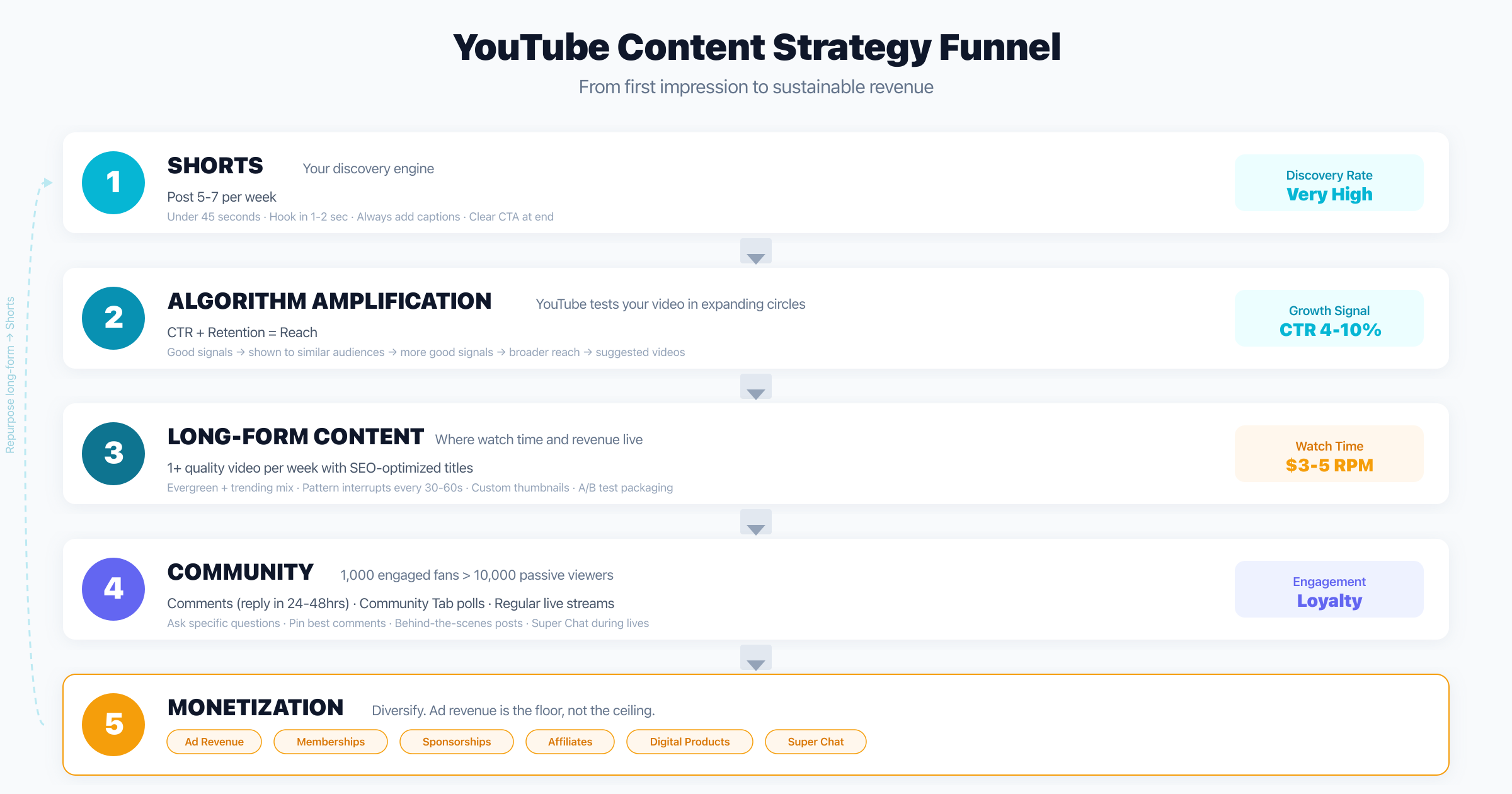
YouTube tests every video in expanding circles. First, your subscribers and regular viewers see it. If they engage, the algorithm shows it to similar audiences. Positive signals at each layer expand reach further. Negative signals kill momentum.
The signals that matter most:
Click-through rate (CTR) measures how many people click after seeing your thumbnail and title. Aim for 4-10% depending on your niche. Below 2% means your packaging isn’t working.
Average view duration tells YouTube if people actually watch. A video with 50% retention at 10 minutes beats a video with 20% retention at 30 minutes. The algorithm cares about satisfaction, not just time spent.
Engagement signals include likes, comments, shares, and subscribes. Comments are weighted heavily. A video generating discussion signals value.
Session time tracks whether viewers stay on YouTube after watching your video. If your content leads to more watching, YouTube rewards you. If viewers leave the platform, you lose algorithmic favor.
The algorithm also uses viewer history to personalize recommendations. Someone who watches three coding tutorials will see more coding content. Your job is to become the channel YouTube recommends to your target audience.
The Shorts Strategy: Your Discovery Engine
YouTube Shorts have become the primary discovery mechanism for new channels. Ignoring Shorts means ignoring how most viewers find new creators.
Shorts work differently than long-form content. The algorithm treats them separately. A channel can have zero long-form success but explode through Shorts, or vice versa. Use this to your advantage.
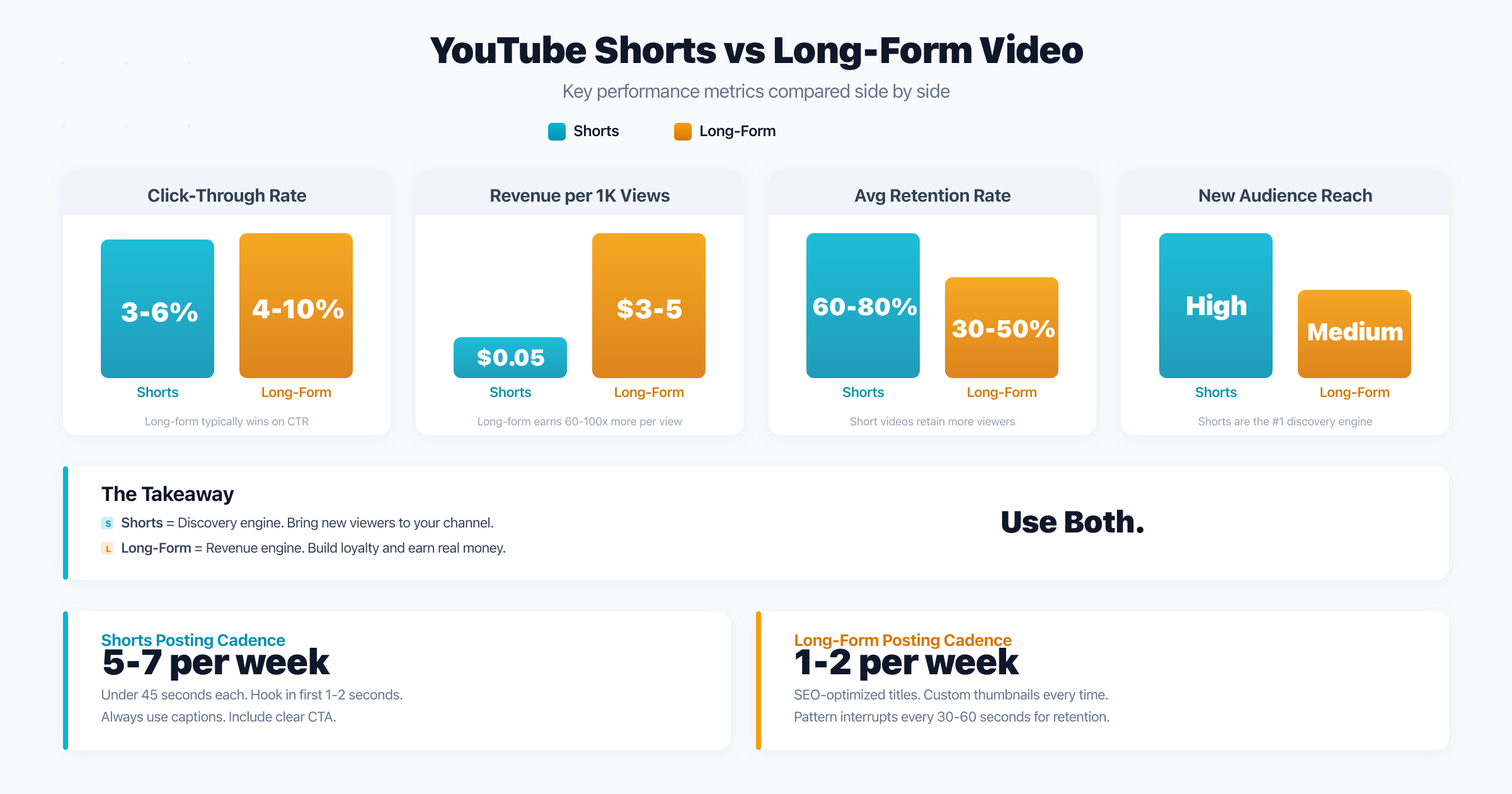
| Metric | YouTube Shorts | Long-Form Video |
|---|---|---|
| Best For | Discovery, new audiences | Revenue, loyalty, deep engagement |
| Ideal Length | Under 45 seconds | 8-15 minutes (niche-dependent) |
| Posting Frequency | 5-7 per week | 1-2 per week |
| RPM (Revenue per 1K views) | $0.03-0.10 | $3-5 (varies by niche) |
| Avg Retention Rate | 60-80% | 30-50% |
| Monetization Threshold | 10M views in 90 days | 4,000 watch hours |
| Production Effort | Low (phone + captions) | High (scripting, editing, thumbnails) |
Optimal Shorts strategy:
Post 5-7 Shorts per week to maintain visibility. Consistency matters more than perfection. A steady stream of decent Shorts outperforms occasional viral attempts.
Hook viewers in the first 1-2 seconds. Shorts scroll vertically like TikTok. If you don’t grab attention immediately, viewers swipe past. Start with action, a question, or a surprising statement. Never start with an introduction.
Keep Shorts under 45 seconds. Technically, they can be 60 seconds, but completion rate matters. Shorter videos get watched completely more often. A 30-second Short with 90% completion beats a 60-second Short with 50% completion.
Use captions. Most viewers watch without sound initially. Text overlays and captions keep them engaged long enough to turn on audio.
Include a clear call-to-action. Tell viewers to follow, subscribe, or watch a related long-form video. Don’t assume they’ll figure it out.
Shorts monetization:
You need either 10 million valid Shorts views in 90 days or 4,000 watch hours from long-form content to qualify for full monetization. Shorts watch time doesn’t count toward the 4,000-hour requirement.
Revenue comes from a pool of ad money shared among creators. Expect $0.03-0.10 per 1,000 views. This is much lower than long-form RPM, so treat Shorts as a discovery tool rather than a primary income source.
An alternative path exists: 500 subscribers plus 3 million Shorts views or 3,000 watch hours unlocks fan-funding features like Super Thanks, channel memberships, and the shopping shelf. This partial monetization helps you earn before hitting full requirements.
Repurpose every long-form video into 3-5 Shorts. Pull the strongest 30-second segments, add captions in CapCut, and post them over the following week. One 15-minute video can fuel a full week of Shorts content.
Long-Form Video Optimization
Shorts bring viewers. Long-form converts them into subscribers and generates real revenue.
The packaging matters:
Thumbnails and titles determine whether anyone clicks. Spend more time on packaging than you think necessary. A/B test thumbnails using YouTube’s built-in testing feature.
Effective thumbnails follow patterns:
- High contrast colors that pop on mobile screens
- Faces with clear emotions (surprise, curiosity, excitement)
- Minimal text (3-4 words maximum)
- Consistent branding elements so returning viewers recognize you
Title rules:
Keep titles under 60 characters. Longer titles get truncated in search results and suggested videos. Front-load the important keywords.
Use curiosity gaps. “I Tried X for 30 Days” or “Why X is Wrong About Y” creates questions viewers want answered.
Avoid clickbait that doesn’t deliver. Misleading titles tank your retention metrics when viewers leave disappointed. The algorithm notices.
Structure for retention:
The first 30 seconds determine whether viewers stay. State the value proposition immediately. What will viewers learn, feel, or experience? Why should they keep watching?
Use pattern interrupts every 30-60 seconds. Change camera angles, add graphics, insert b-roll, or shift topics slightly. Monotonous videos lose attention regardless of content quality.
Create loops that reference future content. “I’ll explain why this matters in a minute” keeps viewers watching to satisfy curiosity.
End with clear next steps. Subscribe call-to-action, related video recommendation, or question for comments. Dead endings kill session time.
YouTube SEO: Getting Found in Search
YouTube is the second largest search engine. Treating your videos as searchable content unlocks consistent organic traffic.
Keyword research process:
Use YouTube’s search suggestions to find what people actually search for. Type your topic and note the autocomplete suggestions. These represent real search volume.
Tools like VidIQ and TubeBuddy show search volume and competition for keywords. Target keywords with decent volume but manageable competition. Long-tail keywords often perform better for newer channels.
Check competitor videos ranking for your target keywords. Note their titles, descriptions, and tags. You’re not copying. You’re understanding what the algorithm associates with that topic.
Optimization checklist:
Include your primary keyword in the title, preferably near the beginning. Natural phrasing beats keyword stuffing.
Write descriptions that are 200-300 words. Include your primary keyword in the first two sentences, then naturally incorporate related terms. Add timestamps for longer videos because these appear in search results and improve user experience.
Tags still matter but less than before. (If you want to go deeper, check out my guide to SEO in the age of AI.) Include your exact target keyword, variations, and your channel name. Don’t waste tag space on irrelevant terms.
Create custom thumbnails for every video. Default thumbnails from random frames look unprofessional and hurt CTR.
Add closed captions. YouTube’s auto-generated captions are decent but contain errors. Correcting them or uploading your own improves accuracy and helps with accessibility.
YouTube SEO compounds over time. A video optimized for “how to set up WordPress caching” can generate views for 3-5 years. Prioritize evergreen keywords over trending topics for your core content library.
Building a Content System
Random uploads kill channels. You need a system that produces consistent content without burning you out.
Batch production:
Film multiple videos in a single session. Changing outfits and backgrounds creates the illusion of different days. This saves setup time and mental energy from repeated context switching.
Dedicated filming days with dedicated editing days creates rhythm. When you sit down to film, you’re in filming mode. When you edit, you’re fully focused on post-production.
Content planning:
Map out content 30-60 days in advance using a proper content marketing strategy. Maintain a spreadsheet with video ideas, target keywords, filming status, and publish dates. Running out of ideas mid-week leads to desperate content that underperforms.
Create content series with consistent formats. “Weekly Tips” or “Monthly Challenges” set viewer expectations and simplify your planning. The algorithm also favors series because they drive repeat viewership.
Repurpose strategically. A long-form video can become 3-5 Shorts, a blog post, social media clips, and newsletter content. One piece of production feeds multiple platforms.
Sustainable pace:
One quality video per week beats five rushed videos. Determine your actual capacity considering other responsibilities. Commit to that pace. Consistency at your sustainable level beats sporadic bursts of activity followed by weeks of silence.
Community Building Tactics
The algorithm rewards engagement, but genuine community building creates something more valuable: loyal viewers who watch everything you publish. This is the same principle behind building brand authority on social media.
Comment management:
Reply to every comment in the first 24-48 hours after publishing. This signals activity to the algorithm and makes commenters feel valued. Pin a thoughtful comment to encourage discussion.
Ask questions in your videos that prompt specific responses. “What’s your biggest struggle with X?” generates more responses than “Let me know what you think.”
Heart comments generously. It costs nothing and rewards engagement.
Community posts:
YouTube’s Community tab is underutilized. Post polls, behind-the-scenes content, questions, and updates between videos. This keeps your channel active in subscriber feeds even when you’re not publishing videos.
Polls have extremely high engagement rates. Ask for input on future content. “Which topic should I cover next?” makes viewers feel invested in your channel direction.
Live streaming:
Live content creates real-time connection. Even small channels can build dedicated communities through regular live sessions. Set a consistent schedule so viewers know when to show up.
Live streams don’t need production polish. Viewers expect a conversational, authentic experience. Q&A sessions, live tutorials, or casual discussions all work.
Super Chat during live streams provides immediate revenue and identifies your most engaged fans.
Collaboration Strategies
Collaborations remain one of the fastest ways to reach new audiences. But random collaborations with mismatched creators waste everyone’s time.
Finding collaboration partners:
Target creators with similar audience demographics but non-competing content. A fitness creator and a nutrition creator share audiences without directly competing.
Look for channels slightly larger than yours but not exponentially bigger. Collaborations work best when both parties gain roughly equal value. A channel with 10x your subscribers has less incentive to collaborate.
Reach out with specific ideas, not vague requests. “I’d love to collaborate sometime” gets ignored. “I have an idea for X video where we could Y, and I think your audience would enjoy it because Z” shows you’ve thought about mutual benefit.
Collaboration formats:
Guest appearances on each other’s channels double the content output with shared effort. Each creator publishes a video featuring the other.
Podcast-style conversations work for educational or commentary channels. Long-form discussions build deeper audience connections than quick cameos.
Challenge videos, reactions, and head-to-head competitions create natural entertainment value. The format drives engagement inherently.
Monetization Beyond Ads
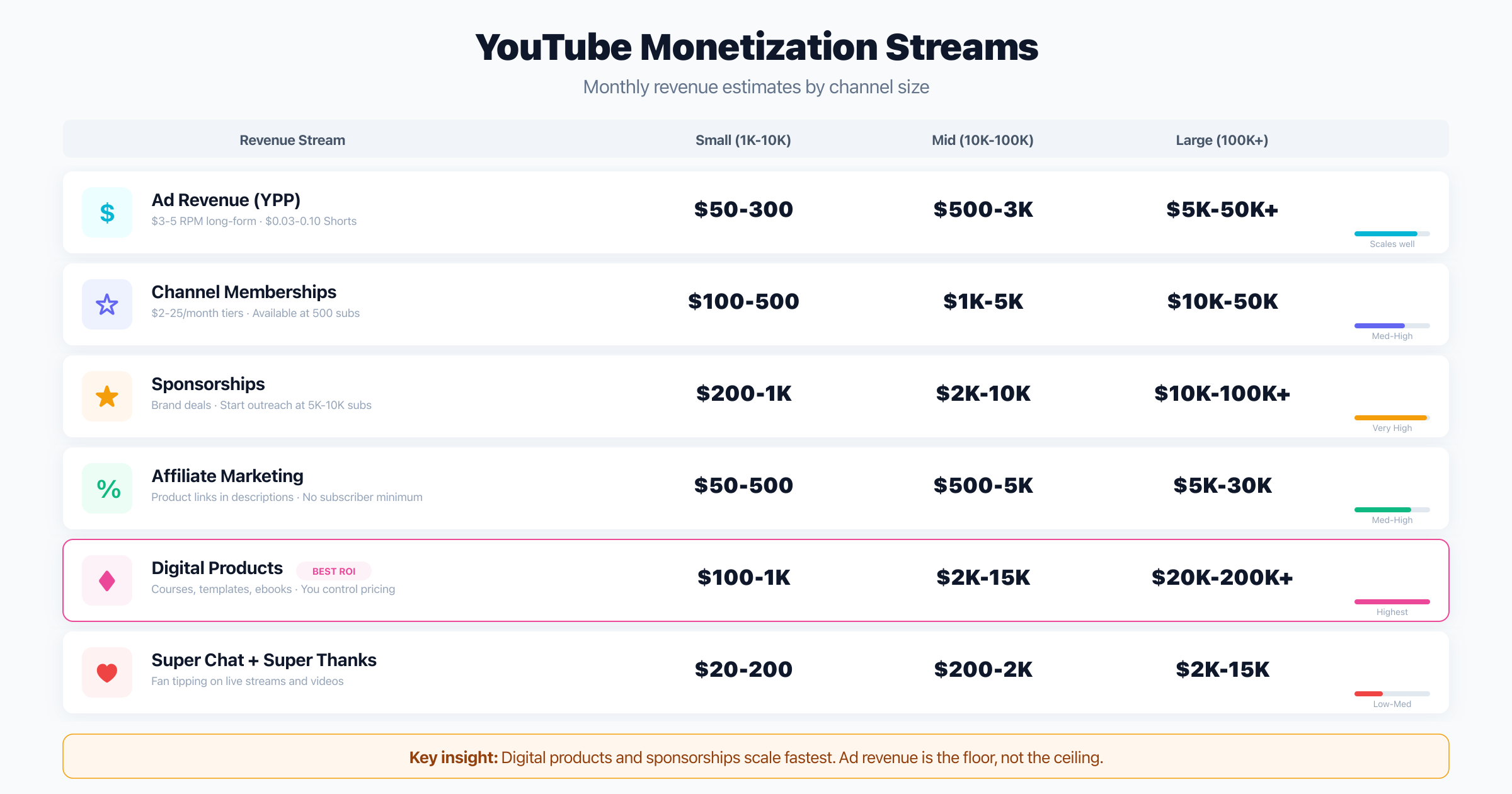
Ad revenue alone rarely sustains a channel. Diversified income streams create stability and higher earnings. I covered this in my guide on monetization methods beyond ads.
YouTube Partner Program earnings:
Long-form ad revenue averages $3-5 per 1,000 views for most niches. Some niches (finance, business, tech) earn significantly more. Entertainment and gaming typically earn less.
Shorts revenue is much lower at $0.03-0.10 per 1,000 views. Don’t rely on Shorts for income.
Channel memberships:
Available at 500 subscribers with fan-funding eligibility. Set up multiple tiers with escalating perks: exclusive content, early access, behind-the-scenes, live chats, or community access.
Even modest channels can generate meaningful membership revenue. 100 members at $5/month equals $500/month before YouTube’s cut.
Super Chat and Super Thanks:
Enable these features once eligible. Super Thanks allows tipping on regular videos. Super Chat works during live streams. Engaged fans often want to support creators directly.
Recommend products you genuinely use and include affiliate links in descriptions. Amazon Associates is the most common starting point. Specialized affiliate programs (software, courses, services) often pay higher commissions.
Always disclose affiliate relationships. Viewers appreciate honesty and trust your recommendations more when you’re transparent.
Sponsorships:
Brands pay for dedicated segments, integrations, or entire sponsored videos. Rates vary wildly based on niche, engagement, and negotiation skills.
Start reaching out to brands once you hit 5,000-10,000 subscribers if your engagement metrics are strong. Smaller channels with highly engaged niche audiences often outperform larger channels with passive viewers.
Digital products:
Courses, templates, ebooks, and community access create income you control. Unlike ad revenue, product sales don’t depend on platform algorithms.
Use your YouTube content to demonstrate expertise and build trust. The audience who watches your free content becomes the customer for your paid products.
AI Tools for YouTube Creators
AI has become a legitimate productivity multiplier. Used correctly, it accelerates content creation without sacrificing quality.
Scriptwriting assistance:
AI can generate outlines, suggest hooks, and help overcome writer’s block. Don’t publish AI-written scripts directly. Use AI as a starting point, then rewrite in your voice.
Tools like ChatGPT and Claude help brainstorm video ideas, structure arguments, and find angles you hadn’t considered.
Thumbnail and title testing:
AI tools now predict CTR based on thumbnail and title combinations. While not perfect, they provide data-driven starting points for testing.
Caption and transcription:
AI generates captions faster and more affordably than manual transcription. YouTube’s auto-captions work for most videos, but third-party tools offer better accuracy.
Editing automation:
AI-powered editors identify highlights, remove filler words, and suggest cuts. This speeds up rough cut creation significantly.
Content repurposing:
AI extracts key moments from long videos for Shorts creation, generates blog posts from transcripts, and reformats content for different platforms.
The key is using AI to handle repetitive tasks while you focus on creativity, personality, and strategic decisions that AI can’t replicate.
Analytics That Actually Matter
YouTube provides overwhelming data. Focus on metrics that inform decisions.
Watch time and average view duration:
Total watch time drives algorithmic promotion. Average view duration tells you how engaging specific videos are. If duration drops suddenly, identify where viewers leave and fix that section.
Click-through rate:
CTR combines with impressions to determine reach. Low CTR with high impressions means your packaging doesn’t resonate with the audience YouTube is showing you. Improve thumbnails and titles.
Traffic sources:
Understand where viewers find you. Search traffic means your SEO works. Suggested traffic means the algorithm promotes you. External traffic means your social media promotion works.
If you’re over-indexed on one traffic source, diversify. Channels dependent entirely on suggested videos collapse when algorithm preferences shift.
Subscriber conversion rate:
What percentage of viewers subscribe? Compare across videos to identify what drives subscriptions. Videos creating subscribers differ from videos generating views.
Audience retention graphs:
These show exactly where viewers drop off. The first 30 seconds typically sees the biggest drop. Spikes indicate particularly engaging moments worth repeating.
Common Mistakes to Avoid
Inconsistent posting: The algorithm forgets you exist. Viewers unsubscribe from inactive channels. Establish a schedule and stick to it.
Ignoring Shorts: Many creators dismiss Shorts as inferior content. This leaves massive discovery opportunities on the table.
Chasing trends blindly: Trending topics bring viewers who don’t care about your usual content. They watch one video and never return. Occasional trend-jacking works, but your core content should serve your core audience.
Neglecting packaging: Brilliant content with terrible thumbnails stays invisible. Spend time on packaging proportional to production effort.
Avoiding analytics: Creators who don’t study their data keep repeating mistakes. Set aside time weekly to review performance and adjust strategy.
Comparing to viral outliers: Some videos explode randomly. Most growth comes from consistent execution over time. Don’t abandon strategies because one video didn’t go viral.
The Long Game
YouTube success compounds over time. Channels that survive the first 1-2 years of slow growth often accelerate rapidly afterward. The algorithm increasingly favors established channels with proven track records.
Build for the long term:
Create evergreen content that stays relevant for years. Tutorials, educational content, and how-to guides continue generating views long after publication.
Develop a recognizable style and format. Viewers should know what to expect from your channel.
Treat YouTube as a business, not a hobby. Track metrics, set goals, adjust strategies, and invest in quality.
And most importantly, make content you’d actually want to watch. Forced content reads as inauthentic. Long-term success requires a genuine interest in your topics because you’ll be making videos about them for years.
FAQs
How often should I post on YouTube in 2026?
For long-form content, aim for at least one video per week. Consistency matters more than frequency. For Shorts, 5-7 per week is optimal for discovery. Find a sustainable pace you can maintain for months without burning out.
How long does it take to grow a YouTube channel?
Most successful channels take 12-24 months of consistent posting to gain traction. The first 1,000 subscribers are the hardest. Growth typically accelerates after establishing a consistent audience and content style. Expect slow progress initially.
Are YouTube Shorts worth making?
Yes. Shorts are currently YouTube’s primary discovery mechanism. They reach audiences who haven’t found your long-form content. While Shorts monetization earns less per view, they drive channel growth and funnel viewers to longer videos where you earn more.
What’s a good click-through rate on YouTube?
A good CTR ranges from 4-10% depending on your niche and traffic source. Browse features typically have lower CTR than search traffic. Below 2% indicates your thumbnails and titles need improvement. Above 10% is exceptional.
How many subscribers do I need to make money on YouTube?
Full monetization requires 1,000 subscribers plus either 4,000 watch hours or 10 million Shorts views. Partial monetization (fan-funding) requires 500 subscribers plus 3,000 watch hours or 3 million Shorts views. Affiliate marketing and sponsorships can generate income at any subscriber count.
Should I use AI tools for my YouTube channel?
AI tools can help with scriptwriting, caption generation, thumbnail ideas, and content repurposing. Use them to accelerate production, not replace your creativity. AI-assisted content still needs your voice and expertise to stand out.
How important are thumbnails on YouTube?
Thumbnails are critical. They determine whether anyone clicks on your video. A great video with a bad thumbnail stays invisible. Spend significant time on thumbnail design. Use YouTube’s A/B testing feature to optimize CTR.
Does the YouTube algorithm favor longer or shorter videos?
The algorithm favors videos that retain viewers, regardless of length. A 5-minute video with 80% retention beats a 30-minute video with 20% retention. Make videos as long as necessary to deliver value, but no longer. Padding runtime hurts performance.