
Social Media for Businesses: A Definitive Guide
I’ve watched businesses burn thousands of dollars on social media with nothing to show for it. I’ve also seen a single-person brand build a $200K/year business entirely from Instagram DMs and LinkedIn posts. The difference isn’t budget. It’s strategy. If you’re a business owner trying to figure out social media marketing, you don’t need to be on every platform. You need to be on the right platforms, with the right content, posted at the right time.
I’ve seen brands switch from an SEO-only approach to the SEO+SMM (Search Engine Optimization + Social Media Marketing) approach and get real results. The combination works because social media generates awareness and trust, while SEO captures demand. Together, they create a flywheel that neither can build alone.
This guide covers everything from creating your social media strategy to picking the right platforms in 2026, including newer networks like Threads and Bluesky that most businesses are ignoring.
How to Create a Social Media Strategy for Your Business
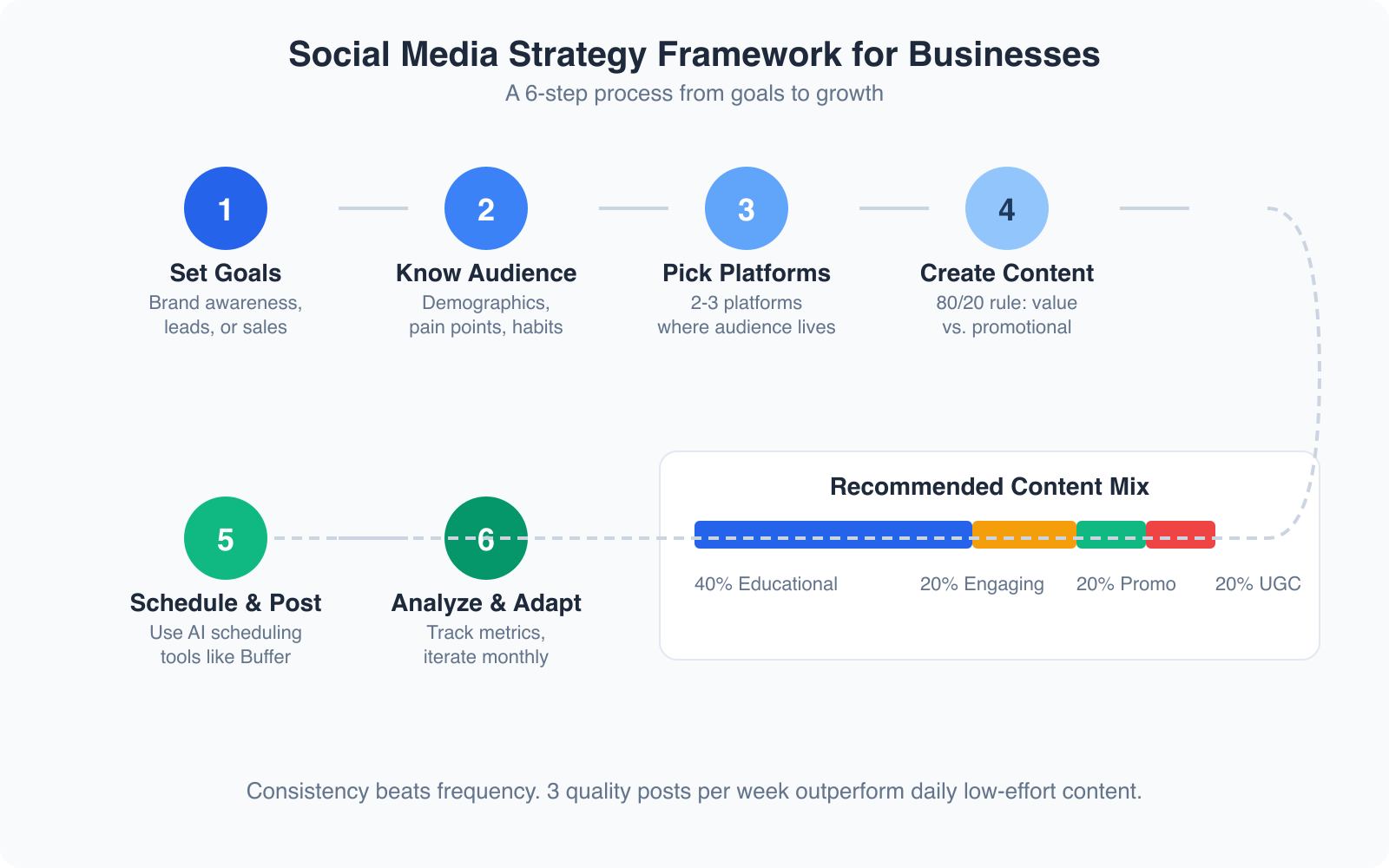
A social media strategy isn’t a content calendar. It’s the framework that tells you what to post, where to post it, and why. Without it, you’re just shouting into the void. Here’s the step-by-step process I use when building social strategies for businesses.
Plan Your Goals, Budget, and Results
Before you create a single post, you need to answer three questions. First, what are your social media goals? For a shoe seller, that might mean getting people talking about your brand, driving them to buy your products, or both. These goals don’t need numbers yet. They just need direction.
Second, what’s your budget? This isn’t all going to paid advertising. A solid social media plan focuses mainly on organic approaches, getting leads naturally. While paid ads are the fastest way to start, you can amplify them with organic strategies that I’ll cover later.
Third, what results do you expect? Most businesses want revenue. But some want brand awareness, email signups, or community growth. Define the numbers: 500 new followers, 50 leads, $10K in attributed revenue. You can’t measure progress without a target.
Identify Your Audience
Succeeding with social media marketing requires a deep understanding of your target audience. You need to know who your target market is, what they care about, and where they spend their time online. Take time to research what your audience wants. Existing customers are extremely helpful here because they hold the power to spread the word, good or bad, about your company.
Foster good relationships with these individuals. Send emails about upcoming deals. Communicate in comment sections under video content on YouTube, Threads, or Facebook. Use their testimonials as part of your advertising strategy.
Create Content That Stops the Scroll
Hire a graphic designer and a content writer alongside your social media strategist. If your budget is tight, outsource to freelancers. If your budget is really tight, use a Canva-like tool to design and schedule your social media content. But all of this needs to happen only after you’ve identified your potential market.
Once you start publishing good content, your prospects will see you as an authority. The deeper the relationship with your audience, the easier it is to turn conversations into conversions.
Use Video Everywhere
Video isn’t optional anymore. Create high-quality videos and upload them to every platform: Facebook, Instagram Reels, TikTok, YouTube Shorts, and LinkedIn. Short-form video (under 60 seconds) gets the highest engagement across every platform in 2026. If you’re worried about professional editing standards, consider live streaming. It’s raw, authentic, and shows the public exactly what you offer.
Schedule Your Content with AI Tools
Set a timetable for your social media campaigns. Consistency matters more than frequency. Three quality posts per week will outperform daily low-effort content every time. Always answer queries on time, and don’t spread yourself too thin across platforms.
I use Buffer for scheduling because its AI assistant suggests optimal posting times, generates caption ideas, and repurposes long-form content into platform-specific formats. It handles Instagram, TikTok, LinkedIn, Facebook, Threads, and Pinterest from a single dashboard. The free plan covers 3 channels with 10 scheduled posts per channel, which is enough for most small businesses starting out.
Batch your content creation. I spend 2-3 hours every Monday creating and scheduling the entire week’s content. This frees up the rest of the week for engagement, responding to comments, and DMs, which is where the real conversions happen.
Teach Your Staff Social Media
Some businesses are outdated and their employees don’t know how social media works for the company’s benefit. Plan a schedule to teach your employees how to use social media. Ask them to help by regularly sharing brand content. This builds your network and increases impressions among their connections. Employee advocacy programs can increase organic reach by 200-500% because platform algorithms favor personal profiles over brand pages.
Platform Priority Ranking for Businesses in 2026
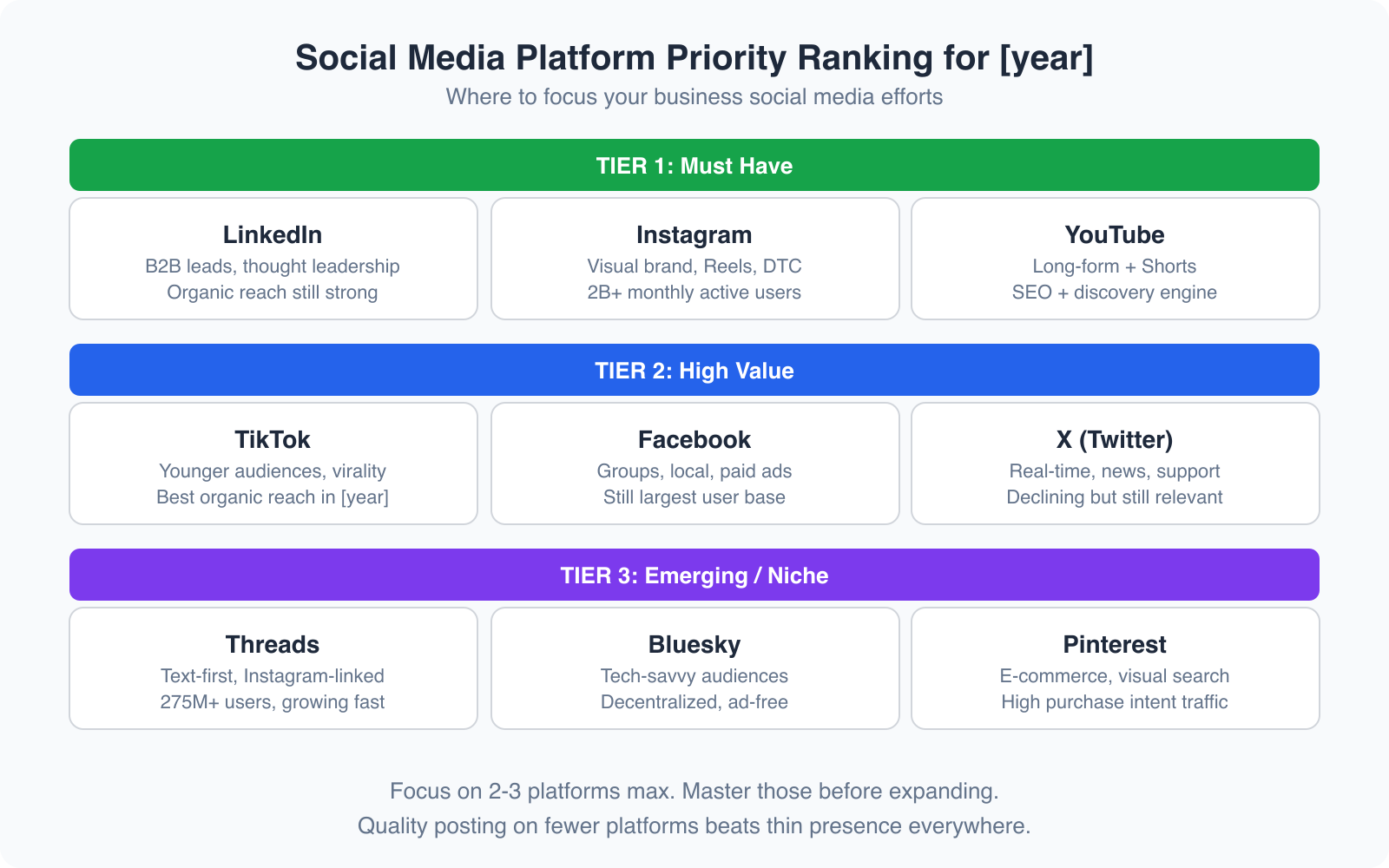
Not every platform deserves your attention. Here’s how I rank them based on business value, organic reach, and ROI potential.
Tier 1: LinkedIn, Instagram, YouTube
LinkedIn is the undisputed king for B2B. Organic reach is still strong, and the algorithm rewards consistent text posts and carousels. If you sell to other businesses, LinkedIn should be your primary platform.
Instagram is essential for visual brands, DTC (direct-to-consumer) businesses, and anyone targeting consumers under 45. Reels get the most reach. Stories build loyalty. The platform’s shopping features make it a genuine sales channel.
YouTube is both a social platform and a search engine. YouTube Shorts compete directly with TikTok, while long-form videos build deep trust and authority. The content has the longest shelf life of any social platform.
Tier 2: TikTok, Facebook, X (Twitter)
TikTok still has the best organic reach of any platform. If your audience is under 35, you should be creating short-form content here. The algorithm is remarkably good at finding your audience, even with zero followers.
Facebook isn’t dead for businesses, especially for local businesses, community-driven brands, and anyone running paid ads. Facebook Groups are genuinely valuable for building engaged communities. The ad platform remains the most sophisticated targeting engine available.
X (Twitter) has declined in reliability, but it’s still where real-time conversations happen. I use it for customer support, news sharing, and thought leadership. It’s also surprisingly effective for B2B tech companies.
Tier 3: Threads, Bluesky, Pinterest
Threads crossed 275 million monthly active users and is growing fast. It’s linked to your Instagram account, so you get a built-in audience from day one. I’m treating Threads as a text-first complement to Instagram. The algorithm favors conversational content over polished posts. If you’re good at writing casual, authentic text, Threads will reward you.
Bluesky is worth watching if your audience is tech-savvy. It’s decentralized, ad-free, and attracting users who left Twitter. For tech companies, developer tools, and SaaS businesses, Bluesky has an engaged early-adopter audience. It’s too early to go all-in, but create a profile and start posting.
Pinterest is underrated for e-commerce. Users come to Pinterest with purchase intent. If you sell physical products, home goods, fashion, food, or anything visual, Pinterest drives traffic that converts at higher rates than most social platforms.
Social SEO: Making Your Content Searchable
Here’s something most businesses are missing: social media is becoming a search engine. Over 40% of Gen Z uses TikTok and Instagram as their primary search tools instead of Google. This changes how you should write captions.
Instead of writing clever, vague captions, write keyword-rich descriptions that match what people search for. If you’re a bakery in Mumbai, don’t caption your post “Sunday vibes.” Caption it “Best chocolate cake in Mumbai, custom birthday cakes with same-day delivery.” The algorithm matches search queries to caption text.
This applies to every platform. LinkedIn posts with clear topic keywords get shown in LinkedIn search results. YouTube descriptions with specific phrases rank in both YouTube and Google search. Instagram alt text and captions are indexed by Instagram’s search feature.
Social SEO doesn’t replace traditional SEO. It complements it. I write a blog post optimized for Google, then repurpose the key points into platform-specific social content optimized for social search. The blog captures intent-based traffic. The social posts capture discovery-based traffic.
Benefits of Social Media for Businesses
Social media keeps evolving faster than most businesses can keep up. But the core benefits remain solid. Here’s what you actually gain from doing it well.
Easiest Marketing Channel to Start
Social media marketing is the lowest-barrier entry point for marketing your business. Sign up, start posting, start engaging. You don’t need a website, a marketing degree, or a big budget. You need a phone, good ideas, and consistency.
Free Customer Support
I use X and Facebook to get support for products I’ve purchased. Users chat with brands and get real-time responses. From a business perspective, social networks work as a customer support tool. You provide accessible support and receive valuable feedback from customers at the same time. Companies that respond to social media queries within 1 hour see 20% higher customer satisfaction.
Word-of-Mouth at Scale
Brands that are active on social networks get a huge competitive advantage in word-of-mouth promotion. When someone starts talking about your product, other people join in. Once that chain starts, your products can reach audiences you never paid to reach. One viral post can do what $50,000 in ads couldn’t.
Higher Conversion and Referral Rates
If your social media strategy is good, you can attract more leads in less time. There are proven strategies that work. Improvise on them, apply them to your approach, and measure the results. Businesses with active social media presence see 32% more referral traffic to their websites compared to those without.
Reduced Marketing Costs
Social media marketing can reduce unnecessary costs. Small businesses can use it as their primary customer support channel, reducing the need for dedicated support staff. Organic social media costs nothing except your time. And when you layer in paid advertising, the ROI is often better than traditional channels because you can target precisely.
Keep on reading: 11 Effective Measures to Improve Social Media Presence
What Not to Post on Social Media
Whether your business is new to social media or a veteran, what you share on any platform is key to the success of your strategy. You need to know what to post and what to avoid.
Offensive or Divisive Content
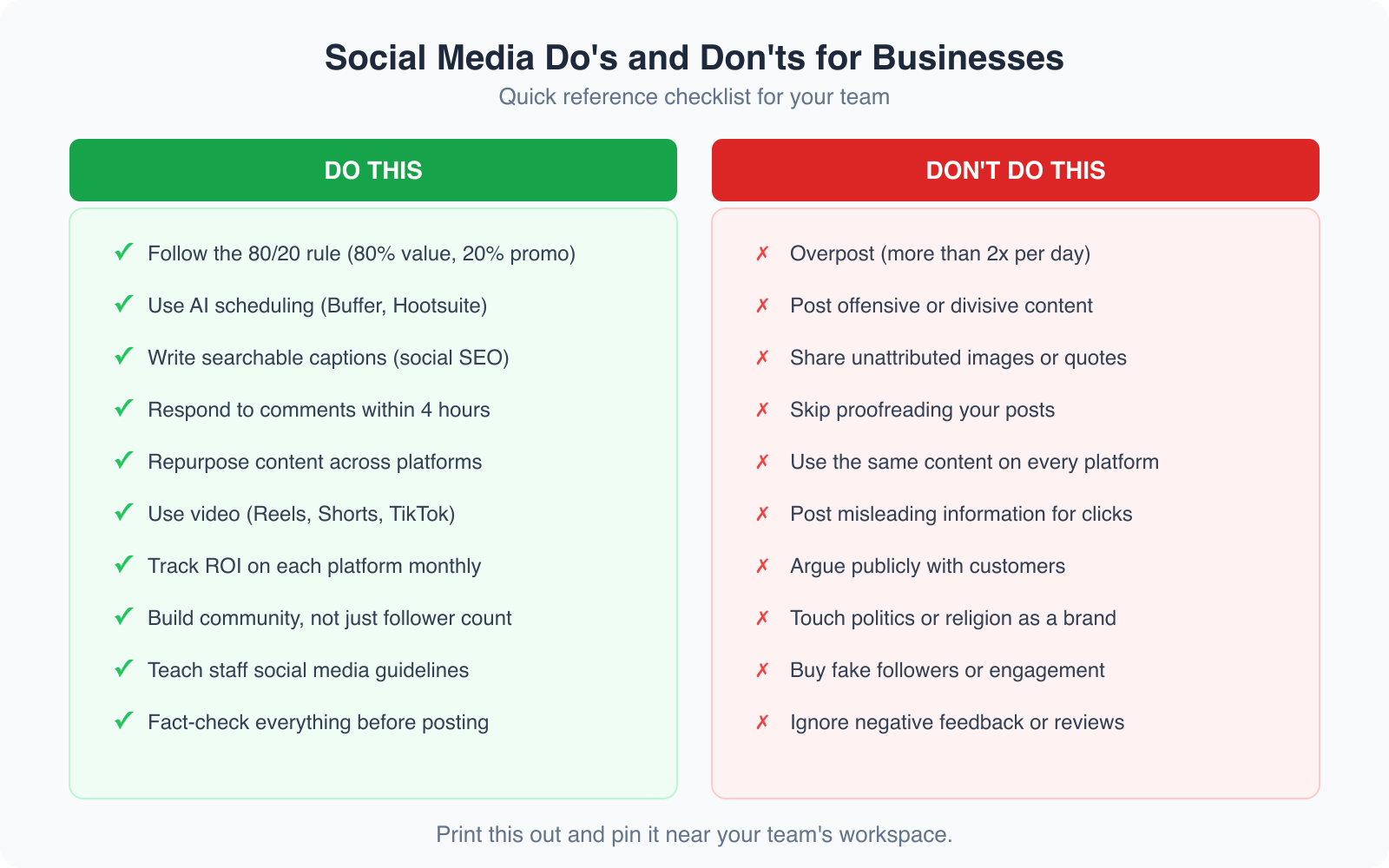
If there’s a chance you can offend someone, don’t post it. Anything related to racial slurs, crude jokes, graphic images, or content that targets any group should be avoided. You may think the controversy is worth it. It’s not. You can cause irreparable harm to your brand.
Unattributed Content
Any content you post without attribution, whether images, quotes, or original ideas, can cause legal issues. Copyright infringement is serious and can lead to legal action. Always credit the original creator.
Content That Hasn’t Been Fact-Checked
If you come across a juicy article that’s controversial or sensational, check its validity first. It could be inaccurate or a scam. Posting unverified content makes your business look careless. Always click on links you plan to share.
Too Much Promotional Content
Follow the 80/20 rule. 80% should be valuable and informative content. 20% should be promotional. And when I say promotional, it should be newsworthy for the follower: a product launch, a great sale, a new location. People don’t follow businesses to see ads. They follow for value.
AI-Powered Social Media Management
The biggest shift in social media marketing over the past year is AI integration. Every major scheduling tool now uses AI to suggest content, predict performance, and automate repetitive tasks.
Buffer’s AI assistant can generate caption ideas, suggest hashtags, repurpose blog posts into social content, and recommend the best posting times based on your audience’s behavior. I’ve tested it against manual scheduling and it consistently finds 15-20% better engagement windows than I could pick manually.
Beyond scheduling, AI tools can now analyze your competitors’ social strategies, generate image variations for A/B testing, and even predict which content formats will perform best for your specific audience. The time savings are real. What used to take me 8 hours per week for a client’s social media now takes 3 hours.
But here’s my honest take: AI is a tool, not a replacement. The posts that perform best are still the ones with genuine personality, real opinions, and authentic stories. Use AI for efficiency. Use your brain for strategy and voice.
Building Your Social Media Measurement Framework
You can’t improve what you don’t measure. Here are the metrics that actually matter for business social media:
Engagement rate tells you if your content resonates. Track likes, comments, shares, and saves as a percentage of reach. A 3-5% engagement rate is solid. Above 5% means your content is really connecting.
Click-through rate tells you if your content drives action. If you’re getting lots of likes but no clicks, your call-to-action is weak or your content doesn’t match your offer.
Conversion rate from social is what your boss actually cares about. Track how many social visitors complete a desired action (purchase, signup, inquiry) using UTM parameters and Google Analytics.
Cost per lead from social ads tells you if your paid strategy is efficient. Compare this across platforms to know where to allocate budget.
I review these numbers monthly and make strategy adjustments quarterly. Social media is a long game. Give each platform at least 90 days before deciding whether it’s working.
Final Words
Social media for businesses isn’t about being everywhere. It’s about being strategic. Pick 2-3 platforms where your audience actually spends time. Create content that provides genuine value 80% of the time. Use AI tools for efficiency, but keep your authentic voice. Measure what matters, not vanity metrics.
The businesses that win at social media in 2026 won’t be the ones with the biggest budgets. They’ll be the ones who understand their audience deeply, show up consistently, and treat social media as a conversation, not a broadcast channel. Use the right tools, follow the 80/20 rule, and remember that success doesn’t come overnight. But with the right practices, you can build a social media presence that directly impacts your revenue.
For more on this topic, check out building brand authority through social media strategies and how bloggers can maximize social media marketing.
Frequently Asked Questions
Which social media platform is best for small businesses?
It depends on your audience. For B2B businesses, LinkedIn is the best starting platform because of its strong organic reach and professional audience. For consumer-facing businesses, Instagram combined with short-form video (Reels) delivers the best results. Start with one platform, master it, then expand. Trying to be on 5 platforms from day one spreads your effort too thin.
How often should a business post on social media?
Quality beats frequency every time. I recommend 3-5 posts per week on your primary platform and 2-3 on secondary platforms. Consistency matters more than volume. A business that posts 3 excellent pieces per week will outperform one that posts mediocre content daily. Use scheduling tools like Buffer to maintain consistency without burning out.
Is Threads worth it for businesses in 2026?
Yes, Threads is worth testing. With over 275 million monthly active users and growing, it offers free organic reach that other mature platforms don’t. Since it’s linked to your Instagram account, you get a built-in audience from day one. The best content for Threads is conversational, authentic text posts, opinions, and behind-the-scenes insights. It takes minimal effort to repurpose your existing content for Threads.
What is social SEO and why does it matter?
Social SEO means optimizing your social media content to appear in search results on social platforms. Over 40% of Gen Z uses TikTok and Instagram for search instead of Google. Write keyword-rich captions that describe your content clearly instead of clever but vague captions. For example, instead of ‘Sunday vibes’ for a bakery post, write ‘Best chocolate cake in Mumbai with same-day delivery.’ The algorithm matches search queries to your caption text.
How much should a small business spend on social media marketing?
Start with zero paid spend and focus on organic content for the first 90 days. This lets you understand what resonates with your audience before spending money amplifying it. Once you identify winning content formats, allocate $300-500/month for boosting top-performing posts and running targeted ads. Scale up only when you can demonstrate positive ROI. Most small businesses see the best returns when they spend 5-10% of their revenue on marketing, with social media being one component of that budget.