
15 Advanced Internet Marketing Tips (That Actually Work)
Here’s a number that should wake you up: 5.66 billion people are on social media right now. That’s not a projection. That’s the reality as of late 2025, and it means for the first time in history, social media users outnumber non-users two to one globally.
Marketing has fundamentally changed since I last wrote about this topic in 2021. Back then, we were talking about 4.55 billion social users and Reddit having “170 million monthly visitors.” Reddit now has over 1.2 billion monthly active users. TikTok was still considered a Gen Z playground. AI was something we read about in tech blogs, not something 88% of marketers use daily.
I’ve been in digital marketing professionally for over 16 years now. I’ve watched strategies that worked brilliantly become obsolete in months. I’ve also seen “dead” tactics revive themselves when platforms evolve. The one constant? What actually works rarely matches what most guides tell you.
Peter Drucker said marketing and innovation are the only functions that matter in business. He was right. But in 2026, the two have merged. You can’t market effectively without understanding how AI is transforming search, how social platforms have become commerce engines, and how your audience expects to find you where they already are.
This guide covers 15 internet marketing tips and strategies that are working right now. Not theory. Not “best practices” recycled from 2020. These are tactics I’ve tested, refined, and seen results from across client projects and my own businesses.
Let’s get into it.
Social and Community-Based Marketing
Social media marketing isn’t about being everywhere anymore. It’s about being strategic about where you invest your time. With 5.66 billion social media users globally and the average person using 6.8 different platforms monthly, you need to pick your battles.
TikTok
TikTok is projected to reach 1.9 billion monthly active users by 2026. Its advertising revenue is expected to hit $34.8 billion. If your business isn’t on TikTok yet, you’re leaving money on the table.
But here’s what most businesses get wrong: they try to make TikTok content that looks like traditional advertising. It doesn’t work. User-generated content on TikTok is 2.4 times more perceived as authentic compared to branded videos.
What actually works on TikTok in 2026:
- Short, punchy videos under 60 seconds. Hook viewers in the first 3 seconds or lose them.
- Participating in trends and sounds. Incorporating viral audio boosts discoverability significantly.
- TikTok Shop integration. The platform has matured into a legitimate e-commerce channel. Reports suggest 50% of U.S. social shoppers will make purchases directly on TikTok by 2026.
- Micro-influencer partnerships. Creators with 10K-100K followers consistently deliver higher engagement rates than celebrities.
Tools to use: Canva for quick video editing, InVideo AI for AI-assisted video creation, TikTok’s native analytics for performance tracking.
Metrics to track: Completion rate, engagement rate, follower growth, TikTok Shop conversion rate.
LinkedIn has transformed from a professional networking site into a discovery platform. The algorithm now rewards deep engagement through comments, group discussions, and repost interactions.
Here’s something I’ve noticed: strategic commenting on others’ posts sometimes generates more impressions than original posts. I spend 20 minutes daily commenting thoughtfully on posts in my niche. The ROI on that time investment has been remarkable.
LinkedIn strategies that work:
- Newsletters. LinkedIn delivers your content directly to subscribers’ email inboxes. It’s predictable distribution you control.
- Carousels and PDFs. These formats consistently outperform simple text posts and even video in reach.
- Video content. Consumption is growing, though horizontal videos tend to deliver more reach than vertical.
- Authentic, creator-led content. The stiff corporate voice is dead. Personal perspectives generate more engagement than branded posts.
Creator Mode as a dedicated toggle has been retired, but its features are now available to everyone. The “Follow” button is now the default CTA on profiles, which helps build an audience focused on your content rather than just connections.
Tools to use: Canva for carousels, Grammarly for polishing your writing, LinkedIn Analytics for insights.
Metrics to track: Connection growth, engagement rate, newsletter subscribers, lead generation from content.
When I wrote about Reddit in 2021, I mentioned it had “170 million monthly visitors.” That number is laughably outdated. Reddit now has over 1.2 billion monthly active users, and projections suggest it will exceed 1.5 billion by 2026.
Reddit is unique because users come for genuine discussions, not polished marketing. This makes it both challenging and rewarding for marketers.
Reddit marketing strategies:
- Provide actual value first. Redditors can smell promotion from a mile away. Build karma and reputation by genuinely helping people.
- Identify relevant subreddits. Find communities where your target audience already gathers. Become a member, not just a marketer.
- Use Reddit ads strategically. The advertising platform has matured significantly. You can target specific subreddits with sponsored posts.
- AMAs (Ask Me Anything). If you have genuine expertise, hosting an AMA builds credibility faster than months of posting.
I’ve seen businesses generate substantial traffic from Reddit by simply answering questions well and including their site as a resource when genuinely relevant. But I’ve also seen accounts get banned for being too promotional. The line is thin.
Metrics to track: Karma growth, referral traffic from Reddit, engagement on posts, AMA participation.
Discord and Threads
Discord isn’t just for gamers anymore. Brands are building engaged communities there. The advantage? You own the space. Algorithm changes don’t destroy your reach.
Threads, Meta’s X competitor, has reached 8% usage among adult internet users. It’s still early days, but the platform is worth monitoring, especially if your audience is already on Instagram.
What to consider:
- Discord works best for brands with dedicated fans who want deeper engagement.
- Threads benefits from Instagram cross-promotion. Your Instagram audience can follow you on Threads with one tap.
- Both platforms reward consistent presence and genuine interaction over promotional content.
Quora
Quora remains a decent traffic source if you approach it right. The key is providing genuinely helpful answers, not thinly veiled promotions.
Focus on questions with high view counts in your niche. Write comprehensive answers that demonstrate expertise. Include a link to relevant resources on your site only when it genuinely adds value.
The traffic from Quora tends to be highly targeted. Someone searching for your topic on Quora and clicking through to your site is likely genuinely interested.
Thought Leadership and Personal Branding
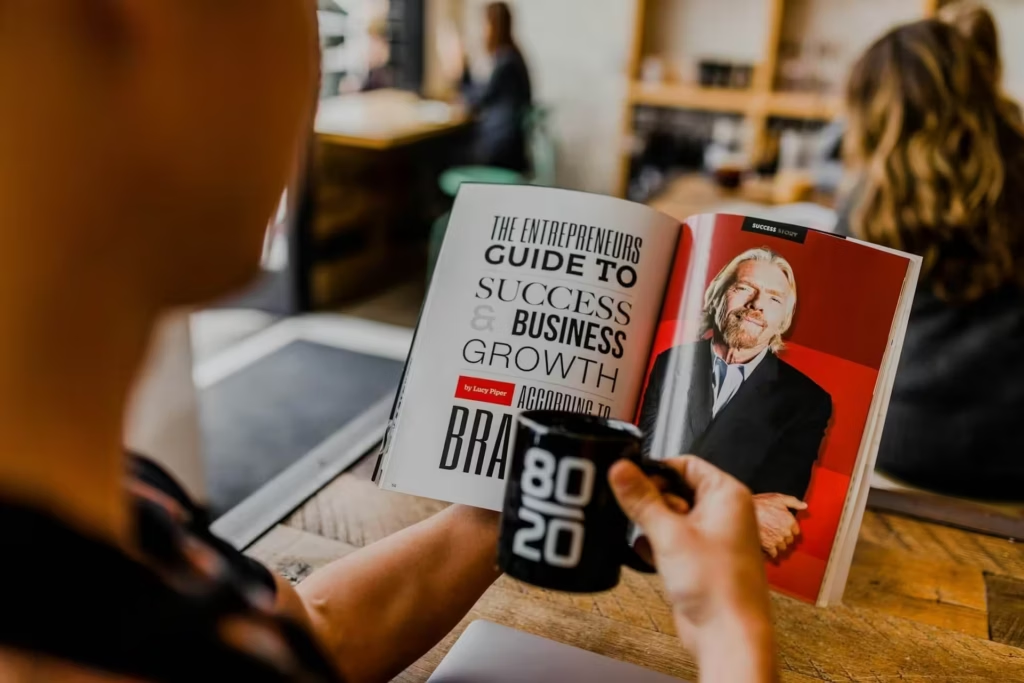
Positioning yourself as a thought leader isn’t about inflating your credentials. It’s about consistently demonstrating expertise over time. And in 2026, the channels for doing this have expanded considerably.
Building a Personal Brand That Generates Leads
Your personal brand is an asset. It compounds over time. When people trust you as a source of knowledge, they’re more likely to buy what you sell.
Elements of effective personal branding:
- Consistency across platforms. Your messaging, visual identity, and voice should be recognizable everywhere.
- Sharing both wins and failures. Vulnerability builds trust. I’ve gotten more engagement from posts about mistakes than from success stories.
- Taking clear stances. Fence-sitters don’t become thought leaders. Have opinions and express them.
- Documenting your journey. “Building in public” resonates with audiences because it feels authentic.
Podcasting as a Marketing Channel
Podcast guesting is underrated for thought leadership. You bypass the need to build your own audience and borrow someone else’s.
I’ve appeared on podcasts with audiences far larger than I could reach on my own. The key is providing genuine value to the host’s audience, not just promoting yourself.
Podcast guesting strategy:
- Identify podcasts your target audience listens to.
- Research the host’s interview style and common topics.
- Pitch a specific, valuable topic rather than just “I’d like to be on your show.”
- Prepare talking points but don’t sound scripted.
- Promote the episode to your own audience after it airs.
Newsletter Growth Tactics
Email newsletters remain one of the few marketing channels you actually own. You’re not at the mercy of algorithm changes.
GetResponse, Mailerlite, and EmailOctopus are solid options depending on your list size and needs.
Newsletter best practices:
- Focus on one clear topic. Newsletters that try to cover everything end up saying nothing.
- Consistent schedule over frequency. Publishing monthly consistently beats publishing weekly sporadically.
- LinkedIn Newsletters. If you’re already active on LinkedIn, their newsletter feature provides direct distribution and email delivery to subscribers.
- Lead magnets. Give people a compelling reason to subscribe. Checklists, templates, and exclusive guides work well.
Metrics to track: Open rate, click rate, subscriber growth, unsubscribe rate.
Measuring Thought Leadership ROI
Thought leadership is a long game. But that doesn’t mean you can’t measure it.
Metrics to track:
- Speaking invitations and podcast interview requests
- Inbound leads mentioning your content as the reason for reaching out
- Social media follower growth
- Newsletter subscriber growth
- Backlinks to your content from other sites
Track these quarterly. If the numbers aren’t moving, your strategy needs adjustment.
Content Marketing Evolution
Content marketing in 2026 looks different from what it did a few years ago. AI tools have changed how content is created. But more importantly, AI search has changed how content is consumed.
Writing Content That AI Actually Cites
With Google’s AI Overviews and tools like Perplexity providing direct answers, the goal isn’t just ranking anymore. It’s getting cited.
Traditional SEO is evolving into what some are calling AI Search Optimization (AISO) or Generative Engine Optimization (GEO). The focus is shifting from keywords and backlinks to intent, context, credibility, and authority.
What this means practically:
- E-E-A-T matters more than ever. Experience, Expertise, Authoritativeness, and Trustworthiness aren’t just nice-to-haves. They determine whether AI systems reference your content.
- Answer questions directly. Structure content so key points are easy for AI to extract.
- Use structured data and schema markup. This helps AI understand your content’s context.
- Long-tail, conversational queries. People are searching in natural language. Your content should answer those natural questions.
AI-Assisted Content Creation
88% of marketers now use AI in their daily operations. Marketing teams using AI report 44% higher productivity on average.
But there’s a right way and wrong way to use AI for content:
Right way:
- Using AI to generate first drafts you then heavily edit
- Having AI research topics and surface sources
- Using AI to repurpose content into different formats
- AI-powered headline and title testing
Wrong way:
- Publishing AI output without editing
- Relying on AI for facts without verification
- Using AI to bulk-produce thin content
- Expecting AI to replace strategy
Tools I use: ChatGPT and Claude for drafting and research, Jasper for marketing copy, Grammarly for editing, Semrush for SEO research.
Interactive Content That Converts
Static blog posts still work. But interactive content consistently produces higher engagement and conversion rates.
Types of interactive content worth creating:
- Calculators and assessments. Help visitors quantify something relevant to their problem. ROI calculators, readiness assessments, and comparison tools all perform well.
- Quizzes. They’re engaging and can segment your audience for personalized follow-up. Outgrow makes creating these relatively simple.
- Interactive infographics. Better engagement than static infographics and more shareable.
Short-Form Video Content Strategy
Short-form video isn’t just for TikTok. YouTube Shorts, Instagram Reels, and even LinkedIn video are all growing.
The key is content atomization. Take one long piece of content and break it into multiple short-form pieces.
Example workflow:
- Record a 30-minute expert interview
- Extract 10 short clips for TikTok/Reels/Shorts
- Transcribe and create a blog post
- Pull quotes for social graphics
- Create an audio version for podcast feeds
One piece of content becomes dozens of distribution opportunities.
Voice Search and Featured Snippet Optimization
Voice search continues to grow. Optimizing for it means:
- Targeting question-based keywords (“how to,” “what is,” “why does”)
- Structuring content with clear headings that match search queries
- Providing direct, concise answers near the top of sections
- Using FAQ schema to help search engines identify Q&A content
Experiential and Gamified Marketing
People remember experiences. They forget advertisements. Gamification and experiential marketing tap into psychology that makes your brand memorable.
Gamification Platforms and Tools
Creating games around your products isn’t as complex as it used to be. Several platforms make it accessible even for small businesses.
Ways to add gamification:
- Loyalty programs with progress mechanics. Think points, levels, and rewards. Advanced Coupons works well for WooCommerce stores.
- Challenges and competitions. User-generated content challenges on TikTok and Instagram combine gamification with community building.
- Quizzes and assessments. Even simple “what type of X are you?” quizzes tap into gamification psychology.
Netflix uses gamification brilliantly. They make discovering content feel like a game with “Because you watched” suggestions and progress indicators.
Metrics to track: Completion rates, repeat engagement, social shares, time spent interacting.
Sponsoring Events
Local event sponsorship still works, but the landscape has changed. Hybrid events (combining in-person and virtual components) are now standard.
Updated event sponsorship strategies:
- Look for hybrid events. You reach both local attendees and a global virtual audience.
- Offer services, not just money. Many events prefer in-kind sponsorships. If you can provide something the event needs (technology, expertise, products), you often get better visibility than cash sponsors.
- Sponsorship marketplaces. Platforms now exist that connect sponsors with events. It’s easier to find opportunities that match your target audience.
Remember: advertisements come and go, but people remember experiences. A well-executed event sponsorship creates memories associated with your brand.
AR/VR Marketing Experiences
Augmented and virtual reality are more accessible than ever, but they’re not right for every business.
When AR/VR makes sense:
- Products that need to be “tried” before buying (furniture, fashion, makeup)
- Complex products that benefit from 3D visualization
- Brands targeting tech-forward audiences
- Event experiences where novelty adds value
When to skip it:
- B2B services where simplicity is valued
- Products where AR/VR doesn’t add meaningful value
- Businesses without budget for proper execution
Bad AR/VR is worse than no AR/VR. If you can’t do it well, don’t do it at all.

Emerging Marketing Channels
The channels your competitors haven’t discovered yet are where the biggest opportunities lie. These are the emerging spaces worth testing.
AI-Powered Search: SGE, Perplexity, and Beyond
Google’s Search Generative Experience (SGE) and tools like Perplexity AI are changing how people find information. Instead of clicking through to websites, users get direct answers synthesized from multiple sources.
This changes marketing in fundamental ways:
- Zero-click searches are increasing. Optimize for being cited, not just ranked.
- Content now competes with AI summaries. You’re not just competing with other websites; you’re competing with AI-generated answers.
- New metrics matter. Track brand mentions in AI answers, citation frequency, and AI referral traffic.
How to optimize for AI search:
- Create content that clearly answers specific questions
- Use structured data and schema markup extensively
- Build topical authority through comprehensive coverage of your subject
- Ensure your claims are factual and verifiable
- Develop a strong E-E-A-T profile
Zero-Click Content Strategies
If users aren’t clicking through to websites as often, meet them where they are.
Zero-click content approaches:
- Answer questions completely in social posts. Don’t just tease content; deliver value directly.
- Create standalone infographics. They should work without requiring viewers to click anywhere.
- Build brand awareness, not just traffic. If someone sees your valuable content in an AI overview, they remember your brand even without clicking.
This feels counterintuitive to marketers used to measuring everything by clicks. But brand awareness has value, even when it’s harder to measure directly.
Conversational Marketing and Chatbots
AI-powered chatbots have improved dramatically. They can now handle genuine conversations, qualify leads, and provide personalized recommendations.
Tools to consider: HubSpot’s chatbot builder, Freshchat, ChatBot.
Effective chatbot implementation:
- Don’t pretend bots are human. Be upfront that it’s automated.
- Have a clear handoff to human support when needed.
- Use chatbots for qualification and initial engagement, not closing sales.
- Continuously train and improve based on conversation data.
First-Party Data in a Cookieless World
Third-party cookies are disappearing. Building first-party data relationships with your audience is crucial.
First-party data strategies:
- Email remains king. Every email subscriber is first-party data you own.
- Logged-in experiences. Create reasons for visitors to create accounts.
- Surveys and progressive profiling. Ask one question at a time over multiple interactions.
- CRM integration. Use tools like HubSpot CRM, Zoho CRM, or FluentCRM to consolidate customer data.
Programmatic Advertising Evolution
AI has transformed programmatic advertising. Platforms can now optimize campaigns in real-time with minimal manual intervention.
What’s changed:
- AI-driven creative optimization
- Better audience modeling without relying on cookies
- Cross-channel attribution improvements
- Dynamic creative optimization at scale
The barrier to entry has lowered. Even small businesses can run sophisticated programmatic campaigns through platforms like Meta and Google.
Recommended Marketing Tools for 2026
Here’s my curated list of tools that actually work:
SEO and Research:
- Semrush – All-in-one SEO platform ($130/month, worth it)
- Rank Math – Best WordPress SEO plugin
- BuzzSumo – Content research and trending topics
Email Marketing:
- GetResponse – Great automation features
- Mailerlite – Best free tier
- FluentCRM – Self-hosted WordPress option
Social Media:
- SocialPilot – Scheduling and analytics
- Crowdfire – Content curation and scheduling
- Brand24 – Social listening
Content Creation:
Website Performance:
- FlyingPress – WordPress caching
- Bunny CDN – Content delivery network
- Imagify – Image optimization
CRM and Automation:
- HubSpot – Full marketing stack
- FluentCRM – WordPress-native CRM
- ActiveCampaign – Email + CRM
Internet Marketing Checklist
15 advanced strategies to grow your business online. Track your progress and implement step by step.
Congratulations!
You've completed the entire 2026 Marketing Checklist. Your business is ready to dominate online!
Key Takeaways
- Social media has 5.66 billion users. Pick platforms strategically; don’t try to be everywhere.
- AI is transforming search. Optimize for being cited in AI answers, not just ranking.
- Authenticity beats polish. User-generated content outperforms branded content on every platform.
- Micro-influencers deliver ROI. Expect $5.20-$6.50 return for every $1 spent on average.
- First-party data is essential. Build direct relationships; don’t rely on third-party cookies.
- Content atomization maximizes effort. One long piece becomes dozens of distribution opportunities.
- Thought leadership compounds. Consistent expertise demonstration builds trust over time.
FAQs
What are the best internet marketing strategies for small businesses in 2026?
The best marketing strategies for small businesses in 2026 focus on channels where you can compete without massive budgets. This includes TikTok marketing (authenticity beats production value), LinkedIn content creation, Reddit community engagement, and email newsletter building. Start with 2-3 platforms where your audience actually spends time rather than trying to be everywhere.
How many social media users are there worldwide in 2026?
As of late 2025, there are 5.66 billion social media user identities globally, representing 68.7% of the world’s population. This is projected to reach 5.9 billion by 2026. For the first time in history, social media users outnumber non-users two to one worldwide. Facebook leads with 3.07 billion monthly active users, followed by YouTube (2.8 billion), Instagram (2.35 billion), and TikTok (1.9 billion).
What is AI Search Optimization (AISO) and why does it matter?
AI Search Optimization (AISO), also called Generative Engine Optimization (GEO), is the evolution of traditional SEO for AI-powered search engines like Google’s Search Generative Experience (SGE) and Perplexity AI. Instead of just ranking high in search results, the goal is getting your content cited in AI-generated answers. This requires focusing on E-E-A-T (Experience, Expertise, Authoritativeness, Trustworthiness), structured data, direct question answering, and building topical authority.
What is the average ROI of influencer marketing in 2026?
Influencer marketing delivers an average ROI of $5.20 to $6.50 for every $1 spent. Top-performing campaigns can achieve up to $20 return per dollar invested. This is 11 times higher than traditional digital advertising. Micro-influencers (10K-100K followers) consistently deliver higher engagement rates and better ROI than celebrity influencers due to stronger trust relationships with their niche audiences.
How do I market on TikTok for business in 2026?
TikTok marketing in 2026 requires authenticity over production value. Create short, punchy videos under 60 seconds that hook viewers in the first 3 seconds. Participate in trending sounds and challenges for discoverability. Use TikTok Shop for social commerce integration. Partner with micro-influencers who have genuine connections with niche communities. User-generated content is 2.4 times more perceived as authentic than branded videos, so encourage customers to create content featuring your products.
What percentage of marketers use AI in 2026?
88% of marketers now use AI in their daily operations, and 56% of companies actively employ AI marketing tools. 85% of marketers plan to significantly increase their AI usage by 2026. Marketing teams using AI report 44% higher productivity and save an average of 11 hours per week. The global AI in marketing market is valued at $47.32 billion in 2025 and is projected to reach $107.5 billion by 2028.
Is Reddit good for marketing in 2026?
Yes, Reddit is excellent for marketing in 2026. With over 1.2 billion monthly active users (projected to exceed 1.5 billion in 2026), Reddit has grown dramatically from 170 million in 2021. However, Reddit marketing requires a different approach than other platforms. You must provide genuine value first, become an authentic community member, and avoid overt promotion. AMAs (Ask Me Anything) and helpful answers with appropriate resource links can drive substantial traffic when done authentically.
Disclaimer: This site is reader-supported. If you buy through some links, I may earn a small commission at no extra cost to you. I only recommend tools I trust and would use myself. Your support helps keep gauravtiwari.org free and focused on real-world advice. Thanks. - Gaurav Tiwari
Social Media is one of the greatest platform for Internet Marketing. Online Marketing is very competitive nowadays. The most important thing about Internet Marketing is to make your Business popular. Internet Marketing helps to boost your business.
Indeed social media brings a big impact today. It is a wise move to maximize your resource to make it more beneficial for you, this is a great article thanks for sharing it with us!
I do use Quora for marketing. It is the best way to get traffic to our website.
Hi Gaurav Tiwari,
A great article looking ahead to read more articles like this ahead in the future.
very helpful article in my opinion, keep posting
Very informative, I agreed with you and Digital Marketing Results Don’t Just Happen Overnight so be patient
and look forward. thanks for all
Yes, Really, Digital Marketing plays a great role for any organization to grow their business.
Thank you for your comment. I appreciate it.
The information you have shared in your article regarding online marketing strategy is really beneficial for me because I entered into new business profession. But I don’t understood how to boost up the business. After reading your article I have learnt many things and I have started sharing my product related information on LinkedIn network site. Finally I get the best results for using your techniques. I am really thankful to you for sharing this excellent thoughts which helped me to boost my business.