
 by
by
You don’t chase backlinks. You build linkable assets, things so useful, so specific, or so quotable that other people link to them without you ever asking. That’s the whole game. Every site that pulls links on autopilot has one thing in common: somewhere on it sits a piece of content people genuinely want to cite. Beg-for-links outreach scales to maybe a few dozen placements. A single linkable asset can earn hundreds over its lifetime, while you sleep.
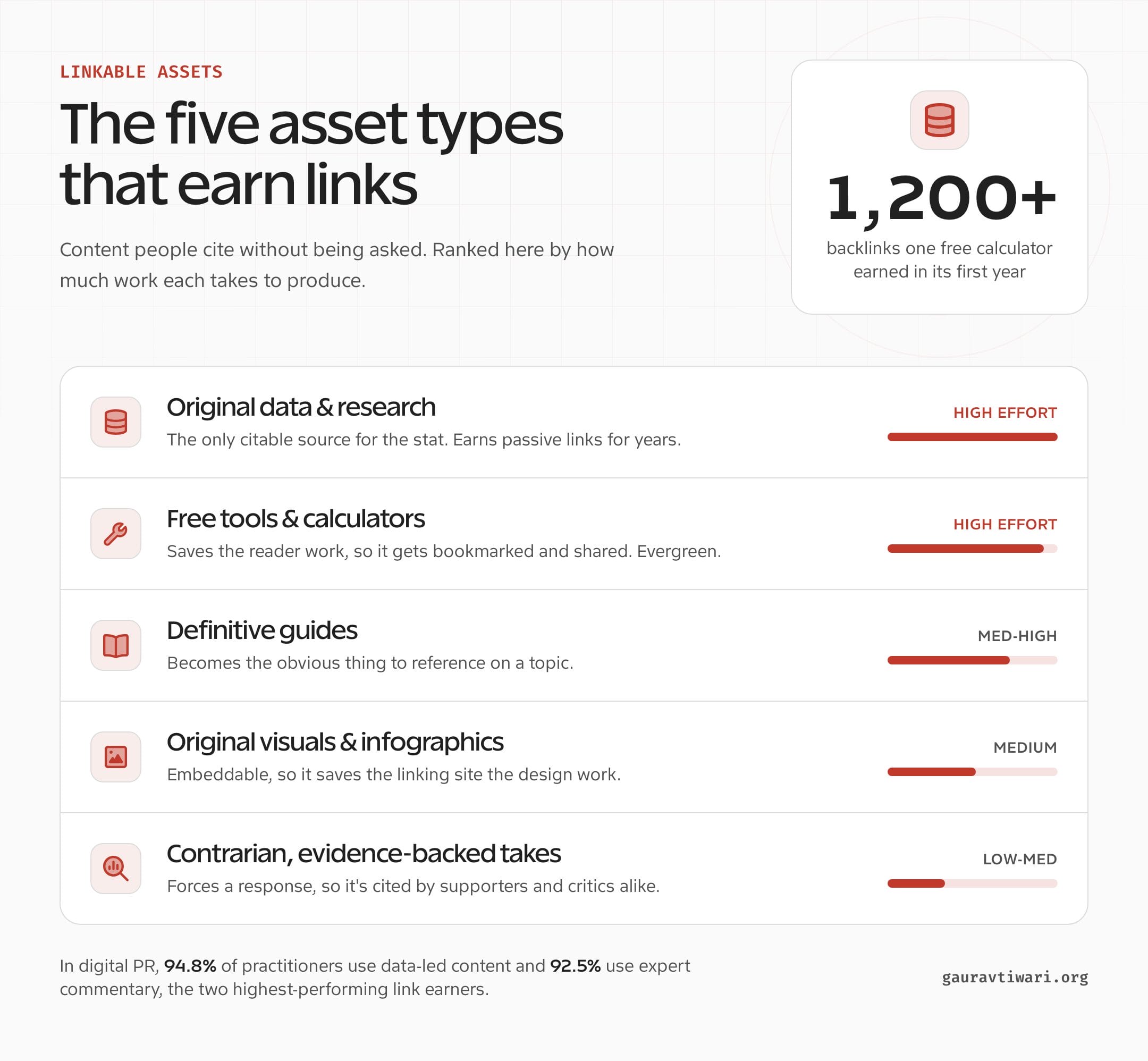
So which assets actually earn links? In 18 years of doing this across 800-plus client projects, the same seven types keep delivering: original data and research, free tools and calculators, definitive guides, original visuals and infographics, expert roundups, contrarian takes, and ego-bait. The rest of this post breaks each one down, how to build it, a real example, and the promotion it needs, because an asset nobody sees earns nothing.
- The verdict: if you run a small site, build one small original-data asset first, even a 100-person survey, because it’s the only type nobody else can copy and it earns passive links for years.
- What I’ve seen work: 18 years, 800-plus client projects, and the same handful of asset types keep pulling links while we sleep.
- The proof it’s not theory: one free retirement calculator earned 1,200+ backlinks in its first year with almost no outreach, and a single industry data report has produced 22 referring links plus 156% branded-search growth.
- The honest tradeoff: linkable assets cost real time up front and pay off slowly, so they’re the wrong move if you need traffic this week.
What changed: in the AI-search era, generative engines cite far fewer sources, so original data and expert commentary now carry outsized weight. Recent digital-PR data shows 94.8% of practitioners lean on data-led content and 92.5% use expert commentary, the two highest-performing link earners. Generic stat-stuffed infographics, by contrast, have stopped earning links.
Table of Contents
What a Linkable Asset Actually Is
A linkable asset is a piece of content built with one job: to be the thing other writers reference when they need to back up a point. Not your homepage, not your service page, not a thin 600-word blog post that says the same thing 40 other sites already said. A linkable asset gives someone a reason to link. It hands them a statistic they can’t find elsewhere, a tool that saves their reader ten minutes, or a definition so clean they’d rather cite you than rewrite it.
Here’s the test I use. Read your own page and ask: would a journalist or another blogger link to this instead of writing their own version? If the answer is no, you’ve made content, not an asset. The difference is information gain. Your page has to contain something that doesn’t already exist on the first page of Google for that query. That’s the bar. Everything below clears it in a different way. If you want the full backlink playbook around these assets, read my ultimate guide to backlink building strategies, which covers outreach, anchor text, and the link types that still move rankings in 2026.
The Seven Asset Types That Earn Links
Original Data, Research, and Surveys
This is the single most powerful linkable asset, and it isn’t close. When you publish a number nobody else has, you become the only citable source for it. Every writer who wants to say “X percent of marketers do Y” needs a source, and if you’re that source, you get the link. Data assets earn what link builders call passive citations, links you never asked for, accumulating for years.
How to build one: survey your audience, mine your own product data, or analyze a public dataset nobody bothered to crunch. You don’t need a thousand respondents. A focused survey of 150 people in a specific niche, presented with clear charts, beats a vague poll of 5,000. Pull out three or four headline stats, build a chart for each, and write a short methodology note so journalists trust the numbers.
Real example: Orbit Media’s annual blogging survey. They ask bloggers how long posts take, how often they publish, and what’s working. That one recurring study has pulled thousands of backlinks because anyone writing about content marketing reaches for those numbers. The promotion that makes it work: email every person you surveyed when it goes live, pitch the headline stat to journalists covering your niche, and turn each chart into a standalone social post that links back.
Free Tools and Calculators
A free tool is a linkable asset that keeps working long after you stop promoting it. People bookmark tools. They share tools in forums and Slack groups. Other bloggers link to a calculator because it does something their article can’t, it lets the reader plug in their own numbers and get an answer. A good tool earns links and signups at the same time.
How to build one: solve one annoying calculation your audience does by hand. A mortgage calculator, a profit-margin calculator, a reading-time estimator, a color-contrast checker. It doesn’t need to be complicated. The best tools do one job and load instantly. If you can’t code, a simple form built on a no-code platform or a single-page calculator gets you 80 percent of the value.
Real example: HubSpot’s Website Grader. You enter a URL, it scores your site, and it has earned links from tens of thousands of domains because every “best free SEO tools” listicle includes it. The promotion that makes it work: submit it to tool directories, post it in the niche communities where your audience already hangs out, and write a launch post explaining the problem it solves. Tools spread through word of mouth, so the first hundred users matter more than the next thousand.
Definitive Guides
A definitive guide earns links by becoming the obvious thing to reference on a topic. When someone mentions a concept in passing and wants to point readers somewhere for the full explanation, they link to the guide that covers it best. The key word is definitive. A 1,200-word “what is” post isn’t a linkable asset. The 5,000-word guide that answers every follow-up question is.
How to build one: pick a topic you genuinely know cold, then go deeper than anyone ranking for it. Cover the basics for beginners, the edge cases for experts, and the questions people ask in forums but never see answered. Structure it with clear headings so writers can link to the exact section they’re referencing. Strong on-page work matters here too, and my breakdown of the characteristics of high quality content that ranks covers what separates a guide that earns links from one that gets ignored.
Real example: Backlinko’s guides. Brian Dean built a brand on a handful of exhaustive, beautifully formatted guides that other SEOs cite constantly. The promotion that makes it work: update the guide every year so it stays accurate, reach out to anyone who linked to a weaker resource on the same topic, and break the guide into smaller posts that each link back to the full version.
Original Visuals and Infographics
Original visuals earn links because they save the linking site the work of making their own. A clear diagram, a data visualization, or an infographic gives another writer something to embed, and the embed almost always comes with a credit link. The catch in 2026: generic, stuffed-with-stats infographics are dead. What earns links now is one sharp visual that explains a single idea better than words can.
How to build one: take a process, comparison, or dataset and turn it into a diagram a reader understands in three seconds. Pair it with original data and you’ve stacked two asset types into one. Make it easy to embed by providing an embed code under the image. Keep the file clean and labeled with your brand so screenshots still credit you.
Real example: Information Is Beautiful built an entire site on visuals so well designed that publications license and link to them. The promotion that makes it work: pitch the visual to writers covering the topic, offer it free with attribution, and submit it to infographic and design galleries. A visual nobody embeds is just decoration.
Expert Roundups
An expert roundup earns links through the people in it. You ask 15 to 30 experts one good question, compile their answers, and publish. The links come because most experts share content they’re featured in, and some link to it from their own sites. It’s a linkable asset that also doubles as a relationship-building exercise with people in your niche.
How to build one: ask a question that’s specific enough to get real answers but open enough that experts have opinions. “What’s the one link-building tactic you’d keep if you could only use one?” beats “What are your SEO tips?” Make the experts look good, format their answers cleanly, and put a photo and link next to each contributor.
Real example: roundups have built early audiences for countless marketing blogs precisely because they tap other people’s reach. The honest tradeoff: roundup links have weakened over the years because the format got abused, so do them sparingly and only when the contributors are genuinely worth featuring. The promotion that makes it work: email every contributor a ready-to-share message and graphic the moment it publishes.
Contrarian and Controversial Takes
A contrarian take earns links because it gives people something to react to. When you argue against the consensus, everyone writing about the topic has to address your position, and addressing it usually means linking to it. Agreement is forgettable. A well-argued disagreement gets cited by both the people who love it and the people who want to prove you wrong.
How to build one: find a piece of accepted wisdom in your niche that you actually disagree with, then make the case with evidence. The word “actually” matters. Manufactured outrage gets ignored, and worse, it costs you trust. A real contrarian take comes from experience, “I ran this for 12 clients and the standard advice failed every time.” Back the opinion with proof or it reads as a stunt.
Real example: posts arguing “SEO is dead” or “stop doing guest posts” get linked to relentlessly because they force a response. The promotion that makes it work: share it where the debate is already happening, tag the people whose views you’re challenging, and be ready to defend the position in the comments. A take nobody argues with isn’t contrarian enough.
Ego-Bait
Ego-bait is content that features other people, who then link to it because it makes them look good. A “top 30 marketers to follow” list, a case study praising a client’s results, a tool you built that ranks people in your niche. The mechanism is simple: people link to things that flatter them. Done well, it’s a linkable asset and a networking play at once.
How to build one: feature real people who have audiences, and feature them for a real reason. A “best blogs in our niche” list works because the listed sites want to display the badge and link back. Give each person a reason to share, an embeddable badge, a quote you pulled from their work, a genuine compliment with substance behind it.
Real example: “best of” award lists that hand out badges, the recipients proudly link to the page showing they won. The promotion that makes it work: personally notify everyone featured, give them the badge code, and make the share effortless. The honest tradeoff: ego-bait links can be low authority, so use it to seed initial momentum, not as your whole strategy.
Asset Type Comparison
Here’s how the seven asset types stack up on the two things that matter most: how reliably they earn links, and how much work they take to produce. Use this to pick where to start based on the time and skills you have.
| Asset type | Why it earns links | Effort |
|---|---|---|
| Original data & research | Only citable source for the stat; earns passive links for years | High |
| Free tools & calculators | Saves the reader work; bookmarked and shared; evergreen | High |
| Definitive guides | Becomes the obvious thing to reference on a topic | Medium-High |
| Original visuals & infographics | Embeddable; saves linking site the design work | Medium |
| Expert roundups | Contributors share and link to content they appear in | Medium |
| Contrarian takes | Forces a response; cited by supporters and critics alike | Low-Medium |
| Ego-bait | Features people who link because it flatters them | Low |
The Best ROI Asset for a Small Site
If you run a small site with limited time, here’s my honest verdict: start with original data, even if it’s small. A focused survey of your own audience or a simple analysis of data you already have is the highest-ROI asset you can build, because it gives you something nobody else owns. You don’t need a research budget. You need one good question and 100 honest answers. That single asset will out-earn a dozen ordinary blog posts.
If a survey feels out of reach this month, the next best move is a contrarian take backed by your real experience. It costs nothing but a strong opinion and the evidence to defend it, and it’s the fastest asset to produce. Skip ego-bait and roundups until you have an audience to tap, the links they pull are weaker and the format is tired. Then wrap whatever you build in real promotion: an asset nobody sees earns nothing, and the best survey on the internet is worthless if it sits on a page with zero distribution.
One honest caveat, because linkable assets aren’t always the right call. If you need leads or sales inside the next 30 days, skip them. A good asset takes weeks to build and months to accumulate links, so a brand-new site with a launch deadline is better off with direct outreach and paid traffic first. They’re also a poor fit for a hyper-local service business, a plumber in one city, say, where a national data study earns links from people who will never become customers. Linkable assets win when you’re playing a long game in a niche where journalists, bloggers, and other site owners are actively looking for things to cite. If that’s not your situation yet, bookmark this and come back when it is.
Two things turn an asset into actual links. First, the right people have to see it, which is where blogger outreach for link building comes in, the targeted, non-spammy kind where you show a specific person why your asset improves their specific page. When you do pitch an asset directly, the difference between a yes and a no is the pitch itself, so it pays to pitch your guest posts and placements properly. Second, the asset has to sit inside a system that keeps producing, which is why I treat linkable assets as one pillar of a perfect content marketing plan rather than a one-off stunt. Build the asset, promote it properly, and let it earn links for years.
An asset still needs the right people to see it. My book Ultimate Guide to Backlink Building Strategies covers pitching a story rather than a link, and the broken link method, where your asset replaces a dead resource someone already links to.
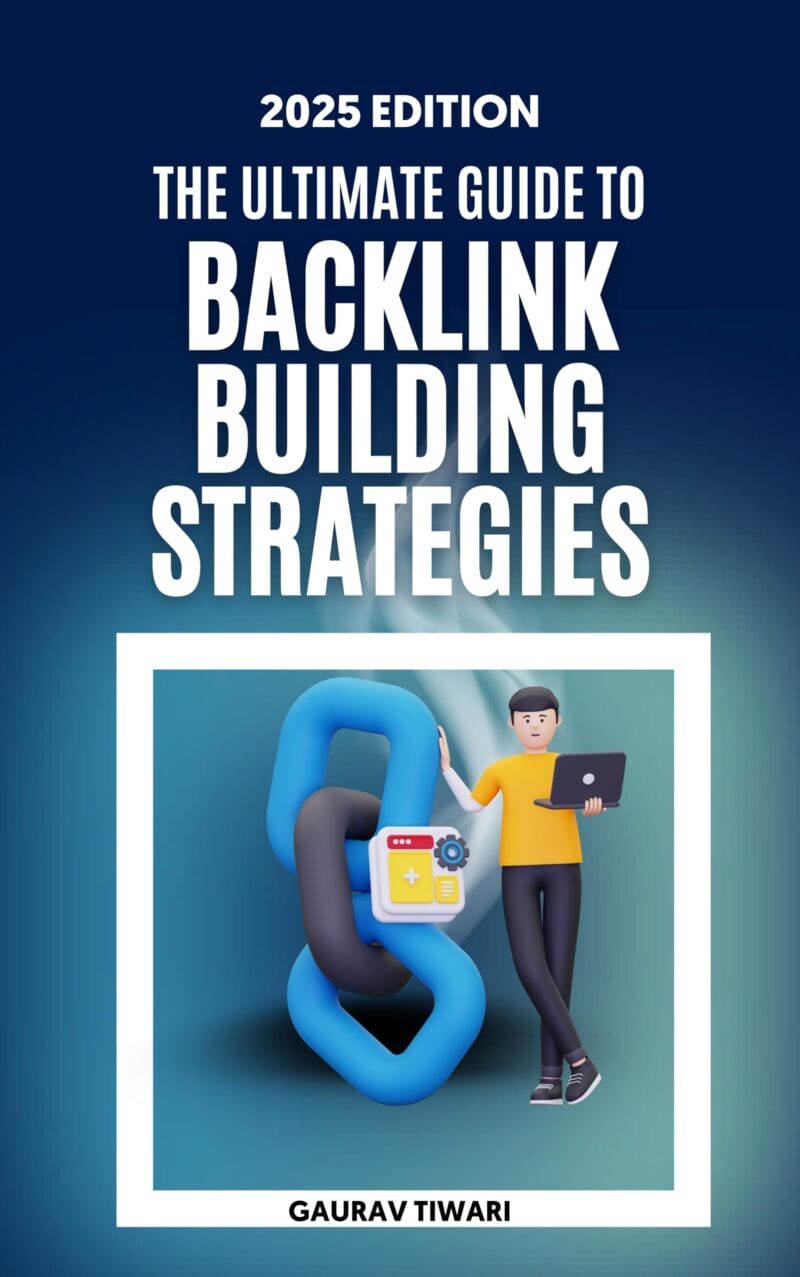
Ultimate Guide to Backlink Building Strategies
- 42 pages
- 4 methods
- Kindle + paperback
- Guest posting: where it still works and the pitch that gets past an editor
- Broken link building, step by step, with outreach and follow-up
- Journalist outreach after HARO shut down, and how to write a quotable response
- Digital PR with data and original research worth citing
- Which link metrics to watch and which to ignore
- Tactics that get sites penalized, including paid links
- Organized by method, so you can read the one you'll use
- Short enough to read in an evening
Price checked
- Free to read on Kindle Unlimited
Tell Google you want more of this.
Add Gaurav Tiwari as a preferred sourceOne tap, and this site shows up more often in your own Top Stories, AI Overviews and AI Mode. Remove it any time.
Disclaimer: This site is reader-supported. If you buy through some links, I may earn a small commission at no extra cost to you. I only recommend tools I trust and would use myself. Your support helps keep gauravtiwari.org free and focused on real-world advice. Thanks. - Gaurav Tiwari