by
by
Blogger outreach for link building still works when the email points an editor to something their page genuinely needs. It fails when the sender starts with a scraped list, swaps a first name into a template, and treats any reply as success.
The useful version is a measured editorial process: qualify the page, identify the person who can change it, make one specific case, follow up without pestering, and count live links rather than opens. If the asset is weak, stop before outreach and fix the asset.
My recommendation: start with 25 qualified prospects and one clear reason each editor may care. Scale only after you know your delivery rate, positive-reply rate, approval rate, and live-link rate. A small campaign can teach you why people said no. A 500-address blast usually hides the reason.
Does blogger outreach for link building actually work in 2026?
Yes, but no defensible public benchmark can promise how many emails will earn one backlink in your niche. The cleanest large-scale public evidence I found is a Backlinko and Pitchbox analysis of 12 million outreach emails, published in 2019. Its results support targeted personalization and follow-ups, not a universal conversion rate.
| Measure in the study | Reported result | What it can tell you |
|---|---|---|
| Initial email to one contact | 8.5% response rate | Most outreach received no reply. |
| Initial email plus one follow-up | 14.1% cumulative response rate | One follow-up added replies in this dataset. |
| Initial email plus two follow-ups | 17.1% cumulative response rate | The second follow-up added less than the first. |
| Personalized vs non-personalized subject | 21.8% vs 16.7% | Personalization was associated with more replies. |
| Personalized vs non-personalized body | 20.3% vs 15.3% | Specific body copy was also associated with more replies. |
The limitation matters. This was Pitchbox campaign data from 2019, and a response could be positive, negative, or a request to stop. It did not report how many emails produced editorial links that stayed live. Use the figures as directional evidence, then build your own baseline.
This is also where link building gets confused with inbox activity. Replies are an intermediate signal. The outcome is a relevant live link that an editor chose because the destination improves the page.
For the strategic role of links, see my ultimate guide to backlink building strategies. Outreach is one acquisition method inside that larger system.
Build a forecast before you send the first email
A forecast forces you to separate four rates that weak reports collapse into one. Use this formula: delivered emails x positive-reply rate x approval rate x live-link rate. Then compare the projected links with the hours and software cost required to earn them.
| Planning scenario | Delivery | Positive reply | Approval | Live after approval | Links per 100 sends |
|---|---|---|---|---|---|
| Conservative | 95% | 2% | 40% | 70% | 0.5 |
| Working case | 95% | 5% | 50% | 80% | 1.9 |
| Strong fit | 95% | 8% | 60% | 85% | 3.9 |
Those percentages are planning assumptions, not industry benchmarks. Replace them after every batch. If 100 sends produce five positive replies, two approvals, and one live link, your next forecast should use those observed stages instead of an internet average.
Track the denominator. Report results per delivered email, not per address in a spreadsheet. Separate all replies from positive replies, and verify that a promised link went live before counting it.
When blogger outreach isn’t worth it (build linkable assets instead)
Outreach is a poor first move when the destination adds nothing to the page you are pitching. No subject line can repair a thin article, recycled statistics, or a product page that benefits only the sender.
Invest in creating linkable assets that earn backlinks before outreach when:
- Your page makes the same claims as the current search results without new evidence.
- You can publish first-party data, a calculator, a template, or a documented test instead.
- The source you want replaced is newer, clearer, or more authoritative than yours.
- You cannot explain in one sentence how your page improves the editor’s article.
I would rather send no pitch than ask an editor to weaken a page. The asset should make the request easy to evaluate: newer data, a primary source, a clearer explanation, or a tool the reader can use.
Google’s current spam policies draw the boundary around the link itself. Buying or selling links for ranking, excessive exchanges, automated services that create links, and unqualified sponsored links are listed as link spam. Outreach does not make a manipulative placement editorial.
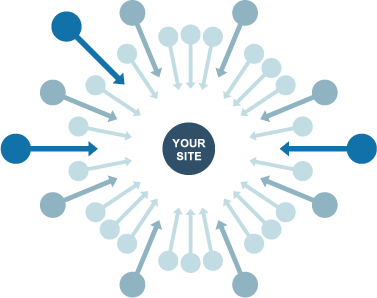
The blogger outreach process, step by step
Run outreach as five gates. A prospect moves forward only when it passes the current gate. This keeps a high authority score from masking poor relevance.
1. Find the right blogs to contact
Start with pages, not domain lists. The best prospect already covers your subject, links to supporting resources, and has a specific gap your asset can fill.
- Competitor backlink gaps. Compare the pages already earning links in Ahrefs or Semrush. Inspect the linking page before adding it to your list.
- Source replacement. Find pages citing an old, broken, secondary, or weaker source. Pitch the evidence gap, not your keyword.
- Unlinked coverage. Look for articles that discuss the problem your original data or tool solves but do not yet cite a useful resource.
Score each prospect before looking for an email. Give up to three points for topical relevance, three for evidence fit, two for editorial linking behavior, one for recent publishing, and one for contact confidence. Contact pages scoring seven or more. Reject obvious paid-link farms even if their authority metric looks attractive.
| Criterion | Points | Question |
|---|---|---|
| Topical relevance | 0-3 | Is the page directly about the problem your asset solves? |
| Evidence fit | 0-3 | Does your source fill a visible gap or replace weaker evidence? |
| Editorial link behavior | 0-2 | Does the site cite useful external resources naturally? |
| Freshness | 0-1 | Has the site published or updated relevant work recently? |
| Contact confidence | 0-1 | Can you identify the responsible author or editor? |
2. Find the right contact
Use the article byline first, then the editorial or content team. A generic inbox is a last resort. Hunter.io can help locate and verify an address, but a valid address does not mean the pitch is relevant or welcome.
Protect delivery before volume. Gmail’s sender guidelines require SPF or DKIM for all senders to personal Gmail accounts, valid DNS records, TLS, RFC 5322 formatting, and spam rates below 0.3%. Gmail recommends staying below 0.1%. Authentication cannot rescue unwanted mail, but missing it can block wanted mail.
3. Send a short, specific email
The editor should understand the context, evidence, and ask without scrolling through your biography. Mention the exact page, name the gap, show the useful part of your asset, and ask whether it belongs. One email should make one request.
- Context: the exact page or claim you read.
- Gap: what is outdated, missing, broken, or unsupported.
- Evidence: the number, source, tool, or explanation you can add.
- Ask: one sentence that leaves the editorial decision with the recipient.
The wording deserves its own pass. My guest post pitch checklist covers subject lines, angles, and email structure. Do not fake familiarity. A precise reason for writing is more persuasive than a generic compliment.
4. Follow up without turning the sequence into spam
One follow-up is supported by the large outreach dataset: the single-contact response rate rose from 8.5% after the initial email to 14.1% after one follow-up. A second follow-up brought the cumulative rate to 17.1%, a smaller gain. That does not mean every editor wants three emails.
Follow up only when the pitch remains relevant. Add a missing detail or make the decision easier. Then stop. A non-response is not permission to keep sending.
5. Track every stage, including the failures
A spreadsheet is enough for the first batches. Record prospect score, contact source, delivery, reply type, approval, live URL, date checked, time spent, and direct cost. Also record why a prospect failed: wrong person, weak fit, no reply, declined, promised but not live, or link later removed.
- Delivery rate: delivered emails divided by emails sent.
- Positive-reply rate: positive replies divided by delivered emails.
- Approval rate: accepted opportunities divided by positive replies.
- Live-link rate: verified live links divided by delivered emails.
- Cost per live link: labor plus software cost divided by verified live links.

Blogger outreach tools worth using
Use software to collect evidence and maintain the queue, not to manufacture relevance. One research tool, one contact verifier, and a spreadsheet cover most small campaigns.
| Tool | Best use | Limitation to watch |
|---|---|---|
| Semrush / Ahrefs | Backlink gaps and linking-page research | Authority metrics do not prove editorial fit. |
| Hunter.io | Finding and verifying work email addresses | Verification does not establish consent or relevance. |
| BuzzStream | Relationship history, sequences, and follow-up tracking | Automation can scale a weak list. |
| Pitchbox | Multi-client workflow and campaign reporting | More workflow than a small campaign needs. |
My starting stack is Semrush or Ahrefs for research, Hunter.io for email verification, and a sheet for the first 100 prospects. Add BuzzStream when relationship history and reminders become messy. Use Pitchbox when multiple campaigns and clients justify the workflow.
Common blogger outreach questions
These answers separate what the evidence can show from what your campaign still has to measure.
How many emails do I need to send to get one link?
There is no fixed number. In the working-case planning model above, 100 sends produce about 1.9 live links, or roughly 53 sends per link. That result comes from stated assumptions, not a benchmark. Replace each rate with your observed delivery, positive-reply, approval, and live-link data.
Is email outreach or social outreach better for links?
Email is easier to track and gives an editor room to evaluate a source. Social can establish recognition, but a public comment is a poor place to negotiate an editorial link. Use the channel where the responsible person handles source suggestions, and do not duplicate the same pitch everywhere.
Will AI-personalized outreach get me penalized?
Google’s Search policies address manipulative links, not which tool drafted your email. AI assistance does not make an editorial link spam, and human-written copy does not make a paid ranking link safe. The policy risk appears when automation, payment, exchanges, or low-value content creates links mainly to manipulate rankings.
What legal rules apply to blogger outreach email?
Rules depend on the sender, recipient, location, and message. In the United States, the FTC says CAN-SPAM covers commercial email, including business-to-business messages. It requires accurate headers, non-deceptive subjects, a valid postal address, a clear opt-out method, and honoring opt-outs within 10 business days. Other jurisdictions can require consent, so get legal advice for the markets you contact.
What good outreach actually looks like
Good outreach is a source suggestion an editor can judge in a minute. The page is relevant. The gap is visible. The asset adds evidence or utility. The sender accepts no as a complete answer. The campaign records a link only after it is live.
The email cannot carry a weak destination forever. link building starts with a page worth citing, and high-quality content that ranks gives the editor a defensible reason to cite it. Build the evidence first. Then send fewer, better pitches and measure the full path to a live link.
If you want the pitch itself broken down, my book Ultimate Guide to Backlink Building Strategies walks through guest post pitches, broken link outreach and journalist responses in 42 pages, organized by method.
Ultimate Guide to Backlink Building Strategies
- 42 pages
- 4 methods
- Kindle + paperback
- Guest posting: where it still works and the pitch that gets past an editor
- Broken link building, step by step, with outreach and follow-up
- Journalist outreach after HARO shut down, and how to write a quotable response
- Digital PR with data and original research worth citing
- Which link metrics to watch and which to ignore
- Tactics that get sites penalized, including paid links
- Organized by method, so you can read the one you'll use
- Short enough to read in an evening
Price checked
- Free to read on Kindle Unlimited
Tell Google you want more of this.
Add Gaurav Tiwari as a preferred sourceOne tap, and this site shows up more often in your own Top Stories, AI Overviews and AI Mode. Remove it any time.
Disclaimer: This site is reader-supported. If you buy through some links, I may earn a small commission at no extra cost to you. I only recommend tools I trust and would use myself. Your support helps keep gauravtiwari.org free and focused on real-world advice. Thanks. - Gaurav Tiwari