
 by
by
The best phablets under ₹10,000 in India in 2026 are nothing like the budget phones of a few years ago. For under five figures you now get 5G, big AMOLED or 120Hz LCD screens past 6.7 inches, 50MP cameras, 5,000-6,300mAh batteries, and chips that handle UPI, WhatsApp, Reels, and casual gaming without stuttering. The term “phablet” used to mean an oversized phone. Today every phone in this bracket is one, so the real question isn’t size, it’s which model gives you the most for your money.
I’ve watched this segment closely for years, and 2026 is the best it has ever been. A competent sub-₹10,000 phone today outpaces a 2019 flagship on screen, battery, and connectivity. The catch is the noise: a dozen brands launch near-identical phones every quarter, most loaded with bloatware and thin on software updates. So I cut through it.
This is my 2026 ranking of the top phablets under ₹10,000 in India, with a clear pick for every priority: battery, brand support, cameras, durability, and raw value. Each one is a phone I’d actually recommend to a family member. If you’re upgrading, read my guide on getting the best offer for your old phone first, the trade-in can knock a chunk off these prices.
Best phablets under ₹10,000 in India at a glance
Short on time? Here’s the shortlist for 2026, sorted by what each phone does best. Prices in this segment move week to week with sales and bank offers, so treat these as the range to hunt under.
- POCO C75 5G — Best overall value. Snapdragon 4s Gen 2, 6.88-inch 120Hz screen, 50MP camera, 5G. The most phone per rupee.
- Samsung Galaxy F06 5G — Best brand support. One UI, four years of security updates, Samsung’s service network.
- Redmi A7 Pro 5G — Best performance. Segment’s fastest processor and a huge 6,300mAh battery.
- realme Narzo 80 Lite — Best battery. A 6,300mAh cell that genuinely lasts two days.
- Lava Bold N2 5G — Best clean software. Near-stock Android, IP64, and free at-home service.
- Samsung Galaxy A06 5G — Best display. 6.7-inch 90Hz screen and a 50MP dual camera from Samsung.
- Tecno Spark Go 3 — Cheapest pick. IP64, drop-resistant, and the lowest price here.
- POCO C85 5G — Newest budget Poco. The latest C-series with 128GB storage and 5G as standard.
1. POCO C75 5G — best overall value
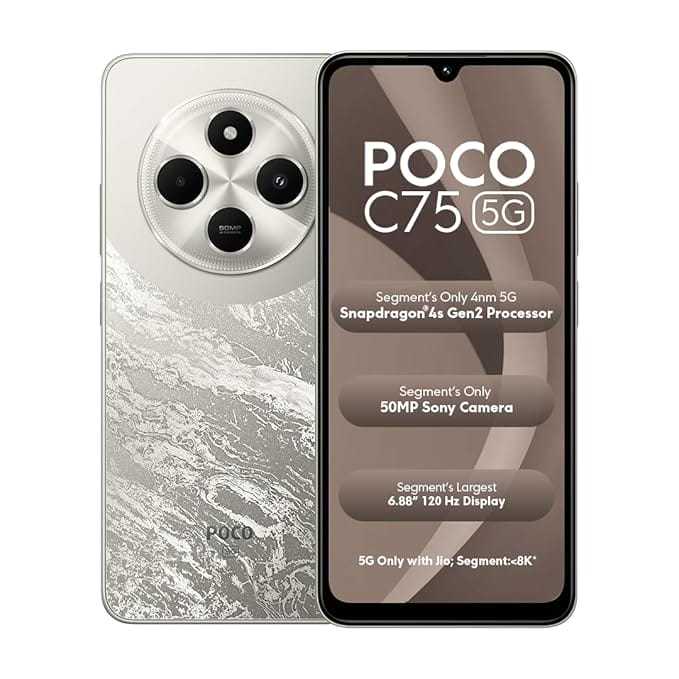
- 4nm Snapdragon 4s Gen 2, runs cool
- 6.88-inch 120Hz display
- 50MP Sony main camera
- 5,160mAh battery with 5G
The POCO C75 5G is the phone I’d hand most people shopping under ₹10,000. It pairs the segment’s only 4nm Snapdragon 4s Gen 2 with a big 6.88-inch 120Hz display and a 50MP Sony main camera, and it does 5G. That combination simply isn’t matched at this price. The 4nm chip matters more than the marketing suggests: it runs cooler and sips less battery than the older processors rivals still use, so day-to-day scrolling, UPI, and WhatsApp stay smooth and the 5,160mAh battery comfortably clears a full day.
It isn’t flawless. The display is a 120Hz LCD, not AMOLED, so blacks aren’t inky, and HyperOS ships with the usual preinstalled apps you’ll want to disable on first boot. But for the money, nothing else gives you a 4nm 5G chip, a 120Hz screen, and a 50MP Sony sensor together. If you want the most capable all-rounder and don’t care about brand badges, start here.
✅ Buy if you want the best mix of performance, screen, and 5G for the lowest price. It’s the default recommendation in this list.
❌ Skip if you specifically want an AMOLED panel or the longest software support, where Samsung pulls ahead.
2. Samsung Galaxy F06 5G — best brand and software support
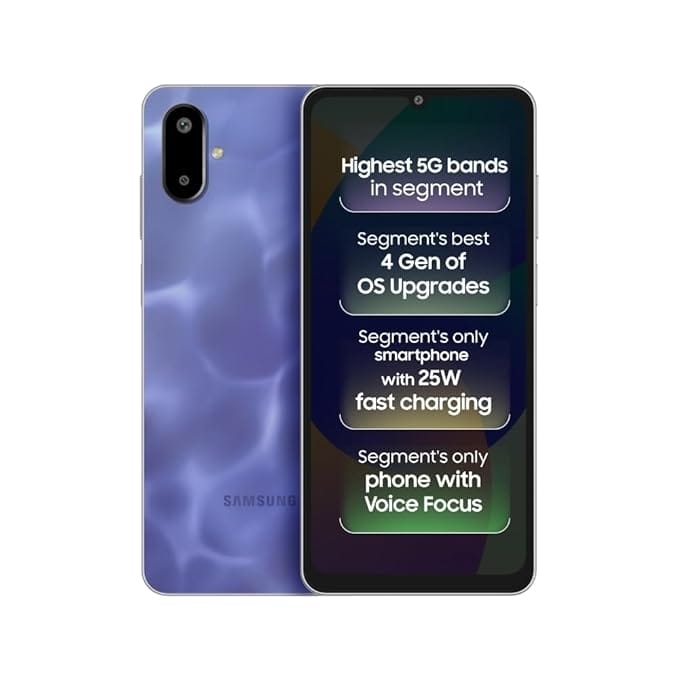
- Up to 4 years of security updates
- Clean One UI, light on ads
- Samsung walk-in service network
- 5,000mAh battery with 5G
If you want a phone that stays secure and serviceable for years, the Samsung Galaxy F06 5G is the smart buy. Samsung commits to four years of security updates on this phone, which is unheard of at this price, and its One UI is cleaner and less ad-ridden than most budget skins. The real, often-ignored advantage is the service network: Samsung has authorised centres in towns where Chinese brands only offer courier pickup, so a cracked screen or battery swap is far less of an ordeal.
You pay for that peace of mind with slightly weaker raw specs than the POCO, the processor is a step behind and the camera is good rather than great. But for a parent’s first 5G phone, a student who needs reliability, or anyone in a smaller city, the combination of long updates and walk-in service is worth more than a faster chip. It’s the safe pick, and that’s a compliment.
✅ Buy if you value long software support, a clean interface, and easy walk-in service over benchmark scores.
❌ Skip if you’re chasing peak performance per rupee, the POCO C75 and Redmi A7 Pro out-spec it.
3. Redmi A7 Pro 5G — best performance
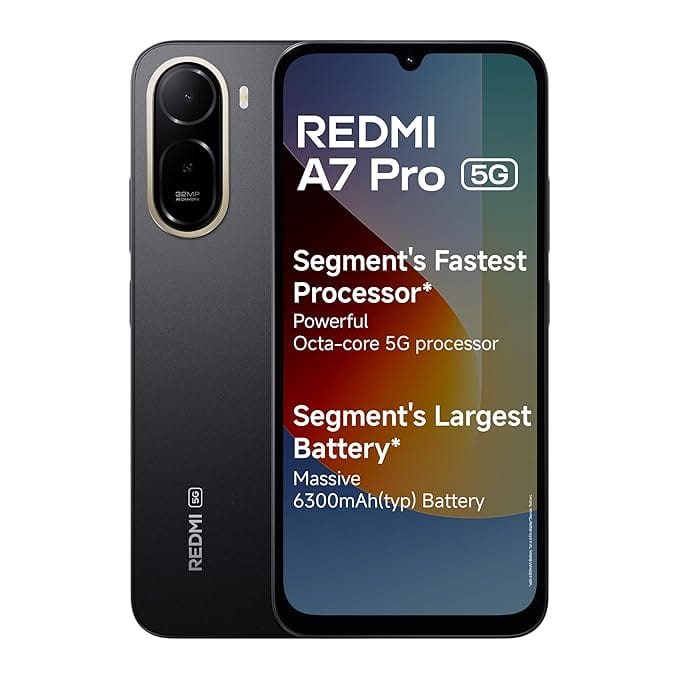
- Segment's fastest octa-core 5G chip
- Huge 6,300mAh battery
- Usable 32MP camera
- Wide Xiaomi spare-part support
The Redmi A7 Pro 5G leans hard into two claims printed right on the box: the segment’s fastest processor and the segment’s largest battery. Both hold up in daily use. The octa-core 5G chip keeps multitasking and casual games fluid, and the 6,300mAh battery is the kind of capacity that turns “charge every night” into “charge every other night.” For heavy users, gig workers, and anyone who lives on their phone all day, that battery is the headline feature.
It’s a Redmi, so you get the broad Xiaomi ecosystem and easy spare-part availability, plus a usable 32MP camera. The trade-offs are familiar: HyperOS bloat to clear out, and an LCD rather than AMOLED. But if you rank performance and endurance above everything, this is the most powerful phone on the list for the money. Pair it with my tips to boost gaming performance on Android and it punches above its price for light gaming.
✅ Buy if you want the fastest chip and biggest battery here, ideal for heavy all-day use and light gaming.
❌ Skip if you want stock-style software or the longest update commitment.
4. realme Narzo 80 Lite — best battery life
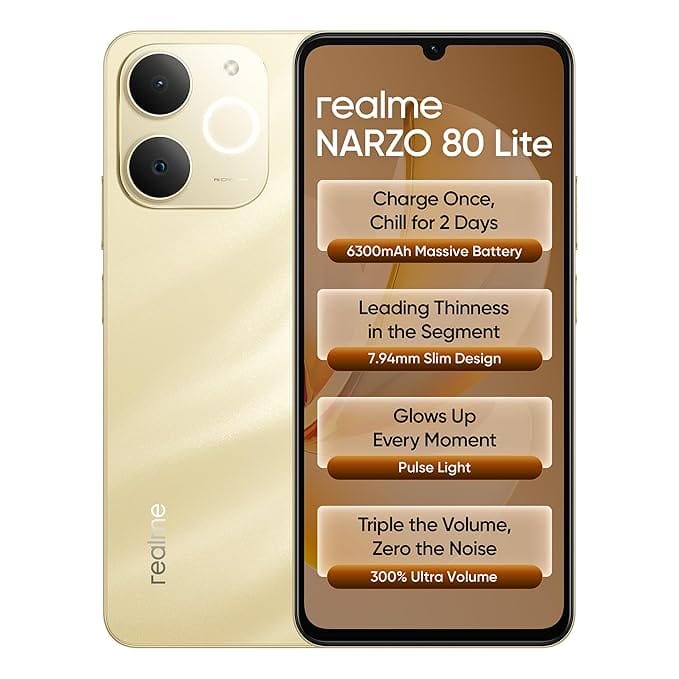
- 6,300mAh segment-biggest battery
- Two-day moderate use
- Large, bright display
- Available in 4G and 5G variants
The realme Narzo 80 Lite is built around one number: a 6,300mAh battery realme calls the segment’s biggest, and it backs the claim with two days of moderate use. If your day runs long, you travel, or you simply hate hunting for a charger, this is the phone that gets you home with charge to spare. It comes in 4G and 5G variants, so check the listing for the connectivity you want before you buy.
Around that big cell, the Narzo is a competent all-rounder: a large bright display, realme UI’s snappy animations, and a slim-feeling body despite the battery. The camera is average and the software pushes notifications you’ll want to mute, but for pure endurance nothing here beats it. This is the phone for the person whose only complaint about their last device was battery life.
✅ Buy if battery life is your top priority and you want two days between charges.
❌ Skip if you want guaranteed 5G, confirm the variant, since the Lite also sells as a 4G model.
5. Lava Bold N2 5G — best clean software
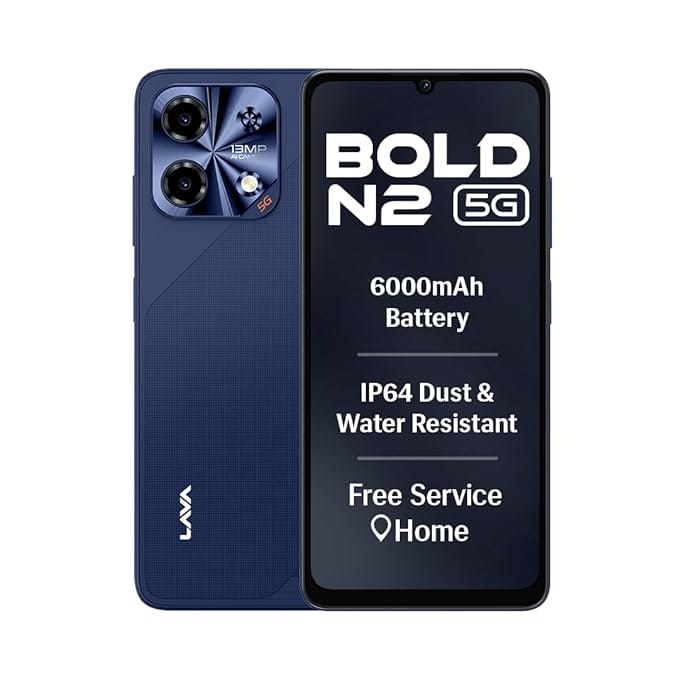
- Near-stock Android, no bloat
- 6,000mAh battery
- IP64 dust and splash resistant
- Free at-home service
The Lava Bold N2 5G is the pick for anyone tired of bloatware. Lava ships near-stock Android with almost no preinstalled junk, which makes a budget phone feel noticeably faster and cleaner than rivals running heavy skins. Add a 6,000mAh battery, IP64 dust and splash resistance, and the standout perk, free at-home service, and it becomes the easiest budget phone to live with, especially for first-time smartphone buyers and older users.
Being made in India, Lava’s service is genuinely local, and the free doorstep repair is a real differentiator nobody else offers at this price. The chip is modest and the 13MP camera is basic, so this isn’t the phone for gamers or shutterbugs. But for clean, no-nonsense daily use with the least hassle, the Bold N2 is underrated and deserves a spot on this list.
✅ Buy if you want clean stock-style Android, no bloat, and free at-home service.
❌ Skip if you want strong gaming performance or a standout camera.
6. Samsung Galaxy A06 5G — best display and cameras
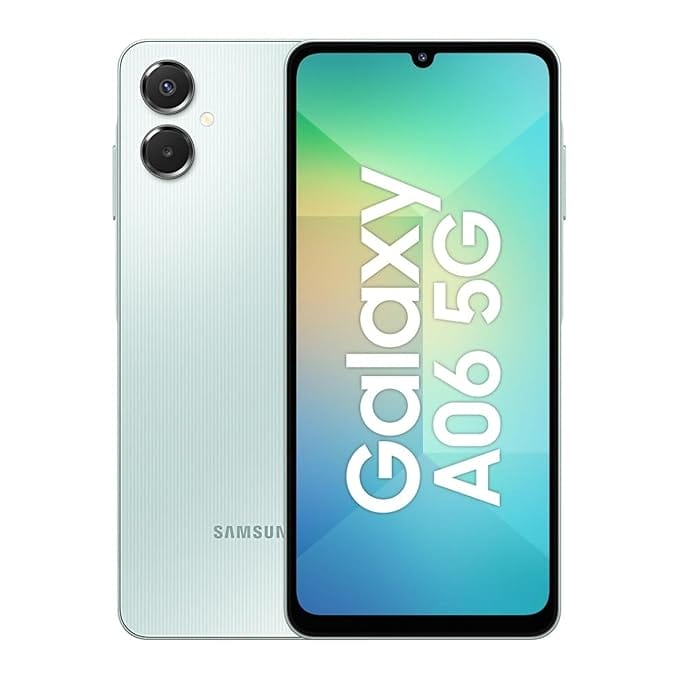
- 6.7-inch 90Hz HD+ display
- 50MP dual camera
- Samsung long updates and service
- 5,000mAh battery with 5G
The Samsung Galaxy A06 5G is the photography-and-screen pick. Its 6.7-inch 90Hz HD+ display is bright and smooth, and the 50MP dual camera produces the most consistently usable photos in this group, with Samsung’s reliable image processing doing the heavy lifting in good light. Like the F06, it inherits Samsung’s long update policy and walk-in service, so it ages well.
It sits at the top of the under-₹10,000 band, so you’re paying a small premium over the Chinese options, and the processor is tuned for efficiency rather than speed. But if you take a lot of photos, watch a lot of video, and want a recognised brand behind it, the A06 5G is the most well-rounded Samsung in this price range. It’s the phone that feels a class above its sticker.
✅ Buy if you want the best everyday camera and a smooth 90Hz Samsung display under ₹10,000.
❌ Skip if you’re on a tight budget, cheaper picks here give you more raw specs for less.
7. Tecno Spark Go 3 — cheapest solid pick
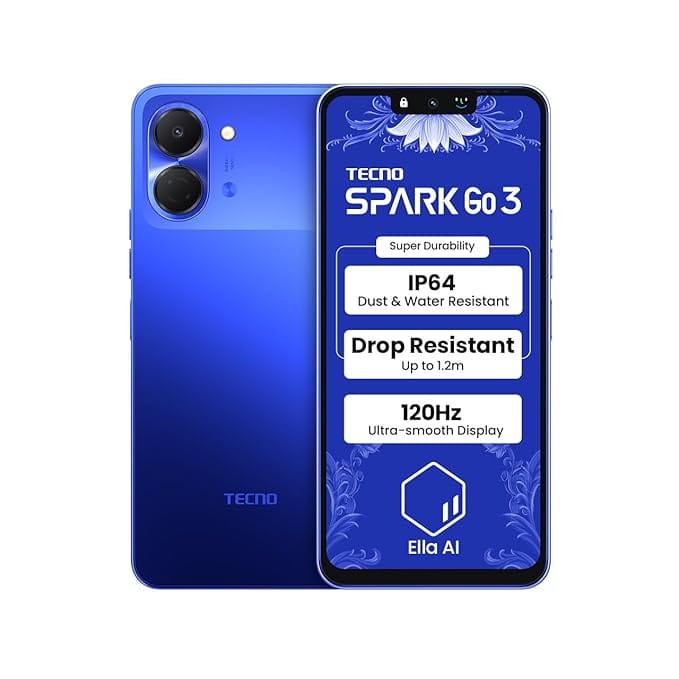
- Lowest price on this list
- IP64 rated, drop-resistant build
- Big screen for calls and chat
- Expandable storage via microSD
The Tecno Spark Go 3 is the entry point: the lowest price here, and surprisingly tough for it. It carries IP64 dust and splash resistance and a drop-resistant build, which is rare this cheap, so it’s a sensible first phone for a child, a backup device, or anyone who just needs reliable calling, WhatsApp, and UPI without spending much. The big screen and clean-enough interface cover the basics well.
Don’t expect speed or photography here, the chip and camera are basic, and the base storage fills quickly, so add a microSD card. But as the cheapest dependable phone on the list, with durability ratings the price has no business offering, the Spark Go 3 earns its place. It’s the “good enough, built to survive” option.
✅ Buy if you want the lowest price and a durable, no-frills phone for calls, chat, and payments.
❌ Skip if you want any real performance, camera quality, or storage headroom.
8. POCO C85 5G — newest budget Poco
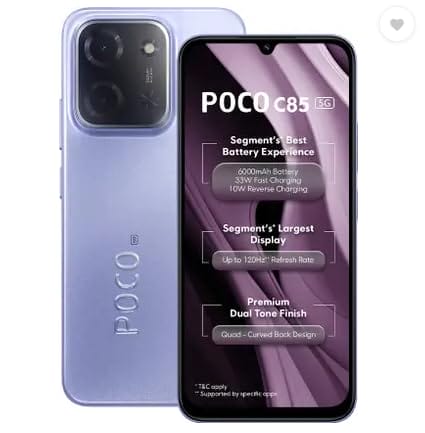
- Newest POCO C-series
- 128GB storage on the base model
- 5G as standard
- Big battery, clean design
The POCO C85 5G is the freshest C-series entry, and it modernises the budget formula: 5G as standard, 128GB of storage on the base model, and a big battery in a clean-looking body. If you like the POCO C75’s value but want the latest release with more storage out of the box, the C85 is the natural step. It’s a sensible future-proofing choice for buyers who keep a phone three or four years.
It’s close enough to the C75 that the better deal on any given day usually wins, so compare both prices before buying. HyperOS bloat applies here too. But as the newest budget POCO with generous storage and 5G, the C85 is a strong, current option that should stay relevant longer than older models still lingering on shelves.
✅ Buy if you want the newest budget POCO with 128GB storage and 5G, and it’s priced near the C75.
❌ Skip if the older POCO C75 is meaningfully cheaper that day, the experience is very similar.
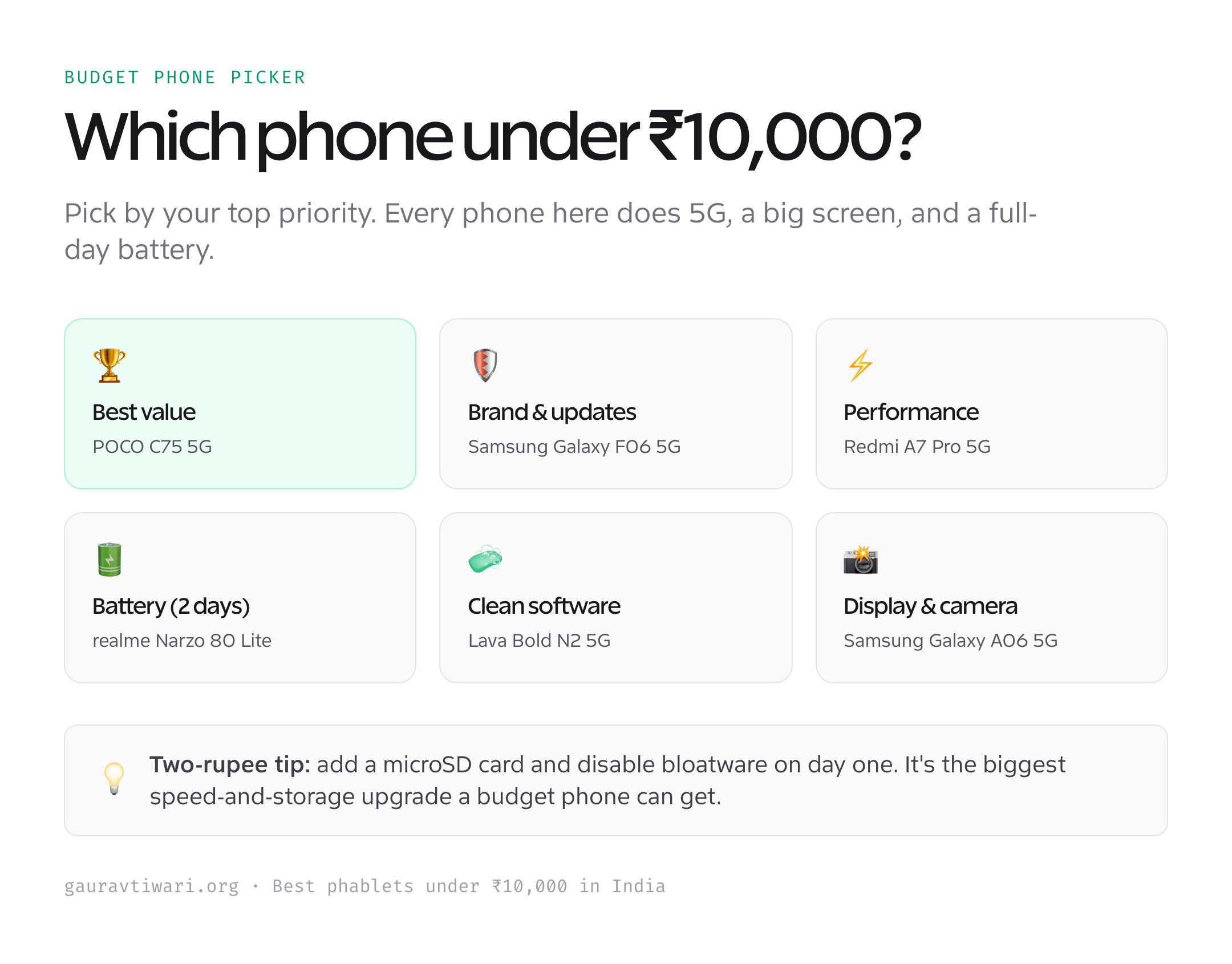
Phablets under ₹10,000 compared
Here’s the full lineup side by side. Pick the row that matches your top priority, then check the live price before you buy.
| Phone | Best for | Battery | 5G | Approx. price |
|---|---|---|---|---|
| POCO C75 5G | Overall value | 5,160mAh | Yes | ~₹7,999 |
| Samsung Galaxy F06 5G | Brand & updates | 5,000mAh | Yes | ~₹8,699 |
| Redmi A7 Pro 5G | Performance | 6,300mAh | Yes | ~₹8,999 |
| realme Narzo 80 Lite | Battery life | 6,300mAh | 4G/5G | ~₹8,999 |
| Lava Bold N2 5G | Clean software | 6,000mAh | Yes | ~₹7,999 |
| Samsung Galaxy A06 5G | Display & camera | 5,000mAh | Yes | ~₹9,749 |
| Tecno Spark Go 3 | Lowest price | 5,000mAh | 4G | ~₹6,999 |
| POCO C85 5G | Newest, storage | 5,000mAh+ | Yes | ~₹8,999 |
How to choose a phone under ₹10,000 in India
Specs blur together at this price. Here’s what actually matters when you’re spending under ₹10,000, and what’s just marketing on the box.
Do you really need 5G?
In 2026, yes, if you plan to keep the phone two or three years. 5G coverage from Jio and Airtel is now wide across Indian cities and growing in towns, and a 5G phone protects your purchase as networks shift. The myth worth busting: modern 5G modems are efficient, so 5G no longer wrecks battery the way early phones did. I covered the data in does 5G drain your phone battery faster. The short version: leave it on, the hit is small.
Battery and charging
This is where budget phones have genuinely leapt ahead. A 5,000mAh battery is the floor now; the Redmi A7 Pro and realme Narzo 80 Lite push to 6,300mAh for true two-day life. If you’re a heavy user or away from outlets a lot, prioritise capacity over almost everything else. Just temper expectations on charging speed, fast charging is usually modest in this band, so an overnight top-up is the norm.
RAM, storage, and the microSD card
Aim for at least 4GB RAM and 128GB storage if your budget allows; 64GB fills fast once WhatsApp media and apps pile up. Most phones here support a microSD card, so a cheap 128GB card is the smartest ₹800 you can spend to avoid “storage full” warnings. Don’t be fooled by “virtual RAM” claims, they borrow slow storage and help far less than real RAM.
Software updates and bloatware
Update commitment varies wildly. Samsung leads with up to four years of security patches; Chinese brands typically promise one to two; Lava keeps software clean but light on long-term updates. Whatever you pick, spend ten minutes on first boot disabling preinstalled games, news apps, and promotional notifications, it’s the single biggest speed and sanity upgrade on a budget phone.
Display: AMOLED vs 120Hz LCD
At this price you’ll mostly choose between a 120Hz LCD (like the POCO C75) and a 90Hz panel, with true AMOLED still rare under ₹10,000. A 120Hz LCD feels smoother for scrolling and is brighter outdoors, while AMOLED, when you find it, gives inkier blacks and richer colours for video. For most buyers, a high-refresh LCD is the better practical choice here: the fluidity you notice every minute beats the contrast you notice during movies. Don’t overpay for resolution either, HD+ is normal and perfectly sharp at this size; FHD+ is a nice bonus, not a dealbreaker.
Service and resale
The spec sheet ignores what happens when something breaks. Samsung and Lava win on walk-in and at-home service; Chinese brands often rely on courier repairs that take longer. Resale also favours recognised brands. And before you buy, set up phone-tracking, my list of apps to track a lost or stolen Android phone takes five minutes and can save you the whole price of the device.
Mistakes to avoid buying a budget phone
The same avoidable errors cost people money in this segment. Skip these:
- Chasing the highest megapixels. A 50MP sensor with weak processing loses to a well-tuned camera. Look at sample photos, not the number.
- Ignoring software support. A slightly slower phone with four years of updates beats a faster one abandoned in a year.
- Buying 4G to save ₹500. If you’ll keep the phone past 2027, the small 5G premium is worth it.
- Skipping the microSD card. 64GB feels fine on day one and painful by month three. Budget for expandable storage.
- Forgetting service access. In a smaller town, a brand with a local centre is worth more than ten extra benchmark points.
What ₹10,000 still can’t buy you
Budget phones have come a long way, but it’s worth being honest about the ceiling so you buy with clear eyes. Under ₹10,000, you won’t get flagship-grade cameras, the low-light shots will be soft and night mode is hit or miss. You won’t get fast 60W+ charging; expect modest speeds and overnight top-ups. You won’t get premium materials, optical-stabilised lenses, stereo speakers of any quality, or guaranteed multi-year OS upgrades beyond Samsung’s security patches.
What you do get is genuinely impressive for the money: smooth everyday performance, big high-refresh screens, all-day-plus batteries, 5G, and cameras that are great in daylight. The trick is to match a phone’s strengths to your real usage and accept its weak spots, rather than expecting a flagship for budget money. Set that expectation and any phone on this list will feel like a bargain rather than a compromise.
Which one should you buy?
For most people, the POCO C75 5G is the answer: the best blend of 4nm performance, a 120Hz screen, 5G, and a 50MP camera for the lowest realistic price. If you’d rather have long updates and easy service, the Samsung Galaxy F06 5G is the safe, sensible pick. Need maximum power and battery? The Redmi A7 Pro 5G. Want two-day endurance? The realme Narzo 80 Lite. Prefer clean software and free home service? The Lava Bold N2 5G.
Whatever you choose, buy during a sale, stack a bank offer, add a microSD card, and disable the bloatware on day one. Budget phones in India in 2026 are genuinely good, so the goal isn’t to find a perfect phone, it’s to match the right strengths to how you actually use it. For more ways to get the most from a new device, see my smartphone hacks guide.
Frequently asked questions
Which is the best phone under ₹10,000 in India in 2026?
For most buyers, the POCO C75 5G is the best phone under ₹10,000 in India right now. It combines a 4nm Snapdragon 4s Gen 2 processor, a 6.88-inch 120Hz display, a 50MP Sony camera, and 5G, a mix no rival matches at this price. If you prefer long software support and walk-in service, the Samsung Galaxy F06 5G is the strongest alternative.
Are 5G phones worth it under ₹10,000?
Yes, if you’ll keep the phone two or three years. 5G coverage from Jio and Airtel is now broad across Indian cities, and modern 5G modems are efficient, so the battery impact is small. Most phones on this list ship with 5G as standard. Only drop to 4G if you’re certain you won’t need 5G and the savings are significant.
Which budget phone has the best battery life?
The Redmi A7 Pro 5G and realme Narzo 80 Lite both pack 6,300mAh batteries, the largest in this segment, and genuinely last close to two days of moderate use. If battery life is your single biggest priority, choose one of these two over the others.
How much RAM and storage do I need in a budget phone?
Aim for at least 4GB of RAM and 128GB of storage. 64GB fills up quickly once apps and WhatsApp media accumulate. Most phones here accept a microSD card, so a 128GB card for a few hundred rupees is the cheapest way to avoid storage problems. Ignore inflated virtual-RAM claims, they help far less than real RAM.
Which budget brand gives the longest software updates?
Samsung leads at this price, committing to around four years of security updates on phones like the Galaxy F06 5G and A06 5G. Chinese brands such as POCO, Redmi, and realme typically promise one to two years. Lava keeps its software clean but is lighter on long-term update guarantees. For longevity, Samsung is the safest pick.
Should I buy online or from a local store?
Online, during sales, almost always wins on price thanks to bank and exchange offers, and you can read real buyer reviews. A local store helps if you want to hold the phone first or need instant replacement. Whichever you choose, compare the live price across Amazon and Flipkart, and factor in your old phone’s exchange value before deciding.
The bottom line
The phablets under ₹10,000 in India in 2026 prove how far budget phones have come: 5G, big high-refresh screens, two-day batteries, and capable cameras are now normal at this price. The POCO C75 5G is my overall pick for value, the Samsung Galaxy F06 5G for support, the Redmi A7 Pro 5G for power, and the realme Narzo 80 Lite for battery. There’s no single best phone, only the best one for how you use it.
Decide your top priority, buy in a sale with a bank offer, add a microSD card, and clear the bloatware on day one. Do that, and any phone on this list will serve you well for years, without spending more than ₹10,000.
Tell Google you want more of this.
Add Gaurav Tiwari as a preferred sourceOne tap, and this site shows up more often in your own Top Stories, AI Overviews and AI Mode. Remove it any time.
Disclaimer: This site is reader-supported. If you buy through some links, I may earn a small commission at no extra cost to you. I only recommend tools I trust and would use myself. Your support helps keep gauravtiwari.org free and focused on real-world advice. Thanks. - Gaurav Tiwari