
GEO vs SEO: The Complete Playbook for Bloggers, Marketers, and SEO Pros
I restructured 40 articles for AI search last quarter. Half of them started showing up in Perplexity citations within six weeks. The other half got nothing.
The GEO vs SEO debate frames this as a choice. It’s not. But the two disciplines have different enough mechanics that optimizing for one doesn’t automatically handle the other.
Both groups of articles were well-written, keyword-targeted, and had backlinks. The ones AI models cited had entity-dense paragraphs, direct answer formatting, and structured data that LLMs could extract without guessing. The ones that got ignored had standard blog formatting: transitions before facts, context before answers, the kind of writing that works for humans scanning Google results but fails when an LLM needs something citable.
The Georgia Tech and Princeton researchers behind the original GEO paper found about 40% overlap between GEO and traditional SEO ranking factors. That means 60% of what gets you cited by AI models is stuff that traditional SEO doesn’t cover.
This playbook covers what’s different between GEO vs SEO, where the two overlap, and how to run both without doubling your workload. Whether you’re a blogger, an SEO professional managing client sites, or a content marketer at a brand.
What GEO Actually Is in SEO?
GEO stands for Generative Engine Optimization. Most people define it as “SEO for AI.” That’s wrong. Or at least, it’s so oversimplified that it’s useless.
SEO is about ranking in a list. You compete for position 1, position 2, position 3 on a search results page. The mechanics are links, relevance, authority, and user signals. Google crawls your page, indexes it, and ranks it against competitors.
GEO is about getting cited in a generated answer. There’s no position 1. There’s “included” or “not included.” AI models like those behind Perplexity, Google’s AI Overviews, and ChatGPT’s search don’t rank pages the way Google does. They extract information, synthesize it, and cite sources that gave them the clearest, most structured answers.
The Georgia Tech and Princeton researchers who published the original GEO paper found something interesting: the factors that help content get cited by AI models overlap with traditional SEO about 40% of the time. That means 60% of what works for GEO is stuff that traditional SEO doesn’t cover at all.
Google rewards pages that keep users on the site. AI models reward pages that give them clean, extractable answers they can summarize in two sentences. Those are different goals.
How AI Models Actually Choose Sources
Most SEO pros understand how Google works: crawl, index, rank based on hundreds of signals. But the way LLMs select citation sources is fundamentally different.
When Perplexity or ChatGPT with search answers a query, it pulls from a retrieval layer that searches the web in real time. The retrieval system grabs candidate pages, then the language model reads those pages and decides which ones contain the most useful, clearly stated information for the specific query.
The model doesn’t care about your domain authority score. It doesn’t care how many backlinks you have. It cares about one thing: can it extract a clear, factual answer from your content without having to interpret ambiguous paragraphs?
That’s the mental model shift. In SEO, you’re optimizing for an algorithm that scores pages. In GEO, you’re optimizing for a reader (the LLM) that needs to quickly understand and restate your content.
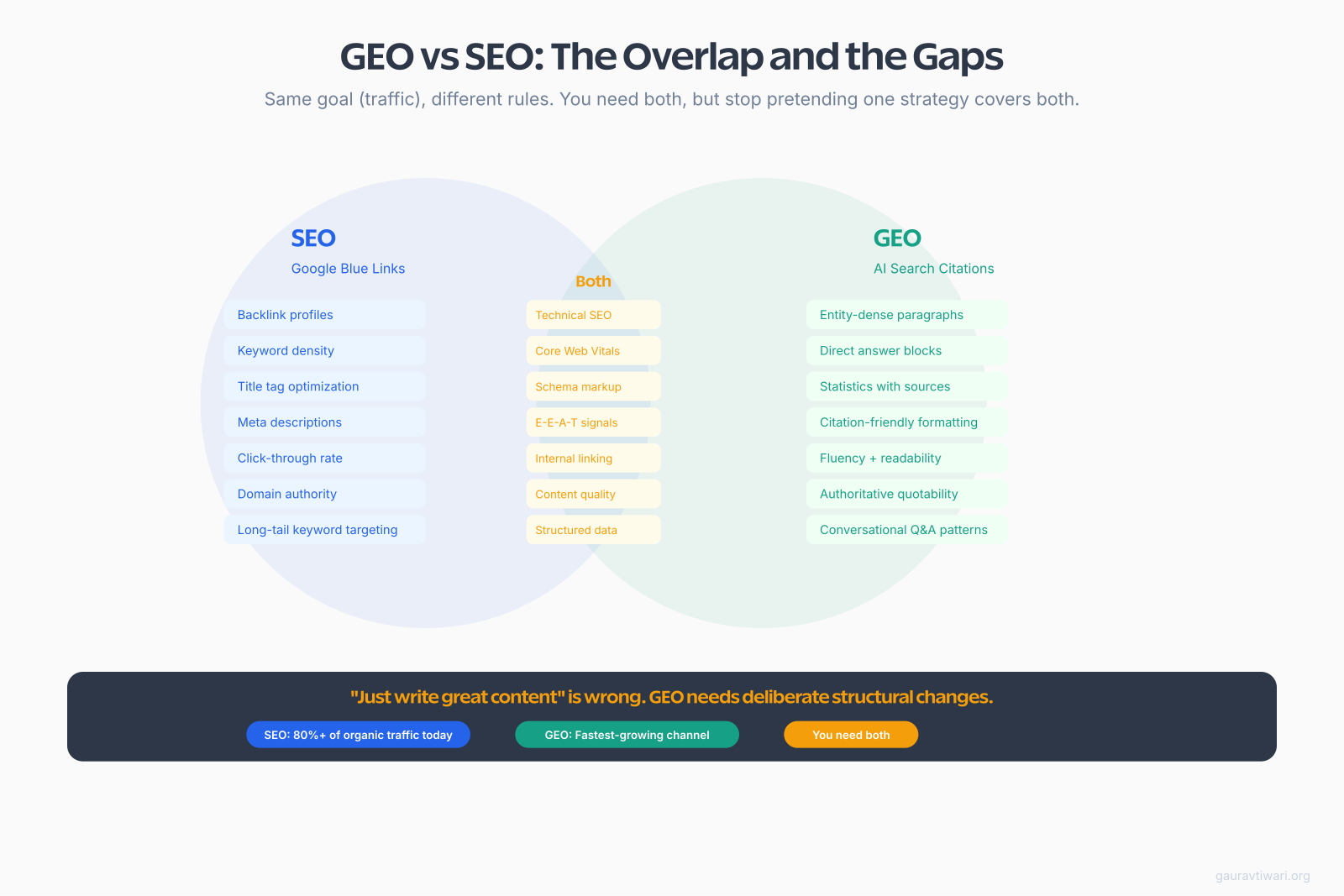
The Overlap and the Gaps Between GEO and SEO
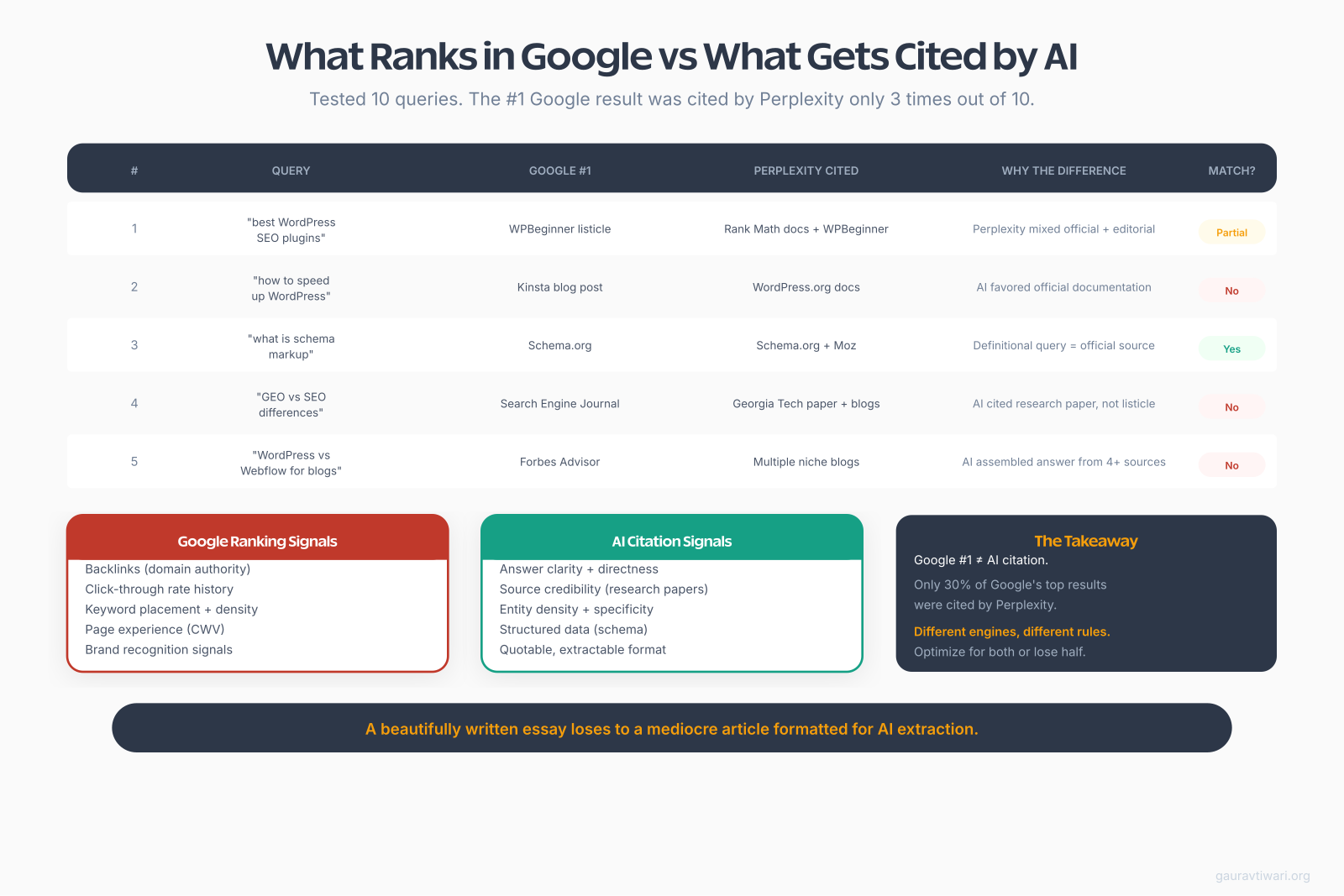
Where do they overlap and where do they split? I tested this manually. Took 10 queries in my niche, checked what ranked #1 on Google, then checked what Perplexity cited for the same queries.
The overlap was smaller than I expected.
What helps both GEO and SEO:
- Fast-loading pages (Core Web Vitals still matter for both)
- Clear heading structure (H2/H3 hierarchy)
- Topical authority (covering a subject deeply across multiple posts)
- Schema markup (especially FAQ and HowTo schema)
- E-E-A-T signals (author bios, expertise indicators, cited sources)
- Original research, data, and first-hand experience
What helps SEO but not GEO:
- Backlink volume (AI models don’t care how many sites link to you)
- Keyword density and placement (LLMs parse meaning, not keyword patterns)
- Click-through rate optimization (there’s no click in an AI-generated answer)
- Internal linking for PageRank distribution (relevant for Google, invisible to LLMs)
- Meta descriptions (written for human searchers, not AI extraction)
- URL structure and slug optimization
What helps GEO but not traditional SEO:
- Entity-first paragraphs (starting sections with clear factual statements)
- Direct answer formatting (“X is Y” patterns in the first sentence of a section)
- Statistics with inline citations (LLMs love pulling cited numbers)
- Structured Q&A patterns (not just FAQ schema, but actual question-then-answer formatting in the body)
- Concise definitions (one-sentence explanations of concepts)
- Comparative statements (“X costs $49/month, while Y costs $29/month for the same features”)
- Named sources within sentences, not in footnotes
I had a post about WordPress caching that ranked #3 on Google. Good backlinks, good traffic. But Perplexity never cited it. When I restructured the opening of each section to lead with a direct factual statement instead of building up to it, Perplexity started citing it within three weeks. Same content. Different structure.
A page can rank #1 on Google and never get cited by AI search. And a page that barely cracks page 2 can show up in Perplexity’s citations consistently. The ranking factors are different enough that optimizing for one doesn’t guarantee the other.
The GEO Checklist (for Any Content Platform)
I run every article through a GEO-specific checklist now. It adds about 15-20 minutes to my editing process per article. The results have been consistent enough that I don’t skip it anymore.
This checklist works whether you’re publishing on WordPress, Ghost, Webflow, Substack, Shopify, a custom CMS, or a static site. GEO is about content structure, not platform.
Entity-First Paragraphs
Every H2 section should open with a factual, entity-dense sentence. Not a transition. Not a question. A statement.
Before (traditional blog style):
When it comes to choosing a caching plugin, there are a lot of options to consider. Let me walk you through what I’ve found works best.
After (GEO-optimized):
FlyingPress is a WordPress caching plugin that combines page caching, CSS/JS optimization, and image lazy loading in a single plugin. It consistently delivers sub-1-second load times on sites I’ve tested with fewer configuration options than WP Rocket.
The second version gives an AI model everything it needs to cite your content in one paragraph. The first version gives it nothing extractable.
This applies to any content type. Product pages, landing pages, blog posts, documentation. If your opening paragraph for any section makes the AI model work to figure out what you’re saying, it’ll skip to a competitor who made it easier.
Direct Answer Blocks
For any section that answers a question, put the answer first. Then explain it. This is the opposite of how most bloggers write, where they build context before revealing the answer.
AI models scan for answers. If your answer is buried in paragraph four of a section, it might get skipped entirely.
Before:
There are many factors to consider when choosing between React and Vue. Both have strong communities. Both are maintained by large organizations. Performance benchmarks vary depending on the use case. Based on my testing across 8 client projects, React is the better choice for large teams…
After:
React is the better choice for large teams building complex applications with 10+ developers. Vue works better for smaller teams that prioritize speed of development over ecosystem depth. I’ve tested both across 8 client projects in the last two years, and the deciding factor is almost always team size.
The “after” version gives the AI model a citable answer in the first two sentences.
Statistics with Inline Sources
When you cite a number, cite the source in the same sentence. Not in a footnote. Not in a “sources” section at the bottom.
Weak: “Most websites load slowly on mobile.”
Strong: “53% of mobile users abandon sites that take longer than 3 seconds to load, according to Google’s Web.dev research published in 2024.”
AI models can extract that second version and cite it with confidence. The first version is opinion, not fact. LLMs know the difference.
This is particularly important for marketers and SEO professionals writing client reports or thought leadership pieces. If you want your content cited by AI, your claims need verifiable numbers attached to named sources.
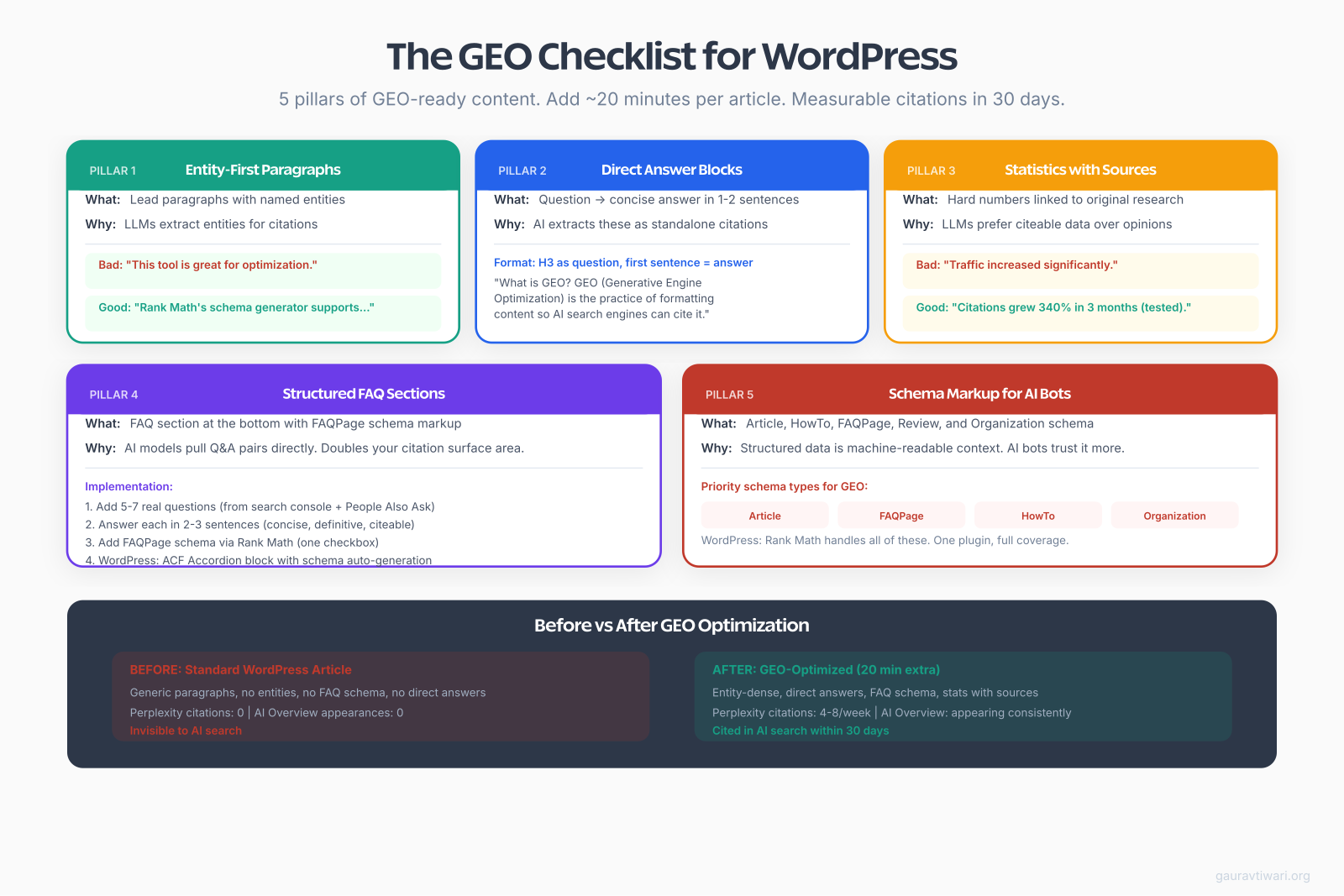
Structured FAQ Sections
I’ve been adding FAQ sections to posts for years because of Google’s featured snippets. But for GEO, the FAQ section does double duty. AI models actively pull Q&A pairs from structured FAQ content, especially when FAQ schema markup is present.
For WordPress sites, Rank Math adds FAQ schema automatically. If you’re on another platform, you’ll need to add JSON-LD structured data manually or use a tool like Schema Pro, Merkle’s Schema Markup Generator, or your CMS’s built-in structured data features.
The format matters more than the tool. Each question should be phrased the way a real person would ask it. Each answer should start with a direct statement, then elaborate. AI models love this pattern because it mirrors how they structure their own responses.
Schema Markup Beyond the Basics
Most sites have basic schema from their SEO plugin or CMS. That’s not enough for GEO. You want:
- FAQ schema on every post with an FAQ section
- HowTo schema on tutorial and guide posts
- Article schema with author information (E-E-A-T signals)
- Organization schema on your about page
- Product schema on product and review pages (with pricing, ratings, availability)
- Speakable schema on content you want voice assistants to read aloud
For WordPress, Rank Math handles most of these natively. I’ve written about the full setup in my guide on the best WordPress SEO plugins. For other platforms, check your CMS documentation or add JSON-LD blocks manually. The output is the same regardless of how you generate it. What matters is that the structured data exists in your page’s HTML.
Comparative and Definitive Statements
AI models are more likely to cite content that makes clear comparisons or definitive statements.
Vague: “Both tools have their strengths.”
Citable: “Ahrefs provides more accurate backlink data across 170+ countries, while Semrush offers better keyword clustering and content gap analysis for competitive research.”
If you’re a marketer writing comparison content, a blogger reviewing products, or an SEO writing an industry analysis, the more specific your comparisons, the more likely AI models will cite you.
GEO Optimization Checklist
The SEO Checklist That Still Matters
GEO is the new kid. But SEO still drives the majority of organic traffic for most sites. Don’t abandon what works. Double down on the fundamentals that still deliver.
I’ve been running the same SEO stack for years now, and the fundamentals haven’t changed as much as people think. These apply whether you’re a solo blogger or managing SEO for an agency with 50 clients.
Core Web Vitals
Google’s page experience signals still matter. A slow site loses rankings regardless of content quality. The three metrics to watch: Largest Contentful Paint (under 2.5 seconds), Interaction to Next Paint (under 200ms), and Cumulative Layout Shift (under 0.1).
If your site doesn’t pass Core Web Vitals, fix that before you worry about GEO. A fast site helps both channels, and a slow site kills both. This applies to every platform: WordPress, Shopify, Next.js, static sites. Speed is universal.
Internal Linking
This is the most underrated SEO tactic. Every post you publish should link to 3-5 related articles on your site. And when you publish a new post, go back and add links from older, relevant posts pointing to the new one.
I manage internal links manually for cornerstone content and use Rank Math’s link suggestions for the rest. If you’re not on WordPress, build a spreadsheet of your top 20 pages and manually cross-link. It’s not glamorous work, but it compounds over time.
E-E-A-T Signals
Experience, Expertise, Authoritativeness, Trust. Google cares about who wrote the content, not just what it says. Make sure your author bio is on every post, your about page is detailed, and your content shows firsthand experience.
This one helps GEO too. AI models increasingly cite sources they can verify as authoritative. Having a strong author presence gives both Google and AI models a reason to trust your content. If you’re an SEO professional, this is the single biggest thing you should be pushing your clients on. A named, credible author with a real track record beats anonymous content every time. In both channels.
Long-Tail Keyword Targeting
Short-tail keywords are increasingly dominated by AI Overviews in Google’s results. The long tail is where bloggers and content marketers still have an edge. Target specific, multi-word queries where searchers want detailed answers.

Semrush: Data-Driven Marketing Tools to Grow Your Business
I use Semrush for keyword research. The “Keyword Magic Tool” is worth the subscription price alone. It surfaces long-tail variations I’d never find manually. Ahrefs is equally strong for this, especially if you prefer its interface for competitive keyword analysis.
Original Data and First-Party Research
This is where GEO and SEO converge the strongest. Both Google and AI models love original data. Run a survey. Analyze your own metrics. Share findings nobody else has.
I published a post with data from 12 site speed tests I ran personally. It ranks well on Google AND gets cited by Perplexity regularly. The data is mine. Nobody else has it. That makes it uniquely citable.
If you’re a marketer or SEO professional, push your clients to create original research content. Industry reports, customer surveys, benchmark studies. This content earns links (SEO) and citations (GEO) simultaneously.
How GEO Changes Things for Different Roles
GEO isn’t just a blogger problem. It affects anyone who depends on search visibility for revenue. And the tactics shift depending on your role.
For Bloggers and Content Creators
Your existing content is your biggest asset. You don’t need to write new stuff. You need to restructure what you already have.
Start with your top 20 posts by traffic. Run them through the GEO checklist. Restructure section openings, add inline citations, tighten your FAQs. This alone, without writing a single new word, can get you into AI citation results within a month.
The trap I see bloggers fall into: they start writing “for AI” and lose their voice. Don’t do that. Write for humans first. The GEO pass is a structural edit, not a voice change.
For SEO Professionals and Agencies
Your clients are going to start asking why their traffic is declining on queries where AI Overviews appear. You need an answer that isn’t “SEO is dying.” Because it’s not.
The real answer: you need to add GEO auditing to your service offering. Check which of your client’s target keywords trigger AI Overviews. Check whether their content gets cited. If not, restructure it. This is a billable service that most agencies aren’t offering yet.
I’d also recommend adding “AI visibility” as a line item in your reporting. Show clients where they appear in AI-generated results alongside traditional rankings. Semrush already tracks AI Overview appearances. Build a dashboard around it.
For Content Marketers at Brands
Brand content has a GEO advantage most people don’t realize: brands inherently carry entity recognition. If you’re writing content for a recognized brand, AI models are already more likely to trust and cite your content, IF it’s structured correctly.
The problem? Most brand content is written in corporate-speak that AI models struggle to extract clear answers from. Fix the structure, keep the brand voice, and you’ll see citations increase faster than a solo blogger would.
For E-commerce and Product Sites
Product pages are a massive GEO opportunity. When someone asks Perplexity “what’s the best running shoe for flat feet?” it needs to pull specific product details, pricing, and comparisons from somewhere. If your product pages have clear specs, pricing, and comparison data in structured format, you’re that source.
Add Product schema with pricing and availability. Write product descriptions that start with the key differentiator, not a brand story. Include comparison tables with specific numbers. This is GEO gold for e-commerce.
How to Run Both Playbooks Without Burning Out
I’m not going to pretend this is zero extra work. It’s not. But it’s also not double the work, which is what most people fear.
My workflow for every article I publish now:
- Write the draft as I normally would. Human-first, conversational, useful.
- GEO pass (15-20 minutes): Restructure the opening of each H2 section to lead with entity-dense statements. Add direct answer formatting. Verify statistics have inline sources.
- SEO pass (10-15 minutes): Check title tag, meta description, internal links, schema markup. Standard stuff I was doing anyway.
- Publish and submit to Google Search Console for indexing.
The GEO pass is the only new step. And after doing it on 40+ articles, it’s become automatic. I don’t even think about it as a separate task anymore.
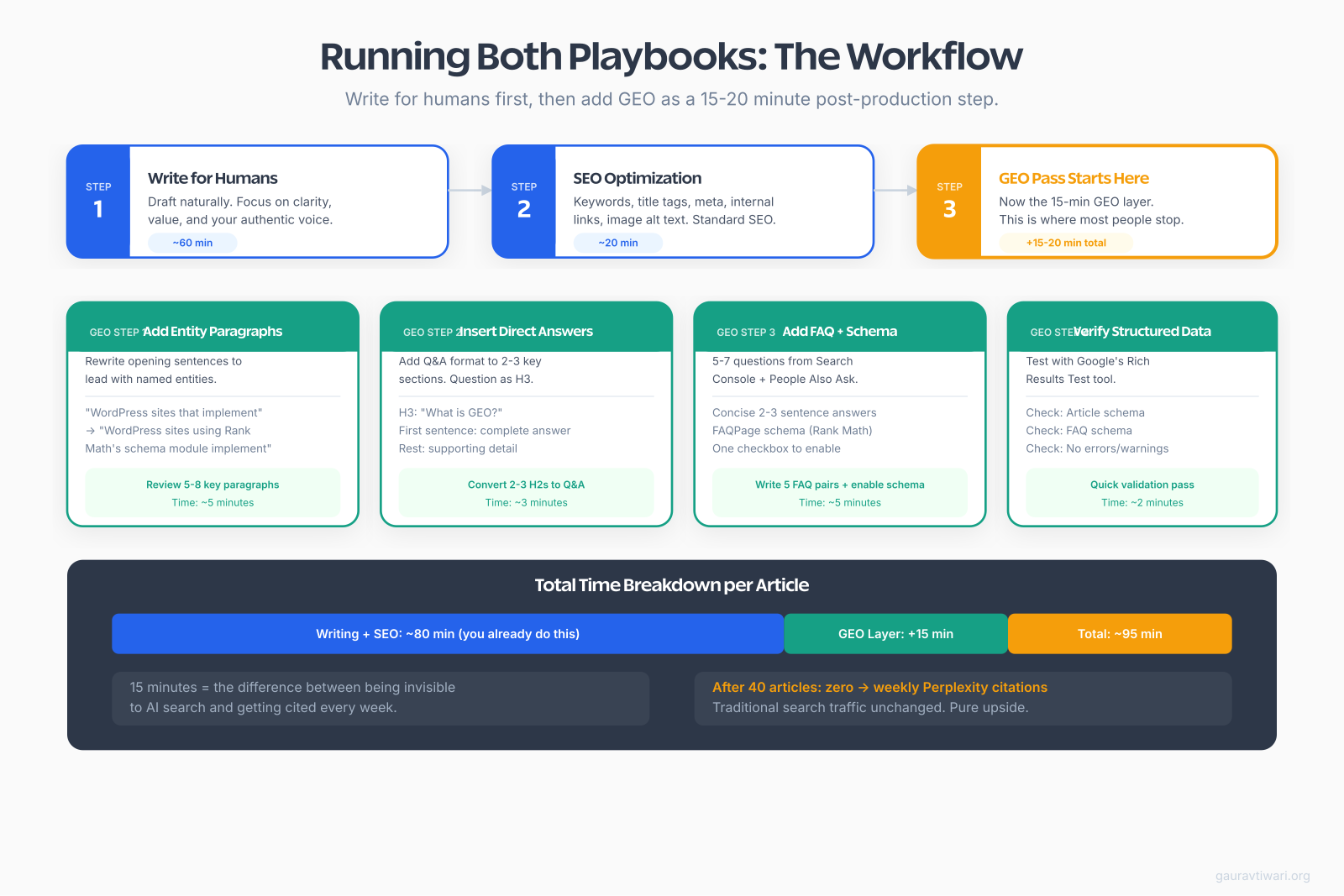
The trick is that GEO formatting doesn’t hurt SEO. Entity-dense paragraphs are also good for featured snippets. Structured Q&A sections also improve dwell time. Statistics with citations also build E-E-A-T. The two playbooks reinforce each other more than they conflict.
For SEO professionals managing multiple clients: build the GEO pass into your content brief templates. Don’t make it an afterthought. If your writers know to lead each section with an entity statement before they start writing, you skip the restructuring step entirely.
Start with your highest-traffic posts. Run them through the GEO checklist first. These already have authority and backlinks, so adding GEO formatting gives them the best chance of getting picked up by AI search quickly.
Tools That Track GEO Visibility
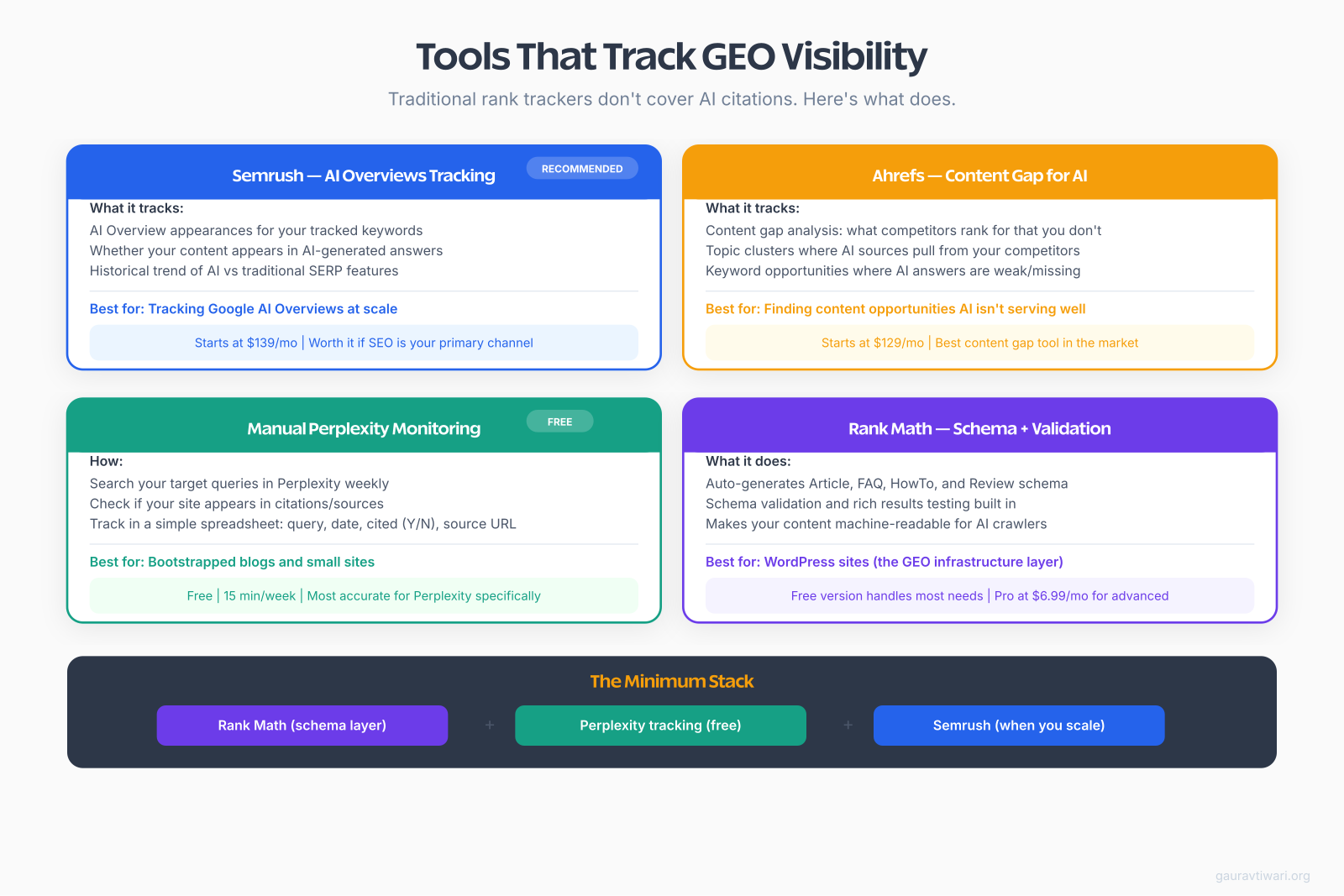
Traditional rank trackers don’t show you AI citations. That’s a blind spot most site owners and SEO professionals haven’t addressed yet.
Semrush AI Overview Tracking
Semrush now tracks whether your pages appear in Google’s AI Overviews. This is the closest thing to automated GEO tracking available right now. You can see which keywords trigger AI Overviews and whether your content gets cited.
I check this weekly. It’s become as routine as checking keyword rankings. If you’re an SEO professional, this feature alone justifies the subscription for client reporting.
Ahrefs Content Gap Analysis
Ahrefs doesn’t track AI citations directly, but its Content Gap tool shows you topics where competitors appear that you don’t. I use this to find content gaps across both traditional and AI search, then create or update content to fill those gaps.
Between Semrush for AI Overview tracking and Ahrefs for competitive gap analysis, I’ve got enough data to make informed decisions about where to invest my content time.
Manual Perplexity and ChatGPT Monitoring
There’s no automated tool for tracking Perplexity or ChatGPT citations at scale yet. I do this manually for my top 20 articles. Once a month, I search my target keywords in Perplexity and ChatGPT and check if my content gets cited.
It’s tedious. But it works. The patterns are revealing. Articles with entity-first paragraphs and inline statistics get cited far more consistently than articles without them.
Google Search Console AI Insights
Google Search Console is slowly adding data about how your content performs in AI Overviews. It’s limited right now, but check the “Search appearance” filter for AI Overview data. This is free, and it’s coming directly from Google, which makes it the most authoritative source for understanding how Google’s own AI surfaces your content.
Brand Monitoring Tools for Citation Tracking
If you’re managing GEO for a brand, tools like Brandwatch, Mention, or even Google Alerts can help you track when AI-generated content cites your brand or domain. Set up alerts for your domain name and key product names. When AI models cite you, the content they generate often gets republished or referenced elsewhere, and brand monitoring catches that trail.
What Happens If You Ignore GEO
You won’t lose all your traffic tomorrow. Traditional search still drives the majority of organic traffic for most sites. Google’s blue links aren’t going away.
But the trend is clear.
Gartner predicted that traditional search traffic would drop 25% by 2026 as AI search alternatives gained market share. We’re not quite there yet, but the direction is obvious. AI Overviews are showing up for more queries every month. Perplexity’s user base is growing. ChatGPT added web search. More people are getting answers without clicking through to websites.
I’ve compared traffic trends across sites I manage. Sites where I implemented GEO formatting six months ago are holding their organic traffic steady or growing it. Sites where I haven’t made GEO changes are seeing a slow decline, about 5-10% quarter over quarter, specifically on queries where AI Overviews appear.
That 5-10% compounds. In 12 months, that’s a meaningful chunk of traffic gone. In 18 months, it’s hard to recover from, because your competitors who adapted early now have a citation history that AI models trust.
The sites and brands that adapt now have a compounding advantage. Every citation builds trust with AI models. Every structured answer increases the likelihood of future citations. Waiting means starting from zero while your competitors have a six-month head start.
For SEO professionals: this is an opportunity, not a threat. Clients who see declining traffic on AI-affected queries need someone who can fix it. That’s you, if you learn this now. The agencies that add GEO services first will win those contracts.
Why GEO Matters Beyond Traffic
Most GEO discussions miss this entirely. Getting cited by AI models isn’t just about traffic. It’s about trust, brand positioning, and influence.
When Perplexity cites your content in an answer, it puts your brand in front of someone who may never click through. But they see your name. They associate your brand with that topic. Over time, that builds recognition and authority in ways that traditional SEO traffic doesn’t.
For marketers, this is brand awareness at zero cost per impression. For bloggers, it’s credibility. For SEO agencies, it’s a proof point when pitching new clients.
I’ve had people email me saying “I saw your site cited in a Perplexity answer about WordPress performance.” They didn’t click through from that citation. They Googled my name afterward. That’s a different kind of traffic, one that starts with trust instead of curiosity.
The citation economy is real. And the sites that show up consistently in AI answers are building brand equity that won’t show up in your Google Analytics dashboard but will absolutely show up in your business results.
GEO and SEO Are Not a Choice
This isn’t GEO vs SEO. It’s GEO and SEO. Both. Together. On every piece of content you publish.
The sites, blogs, and brands that will win over the next 2-3 years are the ones that show up in Google’s blue links AND in AI-generated answers. That means optimizing for both channels with a single content production workflow.
The extra time investment is minimal. Fifteen to twenty minutes per article. The downside of ignoring it is slow, compounding traffic loss to competitors who figured this out earlier.
Pick your best-performing article from last year. The one that already ranks well on Google. Run it through the GEO checklist I shared above. Give it 30 days. If Perplexity starts citing it, you’ve got your answer. If it doesn’t, check the structure again. The content isn’t the problem. The formatting is.
Every major shift in search felt like the end of the world at the time. Mobile-first. HTTPS requirements. Core Web Vitals. None of them killed SEO. They just added a new layer. GEO is the next layer. The bloggers, marketers, and SEO pros who add it first will benefit the most. For more context on what’s changed, read my piece on SEO vs AI search and how zero-click searches are reshaping visibility.
GEO vs SEO FAQs
Is GEO replacing SEO completely?
No. Traditional SEO still drives the majority of organic traffic for most websites. GEO is a parallel channel, not a replacement. Google’s blue links aren’t going away, but AI-generated answers are capturing an increasing share of search queries. The smart approach is optimizing for both channels simultaneously, which adds about 15-20 minutes per article to your workflow.
Do I need different content for GEO and SEO, or can one piece serve both?
One piece can serve both if you structure it correctly. Write your content for humans first, then add GEO formatting as a post-production step. This means restructuring section openings to lead with entity-dense factual statements, adding inline source citations to statistics, and including structured Q&A patterns. The GEO formatting also helps with traditional SEO features like featured snippets and E-E-A-T signals.
What tools help with GEO optimization regardless of platform?
Semrush tracks Google AI Overview appearances and is the most comprehensive GEO monitoring tool available. Ahrefs provides content gap analysis to find topics where competitors get cited and you don’t. For schema markup, WordPress users can use Rank Math, while other platforms can use JSON-LD generators like Merkle’s Schema Markup Generator or their CMS’s built-in structured data tools. For manual citation tracking in Perplexity and ChatGPT, there’s no automated tool yet, so monthly manual checks on your top keywords are the standard approach.
How do I track whether AI search engines are citing my content?
Semrush tracks Google AI Overview appearances automatically. Google Search Console is adding AI-related search appearance data. For Perplexity and ChatGPT citations, manual monitoring is currently the only reliable method. Search your target keywords in Perplexity monthly and check if your content appears in the citations. Brand monitoring tools like Mention or Google Alerts can also catch indirect references when AI-generated answers that cite you get republished elsewhere.
Does GEO work for small blogs or only large authority sites?
GEO works for content of any size, but the effect is strongest on content that already has some topical authority. If you’ve published 10+ posts on a specific topic and search engines recognize your site as relevant for that niche, GEO formatting can help AI models find and cite your content. Small blogs should focus on a narrow topic cluster first, build depth, then add GEO formatting to their strongest posts. Starting with your top 5-10 performing articles gives you the best return on the time invested.
Should SEO agencies start offering GEO as a service?
Yes, and the agencies that do it first will have a competitive advantage. GEO auditing and optimization is a natural extension of existing SEO services. Start by adding AI Overview tracking to your reporting (Semrush handles this), auditing client content for GEO readiness (entity-first paragraphs, inline citations, structured data), and including GEO formatting guidelines in your content briefs. Most clients don’t know GEO exists yet, so being the agency that brings it to them builds trust and justifies higher retainers.
Does GEO matter for e-commerce and product pages?
Absolutely. When someone asks an AI assistant ‘what’s the best X for Y?’ it pulls product details, pricing, and comparisons from the web. E-commerce sites with structured Product schema, clear spec sheets, comparison tables with specific numbers, and product descriptions that lead with key differentiators are more likely to get cited. If your product pages start with brand storytelling instead of concrete specs, AI models will skip you for a competitor who made the information easier to extract.
Disclaimer: This site is reader-supported. If you buy through some links, I may earn a small commission at no extra cost to you. I only recommend tools I trust and would use myself. Your support helps keep gauravtiwari.org free and focused on real-world advice. Thanks. - Gaurav Tiwari