
Best SaaS Blogs to Follow in 2026 for Real Growth
I have been building websites and marketing systems for over 16 years. In that time, I have worked with 800+ clients, including major brands from all across the globe. The one thing that separates founders who scale from those who stall? They read the right stuff.
Not just any content. The right blogs written by people who have actually built something.
Back in 2019, a client asked me to help them reduce their SaaS churn rate. I had opinions, but I needed data. A single article from ChartMogul on cohort analysis changed how I approached the problem. We dropped their churn from 8% to 4.5% monthly. That is the power of learning from people who have solved your exact problem before.
I have read hundreds of SaaS blogs over the years. Most are garbage. Recycled advice from people who have never shipped a product. Corporate content farms churning out keyword-stuffed articles that waste your time. But a handful of publications consistently deliver insights that actually move the needle.
SaaS is a different beast. You are not selling a one-time product. You are selling recurring value. That changes everything from how you acquire customers to how you retain them. And most generic marketing advice falls flat when applied to subscription businesses.
So I put together this list of SaaS blogs that have genuinely helped me and my clients grow. All great publications. No corporate PR disguised as thought leadership. Just real insights from people who have been in the trenches.
Why Following the Right SaaS Blogs Matters
Most SaaS founders I work with make the same mistake. They consume too much content and act on too little. Or worse, they follow outdated playbooks from 2018 and wonder why their CAC keeps climbing.
The SaaS game changes fast. What worked for customer acquisition two years ago might burn money today. AI is reshaping everything from onboarding to support. Product-led growth has matured from buzzword to necessity.
Good SaaS blogs help you stay ahead without drowning in noise. They give you frameworks you can actually implement. They share real numbers, not vanity metrics. And they often tell you what not to do, which is sometimes more valuable.
Here are the blogs worth your time in 2026.
SaaStr
Jason Lemkin built SaaStr into the largest SaaS community on the planet. The blog reflects that scale. You will find content covering everything from hiring your first VP of Sales to managing a $100M ARR company.
What I appreciate most is the raw honesty. Lemkin does not sugarcoat the hard parts of building a SaaS business. He talks about the painful founder decisions, the mistakes that cost millions, and the lessons that only come from watching thousands of companies grow or die. The man has seen more SaaS pitch decks than most people will see websites in their lifetime. That perspective shows.
I remember reading a SaaStr post in 2019 about why most VP of Sales hires fail. It completely changed how I advised a client on their sales leadership search. They avoided a costly mismatch that would have set them back six months.
The filtering system on their blog is excellent. You can sort content by your company stage, your role, and specific topics. Early-stage founder worried about pricing? There is a section for that. Series B CEO thinking about international expansion? Covered. This is not a blog that dumps everything into a chronological feed and hopes you find what you need.
Best for: Founders at any stage, especially those raising funding or scaling past $1M ARR.
Lenny’s Newsletter
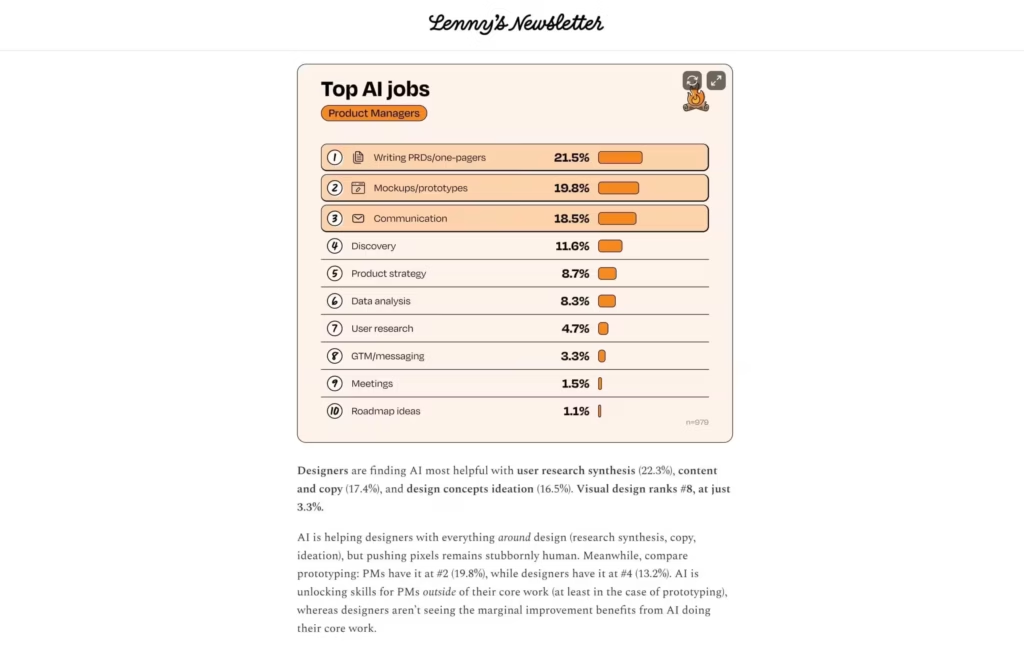
Lenny Rachitsky spent years as a product lead at Airbnb before launching his newsletter. Now he runs arguably the most influential product and growth publication in tech. Over a million subscribers. That is not an accident.
The depth on Lenny’s Newsletter is unmatched. Each issue tackles one specific problem and breaks it down with real examples from companies like Notion, Figma, Stripe, and DoorDash. You are not getting generic advice. You are getting the exact frameworks these companies used to grow.
His seven-part series on building a B2B SaaS business from zero should be required reading. It covers everything from validating your idea to scaling your growth engine, with specific tactics at each stage. I have sent that series to at least ten founders over the past year. All of them came back saying it changed their approach.
What sets Lenny apart is how he synthesizes information. He interviews dozens of operators for each piece. He surveys his audience for real data. Then he distills it into something you can actually use on Monday morning.
The paid subscription is worth it. Access to his Slack community alone can save you months of trial and error. Real operators answering real questions in real time.
Best for: Product managers, growth leads, and founders who want research-backed strategies.
First Round Review
First Round Capital has backed companies like Uber, Notion, Square, and Roblox. Their blog, First Round Review, is where they share what they have learned.
I call this the Harvard Business Review of startups, but actually useful. Each article goes deep on one specific challenge with advice from founders who have solved it. The quality bar is insanely high. No fluff pieces. No self-promotional nonsense.
Their recent work on the Product-Market Fit Method deserves special attention. It breaks down PMF into measurable dimensions and gives you a framework for systematically working toward it. This is the kind of content that can reshape how you think about building.
The writing style is polished but practical. You will walk away from every article with something you can implement immediately.
Best for: Early-stage founders who want tactical, deeply researched advice.
Tomasz Tunguz
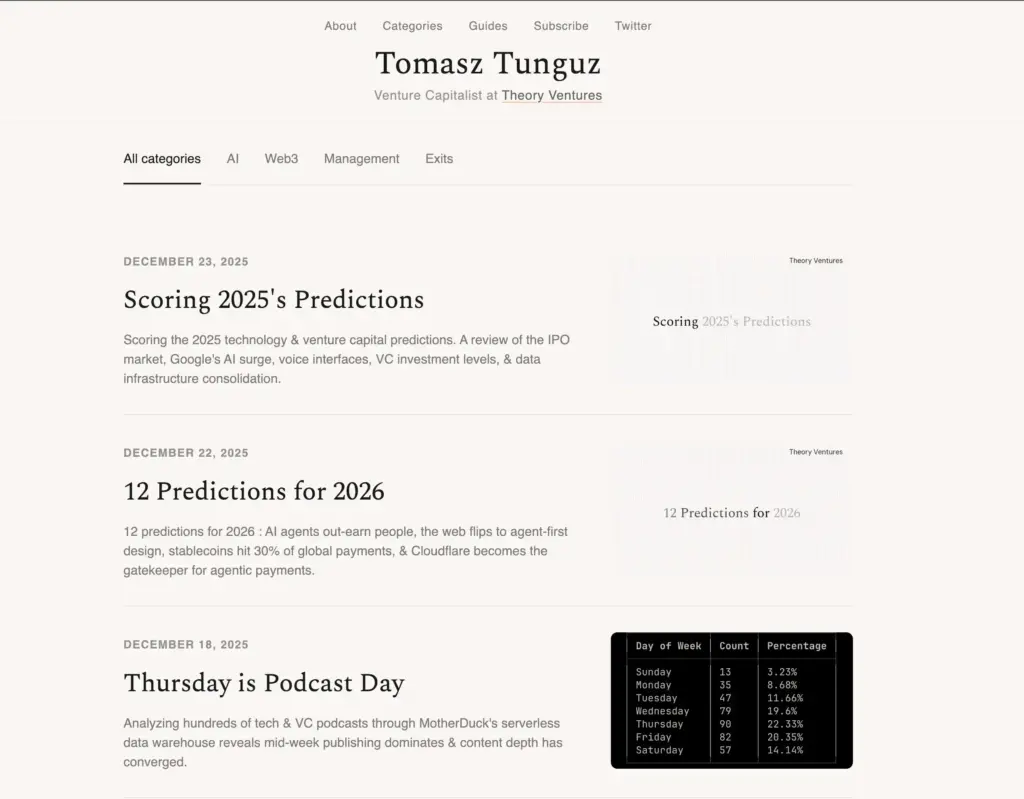
Tom Tunguz is a venture capitalist at Theory Ventures who has worked with eight unicorns. His blog at tomtunguz.com is data-driven in the best way. Charts, benchmarks, and analysis that actually help you understand where your company stands.
If you want to know what healthy SaaS metrics look like at different stages, this is your resource. Tom regularly publishes analyses of public SaaS companies, market trends, and the economics of software businesses.
His writing is concise. Most posts take five minutes to read but pack insights that would take hours to research yourself. I especially value his work on pricing strategy, sales team structure, and the impact of AI on SaaS valuations.
The newsletter has over 150,000 subscribers for a reason. Subscribe if you want your morning read to include actual data instead of opinions.
Best for: Founders, operators, and investors who want data-backed insights.
Ahrefs Blog
- Data-driven SEO research
- Actionable marketing guides
- Case studies with real results
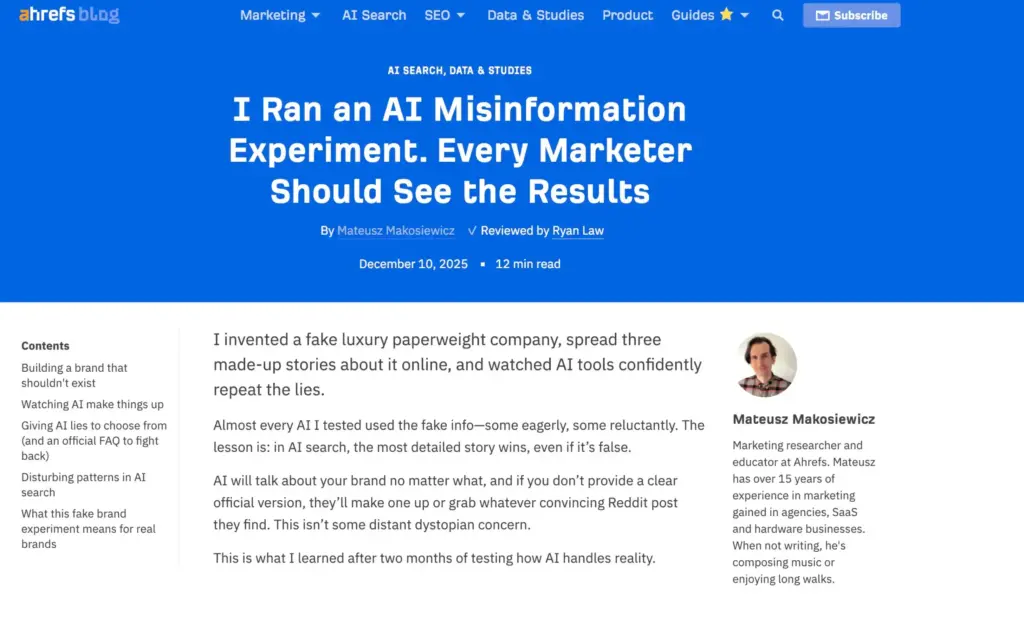
You might think of Ahrefs as just an SEO tool. But their blog is a masterclass in product-led content marketing. They have grown to over $100M ARR without a sales team for most of their existence. The blog drove that growth.
Think about that for a second. A $100M+ business built primarily on content and SEO. No cold calling. No enterprise sales team until very recently. Just helpful content that ranks and converts.
Every article teaches you something about SEO or content marketing while showing you how Ahrefs can solve your problem. It is not pushy. It is genuinely helpful. And the result is content that ranks for thousands of keywords and converts readers into customers. Their blog alone drives nearly 600K organic visits monthly.
For SaaS marketers, the meta-lesson is just as valuable as the tactical advice. Study how they structure articles, how they weave product mentions naturally, and how they prioritize topics based on business potential rather than just search volume. They have a scoring system for every keyword based on how well Ahrefs can solve the problem. That discipline is why their content converts.
I have used their blog as a reference when building content strategies for clients. The framework of business potential scoring alone has saved us from chasing vanity traffic that does not convert.
Best for: SaaS marketers focused on content and SEO-driven growth.
OpenView Partners Blog
OpenView coined the term “product-led growth.” Their blog at openviewpartners.com remains the definitive resource for understanding and implementing PLG strategies.
What sets them apart is the depth of original research. Their annual product benchmarks report is something I reference constantly when advising clients on metrics. They conduct expert interviews, build frameworks, and share data that you simply cannot find elsewhere.
The content covers pricing, packaging, freemium strategies, and expansion revenue. If you are building a self-serve SaaS product, this should be a regular read.
Best for: Founders and product leaders building product-led companies.
ProductLed
Wes Bush wrote the book on product-led growth. Literally. His book “Product-Led Growth” has become essential reading in SaaS circles. The blog at productled.com extends that thinking with practical frameworks and case studies.
The focus here is narrow but deep. Everything centers on using your product as your primary acquisition and conversion tool. You will learn about user onboarding, activation metrics, and building products that sell themselves.
If you are tired of burning money on paid acquisition and want to build sustainable growth into your product, start here.
Best for: Founders transitioning from sales-led to product-led models.
ChartMogul
ChartMogul is a subscription analytics platform, and their blog reflects that focus. This is where you go to understand SaaS metrics properly.
MRR, ARR, churn, LTV, CAC, NRR. These acronyms get thrown around constantly, but ChartMogul actually explains what they mean, how to calculate them, and what benchmarks to aim for. Their content turns complex financial concepts into actionable insights.
I send their churn analysis articles to clients regularly. Understanding why customers leave is often more valuable than knowing how to acquire new ones.
Best for: Founders and finance teams who need to master subscription metrics.
Inside Intercom
Intercom builds customer messaging tools, and their blog covers the customer experience side of SaaS exceptionally well. Topics range from onboarding and support to lifecycle marketing and product strategy.
The design and writing quality is high. Articles are well-researched and visually clear. They often feature insights from Intercom’s own journey, which adds credibility and specificity.
For anyone building customer-facing SaaS products, understanding how to communicate with users throughout their journey is essential. Intercom’s blog delivers that education consistently.
Best for: Product managers and customer success teams.
Close Blog
Close is a CRM built for salespeople, and their blog is one of the best resources for SaaS sales teams. The content is tactical, direct, and written by people who actually sell for a living.
Topics include cold outreach, sales scripts, pipeline management, and hiring salespeople. The advice is specific enough to implement immediately and honest about what actually works in B2B sales.
If you are building a sales-led SaaS company or adding a sales motion to your product-led business, this blog will save you expensive mistakes.
Best for: Sales leaders and founders building sales teams.
Gong Blog
Gong analyzes millions of sales calls, and their blog shares insights from that data. This is sales advice backed by actual conversation analysis, not just opinions.
You will learn what top performers do differently, how to structure discovery calls, and what language patterns correlate with closed deals. The data-driven approach makes the advice unusually credible.
Best for: Sales teams who want to improve based on data.
Read this first: Their analysis of what separates top sales performers.
HubSpot Blog
- In-depth marketing guides
- Free templates and tools
- Research and data reports
HubSpot’s blog is massive. They publish across marketing, sales, service, and website topics. The sheer volume means quality varies, but the best articles are genuinely excellent.
What HubSpot does well is create comprehensive guides for beginners and intermediates. Their content on email marketing, landing pages, and inbound methodology has helped millions of marketers improve.
For SaaS marketers early in their careers or companies building their first marketing function, HubSpot provides a solid foundation.
Best for: Marketing teams building foundational skills.
Kalungi Blog
Kalungi is a SaaS marketing agency, and their blog targets CMOs, growth managers, and founders building go-to-market functions. The content leans toward strategic rather than tactical.
I appreciate their focus on GTM playbooks and full-funnel thinking. They include visuals, video explainers, and real examples that make complex strategies digestible.
If you are thinking about how all your marketing pieces fit together rather than optimizing individual channels, Kalungi provides that perspective.
Best for: CMOs and marketing leaders building GTM strategies.
Userpilot Blog
Userpilot focuses on product adoption and user onboarding. Their blog digs deep into getting users to their “aha moment” and turning trial users into paying customers.
The content is practical and specific. You will find guides on building onboarding flows, improving activation rates, and reducing time-to-value. For product-led companies where onboarding determines success, this is essential reading.
Best for: Product teams focused on onboarding and activation.
Crazy Egg Blog
Crazy Egg makes heatmap and user behavior tools. Their blog, guided by Hiten Shah, covers conversion rate optimization, UX improvements, and growth tactics.
The focus is on turning traffic into action. Why visitors are not converting, how to improve your trial experience, and what changes actually move metrics. The content is testing-driven and practical.
Best for: Marketers and product teams focused on conversion optimization.
Chaotic Flow by Joel York
Joel York has been in the SaaS industry for over 20 years. His blog, Chaotic Flow, is a passion project that provides surprisingly deep insights on SaaS marketing, sales, and metrics.
The perspective is experienced and thoughtful. Joel writes like someone who has seen multiple SaaS cycles and can spot patterns that newer operators miss. The ebooks available for free download are worth your time.
Best for: SaaS veterans who appreciate nuanced thinking.
Read this first: His posts on SaaS metrics and business models.
SaaSBoomi
If you are building SaaS from India or targeting South Asian markets, SaaSBoomi is your community. Founded by successful SaaS founders from the region, it offers a perspective you will not find elsewhere.
The blog and podcasts cover both global SaaS trends and specific challenges of building from India. The community events and connections are arguably more valuable than the content alone.
Best for: Indian SaaS founders and those targeting South Asian markets.
How to Actually Use These Blogs
Reading is not enough. Here is my approach to getting value from SaaS content.
Pick three blogs from this list that match your current challenge. Subscribe to their newsletters. Ignore the rest for now. Information overload kills execution. I have seen founders spend hours reading about growth tactics while their product sits untouched. Do not be that person.
When you read something useful, implement it within 48 hours. Even a small test beats passive consumption. A client once told me he had been “meaning to try” a pricing experiment he read about six months earlier. Six months. Meanwhile, his competitors had already tested and iterated twice. Speed matters more than perfection in SaaS.
I keep a simple doc where I note one insight and one action from each article I read. Just two columns. Insight on the left, action on the right. That habit has compounded into real business results over years. It forces you to extract something actionable from every piece you consume.
Share what works with your team. Content that sits in your head helps no one. Build a culture of learning by distributing insights. I send a weekly Slack message to my team with the best thing I read that week and why it matters. Takes five minutes. The compounding effect on team knowledge is huge.
Set a reading schedule. I do thirty minutes every morning before emails. Some people prefer Sunday afternoons. The specific time matters less than the consistency. Sporadic reading leads to sporadic learning.
Finally, revisit this list as your company evolves. The blogs that matter at $100K ARR are different from what you need at $10M. Your reading list should grow with your company. Early stage? Focus on product-market fit and first customers. Scaling? Shift to sales processes and team building. Enterprise? Deep dive into security, compliance, and multi-stakeholder selling.
FAQs
What is a SaaS blog?
A SaaS blog is a publication focused on software-as-a-service businesses. These blogs cover topics like customer acquisition, retention, pricing strategies, product-led growth, and subscription metrics. They are typically written by founders, operators, or investors who have hands-on experience building and scaling SaaS companies.
Why should I follow SaaS blogs instead of general marketing blogs?
SaaS businesses operate on subscription models with unique challenges like churn, recurring revenue, and customer lifetime value. General marketing blogs often miss these nuances. SaaS-specific blogs provide frameworks and benchmarks tailored to subscription businesses, helping you make better decisions faster.
How many SaaS blogs should I follow?
Start with three blogs that match your current challenges. Following too many leads to information overload without action. Pick one for strategy, one for your specific function like sales or product, and one for metrics. Expand your reading list as your company grows and your needs evolve.
Are paid SaaS newsletters worth the subscription cost?
Yes, if you act on what you learn. Newsletters like Lenny’s Newsletter offer access to private communities, exclusive research, and curated insights that can save months of trial and error. The cost is minimal compared to the value of avoiding one bad hire or failed campaign.
What is the best SaaS blog for early-stage founders?
First Round Review and SaaStr are excellent starting points for early-stage founders. First Round Review offers deeply researched tactical advice on product-market fit and company building. SaaStr covers the full journey from zero to $100M ARR with content filtered by company stage.
Which SaaS blog is best for learning about metrics and analytics?
ChartMogul and Tomasz Tunguz are the top resources for SaaS metrics. ChartMogul explains how to calculate and interpret metrics like MRR, churn, and LTV. Tomasz Tunguz provides data-driven analysis of public SaaS companies and market benchmarks.
How do I find time to read SaaS blogs regularly?
Set a fixed reading schedule. Thirty minutes in the morning before emails works well. Subscribe to newsletters so content comes to you instead of hunting for it. Keep a simple doc to note one insight and one action from each article. This habit compounds over time.
What is product-led growth and which blogs cover it best?
Product-led growth is a strategy where your product drives customer acquisition, conversion, and retention. OpenView Partners coined the term and their blog is the definitive resource. ProductLed by Wes Bush and the Ahrefs blog also provide excellent PLG frameworks and case studies.
Are there any SaaS blogs specifically for Indian founders?
SaaSBoomi is the leading resource for Indian SaaS founders. Founded by successful founders from the region, it covers both global SaaS trends and specific challenges of building from India. Their community events and podcasts offer valuable connections and regional market insights.
How do I apply what I learn from SaaS blogs?
Implement one insight within 48 hours of reading. Even a small test beats passive consumption. Share useful content with your team to build a learning culture. Revisit your reading list as your company evolves because the blogs that matter at $100K ARR differ from what you need at $10M ARR.
Final Thoughts
The best SaaS blogs share a few traits. They are written by practitioners, not just observers. They include real numbers and specific examples. They admit when something is hard or uncertain. They do not pretend every tactic works for every company.
I have learned more from these publications than from most courses or consultants. And I have paid a lot for courses and consultants over the years. The knowledge in these blogs is free. The implementation is on you. That is actually the hard part.
Here is what I want you to do. Pick one blog from this list. Not five. One. Read one article this week. Apply one insight to your business before the week ends. That simple loop, repeated consistently, compounds into serious competitive advantage.
The SaaS founders who keep learning are the ones who keep growing. I have watched companies stagnate because their founders thought they already knew enough. And I have watched scrappy teams punch above their weight because they never stopped learning from people ahead of them.
Make reading a habit. Make sure you are reading from people who have actually built what you want to build. And most importantly, act on what you learn. Knowledge without action is just entertainment.
Now close this article and go read something from the list above. Then do something with what you learn.
Disclaimer: This site is reader-supported. If you buy through some links, I may earn a small commission at no extra cost to you. I only recommend tools I trust and would use myself. Your support helps keep gauravtiwari.org free and focused on real-world advice. Thanks. - Gaurav Tiwari