
Real Sequences: Definitions, Theorems, and Examples
Real sequences form the backbone of real analysis and much of advanced calculus. I’ve taught this topic to dozens of students over the years, and I’ve found that the key to understanding sequences lies in really grasping what they represent: ordered lists of numbers that follow specific patterns or rules.
This study note covers everything you need to know about real sequences, from basic definitions to advanced theorems like Bolzano-Weierstrass and Cauchy’s convergence criteria. Whether you’re preparing for a real analysis course or brushing up on fundamentals, these notes will give you a solid foundation.
What is a Real Sequence?
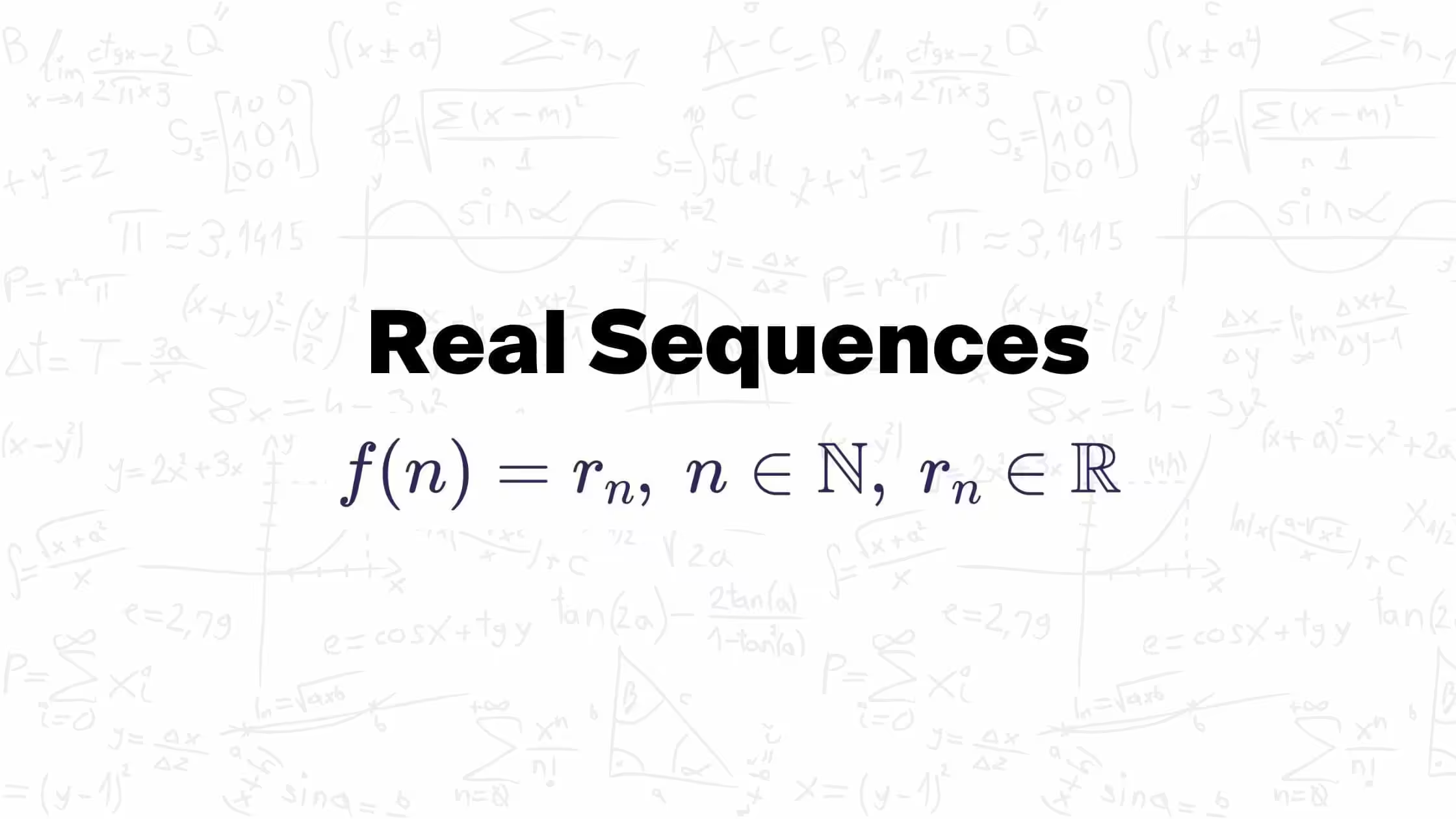
A sequence of real numbers (or a real sequence) is defined as a function \( f: \mathbb{N} \to \mathbb{R} \), where \( \mathbb{N} \) is the set of natural numbers and \( \mathbb{R} \) is the set of real numbers. In simpler terms, it’s an ordered list of real numbers indexed by natural numbers.
The function \( f(n) = r_n \) for \( n \in \mathbb{N} \) and \( r_n \in \mathbb{R} \) produces a sequence of real numbers. We typically write sequences using angle brackets or curly braces: \( \langle f_n \rangle \) or \( \{ f_n \} \). The subscript notation distinguishes a sequence from a regular function, which is helpful when working with multiple mathematical objects.
When I write \( \langle f_n \rangle \), I mean $$ \langle f_1, f_2, f_3, \ldots, f_n, \ldots \rangle $$ a sequence with infinitely many terms. Since every \( f_n \) is a real number, we call this a sequence of real numbers or simply a real sequence.
Examples of Real Sequences
Let me walk through several examples that illustrate different ways sequences can be constructed.
Example 1: The Harmonic Sequence
If \( f(x) = \frac{1}{x} \) for all \( x \in \mathbb{R} \) is a real-valued function, then \( f(n) = \frac{1}{n} \) for all \( n \in \mathbb{N} \) gives us a real sequence. Substituting consecutive natural numbers:
- For \( n = 1 \): \( f(1) = 1 \)
- For \( n = 2 \): \( f(2) = \frac{1}{2} \)
- For \( n = 3 \): \( f(3) = \frac{1}{3} \)
- And so on…
This sequence is written as $$ \left\langle \frac{1}{n} \right\rangle = \left\langle 1, \frac{1}{2}, \frac{1}{3}, \frac{1}{4}, \ldots \right\rangle $$ This is the famous harmonic sequence, and its terms approach zero as \( n \) increases.
Example 2: Alternating Sequence
The sequence \( \langle (-1)^n \rangle \) produces $$ \langle -1, 1, -1, 1, -1, 1, \ldots \rangle $$ This sequence oscillates between -1 and 1 forever. It never settles down to a single value, which makes it particularly interesting when studying convergence.
Example 3: Arithmetic Sequence
The sequence \( \langle -3n \rangle \) gives us $$ \langle -3, -6, -9, -12, \ldots \rangle $$ Each term decreases by 3. This is an arithmetic sequence with common difference -3.
Example 4: Fibonacci Sequence (Recurrence Relation)
Sequences can also be defined using recurrence relations with initial conditions. If we define \( f_n = f_{n-1} + f_{n-2} \) for \( n \geq 2 \) with \( f_0 = f_1 = 1 \), we get:
- \( f_1 = 1 \) (given)
- \( f_2 = f_1 + f_0 = 1 + 1 = 2 \)
- \( f_3 = f_2 + f_1 = 2 + 1 = 3 \)
- \( f_4 = f_3 + f_2 = 3 + 2 = 5 \)
- \( f_5 = f_4 + f_3 = 5 + 3 = 8 \)
This produces the Fibonacci sequence: $$ \langle 1, 1, 2, 3, 5, 8, 13, 21, 34, \ldots \rangle $$ The Fibonacci sequence appears everywhere in mathematics, from number theory to the golden ratio, and shows how simple rules can generate complex and beautiful patterns.
Example 5: Geometric Sequence
The sequence \( \langle 2^n \rangle \) gives us $$ \langle 2, 4, 8, 16, 32, 64, \ldots \rangle $$ Each term is twice the previous one. This is a geometric sequence with common ratio 2.
Example 6: Constant Sequence
The sequence \( \langle c \rangle \) where \( c \) is any fixed real number gives us $$ \langle c, c, c, c, \ldots \rangle $$ Every term equals \( c \). This is the simplest possible sequence and trivially converges to \( c \).
Range Set of a Sequence
The range set of a sequence is the set of all distinct elements that appear in the sequence. This is different from the sequence itself because sequences are ordered and can have repeated elements, while sets are unordered collections of unique elements.
Consider these examples:
- The range set of \( \left\langle \frac{1}{n} \right\rangle \) is \( \left\{ \frac{1}{n} : n \in \mathbb{N} \right\} = \left\{ 1, \frac{1}{2}, \frac{1}{3}, \frac{1}{4}, \ldots \right\} \), which is an infinite set.
- The range set of \( \langle (-1)^n \rangle \) is \( \{-1, 1\} \), a finite set with only two elements despite the sequence having infinitely many terms.
- The range set of a constant sequence \( \langle c \rangle \) is \( \{c\} \), a set with just one element.
Important: The range set of a sequence may be either infinite or finite, but a sequence itself always has infinitely many terms (counting repetitions).
Subsequences
A subsequence of a sequence is another sequence formed by selecting terms from the original sequence while preserving their relative order. You can skip terms, but you can’t rearrange them.
Formally, if \( \langle S_n \rangle \) is a sequence and \( n_1 < n_2 < n_3 < \ldots \) is a strictly increasing sequence of natural numbers, then \( \langle S_{n_k} \rangle = \langle S_{n_1}, S_{n_2}, S_{n_3}, \ldots \rangle \) is a subsequence of \( \langle S_n \rangle \).
Examples:
- \( \langle 1, 3, 5, 7, \ldots \rangle \) is a subsequence of \( \langle 1, 2, 3, 4, 5, \ldots \rangle \) (selecting odd-indexed terms).
- \( \langle 1, 5, 13, 21, \ldots \rangle \) is a subsequence of the Fibonacci sequence \( \langle 1, 1, 2, 3, 5, 8, 13, 21, \ldots \rangle \).
- \( \langle 1, 1, 1, 1, \ldots \rangle \) is a subsequence of \( \langle -1, 1, -1, 1, \ldots \rangle \) (selecting only the positive terms).
Since a subsequence is itself a sequence, it inherits all the properties of sequences. This fact becomes crucial when studying convergence, because if a sequence converges, all its subsequences must converge to the same limit.
Equality of Sequences
Two sequences \( \langle S_n \rangle \) and \( \langle T_n \rangle \) are equal if and only if \( S_n = T_n \) for all \( n \in \mathbb{N} \). Every corresponding term must match exactly.
For example, the sequences \( \left\langle \frac{n+1}{n} \right\rangle \) and \( \left\langle 1 + \frac{1}{n} \right\rangle \) are equal because for any natural number \( n \), we have $$ \frac{n+1}{n} = \frac{n}{n} + \frac{1}{n} = 1 + \frac{1}{n} $$
Important: The sequences \( \langle -1, 1, -1, 1, \ldots \rangle \) and \( \langle 1, -1, 1, -1, \ldots \rangle \) are not equal, even though they have the same range set \( \{-1, 1\} \). Order matters in sequences.
Algebra of Sequences
Sequences can be combined using arithmetic operations, just like numbers. Let \( \langle S_n \rangle \) and \( \langle T_n \rangle \) be two sequences. We define:
- Sum: \( \langle S_n + T_n \rangle \) is the sequence whose \( n \)-th term is \( S_n + T_n \)
- Difference: \( \langle S_n – T_n \rangle \) is the sequence whose \( n \)-th term is \( S_n – T_n \)
- Product: \( \langle S_n \cdot T_n \rangle \) is the sequence whose \( n \)-th term is \( S_n \cdot T_n \)
- Quotient: \( \left\langle \frac{S_n}{T_n} \right\rangle \) is the sequence whose \( n \)-th term is \( \frac{S_n}{T_n} \) (provided \( T_n \neq 0 \) for all \( n \))
For example, if \( \langle S_n \rangle = \langle 0, 1, 2, 3, \ldots \rangle \) and \( \langle T_n \rangle = \langle 1, 7, 17, 27, \ldots \rangle \), then their sum is \( \langle 1, 8, 19, 30, \ldots \rangle \).
Reciprocal Sequence: If \( S_n \neq 0 \) for all \( n \), the sequence \( \left\langle \frac{1}{S_n} \right\rangle \) is called the reciprocal of the sequence \( \langle S_n \rangle \). For example, the reciprocal of \( \langle 1, -2, 3, -4, \ldots \rangle \) is \( \left\langle 1, -\frac{1}{2}, \frac{1}{3}, -\frac{1}{4}, \ldots \right\rangle \).
Scalar Multiple: If \( c \in \mathbb{R} \), the sequence \( \langle cS_n \rangle \) is called the scalar multiple of \( \langle S_n \rangle \). This multiplies every term by the same constant \( c \).
The sequences \( \langle -1, 1, -1, 1, \ldots \rangle \) and \( \langle 1, -1, 1, -1, \ldots \rangle \) have the interesting property that their reciprocals equal themselves. Some authors call these self-reciprocal sequences.
Bounded Sequences
Understanding boundedness is essential for working with sequences. A sequence can be bounded above, bounded below, both, or neither. These concepts connect to the study of convergence and form the foundation for many important theorems.
Bounded Above: A sequence \( \langle S_n \rangle \) is bounded above if there exists a real number \( M \) such that \( S_n \leq M \) for all \( n \in \mathbb{N} \). The number \( M \) is called an upper bound of the sequence.
Bounded Below: A sequence \( \langle S_n \rangle \) is bounded below if there exists a real number \( m \) such that \( S_n \geq m \) for all \( n \in \mathbb{N} \). The number \( m \) is called a lower bound of the sequence.
Bounded: A sequence is bounded if it is both bounded above and bounded below. Equivalently, there exist real numbers \( m \) and \( M \) such that $$ m \leq S_n \leq M \quad \text{for all } n \in \mathbb{N} $$ This can also be written as \( |S_n| \leq K \) for some positive constant \( K \) and all \( n \).
Supremum and Infimum:
- The least upper bound (supremum) of a sequence \( \langle S_n \rangle \) is the smallest real number that is still an upper bound for the sequence, denoted \( \sup S_n \).
- The greatest lower bound (infimum) is the largest real number that is still a lower bound, denoted \( \inf S_n \).
Examples:
- The sequence \( \langle n^3 \rangle = \langle 1, 8, 27, 64, \ldots \rangle \) is bounded below by 1 (in fact, by 0) but is not bounded above. It grows without limit.
- The sequence \( \left\langle \frac{1}{n} \right\rangle = \left\langle 1, \frac{1}{2}, \frac{1}{3}, \ldots \right\rangle \) is bounded. It’s bounded above by 1 and bounded below by 0 (though 0 is never actually attained).
- The sequence \( \langle (-1)^n \rangle = \langle -1, 1, -1, 1, \ldots \rangle \) is bounded. Every term is between -1 and 1, inclusive.
- The sequence \( \langle (-1)^n \cdot n \rangle = \langle -1, 2, -3, 4, \ldots \rangle \) is unbounded. It oscillates but grows in magnitude without limit.
Important: If the range set of a sequence is finite, the sequence is always bounded. This follows directly from the fact that any finite set of real numbers has both a maximum and minimum element.
Convergent Sequences
Convergence is arguably the most important concept in sequence theory. A sequence converges if its terms get arbitrarily close to some fixed value and stay close. The formal definition makes this precise.
Definition: A sequence \( \langle S_n \rangle \) converges to a real number \( l \) if for every \( \epsilon > 0 \), there exists a positive integer \( m \) (depending on \( \epsilon \)) such that $$ |S_n – l| < \epsilon \quad \text{for all } n \geq m $$
The number \( l \) is called the limit of the sequence, and we write \( \lim_{n \to \infty} S_n = l \) or simply \( \lim S_n = l \). The sequence itself is called a convergent sequence.
In plain terms: no matter how small a positive tolerance \( \epsilon \) you choose, eventually (after some point \( m \)) all terms of the sequence will be within \( \epsilon \) of the limit \( l \).
Fundamental Theorems on Convergent Sequences
These theorems form the core toolkit for working with convergent sequences. I’ve listed them in an order that builds understanding progressively.
Theorem 1 (Uniqueness): Every convergent sequence has exactly one limit. A sequence cannot converge to two different values.
Theorem 2 (Non-negative Limits): If \( \langle S_n \rangle \) is a sequence of non-negative numbers that converges, then \( \lim S_n \geq 0 \). The limit of non-negative terms cannot be negative.
Theorem 3 (Boundedness): Every convergent sequence is bounded. However, the converse is false. A sequence can be bounded without converging (for example, \( \langle (-1)^n \rangle \) is bounded but doesn’t converge).
Theorem 4 (Arithmetic Operations): If \( \lim S_n = l \) and \( \lim T_n = l’ \), then:
- \( \lim (S_n + T_n) = l + l’ \)
- \( \lim (S_n – T_n) = l – l’ \)
- \( \lim (S_n \cdot T_n) = l \cdot l’ \)
- \( \lim \frac{S_n}{T_n} = \frac{l}{l’} \) (provided \( l’ \neq 0 \) and \( T_n \neq 0 \) for all \( n \))
Theorem 5 (Order Preservation): If \( S_n \leq T_n \) for all \( n \), and both sequences converge, then \( \lim S_n \leq \lim T_n \).
Theorem 6 (Absolute Value): If \( \lim S_n = l \), then \( \lim |S_n| = |l| \). Taking absolute values preserves convergence.
Theorem 7 (Squeeze Theorem): If \( S_n \leq T_n \leq U_n \) for all \( n \), and \( \lim S_n = l = \lim U_n \), then \( \lim T_n = l \). This is also called the Sandwich Theorem or Pinching Theorem. It’s incredibly useful for proving convergence when direct computation is difficult.
Theorem 8 (Cauchy’s First Theorem on Limits): If \( \lim S_n = l \), then $$ \lim_{n \to \infty} \frac{S_1 + S_2 + \ldots + S_n}{n} = l $$ The arithmetic mean of the first \( n \) terms converges to the same limit as the sequence.
Theorem 9 (Cauchy’s Second Theorem on Limits): If \( \langle S_n \rangle \) is a sequence of positive numbers with \( \lim S_n = l \), then $$ \lim_{n \to \infty} (S_1 \cdot S_2 \cdot \ldots \cdot S_n)^{1/n} = l $$ The geometric mean of the first \( n \) terms converges to the same limit.
Theorem 10 (Ratio Test for Sequences): If \( \langle S_n \rangle \) is a sequence of positive numbers such that \( \lim \frac{S_{n+1}}{S_n} = l \) (where \( l > 0 \)), then $$ \lim_{n \to \infty} S_n^{1/n} = l $$
Theorem 11 (Cesaro’s Theorem): If \( \lim S_n = l \) and \( \lim T_n = l’ \), then $$ \lim_{n \to \infty} \frac{S_1 T_n + S_2 T_{n-1} + \ldots + S_n T_1}{n} = l \cdot l’ $$
Subsequence Theorem
Theorem 12: If a sequence \( \langle S_n \rangle \) converges to \( l \), then every subsequence of \( \langle S_n \rangle \) also converges to \( l \).
The contrapositive of this theorem is often more useful in practice: if two different subsequences converge to different limits, or if any subsequence diverges, then the original sequence does not converge.
Divergent Sequences
A sequence \( \langle S_n \rangle \) is divergent if it tends to infinity. Specifically:
- We write \( \lim_{n \to \infty} S_n = +\infty \) if for every real number \( M > 0 \), there exists a positive integer \( N \) such that \( S_n > M \) for all \( n \geq N \). The sequence grows without bound.
- We write \( \lim_{n \to \infty} S_n = -\infty \) if for every real number \( M < 0 \), there exists a positive integer \( N \) such that \( S_n < M \) for all \( n \geq N \). The sequence decreases without bound.
Examples of divergent sequences:
- \( \langle n \rangle = \langle 1, 2, 3, 4, \ldots \rangle \) diverges to \( +\infty \)
- \( \langle -n^2 \rangle = \langle -1, -4, -9, -16, \ldots \rangle \) diverges to \( -\infty \)
- \( \langle 2^n \rangle = \langle 2, 4, 8, 16, \ldots \rangle \) diverges to \( +\infty \)
Oscillatory Sequences
Not every sequence converges or diverges to infinity. Some sequences oscillate, meaning they keep bouncing around without settling down or shooting off to infinity.
Finite Oscillation: A sequence oscillates finitely if:
- It is bounded
- It neither converges nor diverges to infinity
Example: \( \langle (-1)^n \rangle = \langle -1, 1, -1, 1, \ldots \rangle \) oscillates finitely between -1 and 1.
Infinite Oscillation: A sequence oscillates infinitely if:
- It is unbounded
- It neither converges nor diverges to a single infinity (neither \( +\infty \) nor \( -\infty \))
Example: \( \langle (-1)^n \cdot n \rangle = \langle -1, 2, -3, 4, -5, \ldots \rangle \) oscillates infinitely. It grows in magnitude but keeps alternating signs.
A sequence is called non-convergent if it’s either divergent or oscillatory. This classification covers all possibilities: every sequence either converges to a finite limit, diverges to \( \pm\infty \), or oscillates.
Limit Points of a Sequence
A real number \( P \) is a limit point (or accumulation point, or cluster point) of a sequence \( \langle S_n \rangle \) if every neighborhood of \( P \) contains infinitely many terms of the sequence.
Formally: \( P \) is a limit point of \( \langle S_n \rangle \) if for every \( \epsilon > 0 \), the interval \( (P – \epsilon, P + \epsilon) \) contains \( S_n \) for infinitely many values of \( n \).
This is different from the limit of a sequence. A convergent sequence has exactly one limit point (its limit), but a non-convergent sequence may have multiple limit points, exactly one, or none.
Example: The sequence \( \langle (-1)^n \rangle \) has two limit points: -1 and 1. Every neighborhood of -1 contains infinitely many terms (all the odd-indexed terms), and every neighborhood of 1 contains infinitely many terms (all the even-indexed terms).
Bolzano-Weierstrass Theorem
This is one of the most important theorems in real analysis.
Theorem: Every bounded sequence of real numbers has at least one limit point.
Equivalently: every bounded sequence has a convergent subsequence.
This theorem is powerful because it guarantees the existence of limit points without telling you what they are. It’s used extensively in proofs throughout analysis. You can find a formal proof of the Bolzano-Weierstrass Theorem at ProofWiki.
Important Remarks:
- An unbounded sequence may or may not have limit points. The sequence \( \langle n \rangle \) has no limit points, but the sequence \( \langle 0, 1, 0, 2, 0, 3, 0, 4, \ldots \rangle \) is unbounded yet has 0 as a limit point.
- The greatest limit point of a bounded sequence is called the limit superior (limsup), denoted \( \limsup S_n \) or \( \overline{\lim} S_n \).
- The smallest limit point is called the limit inferior (liminf), denoted \( \liminf S_n \) or \( \underline{\lim} S_n \).
- For any bounded sequence, \( \limsup S_n \geq \liminf S_n \).
- A bounded sequence converges if and only if \( \limsup S_n = \liminf S_n \), and in that case, the common value is the limit.
Monotonic Sequences
A sequence is monotonic if it consistently moves in one direction, never reversing course. This property greatly simplifies convergence analysis.
Definition: A sequence \( \langle S_n \rangle \) is monotonic if either:
- \( S_{n+1} \geq S_n \) for all \( n \in \mathbb{N} \) (monotonically increasing or non-decreasing), or
- \( S_{n+1} \leq S_n \) for all \( n \in \mathbb{N} \) (monotonically decreasing or non-increasing)
If the inequalities are strict (\( > \) or \( < \)), we say the sequence is strictly increasing or strictly decreasing.
Examples:
- \( \left\langle \frac{1}{n} \right\rangle = \left\langle 1, \frac{1}{2}, \frac{1}{3}, \ldots \right\rangle \) is strictly decreasing
- \( \langle n^2 \rangle = \langle 1, 4, 9, 16, \ldots \rangle \) is strictly increasing
- \( \left\langle 1 – \frac{1}{n} \right\rangle = \left\langle 0, \frac{1}{2}, \frac{2}{3}, \frac{3}{4}, \ldots \right\rangle \) is strictly increasing
- \( \langle c \rangle \) (constant sequence) is both non-decreasing and non-increasing
Monotone Convergence Theorem
The following theorems characterize when monotonic sequences converge.
Theorem: A monotonically increasing sequence that is bounded above converges to its supremum. If it’s not bounded above, it diverges to \( +\infty \).
Theorem: A monotonically decreasing sequence that is bounded below converges to its infimum. If it’s not bounded below, it diverges to \( -\infty \).
Corollary: A monotonic sequence converges if and only if it is bounded.
These theorems are extremely useful. To prove a monotonic sequence converges, you only need to show it’s bounded. You don’t need to find the limit directly.
Cauchy Sequences
Cauchy sequences provide an alternative characterization of convergence that doesn’t require knowing the limit in advance. This is particularly valuable when proving theoretical results.
Definition: A sequence \( \langle S_n \rangle \) is a Cauchy sequence if for every \( \epsilon > 0 \), there exists a positive integer \( N \) such that $$ |S_n – S_m| < \epsilon \quad \text{for all } n, m \geq N $$
In other words, the terms of a Cauchy sequence eventually get arbitrarily close to each other. After some point, any two terms are within \( \epsilon \) of each other.
Properties of Cauchy Sequences
Theorem: Every Cauchy sequence is bounded. (Proof)
Theorem (Cauchy’s General Principle of Convergence): A sequence of real numbers converges if and only if it is a Cauchy sequence. (Proof)
This theorem is profound. It says that in the real numbers, being a Cauchy sequence is equivalent to being convergent. This is actually a defining property of the real numbers (completeness). In other number systems like the rationals, Cauchy sequences may not converge within that system.
The practical benefit: to prove a sequence converges without knowing its limit, show that it’s a Cauchy sequence.
Important Limits to Remember
These standard limits appear frequently and are worth memorizing. They form the building blocks for evaluating more complex limits.
- \( \lim_{n \to \infty} \frac{1}{n^p} = 0 \) for any \( p > 0 \)
- \( \lim_{n \to \infty} \sqrt[n]{a} = 1 \) for any \( a > 0 \)
- \( \lim_{n \to \infty} \sqrt[n]{n} = 1 \)
- \( \lim_{n \to \infty} \frac{n^k}{a^n} = 0 \) for any \( k \) and \( a > 1 \) (exponentials dominate polynomials)
- \( \lim_{n \to \infty} \frac{a^n}{n!} = 0 \) for any \( a \) (factorials dominate exponentials)
- \( \lim_{n \to \infty} \left(1 + \frac{1}{n}\right)^n = e \approx 2.71828 \)
- \( \lim_{n \to \infty} \left(1 + \frac{x}{n}\right)^n = e^x \) for any real \( x \)
- \( \lim_{n \to \infty} \frac{\ln n}{n} = 0 \)
If you’re studying calculus from a textbook, you’ll encounter these limits repeatedly. Understanding why each one is true will deepen your grasp of sequence behavior.
Connection to Series
Sequences and series are intimately connected. A series is simply the sequence of partial sums of another sequence.
Given a sequence \( \langle a_n \rangle \), the associated series is $$ \sum_{n=1}^{\infty} a_n = a_1 + a_2 + a_3 + \ldots $$ and the sequence of partial sums is \( \langle S_n \rangle \) where $$ S_n = a_1 + a_2 + \ldots + a_n = \sum_{k=1}^{n} a_k $$
The series converges if and only if the sequence of partial sums converges. When studying convergence of series, you’re really studying convergence of the partial sum sequence. Tools like the p-series test are applications of sequence theory to determine when these partial sums converge.
Practical Tips for Studying Sequences
After years of teaching real analysis, I’ve noticed certain approaches help students master sequences faster.
Start with concrete examples. Before trying to prove abstract theorems, compute the first 10 terms of various sequences. Get a feel for how they behave. Draw them on a number line.
Master the epsilon-N definition. The formal definition of convergence seems intimidating at first, but it’s the key to everything. Practice writing epsilon-N proofs for simple sequences like \( \frac{1}{n} \) until the process becomes natural.
Know the standard limits. Memorize the limits listed above. Most sequence problems reduce to combining these standard results using the algebraic limit theorems.
Check boundedness and monotonicity. These are often the fastest routes to determining convergence. If a sequence is monotonic, you only need to check if it’s bounded. If a sequence is unbounded, it can’t converge.
Use the Squeeze Theorem liberally. When direct computation is hard, try to bound your sequence between two simpler sequences that converge to the same limit.
Consider subsequences. If you can find two subsequences converging to different limits, the original sequence diverges. This is often the cleanest way to prove non-convergence.
If you want to practice these concepts with computational tools, there are excellent math apps and digital tools that can help visualize sequence behavior and check your work.
FAQs
What is the difference between a sequence and a series?
A sequence is an ordered list of numbers, while a series is the sum of the terms of a sequence. Given a sequence ⟨a₁, a₂, a₃, …⟩, the associated series is a₁ + a₂ + a₃ + … When we ask whether a series converges, we’re really asking whether the sequence of partial sums converges.
Can a sequence have more than one limit?
No. The Uniqueness Theorem states that if a sequence converges, its limit is unique. A sequence cannot converge to two different values. However, a non-convergent sequence can have multiple limit points, which is different from having multiple limits.
What is the difference between a limit and a limit point?
A limit is the value that a convergent sequence approaches. A limit point is any value that has infinitely many terms of the sequence arbitrarily close to it. A convergent sequence has exactly one limit point (its limit), but a non-convergent bounded sequence may have multiple limit points. For example, ⟨(-1)ⁿ⟩ has two limit points (-1 and 1) but no limit.
Is every bounded sequence convergent?
No. Boundedness is necessary but not sufficient for convergence. The sequence ⟨(-1)ⁿ⟩ = ⟨-1, 1, -1, 1, …⟩ is bounded (all terms are between -1 and 1) but does not converge because it oscillates between two values. However, every bounded sequence does have at least one convergent subsequence by the Bolzano-Weierstrass theorem.
What is a Cauchy sequence and why is it important?
A Cauchy sequence is one where the terms get arbitrarily close to each other as the sequence progresses. Formally, for any ε > 0, there exists N such that |Sₙ – Sₘ| < ε for all n, m ≥ N. The importance is that in real numbers, a sequence converges if and only if it's Cauchy. This lets you prove convergence without knowing the limit in advance.
How do I prove a sequence converges without finding its limit?
Two main approaches: (1) Show the sequence is monotonic and bounded, then by the Monotone Convergence Theorem, it converges. (2) Show the sequence is a Cauchy sequence, then by Cauchy’s General Principle of Convergence, it converges. Both methods guarantee convergence without requiring you to compute the actual limit.
What does it mean for a sequence to oscillate infinitely?
A sequence oscillates infinitely if it is unbounded but doesn’t diverge to +∞ or -∞. It keeps alternating or cycling without settling down, and its magnitude grows without bound. Example: ⟨(-1)ⁿ · n⟩ = ⟨-1, 2, -3, 4, -5, …⟩ grows in absolute value but keeps switching signs, so it neither converges nor diverges to a single infinity.
What is the Bolzano-Weierstrass theorem used for?
The Bolzano-Weierstrass theorem guarantees that every bounded sequence has a convergent subsequence. It’s used in proofs throughout analysis when you need to extract a convergent subsequence from a bounded sequence. It’s also the basis for proving the Heine-Borel theorem and many results in topology and functional analysis.
Real sequences are the foundation of analysis, connecting discrete mathematics to the continuous world of calculus. Once you understand how sequences behave, concepts like limits, continuity, and differentiation become much clearer. Take your time with these definitions and theorems. The payoff is substantial when you move on to more advanced topics.