
Predict
Read the equation before calculating. Identify likely behavior, constraints and exceptional cases.
An Interactive Course in Theory,
Methods, and Computation
A first course in integral equations, built around choosing a method, solving the problem, and checking what the answer actually establishes.
By Gaurav Tiwari
As an Amazon Associate I earn from qualifying purchases.
Download the free worked-solutions PDF
Explore the full contents ↓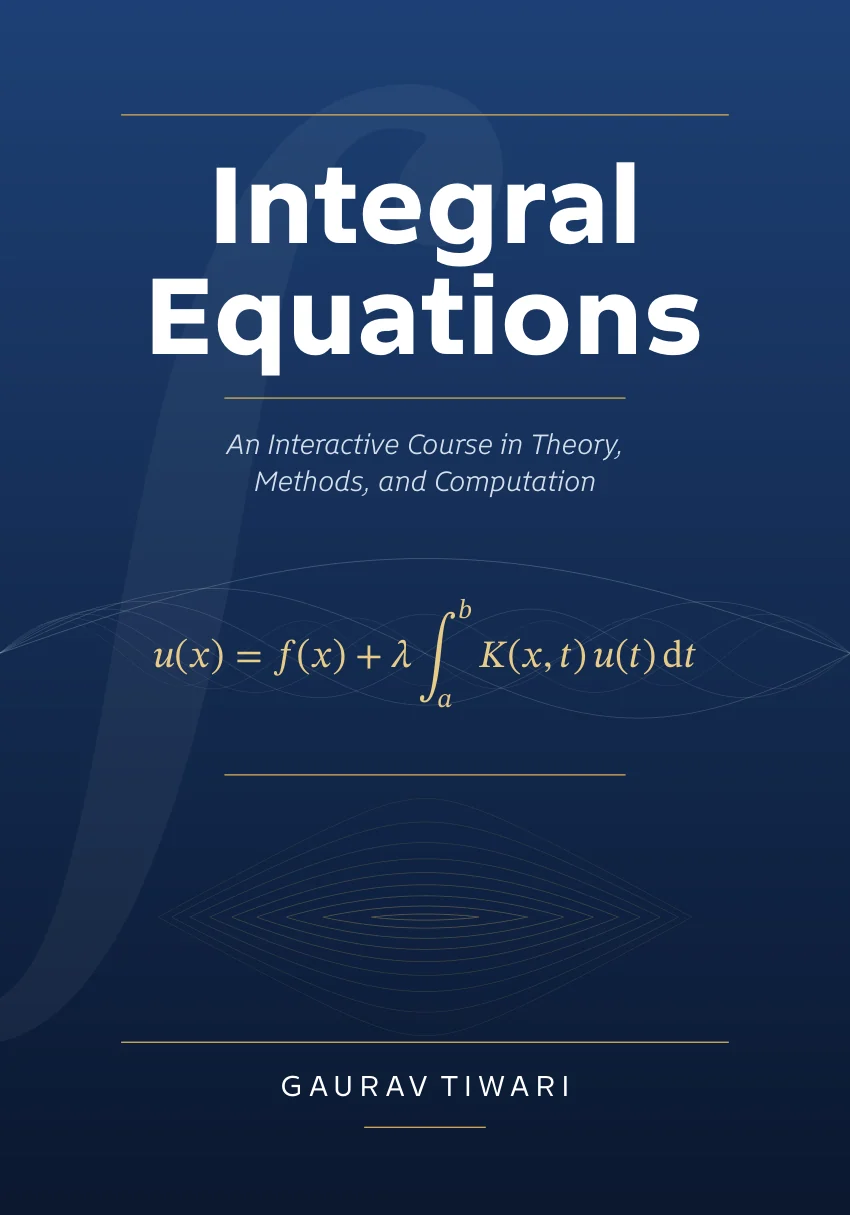
Choose a method. Check the answer.
An answer is useful when you can explain why it works.
A small residual can hide a large error. A substitution check can confirm a solution without proving it’s unique. A convergence condition can be sufficient without being necessary. This course keeps those distinctions visible while you learn the methods.
You move from Fredholm and Volterra equations to spectral theory, numerical methods, regularization and mathematical models of memory and potential. Hand calculation, theorems and computation stay connected throughout.
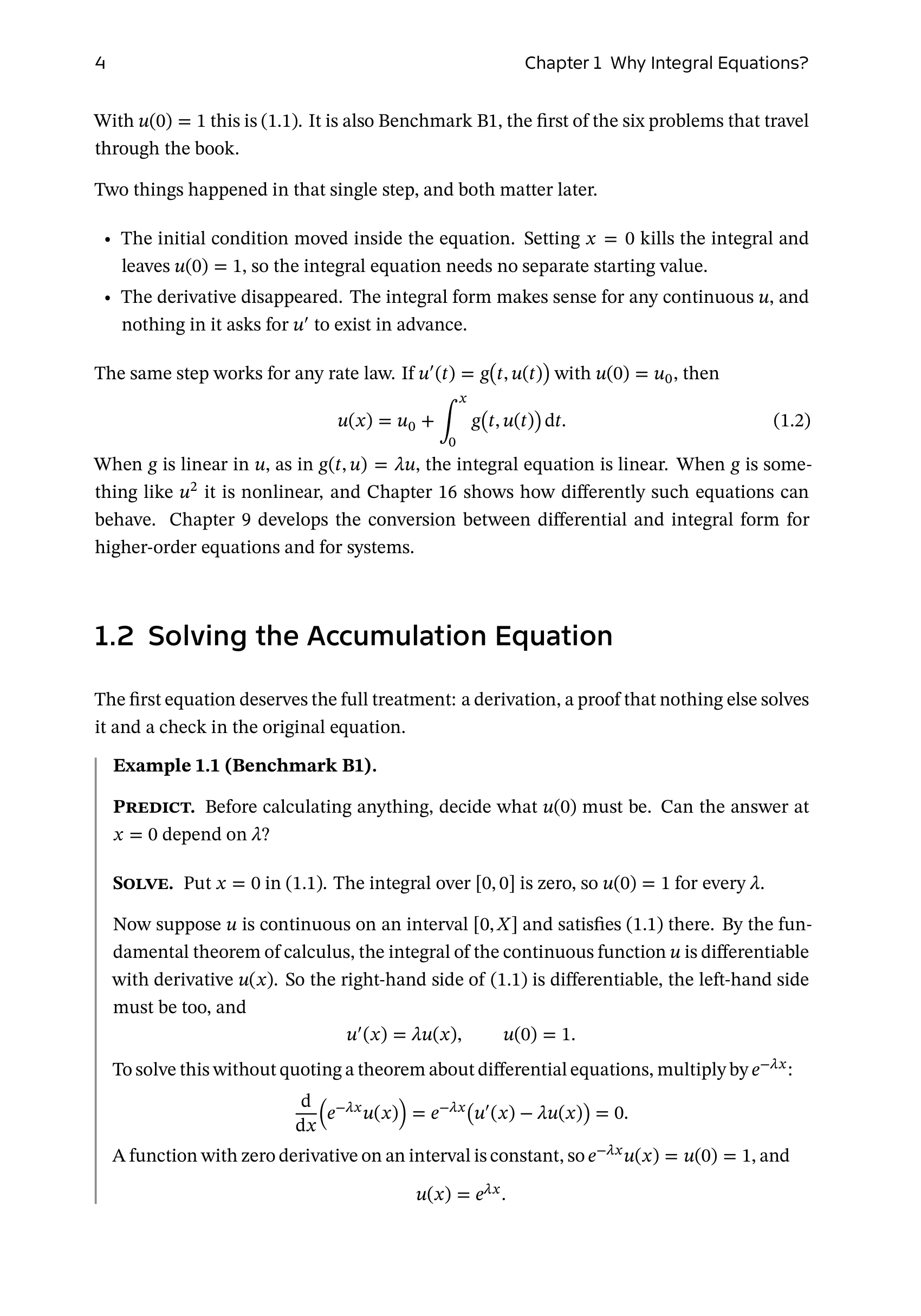
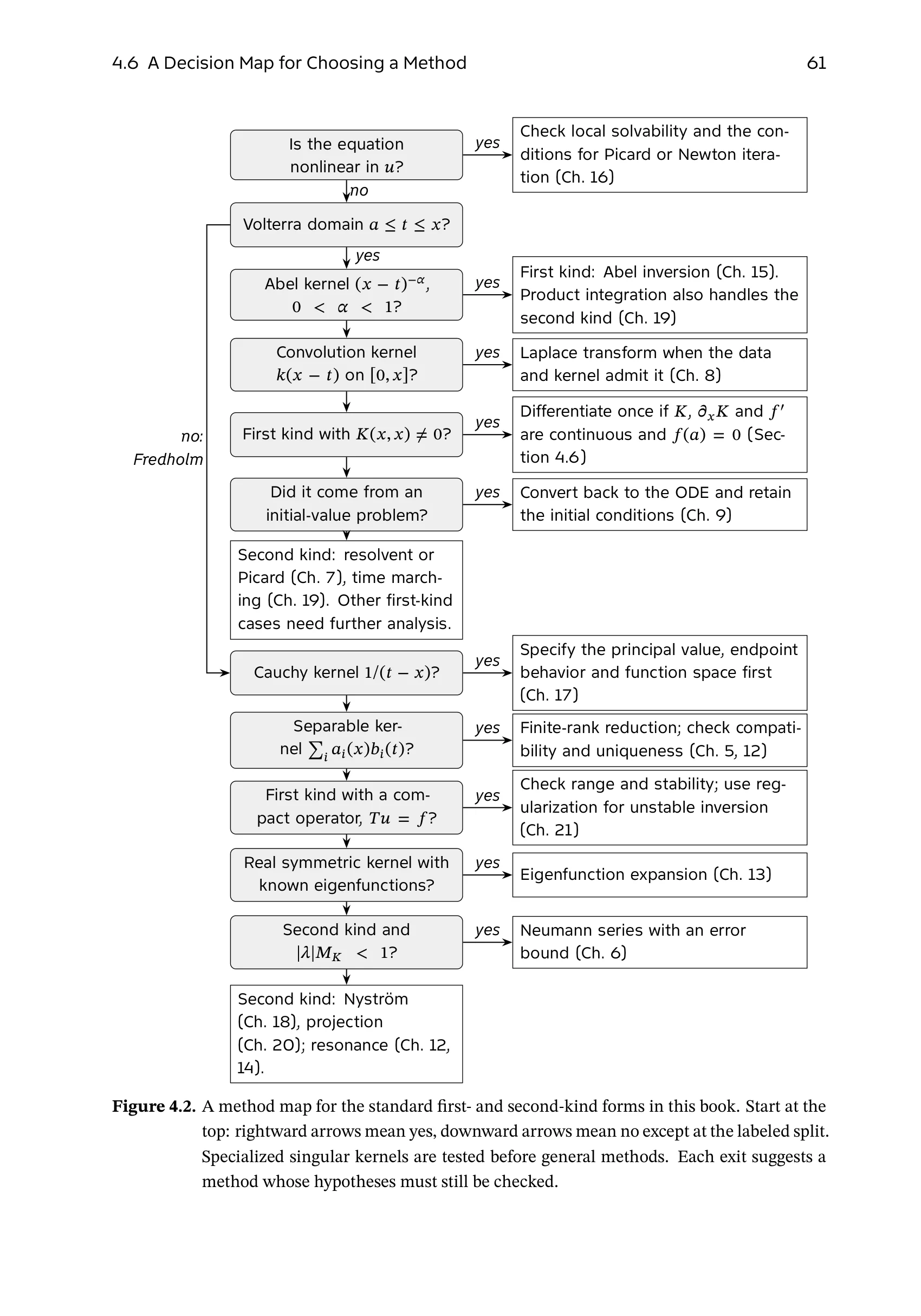
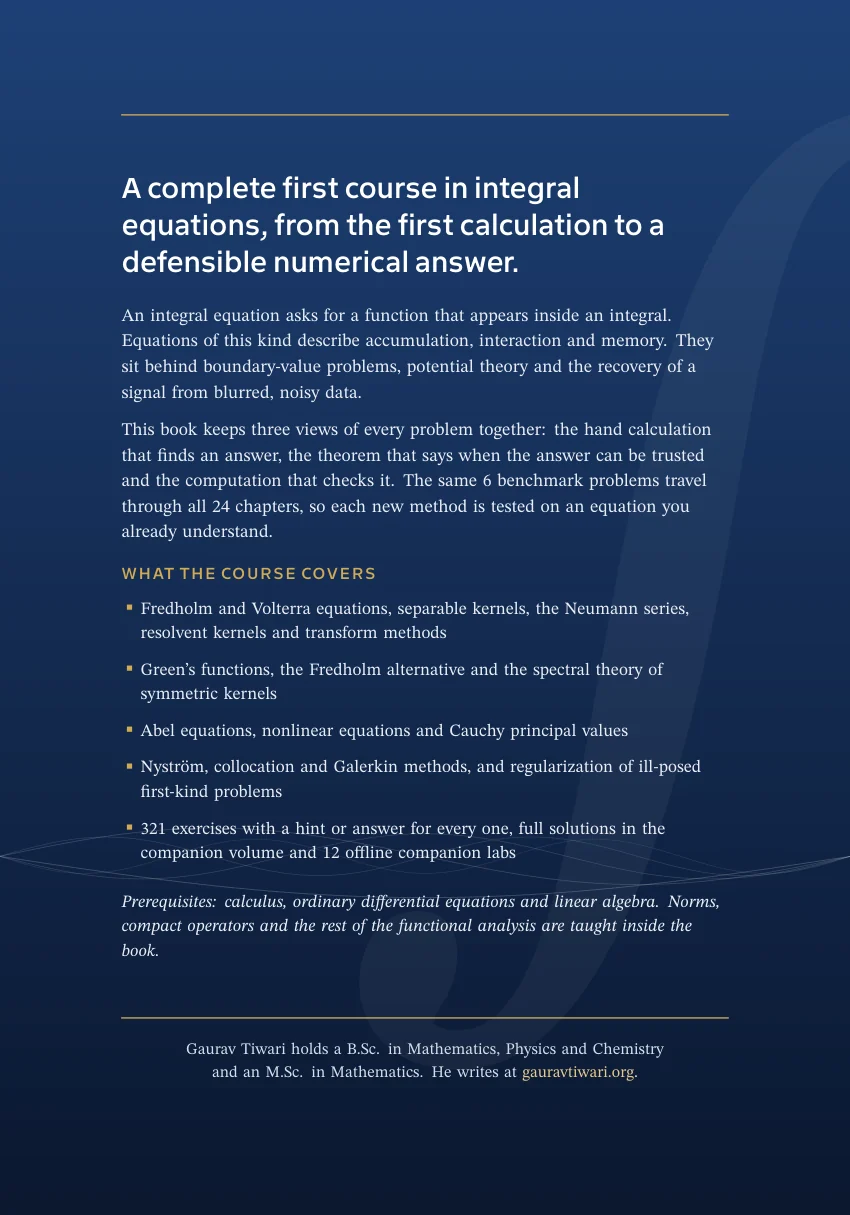
Read a worked example, inspect the method-selection map, and see how the course is organized. Select a page to enlarge it.
The larger examples use the same four-step pattern. Each step asks you to do something with the mathematics.
Read the equation before calculating. Identify likely behavior, constraints and exceptional cases.
Choose a method, state its hypotheses and carry the calculation through.
Substitute the result, examine uniqueness and test numerical accuracy.
Change a parameter or assumption. Find out which conclusions survive.
The same 6 benchmark problems return across the course, so you can compare several methods on an equation you already understand.
Students and independent readers who want to connect mathematical theory with a calculation they can defend.
I recommend working through the early verification examples before jumping to a numerical method. They establish the checks you’ll need later, especially when the data are noisy.
Norms, integral operators, compactness and the functional-analysis ideas used in the course are introduced inside the book. A prerequisite refresher and diagnostic answers help you fill gaps.
This is a first course in integral equations, not a replacement for introductory calculus or a complete treatment of singular and boundary integral theory.
Follow the course from reading an equation to defending a solution from noisy data. Open a part to see its chapters.
Accumulation, interactions, memory and the first worked model.
Fredholm and Volterra forms; equation kinds, kernel structure and eigenvalues.
Calculus, norms, orthogonality, linear algebra and Laplace transforms.
Substitution checks, uniqueness, residuals and a decision map for choosing methods.
Reduce a separable kernel to a finite system and examine exceptional parameters.
Iterated kernels, convergence conditions, resolvents and computable error bounds.
Triangular domains, factorial estimates and the construction of Volterra resolvents.
Convolution kernels, Laplace transforms and inversion.
Convert differential equations to integral form while preserving initial conditions.
Construct Green's functions and connect boundary conditions to integral kernels.
Function spaces, bounded operators and compactness with concrete examples.
Solvability, compatibility and the role of a nontrivial null space.
Orthogonal eigenfunctions, eigenfunction expansions and symmetric kernels.
Resolvent structure, Fredholm determinants and resonance.
Abel inversion, fractional integration and integrable singularities.
Hammerstein and Urysohn forms, contraction arguments and Picard iteration.
Principal values, endpoint behavior and the limits of ordinary quadrature.
Quadrature rules, linear systems and the Nyström interpolation formula.
Time marching, stability, product integration and the cost of memory.
Trial spaces, projection methods, basis choice and residual checks.
Ill-posedness, truncated SVD, Tikhonov regularization and noisy data.
Relaxation, creep and integro-differential models with memory.
Layer potentials, jump relations and potential problems on a circle and ellipse.
Choose a model and method, quantify uncertainty and defend a reconstruction.
The course also includes the tools you need to revisit a prerequisite, choose a method or check your work.
A complete solution for every exercise.
Use this companion after you’ve tried the problems in the main book. It follows the same chapter and exercise numbering, with the method, intermediate steps and checks worked through.
A few practical details about the course and the editions.
All 321 exercises have a hint or answer at the back of the textbook. It also includes 66 selected worked solutions. The separate Complete Worked Solutions PDF is free to download and covers every exercise. You don’t need an Amazon purchase or an account to get it.
No. The computational work is optional, and the book prints the figures and tables needed to follow the discussion. You can work through the core course with pencil and paper.
You’ll predict results, check answers, vary assumptions and work through self-checks and exercises. The book also describes optional companion labs. It isn’t an online course or a subscription.
The main book’s PDF and EPUB aren’t sold here at present. Choose the Kindle edition or paperback on Amazon. The separate worked-solutions companion is available here as a free PDF.
Choose the edition you’ll use.
Keep the Kindle edition in your reading library, or work through the paperback alongside your notes.
Current prices and availability are shown on Amazon. Use the Kindle link for your regional Amazon store. The paperback link opens Amazon.com.
Digital reading through Kindle.
View Kindle on Amazon ↗A printed copy for your desk.
View Paperback on Amazon ↗As an Amazon Associate I earn from qualifying purchases.
Everything here is quick to set up, light on your pages and built to do one real job well. I only charge for the tools that can make you money. The rest are free.

I design, build and support every product on this site myself. When you email me, the person reading it is the one who wrote the code.
I’d rather ship one tool you’d miss if it vanished than ten that sit in your plugin list doing nothing.
18+years building websites, plugins and stores, since 2008
Switch a feature off and it loads nothing. What does load stays small. A tool that replaces a plugin shouldn’t make your pages slower.
Clear screens, sensible defaults and settings written in plain English. If you need a tutorial for the basics, that’s my design mistake, not yours.
Full keyboard support, visible focus, proper labels and text you can actually read. When more people can use your store, more people can buy from it.
My paid tools help you sell, renew, license or convert. If one just sits in your stack, I haven’t done my job.
I won’t charge for anything that can’t make you money. The free tools get the same care as the paid ones, down to the last setting.