You've read the same paragraph 4 times, you know every word in it and still nothing clicks. Mathematical writing is compressed on purpose, and this book gives you a step-by-step procedure to unfold it, whether the text in front of you is a single definition or a full research paper.
Mathematicians get stuck too. The book tells 14 of their stories, and each one teaches a single reading move. Pick a name to see the move and the chapter it belongs to. Every story lists its sources.
Thurston Writes Too Tersely and Empties a Field
When a page seems impossible, suspect compression, and go looking for the background the author assumed you already had.
William Thurston · Chapter 1: The Page That Won't Let You In
Grothendieck Asks What Length Really Means
Refuse to accept a word you can't define, and build out exactly what it has to mean.
Alexander Grothendieck · Chapter 4: Unpacking a Definition
Abel Is Asked for One Worked Example
A single example worked all the way through is a test of a claim, not a decoration for it.
Niels Henrik Abel · Chapter 5: Examples, Non-Examples, and the Boundary
Harish-Chandra Notices the Missing Domains
For every object in a statement, ask exactly where it lives and what the proof quietly assumes about it.
Harish-Chandra · Chapter 7: Reading a Theorem Before Its Proof
Hardy Sorts a Stranger's Theorems Before Trusting Them
Before you believe a statement, sort it, check it against what you already know, and look hard for the case that breaks it.
G. H. Hardy · Chapter 8: Testing a Statement Against the Edges
Bhargava Reads Gauss and Climbs Past Him
Once you see a special case clearly, ask how far up it can go.
Manjul Bhargava · Chapter 9: The Neighborhood of a Theorem
Nick Katz Checks Wiles's Proof One Line at a Time
You don't pass a line until you can say why it is true.
Nick Katz · Chapter 10: Three Ways to Read a Proof
Atiyah Proves a Theorem He Cannot See
A proof you can only follow is not yet a proof you own.
Michael Atiyah · Chapter 12: The Reconstruction Test
Poincaré Steps onto a Carriage at Coutances
Fruitless effort often makes the later insight possible, and every insight still has to be verified.
Henri Poincaré · Chapter 13: Stuck: A Protocol
Ramanujan Works Through Carr's Synopsis Alone
Rebuilding every result yourself builds real power, and without anyone to check you, it can also build confident mistakes.
Srinivasa Ramanujan · Chapter 17: Working Through a Book Alone
Perelman's Short Preprints and the Notes That Filled Them In
Professionals read a hard paper slowly, in company, writing out every step the author skipped.
Grigori Perelman · Chapter 18: Reading a Research Paper
June Huh Stays in a Course He Can't Follow
Hold on to the examples you can follow, ask questions, and keep an honest list of what you still owe.
June Huh · Chapter 19: Reading Above Your Level
Mirzakhani in a Seminar She Could Barely Follow
Listen for the comments that simplify, and turn your confusion into questions.
Maryam Mirzakhani · Chapter 21: Lectures, Groups, and Good Questions
Halmos Finally Understands Epsilon
Understanding tends to arrive in a jump after long, patient work, and when it does, texts that once resisted you open up.
Paul Halmos · Chapter 22: What Changes When You Get Good
Look Inside
Every procedure in the book has a shape, so most of them come with a diagram or a single-page card. You can open any page below at full size.
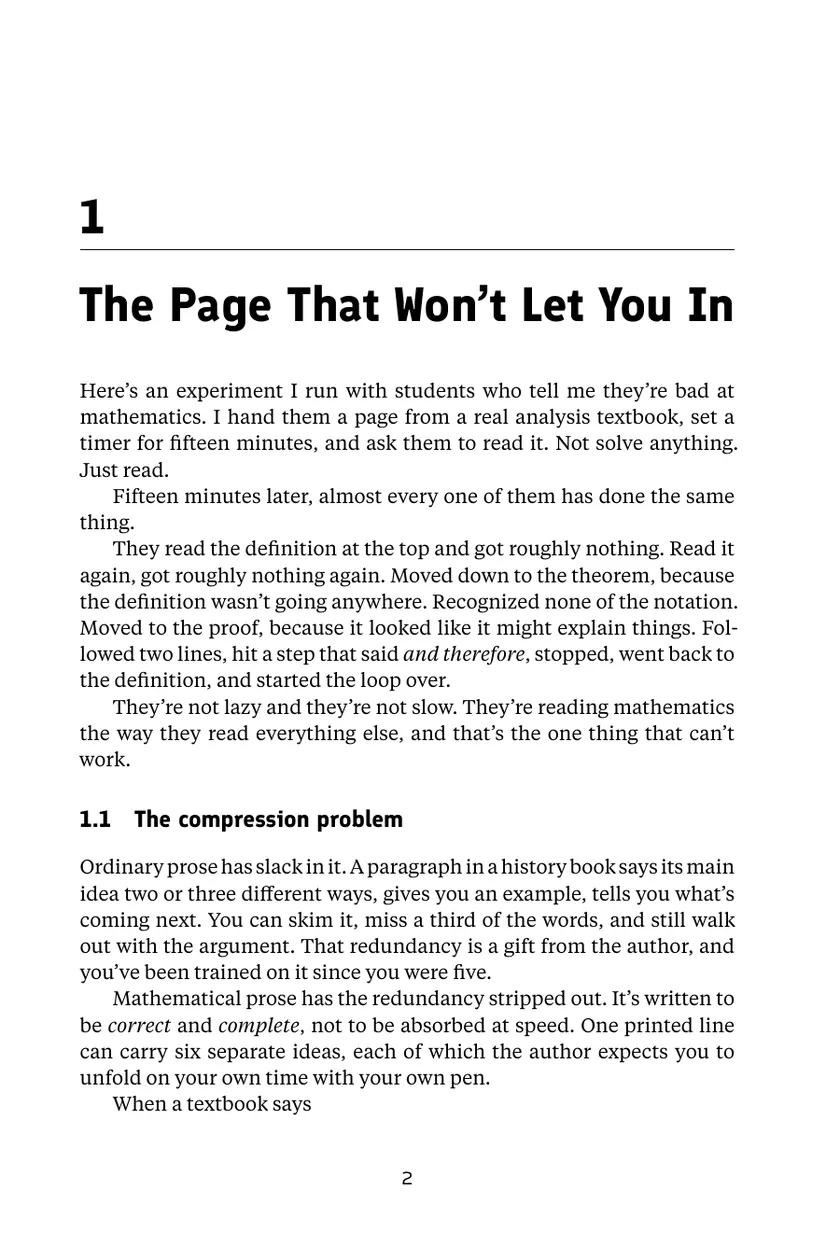
Chapter 1. Why a page of mathematics resists you and what's folded inside a single sentence.
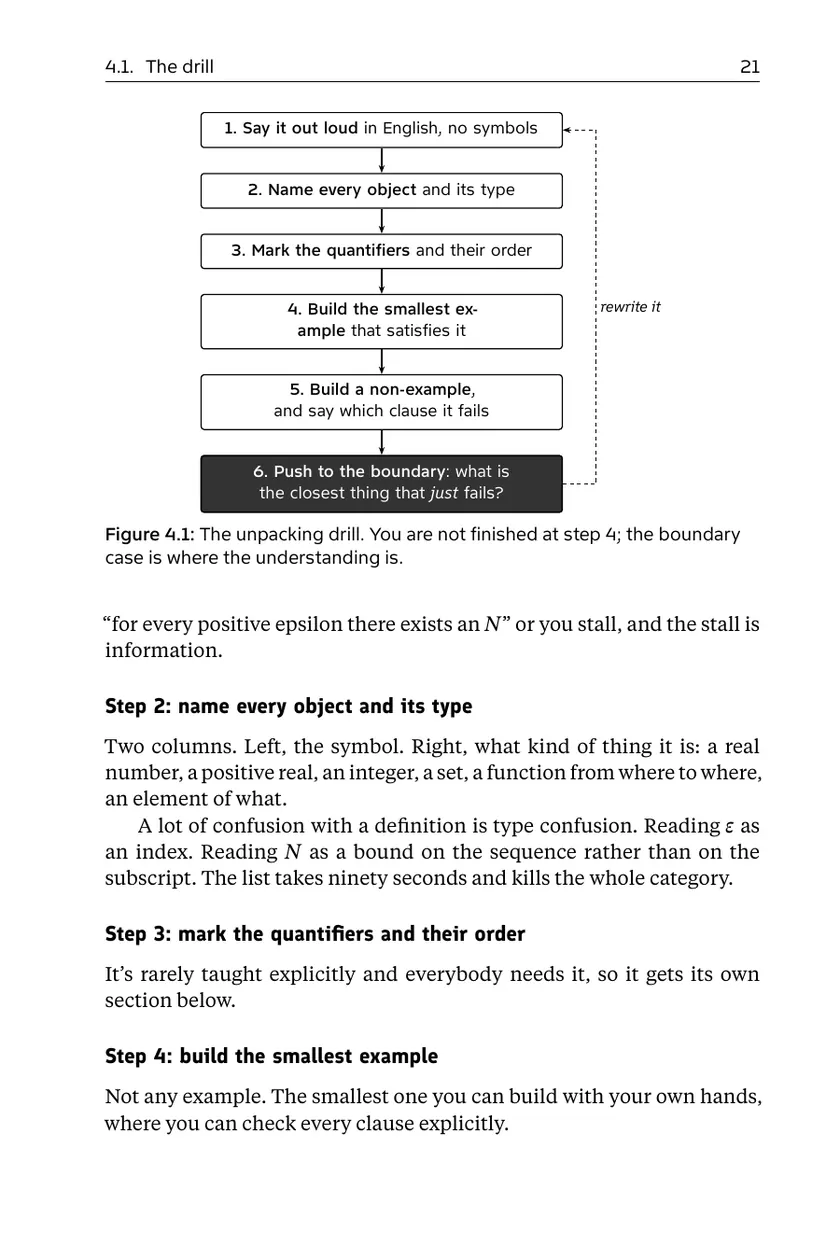
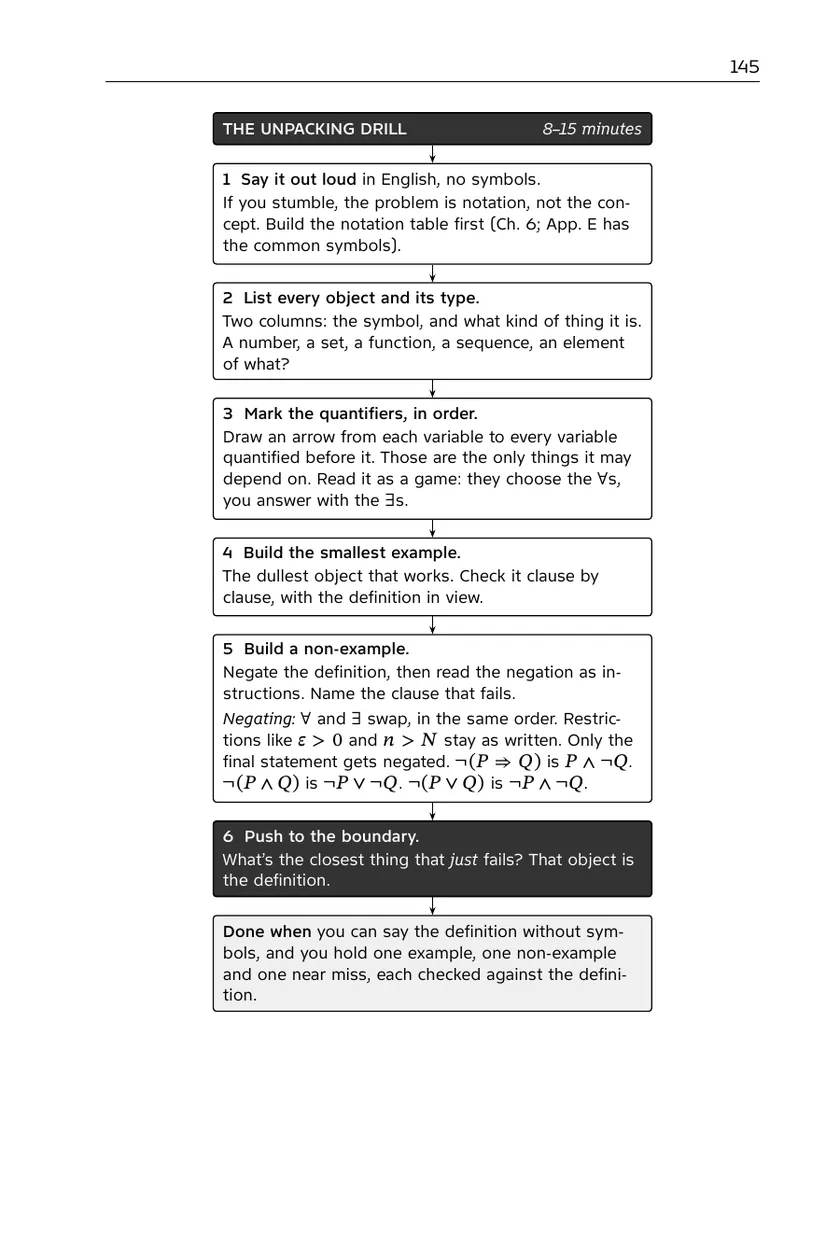
Chapter 4. The unpacking drill as a diagram: 6 steps from saying it out loud to pushing to the boundary.
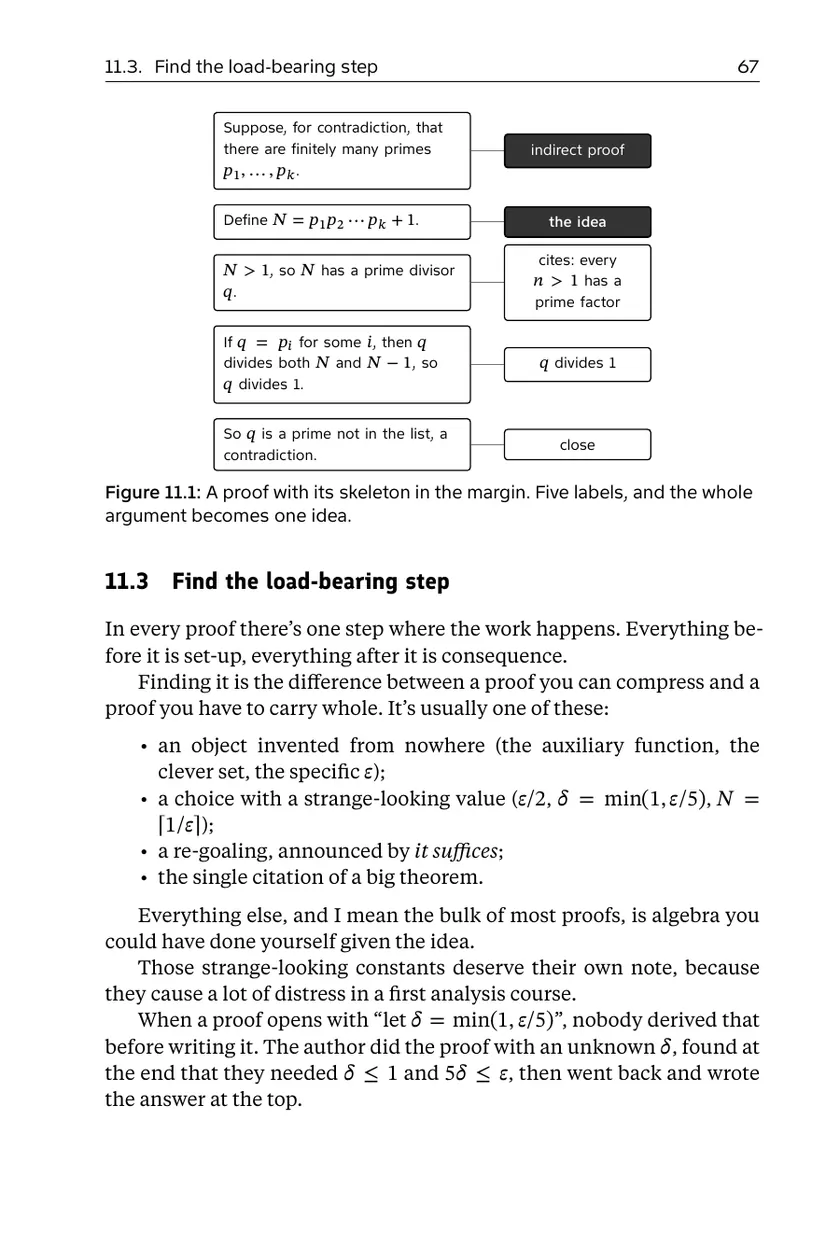
Chapter 11. A proof with its skeleton written in the margin, where 5 labels turn the whole argument into a single idea.
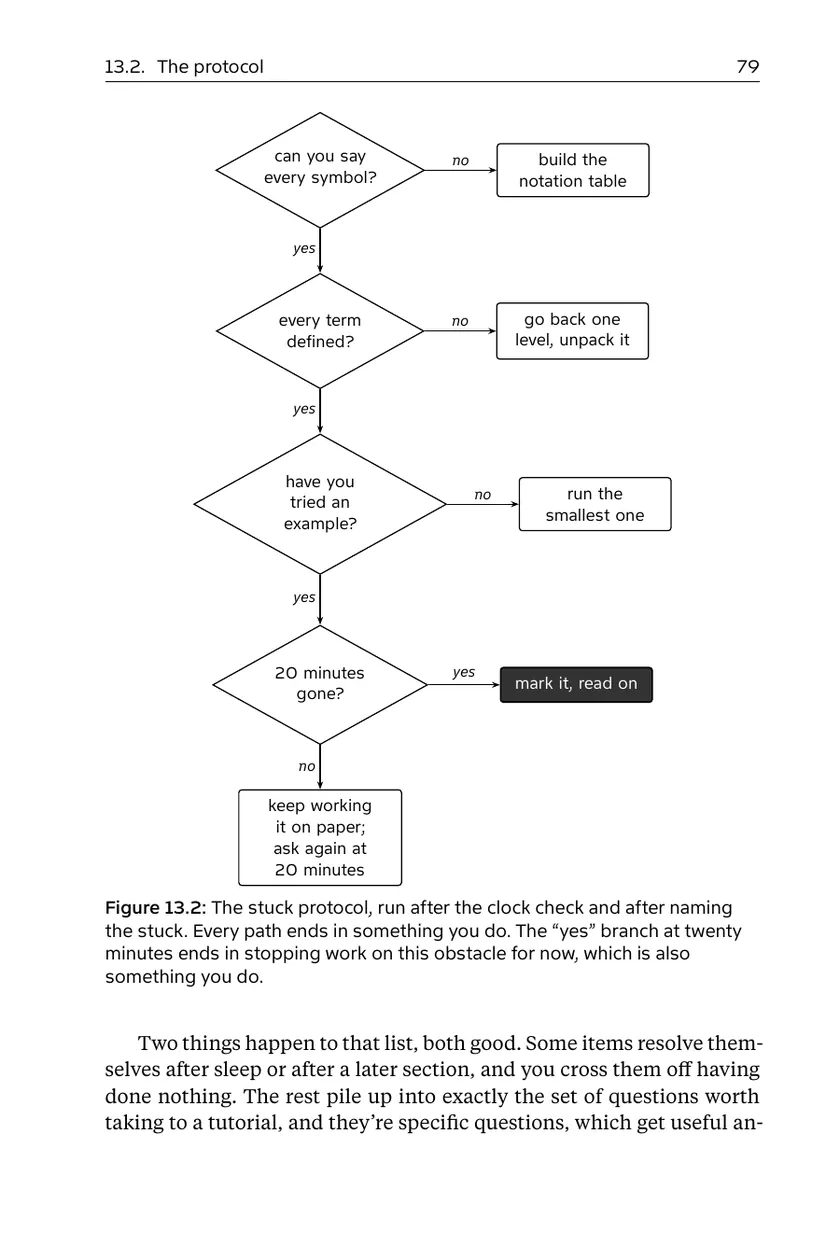
Chapter 13. The stuck protocol as a decision tree, where every branch ends in something you can do.
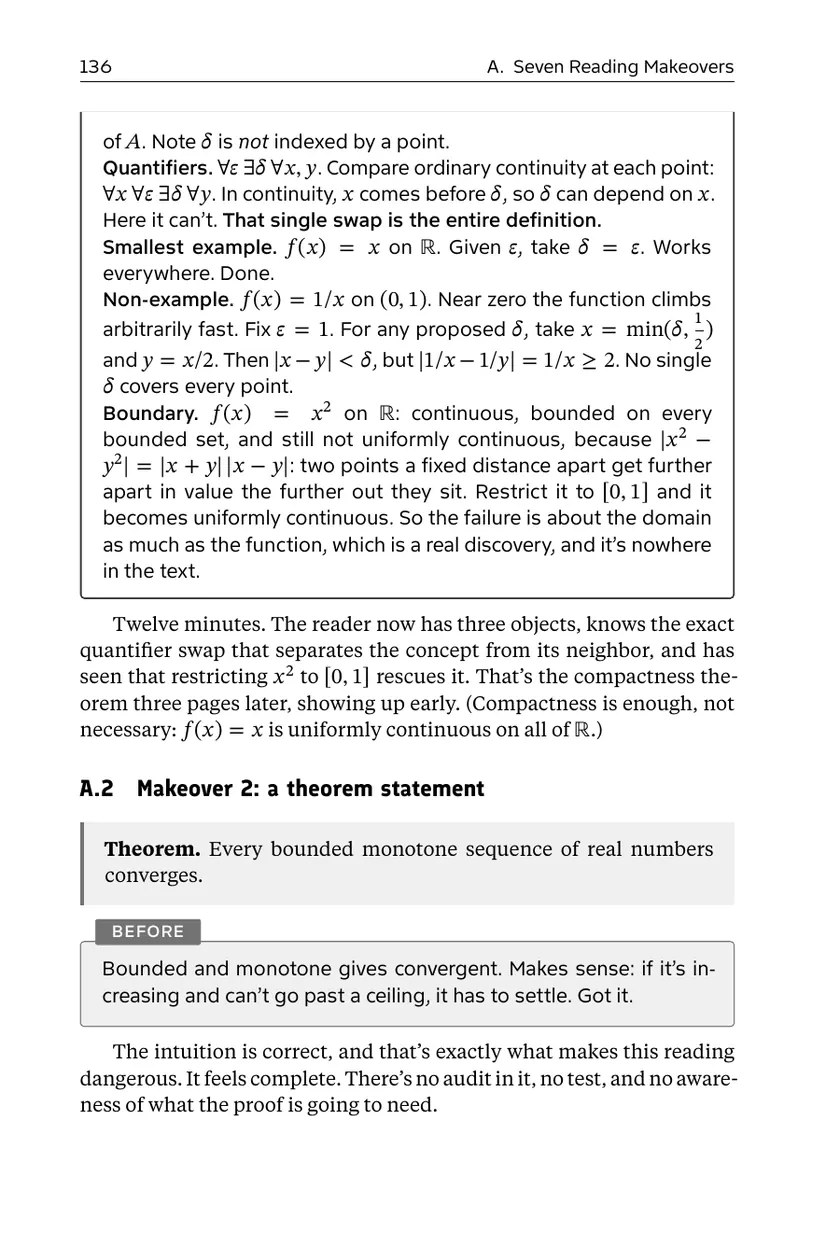
Appendix A. A reading makeover: a passage read badly, then read properly, with the difference spelled out.
Appendix B. The unpacking drill on a single page, with permission to photocopy it for yourself or your class.
Swipe for more pages.
Table of Contents
The parts follow the order you'll need them in. Each part opens to its chapters, and the filter finds a topic across all of them.
30 chapters and appendices
Part IWhy the Page Resists You3 chapters
Why a page of mathematics stalls you and what it's made of. The procedures in the later parts make more sense after this one.
1The Page That Won't Let You InThe compression problem, the rereading loop and 4 ways students read.
2What a Mathematical Text Is Made Of6 kinds of object, the dependency graph and where authors hide the intuition.
3Four GearsReading speeds you choose on purpose and how to spend a 2-hour block.
Part IIDefinitions3 chapters
The 6-step unpacking drill and the example bank that keeps every definition honest.
4Unpacking a DefinitionThe drill, why quantifier order matters so much and a full unpacking of "bounded."
5Examples, Non-Examples, and the BoundaryBuilding an example bank, making non-examples on purpose and collecting monsters.
6Notation: Say It Out LoudNotation's parts of speech, a notation table and a 5-minute daily drill.
Part IIIStatements3 chapters
Reading a theorem before you read its proof, so you know what the proof has to deliver before it starts.
7Reading a Theorem Before Its ProofSplitting the statement, restating it, auditing the hypotheses and predicting the proof.
8Testing a Statement Against the EdgesA test battery, the counterexample instinct and sharpness.
9The Neighborhood of a TheoremThe converse, the contrapositive and the generality ladder.
Part IVProofs6 chapters
6 chapters on proofs. The last one reads a single theorem start to finish with every move in the book.
10Three Ways to Read a ProofFollowing, verifying and reconstructing, and how to choose the depth on purpose.
11Finding the SkeletonStructure words, margin labels, the load-bearing step and 5 proof shapes.
12The Reconstruction TestWhy recognizing a proof lies to you and the gap list that fixes it.
13Stuck: A ProtocolNaming the stuck, running the protocol and escalating in order.
14When the Proof Uses a Technique You Have Never MetNaming the move, translating it, building a toy problem and keeping a technique card.
15One Theorem, Read Start to FinishEvery move in the book on a single fixed-point theorem, including the drop-one test.
Part VLonger Texts4 chapters
The same procedures scaled up to a chapter, a whole book on your own and a research paper.
16Reading a Chapter3 passes, where the difficulty actually is and when to skip.
17Working Through a Book AloneChoosing the book, the 15-page week and 5 exercises instead of 40.
18Reading a Research PaperA 20-minute triage, reading for a single theorem and a 3-pass read.
19Reading Above Your LevelThe one-level lookup, reading for shape and 3 questions to leave with.
Part VIWith a Pen, and With People3 chapters
What to write while you read and how to get more out of lectures, study groups and office hours.
20The ArtifactsMarking the book, the summary sheet and reading with your hands.
21Lectures, Groups, and Good Questions20 minutes of preparation, study groups that work and questions worth asking.
22What Changes When You Get GoodYou still get stuck as often. What changes is how you read and what you know about your own gaps.
Part VIIToolkit8 appendices
8 appendices built to sit open on your desk while you work.
ASeven Reading MakeoversPassages read badly, then read properly.
BThe Unpacking DrillThe Chapter 4 drill on a single photocopiable page.
CThe Stuck ProtocolThe Chapter 13 protocol on a single photocopiable page.
DTime Budgets and Honest SpeedsWhat each move costs in time, so slowness stops feeling like failure.
ESay It Out LoudHow to read symbols aloud, including Greek letters and quantifiers.
FFurther Reading, Honestly AnnotatedEach book says who it's for, and the free ones are marked.
GTips at a GlanceEvery tip in the book, collected on 2 pages.
HAnswers to the Questions in the TextWorked answers to the closed questions the chapters ask.
Nothing matches that. Try a broader word, like proof, definition or paper.
The book ends with Notes and Sources, where every quotation and story is referenced.
Try the Unpacking Drill
This is the drill from Chapter 4, run on the definition of a bounded sequence. It takes about 8 minutes on paper, and stepping through it here shows how a sentence you could recite turns into one you understand.
Definition. A sequence (an) is bounded if there exists M > 0 with |an| ≤ M for all n.
Say It Out Loud
Put the definition into plain English, with no symbols.
"Some single positive number is at least as big as the size of every term."
Stumbling here points to the notation rather than the concept, so the notation table comes first.
List Every Object and Its Type
2 columns: the symbol and what kind of thing it is.
(an) is a sequence of reals. M is a positive real: not a term, and not indexed by n.
A lot of confusion with a definition is type confusion, like reading a number as if it were a sequence.
Mark the Quantifiers in Order
Draw an arrow from each variable to every variable quantified before it.
∃M ∀n. M comes first, so a single M has to work for the whole sequence.
It reads like a game: they choose the ∀s and you answer with the ∃s, so M can't depend on n.
Build the Smallest Example
The dullest object that works, checked clause by clause.
an = 1, with M = 1.
An example that plain can be checked against the definition with nothing else in the way.
Build a Non-Example
Negate the definition, then read the negation as instructions.
Negation: ∀M ∃n with |an| > M. Read as a recipe, it builds an = n.
∀ and ∃ swap in the same order, and only the final statement gets negated.
Push to the Boundary
Find the closest thing that just fails.
an = √n. Its steps shrink to zero, and it's still unbounded.
The near miss shows exactly what the definition is guarding against.
Done when you can say the definition without symbols and you hold an example, a non-example and a near miss, each checked against the definition. Chapter 4 also runs the drill on a definition from graph theory and one from group theory.
Price and Free Sample
You can read Chapter 1 before you pay anything, and the rest of the book works the same way.
Free Sample
The opening of the book, with no email and no account.
Download links appear right after checkout. Checkout may show your local currency, and the refund policy explains what it covers.
Who This Book Is For
The book teaches reading, so it helps most when you already have a course or a textbook in front of you.
✓Worth It If You
are in your first proof-based course or about to start one
can follow the lecture, then open the textbook and stall on the first page
are teaching yourself from a book with nobody to check your reading
are starting on research papers and the abstract already feels dense
tutor or teach, and want a procedure and 2 cards you can hand to students
×Look Elsewhere If You
need the mathematics itself taught. It teaches the reading and leaves the analysis to your textbook.
want worked solutions to your course's problem sets. There are none in it.
want to write proofs rather than read them. The companion, How to Write Mathematics, covers that and it's free.
need a paperback today. Right now the book is PDF only.
want mathematics to get fast. Careful reading stays slow, and the book makes that time count.
I Build Tools That Pay for Themselves And Give Away the Ones That Can’t
Everything here is quick to set up, light on your pages and built to do one real job well. I only charge for the tools that can make you money. The rest are free.
18+years building websites, plugins and stores, since 2008
I obsess over performance
Switch a feature off and it loads nothing. What does load stays small. A tool that replaces a plugin shouldn’t make your pages slower.
I care how it feels
Clear screens, sensible defaults and settings written in plain English. If you need a tutorial for the basics, that’s my design mistake, not yours.
Aa
I build for everyone
Full keyboard support, visible focus, proper labels and text you can actually read. When more people can use your store, more people can buy from it.
I build tools that earn
My paid tools help you sell, renew, license or convert. If one just sits in your stack, I haven’t done my job.
$0
If it can’t earn, it’s free
I won’t charge for anything that can’t make you money. The free tools get the same care as the paid ones, down to the last setting.
FAQs on How to Read Mathematics
Still unsure? You can read Chapter 1 first, or ask me through the contact page.
What do I get for $5.99?
You get 2 DRM-free PDFs of version 1.1: a 6 × 9 edition with 186 pages including covers and an A4 edition with 159 pages. Both download links appear as soon as checkout finishes.
Which edition should I read?
You get both, so you can switch whenever you like:
The 6 × 9 edition uses the paperback layout. It suits a phone, an e-reader or a small tablet and prints as a compact copy.
The A4 edition has a bigger page and slightly larger type. It suits a laptop, a large tablet or a home printer.
It used to be free. What changed?
Version 1.0 was a free download, and if you have it, it's yours to keep. Version 1.1 is a full revision with:
a new chapter that reads a single theorem start to finish
14 stories from working mathematicians
tips in every chapter
2 more reading makeovers
worked answers to the questions in the text
checked notes and sources
Can I get a refund?
Ebooks are instant downloads, so the refund policy covers these cases and not a change of mind:
a defective file
a duplicate charge
an order that never arrived
That's why Chapter 1 is free. You can read it first and buy only if the method works on your own textbook.
Can I print it or share it?
You can print it for your own use as often as you like, and the unpacking drill and stuck protocol cards may be photocopied for personal and classroom use. Please send people to the free sample instead of passing the PDF around.
What math do I need first?
Nothing past what your courses are teaching you now. Nearly every worked passage runs on first-course material such as √2 and continuity. Most examples come from a first analysis course, and a few use first ideas about graphs and groups, which you can skip if you haven't met them yet.
Start With Chapter 1
Chapter 1 is free to read tonight. The full book, with all 22 chapters and the toolkit, is $5.99.