
How can Instagram Influencers help promote your business?
Influencer marketing on Instagram isn’t just for Nike and Coca-Cola anymore. Small businesses with tight budgets are using micro-influencers to drive real sales, and the ROI often beats traditional advertising by a wide margin. I’ve seen businesses spend $500 on a micro-influencer campaign and generate $5,000 in sales within a week. The key is knowing how to find the right influencers, structure the deal, and measure what actually matters.
Instagram remains the most effective platform for influencer marketing, with higher engagement rates than Facebook, Twitter, or even TikTok for most product categories. The platform’s visual nature makes it ideal for showcasing products, and its built-in shopping features create a direct path from discovery to purchase. Whether you’re a small business or an established brand, here’s everything you need to know about working with Instagram influencers.
What Is an Instagram Influencer?
An Instagram influencer is someone who has built a dedicated following on the platform and can affect their audience’s purchasing decisions through their content. But not all influencers are created equal. The influencer landscape breaks down into distinct tiers, each with different strengths and price points.
Nano-Influencers (1,000 to 10,000 followers)
These are everyday people with small but highly engaged communities. They often have 5 to 8% engagement rates (compared to 1 to 2% for mega-influencers). They’re affordable (often accepting free products in exchange for posts) and their recommendations feel genuine because followers know them personally.
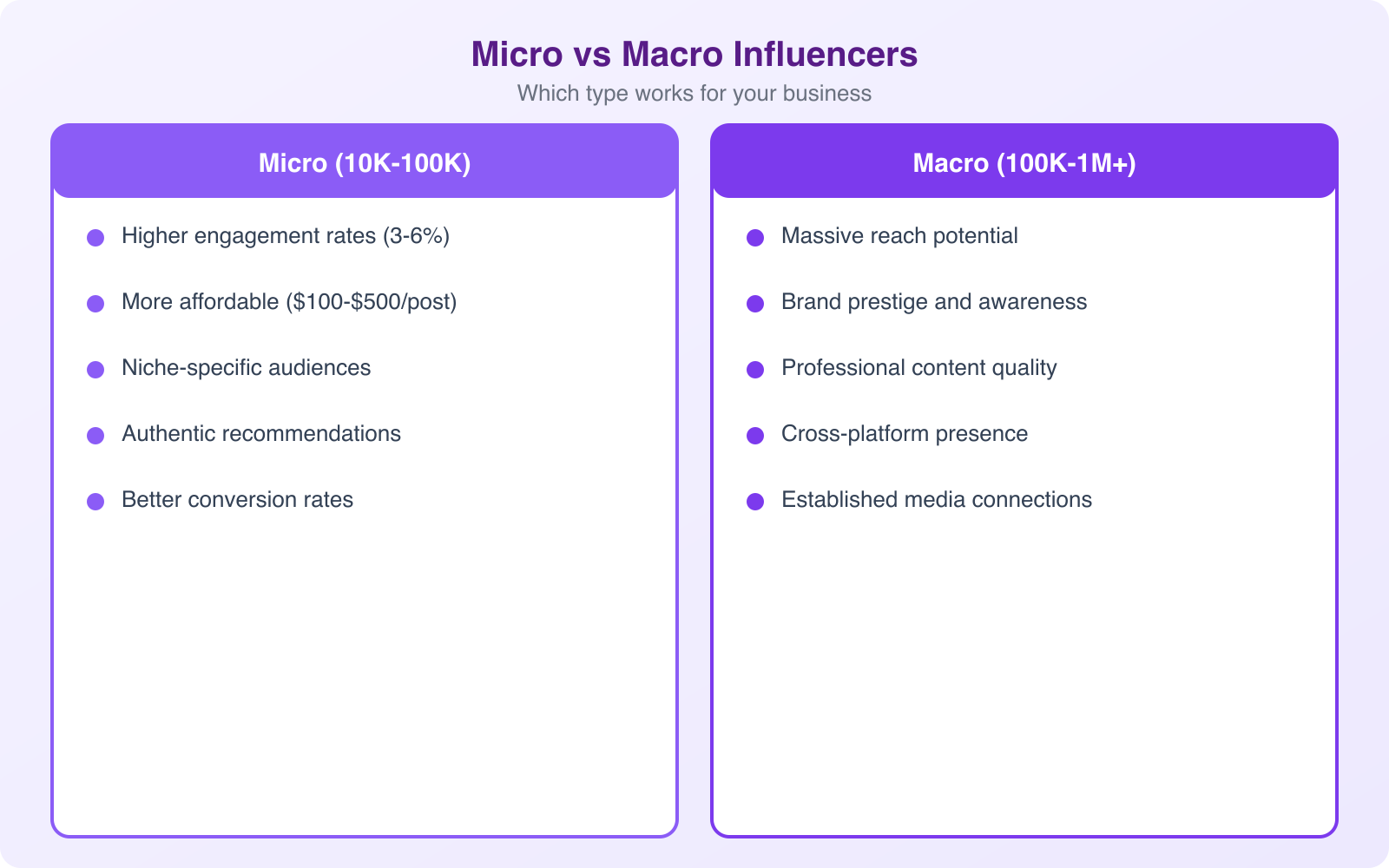
Micro-Influencers (10,000 to 100,000 followers)
The sweet spot for most businesses. Micro-influencers have established credibility in a specific niche (fitness, cooking, tech, beauty) and their engagement rates remain strong at 3 to 5%. They typically charge $100 to $1,000 per post, making them accessible for small and mid-size businesses.
Macro-Influencers (100,000 to 1 million followers)
These creators have broader reach but lower engagement rates. They’re ideal for brand awareness campaigns where you want maximum visibility. Expect to pay $1,000 to $10,000 per post. They’re best suited for established brands with larger marketing budgets.
Celebrity Influencers (1 million+ followers)
Actors, musicians, athletes, and internet celebrities. Massive reach but low engagement rates (often under 1%) and high costs ($10,000 to $500,000+ per post). Unless you’re a major brand with a massive budget, celebrity influencers usually don’t make financial sense.
For most small to medium businesses, micro-influencers deliver the best ROI. Their followers trust them more than celebrities, their engagement rates are 3 to 5x higher, and they cost a fraction of what macro or celebrity influencers charge. Start with 3 to 5 micro-influencers rather than blowing your entire budget on one big name.
How to Find the Right Instagram Influencers
Finding the right influencer is more important than finding the biggest influencer. A beauty influencer with 500,000 followers won’t sell your SaaS product. Here’s how to find influencers who’ll actually move the needle for your business.
Search by Hashtags
Search for hashtags relevant to your industry and look at who’s creating the most engaging content around those topics. Check their profile, engagement rate, and audience demographics before reaching out.
Check Your Own Followers
Some of your best potential influencers might already follow your brand. Look through your followers and identify anyone with a meaningful following who genuinely uses or talks about products in your category. These organic connections convert better than cold outreach.
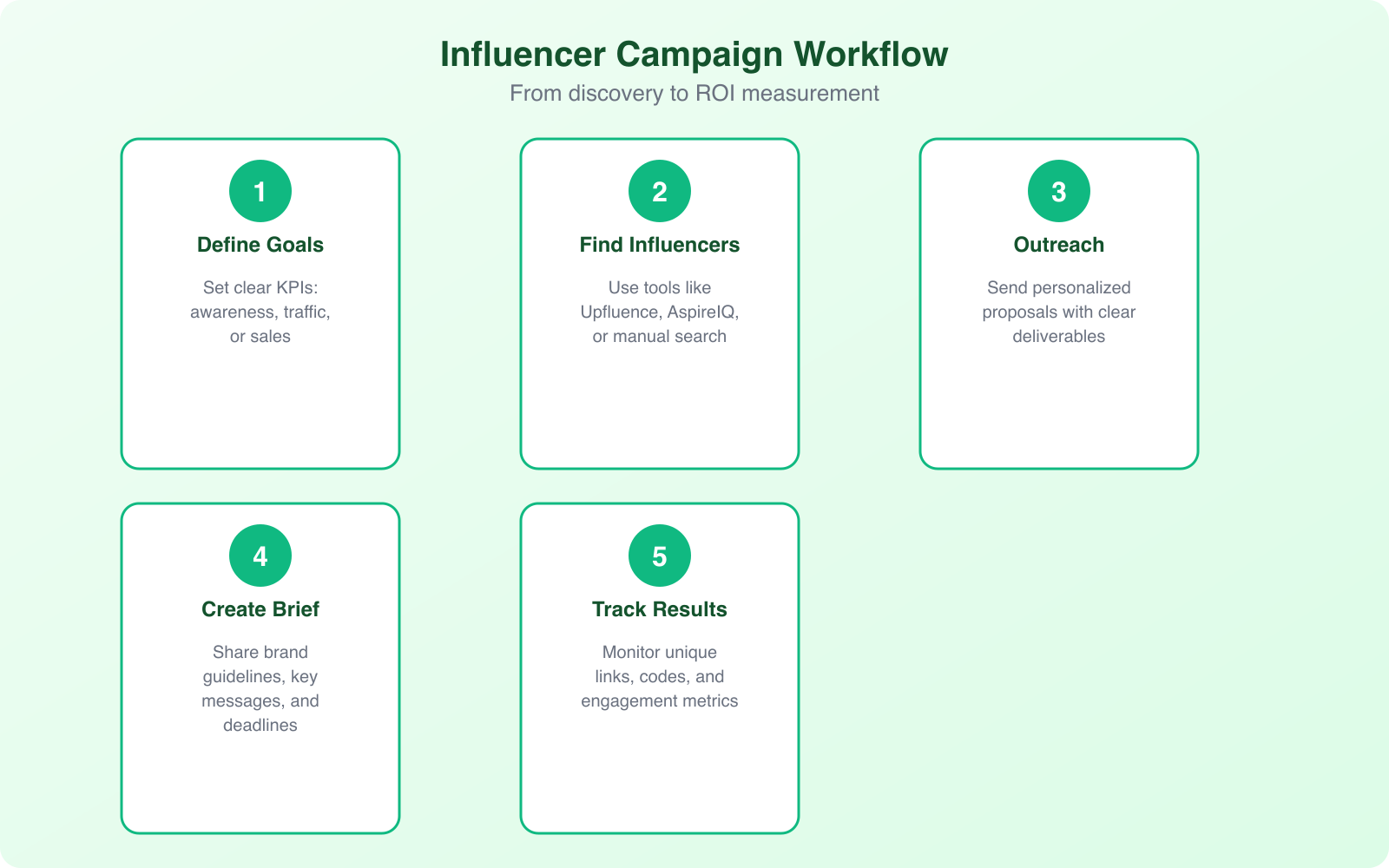
Use Influencer Discovery Platforms
Tools like Upfluence, AspireIQ, and Heepsy let you search for influencers by niche, follower count, engagement rate, location, and audience demographics. These platforms save hours of manual searching and help you verify that an influencer’s followers are genuine (not purchased).
Analyze Competitor Partnerships
Look at which influencers your competitors work with. If an influencer promotes a competing product, their audience is already interested in your category. You can either target the same influencer or find similar ones in the same niche.
Outreach Templates That Actually Get Responses
Most influencer outreach fails because it sounds like a template. Influencers get dozens of partnership requests every week. You need to stand out. Here’s how to structure your outreach:
What to include in your first message:
- Personalization. Reference a specific piece of content they created. Show that you actually follow their work and aren’t just mass-messaging influencers.
- Clear value proposition. Explain what’s in it for them (compensation, free products, exclusive access, revenue share).
- Brief brand introduction. One to two sentences about your brand. Don’t write a novel.
- Specific ask. What do you want them to do? A single post? A story series? A Reel? Be specific.
- Flexibility. Let them know you’re open to their creative input. Influencers know their audience better than you do.
A good outreach DM or email might look like: “Hey [Name], I loved your recent post about [specific topic]. The way you explained [detail] really resonated with me. I run [Brand], and I think our [product] would be a great fit for your audience because [reason]. Would you be interested in a paid collaboration? Happy to share more details.”
Keep it short, personal, and respectful of their time. Follow up once after 5 to 7 days if you don’t hear back. After that, move on.
Micro vs. Macro Influencers: Which Is Right for You?
This is the most common question businesses ask, and the answer depends on your goals and budget.
Choose micro-influencers when you:
- Have a limited budget (under $5,000 per campaign)
- Want to drive direct sales and conversions
- Target a specific niche audience
- Value authentic, trust-based recommendations
- Want to test influencer marketing before scaling
Choose macro-influencers when you:
- Have a substantial marketing budget ($10,000+)
- Want broad brand awareness and reach
- Are launching a new product to a wide audience
- Need professional, polished content creation
- Want to associate your brand with a well-known figure
The role of micro-influencers in building a brand is growing every year. Many brands now prefer running campaigns with 10 micro-influencers rather than one macro-influencer, because the combined reach is similar but the engagement and conversion rates are significantly higher.
Measuring ROI from Influencer Campaigns
If you can’t measure it, you can’t improve it. Here’s how to track the actual impact of your influencer marketing campaigns:
Use UTM Parameters
Create unique tracking URLs for each influencer using UTM parameters. This lets you see exactly how much traffic and how many conversions each influencer drives in Google Analytics. Format: yoursite.com/product?utm_source=instagram&utm_medium=influencer&utm_campaign=[influencer-name]
Unique Discount Codes
Give each influencer a unique discount code (like SARAH15 for 15% off). This makes it easy to track exactly how many sales each influencer generates and gives their followers an incentive to purchase.
Track These Metrics
- Engagement rate. (Likes + Comments) / Followers x 100. Anything above 3% is good for influencer content.
- Reach and impressions. How many unique people saw the content.
- Website traffic. Check your UTM-tagged URLs in Google Analytics.
- Conversion rate. Of the people who clicked through, how many actually purchased?
- Cost per acquisition (CPA). Total campaign cost / number of customers acquired. Compare this to your CPA from other marketing channels.
- Follower growth. Did your own Instagram following grow during the campaign period?
Don’t judge influencer campaigns solely on immediate sales. Influencer marketing also builds brand awareness and trust that lead to conversions over time. Track both direct attribution (UTM links, discount codes) and indirect signals (brand search volume, follower growth, website traffic trends) for a complete picture.
Structuring Influencer Partnerships
Once you’ve found the right influencer, structuring the partnership correctly protects both parties and sets clear expectations.
Key elements of an influencer agreement:
- Deliverables. Exactly what content will be created (number of posts, Stories, Reels).
- Timeline. When content will be posted and how long it needs to stay live.
- Compensation. Fixed fee, commission-based, product exchange, or a combination.
- Content approval. Whether you have the right to review content before it goes live.
- Usage rights. Can you repurpose their content for your own ads or social media?
- Exclusivity. Whether they’re prohibited from promoting competing brands for a certain period.
- FTC disclosure. They must clearly disclose the partnership (using #ad or #sponsored) to comply with advertising regulations.
For campaigns with micro-influencers, a simple email agreement works fine. For larger campaigns with macro-influencers, invest in a formal contract. The best Instagram apps for business can help you manage these relationships and track content delivery.
Campaign Types That Drive Results
Different campaign types work for different objectives. Here are the formats that consistently deliver the best results:
- Product reviews. Send the influencer your product and let them create an honest review. Authenticity drives trust and conversions.
- Giveaways. Partner with an influencer to give away your product. Requires followers to follow your account and engage. Great for rapid follower growth.
- Branded hashtag campaigns. Create a branded hashtag and have influencers encourage their audience to use it. This generates user-generated content and builds community.
- Takeovers. Let an influencer take over your Instagram account for a day. This drives their followers to your profile and creates fresh, engaging content.
- Affiliate partnerships. Long-term arrangements where influencers earn a commission on every sale they drive. This aligns incentives and creates ongoing promotion.
Avoiding Influencer Marketing Mistakes
I’ve seen businesses waste thousands on influencer marketing by making these avoidable mistakes:
- Choosing based on follower count alone. Engagement rate matters more than follower count. Check for fake followers using tools like HypeAuditor.
- Being too controlling. If you script every word, the content won’t feel authentic. Give influencers creative freedom within clear guidelines.
- No clear objectives. Define what success looks like before launching a campaign. Is it sales, brand awareness, followers, or content creation?
- One-off campaigns. Long-term partnerships outperform one-time posts. Audiences need to see a product multiple times before purchasing.
- Ignoring audience fit. The influencer’s audience demographics should match your target customer. A fitness influencer’s audience won’t buy accounting software.
Instagram influencer marketing works when you treat it as a strategic channel, not a one-off tactic. Build relationships with the right influencers, track your results, and iterate based on data. For more Instagram marketing strategies, check out our guide on how to promote your business on Instagram.
Frequently Asked Questions
How much does it cost to work with an Instagram influencer?
Costs vary dramatically by tier. Nano-influencers (1K-10K followers) often accept free products or $50-200 per post. Micro-influencers (10K-100K) typically charge $100-1,000 per post. Macro-influencers (100K-1M) charge $1,000-10,000. Celebrity influencers (1M+) can charge $10,000-500,000 or more per post. For most small businesses, micro-influencers offer the best balance of reach, engagement, and affordability.
How do I know if an influencer has fake followers?
Check their engagement rate first. If someone has 100,000 followers but gets only 50-100 likes per post, most followers are likely fake or inactive. Use tools like HypeAuditor or Social Blade to audit follower authenticity. Also look at the quality of comments. If most comments are generic (‘Nice!’ ‘Great post!’ or emoji-only), that’s another red flag of fake engagement.
Should I give influencers creative freedom or strict guidelines?
Give creative freedom within a clear framework. Provide key messaging points, required hashtags and tags, and any specific requirements (like showing the product in use). But let the influencer create content in their own voice and style. Their audience follows them for their authentic voice, and overly scripted content performs poorly. A creative brief with do’s and don’ts works better than a word-for-word script.
What’s a good engagement rate for influencer content?
For sponsored content on Instagram, an engagement rate above 3% is considered good. Nano-influencers often achieve 5-8%, micro-influencers average 3-5%, and macro-influencers typically see 1-3%. Note that engagement rates on sponsored posts are usually slightly lower than organic posts, which is normal. Focus on finding influencers whose sponsored content still maintains at least 70-80% of their organic engagement rate.
How many influencers should I work with for a single campaign?
For your first campaign, start with 3 to 5 micro-influencers. This gives you enough data to compare performance across different creators and audiences without overextending your budget. As you learn what works, you can scale up. Larger brands often run campaigns with 20-50 micro-influencers simultaneously, but that level of coordination requires dedicated management or an influencer marketing platform.