
 by
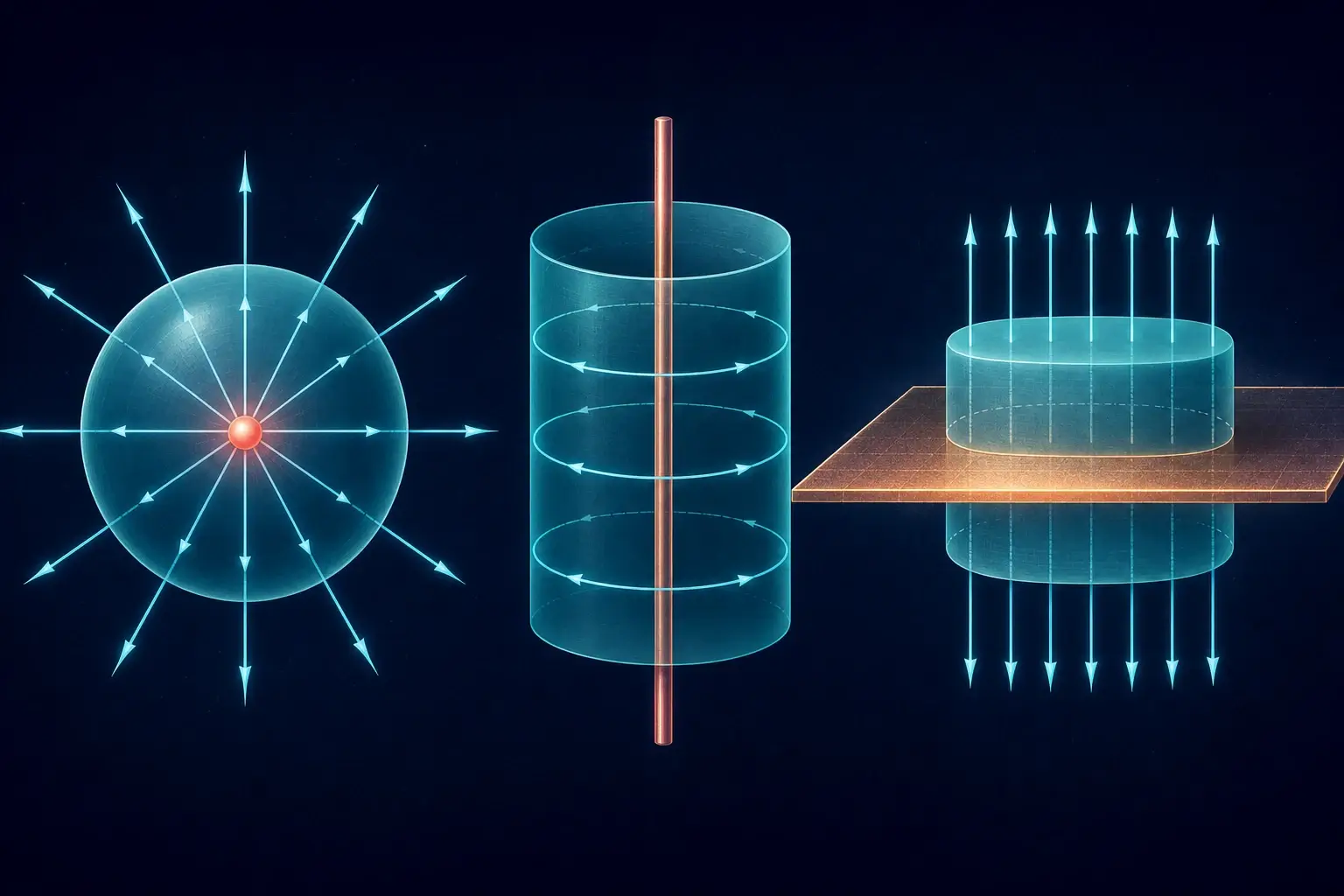
byGauss’s law states that the net electric flux through any closed surface equals the enclosed charge divided by the vacuum permittivity. The law is always true in electrostatics, but it is only a shortcut for finding the field when symmetry controls the field’s magnitude and direction.
A Gaussian surface is imaginary. It does not block the field, and it does not have to match a physical boundary. You choose it so the flux integral becomes simple.
Free download: Gauss’s Law: Electric Flux, Symmetry, and Examples Study Notes (PDF)
The full note as a print-ready PDF: every section and worked example, the 10-question practice set with solutions, an answer key, and a 1-page revision sheet for last-minute revision.
What Is Gauss’s Law?
$$\oint_S\mathbf E\cdot d\mathbf A=\frac{Q_{\mathrm{enc}}}{\varepsilon_0}$$
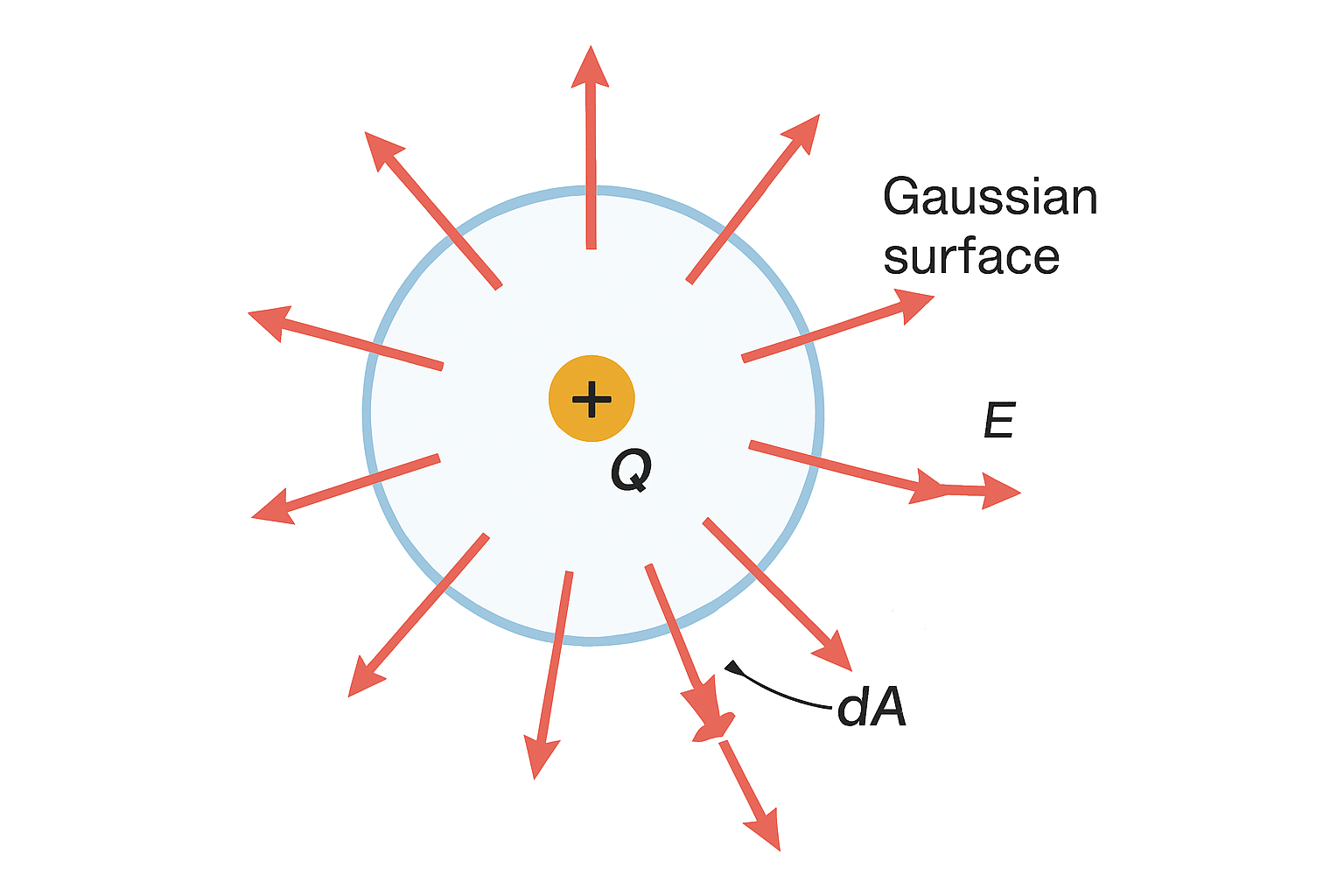
The integral is over a closed surface \(S\). The area vector \(d\mathbf A\) points outward. \(Q_{\mathrm{enc}}\) includes the net charge inside the surface, with signs. Charges outside can affect \(\mathbf E\) on the surface, but their net contribution to the closed-surface flux is zero.
| Quantity | Meaning | SI unit |
|---|---|---|
| \(\mathbf E\) | Electric field | N/C or V/m |
| \(d\mathbf A\) | Outward vector area element | m² |
| \(\Phi_E\) | Electric flux | N m²/C |
| \(Q_{\mathrm{enc}}\) | Net enclosed charge | C |
| \(\varepsilon_0\) | Vacuum permittivity | F/m |
The OpenStax guide to applying Gauss’s law shows the same three standard symmetry classes: spherical, cylindrical, and planar.
Electric Flux Before Gauss’s Law
Flux measures how strongly a vector field passes through a surface. For a uniform field and a flat area
$$\Phi_E=\mathbf E\cdot\mathbf A=EA\cos\theta$$
Here \(\theta\) is the angle between the electric field and the area normal, not the surface itself. A field perpendicular to the surface has maximum flux. A field tangent to the surface has zero flux.
- Outward crossing: positive flux.
- Inward crossing: negative flux.
- Tangent field: zero local flux because \(\mathbf E\cdot d\mathbf A=0\).
- Closed surface: only the net outward flux enters Gauss’s law.
When Gauss’s Law Actually Solves the Field
Gauss’s law is useful for finding \(E\) only when symmetry lets you take \(E\) outside part of the integral or makes other parts contribute zero. The shape of the Gaussian surface alone creates no symmetry. The charge distribution must have the symmetry.
- Identify whether the source has spherical, cylindrical, or planar symmetry.
- Infer the allowed direction of the electric field.
- Choose a closed surface on which \(E\) is constant where flux is nonzero.
- Compute the flux and enclosed charge separately.
- Apply Gauss’s law and solve for \(E\).
- Check the direction, units, and limiting behaviour.
Spherical Symmetry: Point Charge and Charged Sphere
For a point charge \(Q\) at the centre of a spherical Gaussian surface of radius \(r\), symmetry makes the field radial and constant in magnitude on the sphere.
$$E(4\pi r^2)=\frac{Q}{\varepsilon_0}$$
$$E=\frac{1}{4\pi\varepsilon_0}\frac{Q}{r^2}$$
This is the point-charge field from Coulomb’s law. Outside any spherically symmetric charge distribution, the field has the same form with \(Q\) equal to the total enclosed charge.
Uniformly Charged Solid Sphere
For a sphere of radius \(R\) and uniform volume charge density \(\rho\), a Gaussian sphere with \(r $$E(r)=\frac{\rho r}{3\varepsilon_0}=\frac{Qr}{4\pi\varepsilon_0R^3}\qquad(r Inside, the field rises linearly from zero at the centre. Outside, \(E=Q/(4\pi\varepsilon_0r^2)\). The two expressions agree at \(r=R\). For an infinitely long line with linear charge density \(\lambda\), choose a coaxial cylinder of radius \(r\) and length \(L\). The field is radial. Flux through the end caps is zero because the field is tangent there. $$E(2\pi rL)=\frac{\lambda L}{\varepsilon_0}$$ $$E=\frac{\lambda}{2\pi\varepsilon_0r}$$ The field falls as \(1/r\), not \(1/r^2\), because cylindrical area grows linearly with radius. A finite wire approaches this result only far from its ends and at distances small compared with its length. For an infinite sheet with surface charge density \(\sigma\), use a pillbox crossing the sheet. The field is perpendicular to the plane and has equal magnitude on both sides. Only the two flat faces contribute. $$2EA=\frac{\sigma A}{\varepsilon_0}$$ $$E=\frac{\sigma}{2\varepsilon_0}$$ The ideal infinite-sheet field does not depend on distance. A large finite sheet behaves approximately this way near its centre when the observation distance is much smaller than the sheet dimensions. Free charges in a conductor move until the internal electric field is zero. A Gaussian surface entirely within the conducting material therefore has zero flux and encloses zero net charge. Any excess charge resides on the surface. A hollow cavity inside a conductor is field-free only under the appropriate electrostatic conditions, such as no charge inside the cavity. Put a charge in the cavity and induced surface charges appear. A field line from an external charge that enters a closed surface must leave it again. The inward contribution is negative and the outward contribution is positive. Their total is zero even though the external charge can make the field large and nonuniform at individual points. This is why zero enclosed charge does not imply zero electric field. It implies zero net flux. A uniform field passing through an empty box is the simplest example: as much flux enters as leaves. Use these next if you want to connect this result with the surrounding physics: Work each question before reading its solution. The set runs from direct recall and substitution to the applied questions that exams actually use to separate grades. All 10 also appear in the downloadable PDF with a separate answer key. Question 1. State Gauss’s law and explain what \(\Phi_E\) and \(Q_{enc}\) represent. Solution. $$\oint \vec{E} \cdot d\vec{A} = \dfrac{Q_{enc}}{\varepsilon_0}$$ \(\Phi_E\) is the total electric flux through a closed surface, informally how much field “flows out” through it. \(Q_{enc}\) is only the charge ENCLOSED by that surface; anything outside contributes zero net flux, even though it still bends the field locally. Question 2. Why does charge OUTSIDE a closed surface contribute zero net flux through it, even though its field lines do cross the surface? Solution. Every field line from an external charge that enters the surface on 1 side must exit somewhere else, since field lines from a charge outside cannot terminate inside a region containing no charge. Entering and exiting flux exactly cancel in the net sum, which is why only enclosed charge survives in the final total. Question 3. A point charge of 5 \(\mu\)C sits at the center of an imaginary sphere of radius 0.2 m. Find the total electric flux through the sphere. Solution. \(\Phi_E = Q_{enc}/\varepsilon_0 = (5\times10^{-6})/(8.85\times10^{-12}) \approx 5.65\times10^5\) N·m²/C. Notice the RADIUS never entered the calculation: Gauss’s law depends only on enclosed charge, a genuinely surprising and powerful simplification. Question 4. Use Gauss’s law to derive the electric field magnitude at distance \(r\) from a point charge \(Q\), and show it reproduces Coulomb’s law. Solution. Choose a spherical Gaussian surface of radius \(r\). By symmetry \(E\) is uniform and radial, so \(\Phi_E = E \times 4\pi r^2 = Q/\varepsilon_0\), giving \(E = \dfrac{Q}{4\pi\varepsilon_0 r^2} = \dfrac{kQ}{r^2}\), exactly Coulomb’s law. Gauss’s law is not a separate physical fact from Coulomb’s law; it is the same physics viewed through flux, and it derives Coulomb’s law as a special case. Question 5. For a uniformly charged infinite line with linear charge density \(\lambda\), use a cylindrical Gaussian surface to find \(E(r)\). Solution. A coaxial cylinder of radius \(r\), length \(L\): flux exits only through the curved side (the flat ends have field parallel to them, contributing zero). \(E \times 2\pi rL = \lambda L/\varepsilon_0\), so \(E = \dfrac{\lambda}{2\pi\varepsilon_0 r}\). The field falls off as \(1/r\), not \(1/r^2\), because the “source” is spread along an infinite line rather than concentrated at a point. Question 6. For an infinite charged plane with surface charge density \(\sigma\), use a pillbox Gaussian surface to find \(E\), and explain why it does NOT depend on distance from the plane. Solution. A pillbox straddling the plane, flat faces of area \(A\) parallel to it: flux exits both faces equally, \(2EA = \sigma A/\varepsilon_0\), giving \(E = \dfrac{\sigma}{2\varepsilon_0}\), a CONSTANT. Field lines from an infinite plane never spread apart or converge (there is no edge to diverge toward), so intensity never dilutes with distance, unlike the point-charge or line-charge cases. Question 7. Why does the electric field inside a solid conductor in electrostatic equilibrium equal exactly zero, using Gauss’s law reasoning? Solution. Choose a Gaussian surface just inside the conductor’s surface. Free charges in a conductor redistribute until the field inside vanishes (otherwise charges would still be accelerating, contradicting equilibrium); by Gauss’s law, zero field through that interior surface means zero enclosed charge, so all excess charge must reside on the outer SURFACE, none in the bulk. This is why a hollow metal box shields its interior from external fields (a Faraday cage). Question 8. A charged spherical shell (radius \(R\), total charge \(Q\)) has field \(E=0\) everywhere inside it. Use Gauss’s law to prove this without detailed integration. Solution. For any Gaussian sphere of radius \(r < R\) drawn inside the shell, \(Q_{enc} = 0\) (all the actual charge sits on the shell at radius \(R\), outside this smaller sphere). By Gauss's law, \(\Phi_E = 0/\varepsilon_0 = 0\), and by the shell's spherical symmetry \(E\) must be uniform over the Gaussian sphere, so \(E = 0\) throughout the interior. This 1-line argument replaces pages of direct integration. Question 9. A solid sphere of radius \(R\) carries uniform charge \(Q\) throughout its volume. Find \(E\) at a point INSIDE the sphere, at distance \(r < R\) from the center. Solution. Only the charge within radius \(r\) counts as enclosed: \(Q_{enc} = Q\dfrac{r^3}{R^3}\) (charge scales with enclosed volume for uniform density). Then \(E \times 4\pi r^2 = \dfrac{Qr^3/R^3}{\varepsilon_0}\), giving \(E = \dfrac{kQr}{R^3}\): the field grows LINEARLY with \(r\) inside a uniformly charged sphere, in contrast to falling off as \(1/r^2\) outside it. Question 10. Explain why Gauss’s law, while always TRUE, is only USEFUL for calculating E directly in a handful of highly symmetric charge configurations (spherical, cylindrical, planar). What must you do for an arbitrary charge distribution? Solution. Pulling \(E\) out of the flux integral as a constant requires the Gaussian surface to be chosen where \(E\) is known in advance to be uniform in magnitude and either parallel or perpendicular to the surface everywhere, which only symmetric charge distributions guarantee. For an irregular distribution, no such convenient surface exists, and the flux integral cannot be simplified; the practical fallback is Coulomb’s law integrated directly over the charge distribution, or numerical computation. Gauss’s law states that the net electric flux through any closed surface equals the net enclosed charge divided by the vacuum permittivity ε0. It is most useful when the charge distribution has spherical, cylindrical, or planar symmetry, so the field magnitude is constant on parts of a chosen surface and other parts have zero flux. No. It means the net flux is zero. External charges can produce a nonzero field whose inward and outward flux contributions cancel over the closed surface. A Gaussian surface is an imaginary closed surface chosen for a flux calculation. It is not a physical membrane and does not alter the electric field. Their field lines enter and leave the closed surface in equal net amount. They affect the field locally but contribute zero net flux. For a point charge, spherical symmetry reduces Gauss’s law to the inverse-square Coulomb field. Coulomb’s field also satisfies Gauss’s law. The quickest test is blunt: if you cannot state why \(E\) is constant on the chosen surface, Gauss’s law probably will not save algebra. Browse more in Physics.Cylindrical Symmetry: Infinite Line Charge
Planar Symmetry: Infinite Sheet of Charge
Conductors in Electrostatic Equilibrium
Why Outside Charges Give Zero Net Flux
Common Mistakes
Related Physics Guides
Key Takeaways
Practice Questions
Frequently Asked Questions
What does Gauss’s law state?
When is Gauss’s law useful for finding electric field?
Does zero enclosed charge mean zero electric field?
What is a Gaussian surface?
Why do charges outside a Gaussian surface not count?
How is Gauss’s law related to Coulomb’s law?