
The Complete Guide to Dropshipping in 2026
Everyone and their cousin started a dropshipping store during the pandemic. Most of them are gone now. The get-rich-quick crowd burned through their ad budgets, got hit with chargebacks, and quietly closed up shop. Good riddance.
What’s left is a $343 billion market that rewards people who treat it like an actual business. I’ve worked with ecommerce clients for over 16 years, building stores, optimizing conversion funnels, and watching business models come and go. Dropshipping isn’t going anywhere. But the version that works in 2026 looks nothing like what YouTube gurus were pitching in 2020.
The entrepreneurs making real money now aren’t running generic AliExpress stores with 3-week shipping times. They’re building brands, using AI to automate the boring stuff, and treating dropshipping as a launchpad, not a destination. This guide covers what actually works right now, backed by current numbers and real experience.
What Dropshipping Actually Is (And Isn’t)
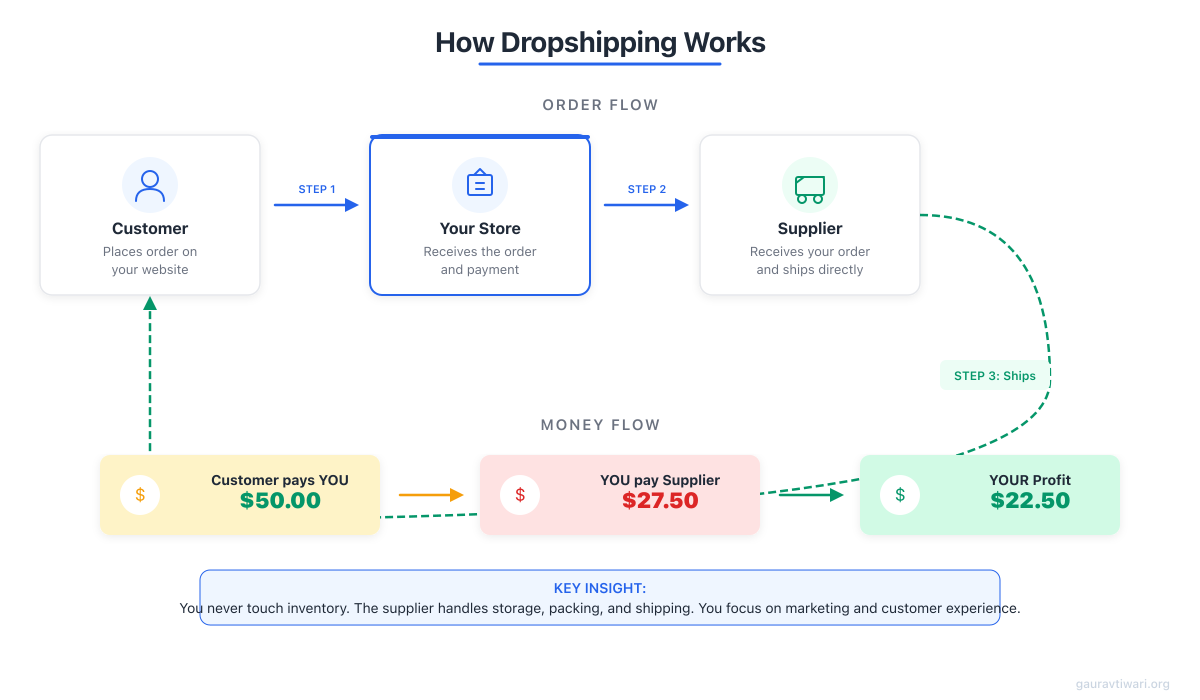
Dropshipping is an order fulfillment method. That’s it. When a customer buys from your store, you purchase the product from a supplier who ships it directly to them. You never touch, see, or store the product.
Here’s what most people get wrong: they call dropshipping a “business model.” It’s not. It’s a logistics method. Your business model is the brand you build, the audience you serve, and the problems you solve. Dropshipping is just how orders get shipped.
The Appeal
- No inventory investment (start with under $1,000)
- No warehouse or storage costs
- Location independence, run it from anywhere
- Test products without committing to bulk orders
- Scale without scaling infrastructure
The Reality
- Thin margins (15-30% is typical after all costs)
- Zero control over product quality or shipping speed
- Intense competition on popular products
- Customer service headaches when suppliers mess up
- You’re one supplier mistake away from a chargeback
Over 27% of online retailers use dropshipping for at least part of their fulfillment. And about 23% of all online sales happen through dropshipping businesses. The market is projected to grow past $400 billion by end of 2026 at a 21% growth rate. Those are real numbers. But they don’t mean it’s easy.
The Economics That Actually Matter
I see too many dropshipping guides showing fantasy profit margins. Let me show you real numbers.
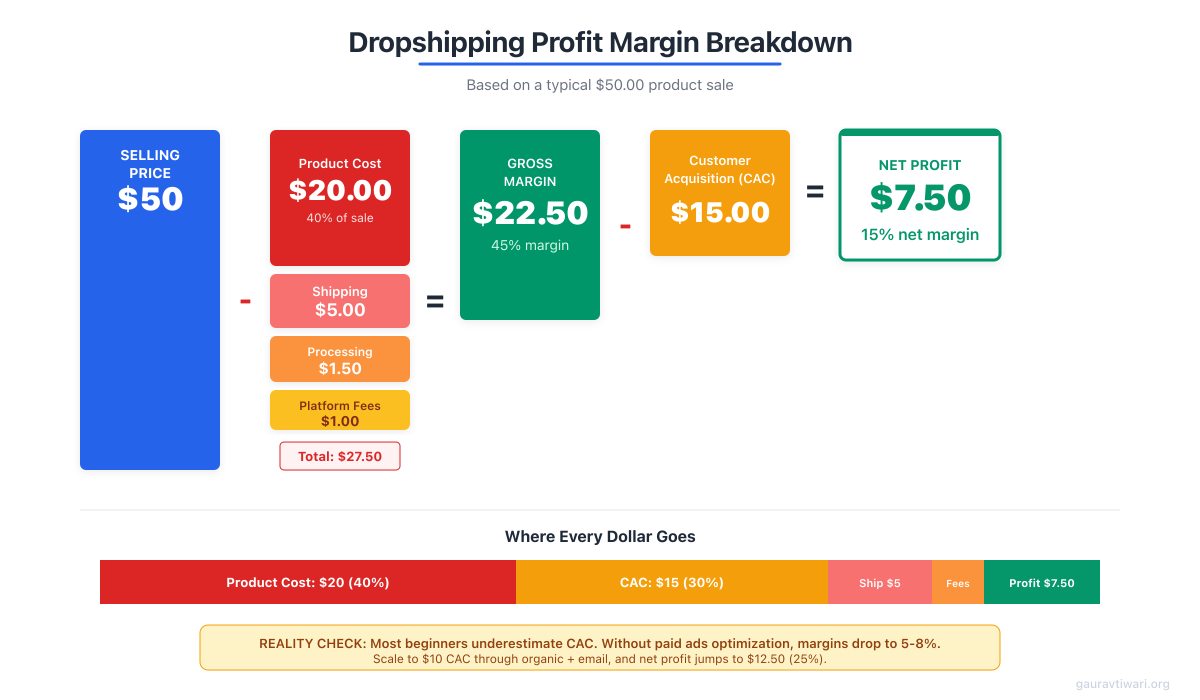
Typical unit economics for a $50 product:
| Component | Amount |
|---|---|
| Selling Price | $50.00 |
| Product Cost (supplier) | $20.00 |
| Shipping to Customer | $5.00 |
| Payment Processing (3%) | $1.50 |
| Platform Fees | $1.00 |
| Gross Margin | $22.50 (45%) |
That 45% looks healthy until you add the number that kills most dropshipping businesses: customer acquisition cost (CAC).
If you spend $15 per customer in Facebook or TikTok ads (which is optimistic for many niches), your actual profit is $7.50 per order. Sell 1,000 orders a month, and you clear $7,500. Before returns, chargebacks, refunds, and your time.
Your CAC must stay well below your gross margin. Repeat customers are where money gets made, someone you acquired once and who buys again costs you nothing additional. Building a 20%+ repeat purchase rate changes everything about your economics.
Returns destroy margins faster than anything. In apparel (the biggest dropshipping niche), expect 10-20% return rates. A product that’s profitable at 5% returns becomes a money pit at 15%. Factor this in before you launch.
Print-on-demand merchants running mid-to-high volume operations see 40-45% profit margins. That’s because custom products have less price comparison pressure. Nobody can search Amazon for “your exact design.”
Finding Products That Actually Sell
Product selection determines about 80% of whether your dropshipping store works or doesn’t. I’ve seen brilliant marketers fail with bad products and mediocre marketers succeed with great ones.
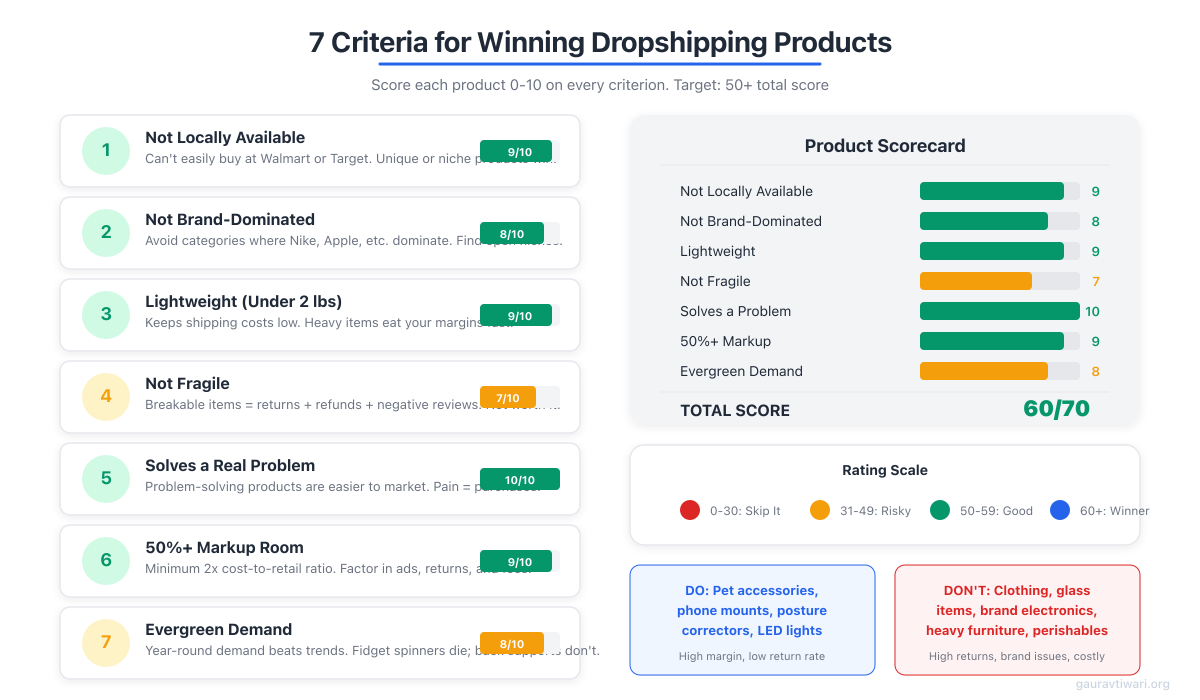
What makes a good dropshipping product in 2026:
- Not easily found at Walmart or Target (specialty items win)
- Not dominated by brands with obvious pricing (avoid selling AirPods)
- Light enough for $5-8 shipping (heavy items kill margins)
- Not fragile (broken items mean returns and refund requests)
- Solves a specific problem or serves a passionate niche
- Room for 50%+ markup without looking overpriced
- Evergreen demand (seasonal is fine if you plan for it)
Where to find products:
Spocket connects you with US and EU suppliers offering 2-5 day shipping. That’s the single biggest advantage over AliExpress sourcing. Faster shipping means fewer refund requests, fewer “where is my order” emails, and higher customer satisfaction. Spocket also offers branded invoicing, which matters when you’re building a real brand.
AliExpress still works for product research and validation. Filter by orders and ratings. But I wouldn’t build a long-term business on 15-25 day shipping from China. Use it to test concepts, then move to faster suppliers.
Alibaba is where you go when a product is proven. You’ll negotiate better pricing with manufacturers directly, but minimum order quantities are higher. This is the bridge between dropshipping and holding inventory.
Printify handles print-on-demand. Custom t-shirts, mugs, phone cases, all printed and shipped when ordered. Lower margins than traditional dropshipping, but much higher differentiation. Nobody else is selling your designs.
Product research tools like Sell The Trend, Ecomhunt, and Niche Scraper show trending products. Useful for ideas, but remember: if 50,000 other dropshippers can see the same “winning product,” it’s already saturated.
Choosing Your Platform
Your ecommerce platform matters more than most beginners think. It affects your costs, your growth ceiling, and how much time you spend on technical work versus selling.
Shopify: The Default Choice
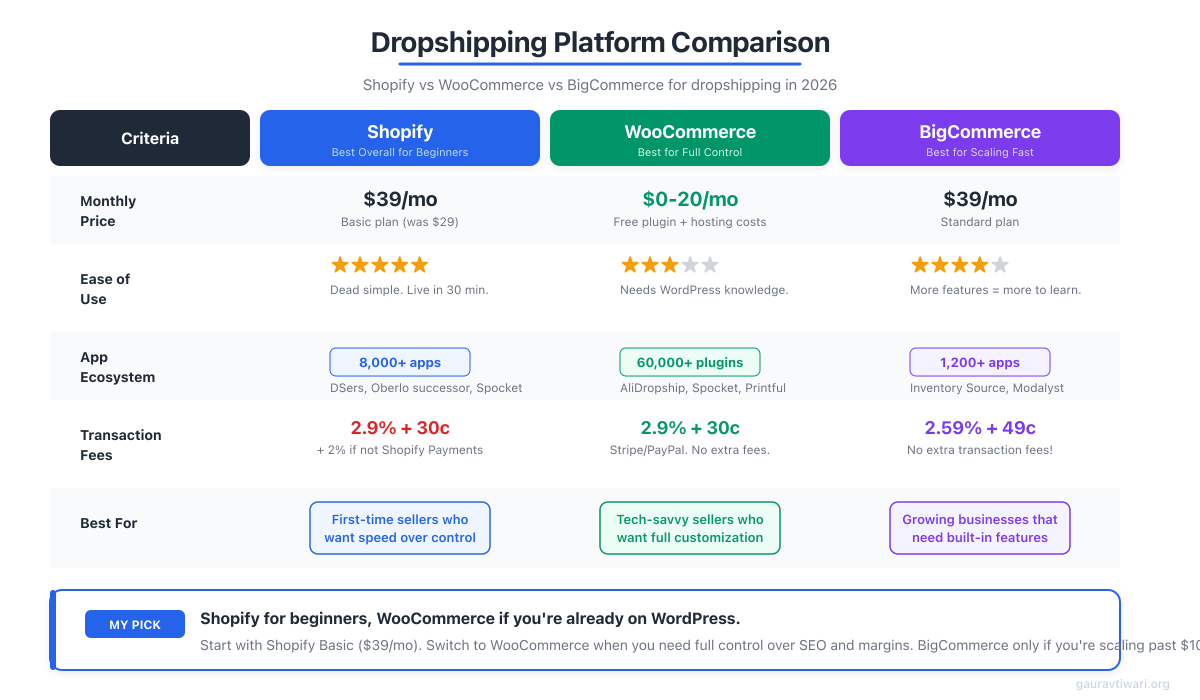
Shopify dominates dropshipping for a reason. The app ecosystem is massive, setup takes hours not days, and the infrastructure handles Black Friday traffic without you worrying. Plans run $39-399/month.
The dropshipping app integration is where Shopify really wins. DSers (official AliExpress partner), Spocket, Printify, and dozens of others plug in with a few clicks. Automated order routing, inventory syncing, tracking updates, it all works.
Downside: transaction fees eat into already-thin margins unless you use Shopify Payments. And monthly costs add up when you factor in apps (most stores need 5-10 apps at $10-50/month each).
WooCommerce: The Control Play
WooCommerce on WordPress gives you more control and lower recurring costs, but demands more technical work. You’ll manage hosting, security, updates, and compatibility yourself. For a deep comparison, check my WooCommerce vs SureCart breakdown.
Best for: people with WordPress experience who want full control. Not ideal for dropshipping beginners.
BigCommerce: The Underrated Option
BigCommerce offers enterprise-grade features with simpler pricing. No transaction fees on any plan. Built-in features mean fewer apps to buy. Less popular for dropshipping, which means less community support and fewer integrations.
What Your Store Actually Needs
Regardless of platform, your store needs:
- Mobile-first design (70%+ of ecommerce traffic is mobile)
- Clear product photos from multiple angles
- Benefit-focused product descriptions, not feature lists
- Honest shipping timeframes (don’t say “fast” if it takes 10 days)
- Easy checkout with guest checkout enabled
- Trust signals: reviews, security badges, clear policies
- Contact information that actually works
New dropshipping stores often look obviously fake. Generic templates, stock photos, no about page, hidden contact info. Customers spot these instantly and bounce. Invest time in looking legitimate before spending money on ads.
AI and Automation: The 2026 Advantage
This is the biggest shift in dropshipping since Shopify launched. AI tools have gone from novelty to necessity. A 2025 report found that 89% of online retailers are already using or testing AI tools for their stores.
Here’s what AI actually changes in a dropshipping operation:
Product Research and Trend Prediction
AI tools analyze millions of data points to identify trending products before they saturate. Tools like AutoDS and Dropship.io use AI to surface winning products based on actual sales velocity, not just social media hype.
I’ve seen operators cut their product testing phase from 3 months to 3 weeks using AI-powered research. That’s 2+ months of ad spend you don’t waste on products that won’t sell.
Content and Listing Optimization
Writing 500 unique product descriptions used to take weeks. AI tools generate optimized descriptions in minutes. But don’t just copy-paste. AI-generated product copy needs your brand voice layered on top. Use AI for the first draft, then make it yours.
Flair AI takes supplier product photos, removes backgrounds, and places items in branded lifestyle scenes. Professional product photography without hiring a photographer.
Customer Service Automation
AI chatbots handle 60-70% of customer inquiries without human intervention. “Where’s my order?” and “What’s your return policy?” questions get answered instantly at 3 AM. Your customers are happier, and you’re not drowning in support tickets.
Pricing and Inventory
AI monitors competitor pricing and adjusts yours automatically. It tracks supplier inventory and removes out-of-stock products before customers order them. This alone prevents the most frustrating customer experience in dropshipping: paying for something that doesn’t exist.
The operators who adopt AI tools now have a structural advantage. They can run leaner operations, test faster, and serve customers better. Those who don’t will find margins compressed to zero by those who do.
Marketing That Works in 2026
Without marketing, your store is invisible. I don’t care how great your products are. If nobody sees them, nobody buys them.
TikTok and Social Commerce
TikTok Shop changed the game. You can sell directly within the TikTok app, reducing friction between seeing a product and buying it. Product demonstration videos perform best. Show the product solving a problem, unbox it, or compare it to alternatives.
Organic reach on TikTok still outperforms every other platform. One viral video can generate 10,000+ visits without spending a dollar on ads. But virality isn’t a strategy. Consistency is. Post daily, test formats, and let the algorithm find your audience.
Facebook and Instagram Ads
Still the workhorse for paid acquisition. Target by interests, behaviors, and build lookalike audiences from your existing customers. Expect to invest $500-2,000 learning before campaigns become profitable.
The rising cost of Meta ads is the biggest challenge. CPMs (cost per thousand impressions) have increased 30-40% since 2022 in most ecommerce niches. This makes unit economics even more important. You can’t afford high acquisition costs with thin dropshipping margins.
Google Ads
Google captures search intent, people actively looking for products. More expensive per click but much higher purchase intent. Best for products people search for by name or category. “Ergonomic desk lamp” has buying intent. “Cool desk accessories” doesn’t.
SEO: The Long Game
Organic search traffic costs nothing per click. But it requires content investment and months of patience. Product reviews, buying guides, how-to articles, and category pages build organic presence over time. I cover the fundamentals in my SEO for beginners guide.
For dropshipping, SEO works best as a long-term play alongside paid ads. Don’t rely on it for initial sales.
Email Marketing
This is the most underused channel in dropshipping. Capture emails with first-purchase discounts. Send abandoned cart sequences (these alone recover 5-15% of lost sales). Build relationships that drive repeat purchases.
Your email list is the one asset you own. Algorithms change, ad costs rise, platforms shut down. Your email list stays. Learn the basics in my email marketing for beginners guide.
Influencer Marketing
Micro-influencers (10,000-100,000 followers) consistently outperform celebrities for ROI. They’re cheaper, their audiences are more engaged, and their recommendations feel authentic. Send free products to 20 micro-influencers in your niche. If even 3-4 post about it, you’ve got content and traffic for pennies on the dollar.
Evaluating and Managing Suppliers
Your supplier is your silent business partner. They determine product quality, shipping speed, and packaging, all things your customers judge you on.
Before committing to any supplier, verify these:
Communication. Message them with questions before ordering. How fast do they respond? Do they understand English well enough to handle order issues? A supplier who takes 3 days to reply to a pre-sale question will be worse when problems arise.
Product quality. Order samples. Every single time. Photos lie. Touch the product, use it, wash it (if apparel), drop it. Know exactly what your customers receive.
Shipping speed. Check recent reviews specifically mentioning delivery times. What suppliers promise and what they deliver are often different things. Domestic suppliers (US/EU) typically deliver in 2-7 days. Chinese suppliers take 7-25 days.
Processing time. How quickly do they ship after receiving your order? 1-3 days is acceptable. 7+ days means your customer is waiting 3-4 weeks total. That’s a refund request waiting to happen.
Scaling capacity. Can they handle 10x your current volume during a sale or viral moment? Ask directly. If they can’t, you’ll oversell and create a customer service disaster.
Start with small test orders. The $50-100 you spend on samples prevents thousands in refund requests from bad products.
Customer Experience: Where Most Dropshippers Fail
Here’s an uncomfortable truth. Most dropshipping businesses don’t fail because of bad products or weak marketing. They fail because the customer experience is terrible.
Set honest expectations. If shipping takes 7-15 business days, say “7-15 business days.” Don’t write “fast shipping” and hope for the best. Customers who know what to expect are far more patient than customers who feel lied to.
Communicate proactively. Email when orders ship. Update them if delays happen. Silence creates anxiety, support tickets, and chargebacks. A simple “your order shipped, here’s the tracking” email prevents half your customer service issues.
Own problems. Products will arrive late, damaged, or wrong. Your response determines whether customers accept it or demand refunds. Apologize genuinely, take responsibility (even when it’s the supplier’s fault), and resolve fast. Reship, refund, or discount immediately. Fighting with customers always costs more than fixing the problem.
The bar in ecommerce is Amazon Prime: free 2-day shipping with no-questions-asked returns. You can’t match that. But you can set clear expectations and exceed them. That’s enough.
Scaling Beyond Dropshipping
The smartest dropshippers treat the model as phase one. Here’s the evolution path I’ve seen work repeatedly:
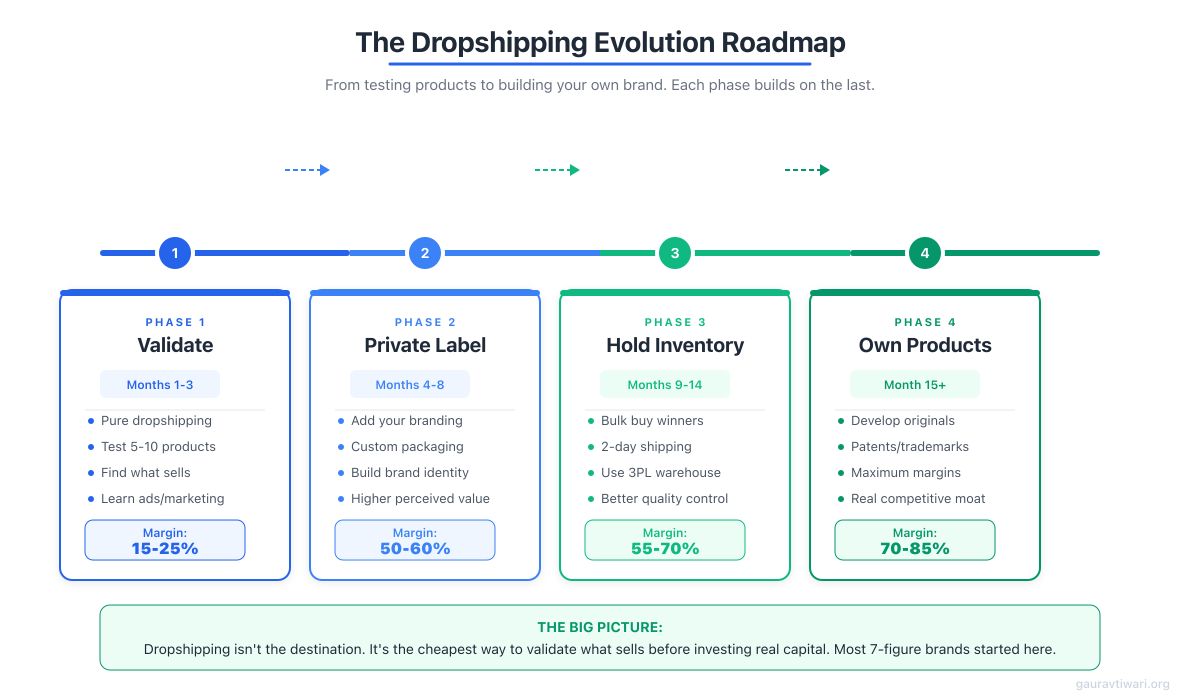
Phase 1: Validate with Dropshipping
Test products, find winners, build initial customer base. No inventory risk. This is the experimentation phase.
Phase 2: Private Label Your Winners
Once a product proves itself (consistent sales, low return rate, strong reviews), order it with your branding. Custom packaging, your logo, branded inserts. Margins jump from 30% to 50-60%. More importantly, you’re building something customers associate with your name.
Phase 3: Hold Inventory on Bestsellers
Buy your top 3-5 products in bulk. Store them with a 3PL (third-party logistics provider) or fulfillment center. Shipping drops from 10 days to 2 days. Margins improve further. Quality control becomes possible.
Phase 4: Develop Your Own Products
Use customer feedback to create products that don’t exist yet. This is where real businesses are built. Highest margins, strongest differentiation, and true competitive advantage.
Most successful ecommerce brands you admire followed this exact path. They started by selling other people’s products. Then they became the product. For a deeper look at building your own brand, check my guide to building an ecommerce brand from scratch.
Legal, Taxes, and Compliance
Dropshipping has legal requirements you can’t ignore. I’m not a lawyer, but here’s what you need to know.
Business structure. Form an LLC (US) or LLP (India) before you start selling. Separating personal and business liability isn’t optional. For Indian entrepreneurs, an LLP provides limited liability protection and is suitable for small to medium-sized ecommerce operations. I cover this in more detail in my guide to registering an LLC in India.
US tax obligations. Collect and remit sales tax where required. Economic nexus laws mean you may need to collect sales tax in states where you have significant sales, even without physical presence. Tools like Avalara or TaxJar automate compliance.
India GST compliance. India’s simplified GST 2.0 structure (effective September 2025) streamlined rates to 5% and 18% for most goods and services. If you’re dropshipping from India, get your GST registration and an Import-Export Code (IEC) before your first international sale.
Product compliance. Some products require certifications (electronics, children’s items, food-related products). The legal responsibility falls on the seller, not the supplier. Selling uncertified products in regulated categories creates serious liability.
Intellectual property. Selling counterfeit or trademark-infringing products creates legal exposure that can shut down your business and your payment processor permanently. Verify supplier legitimacy.
Payment processing. Keep chargeback rates under 1%. High chargeback rates trigger payment processor termination. Once you’re terminated by one processor, others won’t touch you. Use clear billing descriptors and proactive communication to minimize disputes.
For handling international payments, Payoneer is what I recommend for cross-border transactions. Lower fees than PayPal for international sellers, and reliable payouts to Indian bank accounts.
Common Mistakes That Kill Dropshipping Businesses
I’ve watched these mistakes sink operations that had real potential:
Selling everything to everyone. “General store” dropshipping is dead. You can’t compete with Amazon on selection. Niche focus enables expertise, targeted marketing, and customer trust. Pick a niche and go deep.
Ignoring shipping times. Three-week shipping from China is a dealbreaker for most consumers in 2026. They’re comparing your delivery to Amazon’s 2-day Prime. Find faster alternatives or set extremely clear expectations upfront.
Copying competitors exactly. Same products, same ads, same pricing as 50 other stores. No differentiation means price wars. Price wars on thin margins means everyone loses.
Skipping the numbers. Too many dropshippers don’t know their actual CAC, return rate, or profit per order. If you aren’t tracking unit economics weekly, you’re flying blind.
No customer service investment. Every ignored complaint becomes a chargeback, a negative review, or a social media callout. Responsive service prevents escalation. A $5 partial refund is always cheaper than a $50 chargeback fee.
Buying courses instead of starting. I’ve talked to people who spent $2,000 on dropshipping courses before selling a single product. Most of that money should have gone into product samples and ad testing. The best education is doing the work.
Is Dropshipping Still Worth Starting in 2026?
Yes. With clear eyes about what it is and isn’t.
Dropshipping works as:
- Low-risk product validation before investing in inventory
- A side business while keeping your day job
- A crash course in ecommerce, marketing, and customer service
- A bridge to building a real ecommerce brand
- A way to test markets and audiences without financial risk
Dropshipping struggles as:
- A get-rich-quick scheme (it takes 3-6 months to find consistent profitability)
- A permanent business model without evolution toward private label or inventory
- “Passive income” (it requires daily attention, especially early on)
- A competition-proof business (margins always compress over time)
The global dropshipping market is growing at 21%+ annually. More importantly, the tools available in 2026 (AI automation, better supplier networks, social commerce platforms) make it more accessible than ever to run a professional operation.
But accessibility is a double-edged sword. More accessible means more competition. The winners will be operators who build real brands, deliver genuine customer value, and evolve beyond pure dropshipping.
If you’re serious about ecommerce, dropshipping is the best way to start. Just don’t make it the only place you stay. For the complete picture on building an online business, check my definitive ecommerce guide.
Is dropshipping still profitable in 2026?
Yes, but it’s harder than it was in 2020. The dropshipping market is worth over $343 billion and growing at 21%+ annually. Profitable operators focus on niche products, fast shipping (US/EU suppliers), and brand building. Expect 15-30% margins on most products, with 40-45% possible in print-on-demand. The easy money from generic AliExpress stores is gone. You need to treat it like a real business.
How much money do I need to start dropshipping?
Minimum $500-1,000 covers store setup, product samples, and basic marketing. Realistically, $2,000-5,000 gives you enough runway to test products and learn ad optimization. Marketing is your biggest expense. Plan to spend more learning than earning for the first 2-3 months. Don’t spend money on courses before you’ve actually launched a store.
What are the best dropshipping platforms in 2026?
Shopify is the default choice for most dropshippers due to its app ecosystem and ease of use ($39-399/month). WooCommerce works if you have WordPress experience and want more control with lower recurring costs. BigCommerce is underrated with no transaction fees. For sourcing, Spocket offers US/EU suppliers with 2-5 day shipping, and Printify handles print-on-demand products.
How long does it take to make money dropshipping?
Expect 3-6 months of testing and optimization before consistent profitability. Some products hit immediately, but most require iteration on ads, pricing, and suppliers. AI tools have shortened the product research phase from months to weeks, but you still need time to build a customer base and refine operations. Anyone promising fast riches is selling courses, not teaching business.
Should I use AliExpress or domestic suppliers?
Start with domestic suppliers (US/EU) if possible. Platforms like Spocket offer 2-5 day shipping, which dramatically reduces refund requests and customer complaints. Use AliExpress for initial product research and validation, then switch to faster suppliers for products that prove themselves. In 2026, customers expect fast delivery. Three-week shipping from China is a dealbreaker for most buyers.
Do I need an LLC to start dropshipping?
You should form an LLC (US) or LLP (India) before selling. It separates personal assets from business liability, which matters when you’re processing payments and shipping products you don’t control. It also helps with payment processor applications and looks more professional to suppliers. The cost is minimal ($50-500 depending on your state or country) and the protection is worth it.
Can I do dropshipping from India?
Absolutely. Dropshipping from India to US/EU markets is a viable model. You’ll need an IEC (Import-Export Code) for international trade, GST registration, and a payment solution like Payoneer for cross-border transactions. India’s GST 2.0 structure (effective September 2025) simplified rates to 5% and 18%. Use platforms like Shopify with Spocket for US suppliers, so products ship directly from the US without touching India.
Disclaimer: This site is reader-supported. If you buy through some links, I may earn a small commission at no extra cost to you. I only recommend tools I trust and would use myself. Your support helps keep gauravtiwari.org free and focused on real-world advice. Thanks. - Gaurav Tiwari
Investor