
Crypto SEO in 2026: How to Rank in a Volatile, Decentralized Web
 by
by
Crypto SEO is the discipline of ranking a crypto, web3, or DeFi site in a search environment that treats your every page as a financial risk to the reader. Here’s my verdict up front: in 2026, you don’t win crypto SEO with keyword tricks or AI-spun token explainers. You win it by passing Google’s trust bar, because crypto is classified as YMYL (Your Money or Your Life) content, and that bar is higher than almost any other niche on the web. If you can’t prove who wrote the page, where the numbers came from, and why you’re qualified to publish it, you won’t rank, no matter how many keywords you stuff in.
I’ve run SEO for content sites since 2008, and the pattern in regulated and high-stakes niches is always the same: the page that earns trust beats the page that’s merely optimized. Crypto is that pattern turned up to eleven. Google and Bing both suppress or hedge crypto results that look thin, anonymous, or hype-driven, and the paid escape hatch is mostly bolted shut. So organic search isn’t one channel among many for a token, exchange, or wallet project. It’s the channel. This guide is for founders, marketers, and writers shipping crypto content who are tired of generic SEO advice with the word “crypto” sprinkled on top.
How this guide is grounded: I’ve optimized content sites since 2008 and run SEO for clients through Gatilab, my content agency. For this 2026 update I cross-checked current crypto SEO behavior against published research from SEO Francisco, ICODA, SeoProfy, and Google’s own search-quality and ads-policy documentation. Every stat below is sourced. Last verified: June 2026. What may change soon: Google’s AI Overviews coverage on financial queries and its crypto ad-certification rules are both moving targets.
What changed in 2026: Two shifts rewrote crypto SEO. First, AI Overviews now appear on roughly 30% of desktop queries and have cut organic click-through by as much as 61%, yet Google deliberately suppresses them on transactional crypto queries like “buy bitcoin” or “best crypto exchange” because AI-generated financial advice is a liability. Second, with Google and Meta still banning most crypto ads, organic and AI-search visibility went from “nice to have” to the primary way an estimated 18,000+ actively traded tokens get discovered. The game is now ranking in Google and getting cited by ChatGPT, Perplexity, and Gemini.
Table of Contents
Why Crypto SEO Is a Different Game
Crypto SEO is different because the reader is one bad page away from losing money, and Google knows it. Standard SEO rewards relevance and a decent backlink profile. Crypto SEO adds a trust gate on top: Google’s core ranking systems classify financial content as YMYL, which raises the quality threshold a page must clear before it ranks at all. A perfectly optimized page from an anonymous source can sit on page three while a slightly less optimized page from a named, credentialed author ranks above it.
The second difference is competition density. There are more than 18,000 actively traded cryptocurrencies, and most of them publish near-identical content: the same “what is staking” explainer, the same exchange comparison, the same token roadmap. Search engines have gotten ruthless about thin, duplicative crypto pages because the niche is a known farm for low-value, affiliate-stuffed content. To stand out you need information gain, an original number, a real test, a screenshot, a configuration nobody else published.
The third difference is volatility. A Solana fee guide that was accurate last quarter can be wrong today after a network upgrade. Crypto facts decay faster than almost any other niche, so freshness and a visible change log aren’t cosmetic here. They’re part of how you prove the page is trustworthy. A 2024 price or a dead protocol parameter on your page is a trust failure, not just a stale stat.
What Changed: YMYL, AI Overviews, and the Ad Ban
Google treats cryptocurrency as YMYL, and that single classification explains most of what feels strange about ranking crypto content. YMYL pages get held to stricter standards because a wrong answer can cost the reader real money. That’s why E-E-A-T (Experience, Expertise, Authoritativeness, Trustworthiness) signals carry so much weight in this niche, and why “good enough” content that would rank in a hobby niche stalls in crypto.
On AI search, the picture is split. AI Overviews now show on around 30% of desktop keywords and have reduced organic CTR by up to 61% on the queries where they appear, but pages cited inside an AI Overview earn roughly 35% more clicks. The catch: Google mostly suppresses AI Overviews on transactional crypto queries. Searches like “buy bitcoin,” “best crypto exchange,” and “bitcoin price prediction” rarely trigger an AI summary because Google doesn’t want to be the one giving AI-generated financial guidance. So the AI-Overview battle is fought on the educational and how-to half of crypto, not the transactional half.
Then there’s the ad ban. Google and Meta still restrict most crypto advertising. Exchanges and wallets can sometimes advertise in select countries with the right licensing, but DeFi protocols, token launches, and NFT projects face outright bans or constant rejections, and Google’s crypto ad policy has tightened, not loosened, since 2024. When you can’t buy your way to the top of the page, the organic and AI-citation results become the entire battlefield. That’s why crypto projects that treat SEO as a core product function, not a marketing afterthought, pull ahead.
The Trust Signals That Decide Crypto SEO Rankings
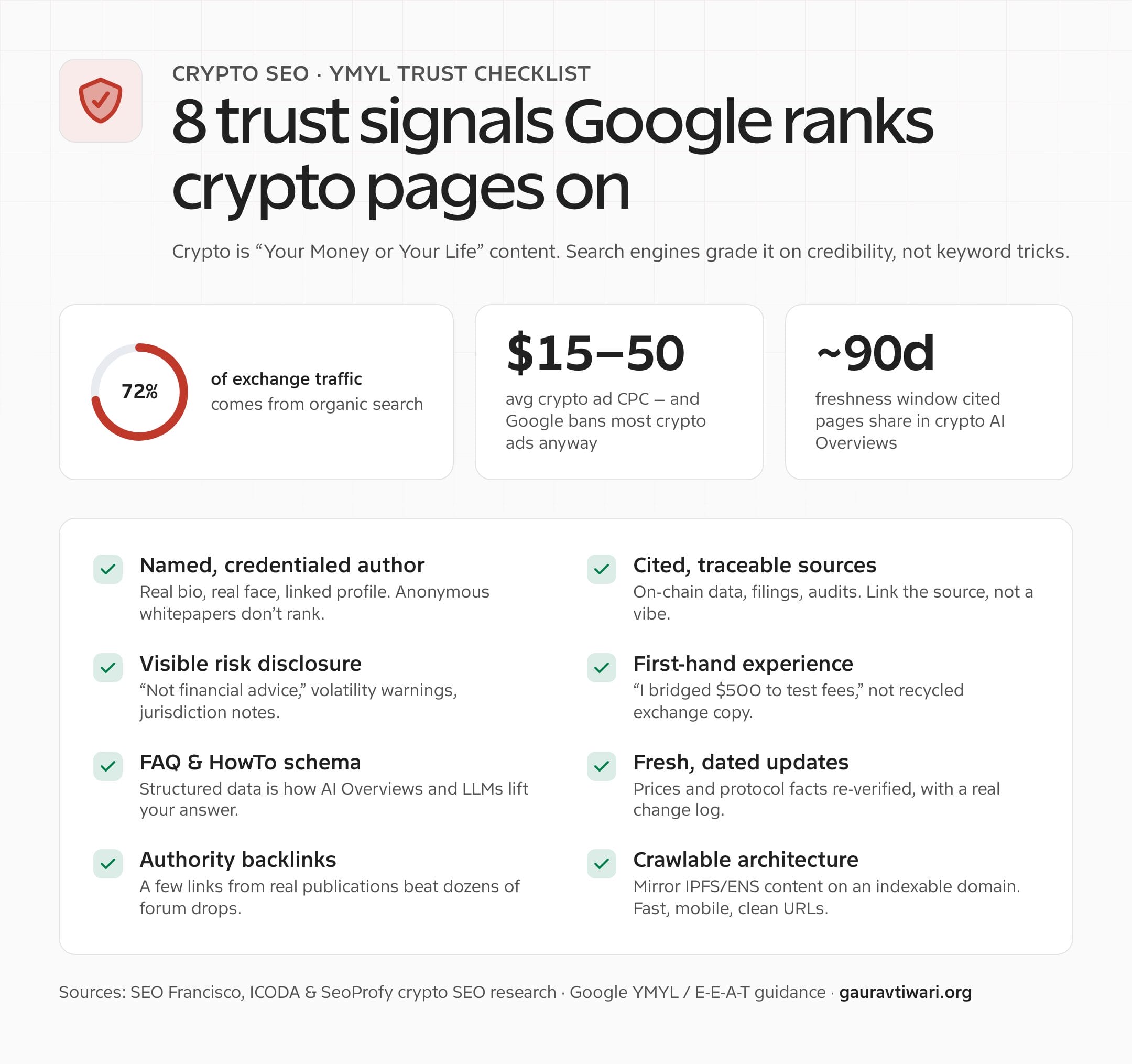
If crypto is graded on trust, then the work is making trust visible and verifiable on the page. Anonymous whitepapers and vague roadmap pages don’t rank anymore. Google rewards openness, real authorship, and disclosure that looks closer to a financial publication than a hype blog. Here are the signals that actually move crypto rankings, drawn from what consistently shows up on pages that get cited in crypto AI Overviews.
Author identity and credentials
Every serious crypto page needs a named author with a real bio, a face, and a linked profile. A page about “how to evaluate a DeFi protocol” written by “Admin” is a trust failure. The same page bylined to a person with a verifiable track record clears the bar. This is the cheapest, highest-leverage fix most crypto sites ignore.
Sources, disclosure, and first-hand testing
Cite where your numbers come from: on-chain data, exchange fee schedules, audit reports, regulatory filings. Add a visible risk disclosure (“this is not financial advice,” volatility warnings, jurisdiction notes), because that’s a trust marker Google’s raters look for in YMYL finance content. And show first-hand experience. “I bridged $500 from Ethereum to Arbitrum and paid $2.14 in fees” beats a recycled paragraph that could have come from any exchange’s marketing copy. The graphic above lists eight of these signals together as a checklist you can audit your own pages against.
Backlinks still matter, but quality decides it
Backlinks count for less than they did, yet authority links carry more weight in crypto than almost anywhere. A handful of links from real publications or research outlets beats dozens of forum and directory drops. The durable plays are digital PR, guest contributions to reputable crypto media, and getting referenced in research. If you’re starting from zero, my guide to backlink building strategies covers the outreach mechanics that translate cleanly to web3.
Crypto Keywords: Intent, Clusters, and the Conversion Map
Ranking for broad terms like “Bitcoin” or “Ethereum” isn’t a strategy in 2026. Crypto SEO is won on specific intent. When someone searches “how to stake DOT,” they could want a step-by-step tutorial, a validator comparison, or live APR numbers, and those are three different pages. Segment your audience first: developers, mainstream first-time buyers, and traders each need a different register, and a developer walkthrough won’t satisfy a buying guide searcher.
The structural win is topic clusters, not standalone posts. A pillar page like “how to buy Solana” with supporting subpages on wallet setup, exchange routes, and network fees ranks better and serves users better than six disconnected blog posts. Cluster architecture also gives AI engines a clean map of your expertise on a token, which is part of how they decide who to cite. This is the same content-quality discipline I cover in what makes high-quality content that ranks, applied to a niche where the trust stakes are higher.
Match content type to where the value is. Educational guides have the highest volume and the longest shelf life. Exchange and wallet comparison pages convert best. DeFi protocol tutorials attract the highest-quality users. Regulatory news ranks fastest but rots quickest. Here’s how the main crypto content types stack up, based on the patterns crypto SEO teams report.
| Content type | Organic traffic value | Conversion | Shelf life |
|---|---|---|---|
| Educational guides | Highest volume | Moderate (2–4% to signup) | Longest |
| Exchange / wallet comparisons | High | Highest conversion | Medium |
| DeFi protocol tutorials | Moderate | Highest user quality | Medium |
| Regulatory news & analysis | Spiky | Low direct | Shortest (ranks fastest) |
| Crypto glossary terms | Steady, long tail | Low direct | Long (best for links) |
Winning AI Overviews and LLM Citations for Crypto Queries
Since Google suppresses AI Overviews on transactional crypto queries, the AI-search game is mostly about educational and conversational queries, plus citations inside ChatGPT, Perplexity, and Gemini. The pages that get pulled into crypto AI Overviews share a profile: structured data (FAQ and HowTo schema), high factual density with specific numbers, dates, and named sources, credentialed authorship, and content updated within roughly the last 90 days.
Proprietary data is the unfair advantage. Content with original, first-party data gets cited by AI systems roughly twice as often. If you run an exchange, publish your real fee benchmarks. If you test wallets, publish your actual gas measurements. AI engines reward the page that says something no competitor page says, and a number you generated yourself is the cleanest form of information gain you can offer.
Don’t neglect Bing and the answer engines. Bing organic traffic has risen as users go there for more direct financial answers, and several crypto projects report large citation gains from ChatGPT and Perplexity within months of restructuring content for answerability. The mechanics overlap with classic on-page SEO, clean structure, schema, fast pages, but the optimization target is now “can a model lift a clean, attributed answer from this page,” not just “does this rank tenth.”
What Crypto SEO Can’t Fix
Here’s the honest part most crypto SEO pitches skip: SEO can’t save a project that shouldn’t exist. If there’s no real product-market fit, no working product, or no reason for the token beyond speculation, ranking a few guides won’t fix the underlying problem. You’ll buy traffic that bounces because the thing it lands on doesn’t deliver. SEO amplifies whatever is already true about your project, and it amplifies a weak one just as faithfully as a strong one.
SEO also can’t launder a scam, and increasingly it won’t even try. Google’s YMYL scrutiny exists precisely to keep deceptive financial content off the first page, so if your project leans on misleading claims, anonymous founders, or promises that don’t survive a disclosure box, the same trust gate that helps legitimate projects rank will work against you. Skip the gray-hat shortcuts. They have a short half-life in a niche this heavily watched, and a manual action on a YMYL site is brutal to recover from.
And SEO can’t beat physics on timing. For genuinely breaking events, an airdrop, a hack, a listing, the first credible, well-structured page often wins, and you can’t out-optimize a competitor who simply published two hours earlier with the same authority. Pick your battles: compete on durable educational and comparison content where depth and trust win, and accept that some real-time queries belong to whoever is fastest and already trusted.
Staying Searchable When You Build Web3-Native
Plenty of crypto projects build web3-native, hosting on IPFS, using ENS names, and then wonder why Google can’t find them. Traditional crawlers struggle with decentralized hosting, and signals like domain authority get murky when your identity lives on-chain. The pragmatic answer most successful projects land on is a hybrid: keep your decentralized stack for ideology and resilience, but mirror the content that needs to rank on a normal, indexable domain.
Whichever route you take, the fundamentals don’t change. Clean, SEO-friendly URL structures, fast load times, mobile responsiveness, and structured data matter the same whether you’re on a standard server or a decentralized platform. Decentralization is an architecture choice, not an excuse to skip the basics that make a page crawlable and rankable.
If you’re optimizing for a project where the reader’s first question is whether crypto is even a sound place to put their money, link out to a balanced primer rather than burying that doubt. I keep one current take in is investing in cryptocurrency a good idea, and pointing skeptical readers to honest context is itself a trust signal, the opposite of the hype most crypto pages lead with.
A Crypto SEO Workflow You Can Actually Run
Here’s the workflow I’d run for a crypto site, stripped of fluff. Start with intent-mapped keyword research and cluster it: pillar pages for each major token or topic, supporting pages for the specific intents underneath. Tools like Semrush or Ahrefs handle the keyword and SERP side, while Rank Math manages on-page schema and the FAQ/HowTo markup that AI Overviews reward. None of these are crypto-specific, and that’s fine. The crypto difficulty is in the trust layer, not the toolset.
Then build the trust layer into your template, not as an afterthought. Bylines with real bios, a risk-disclosure block, a “last verified” line with a change log, and cited sources should be structural parts of every crypto page. Add FAQ and HowTo schema so answer engines can lift clean responses. Re-verify prices and protocol facts on a schedule, because in this niche a stale number is a trust failure, and never bump a date without a real edit behind it.
Finally, treat AI-citation and classic ranking as one job. Write answer-first paragraphs, lead each section with a direct, extractable claim, pack in specific numbers and named entities, and earn a few authority links rather than chasing volume. Crypto SEO in 2026 isn’t a marketing tactic you bolt on at the end. It’s a trust-building discipline, and the projects that internalize that will keep showing up in both Google’s results and the AI answers people increasingly read instead.
Tell Google you want more of this.
Add Gaurav Tiwari as a preferred sourceOne tap, and this site shows up more often in your own Top Stories, AI Overviews and AI Mode. Remove it any time.